three-dimensional scanning
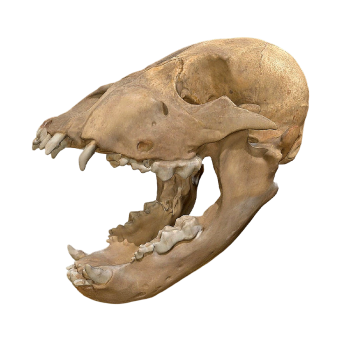
Skull model of a kanglion
This is a model of the skull of a kanglion. The most prominent feature of the bag lion is its large, scissor-like split meat teeth (located on the sides of the upper and lower jaws), and large front, rodent or primate-like incisors, rather than the canines of modern cats. It was not a real lion, but a carnivorous marsupial that lived in Pleistocene Australia. It is the largest carnivorous mammal in Australian history. It has a strong bite force and can hunt prey much larger than its own size.
Snow Mountain 3D rendering model
This model can accurately show geographical details such as peaks, ridges and glacier cracks. The terrain shown in the images is highly similar to 3D scans of the Himalayas (such as Mount Everest and Mount Lo) or glaciers in Iceland (such as the Solheima glacier).
Cave bear skull fossil
This is a fossil skull model of a cave bear. The cave bear (scientific name: Ursus spelaeus) is a bear that lived in Europe and Asia during the Pleistocene and became extinct about 20,000 years ago during the Ice Age. They are much larger than today's brown bears, standing up to 10 feet (about 3 meters) tall and weighing more than 1600 pounds (about 725 kilograms). Because most of their fossils were found in caves, they showed that they were more dependent on caves for habitat and hibernation than existing brown bears, hence the name "cave bear".
Ammonite fossil
This is the fossil of ammonites. Ammonites are an extinct marine cephalopod mollusk related to modern octopus, squid and nautilus. The most notable feature of ammonites is its flat-spun outer shell with tight spiral curls. This shell is not only their shelter, but also controls buoyancy by adjusting the internal air chamber like modern nautilus. They first appeared in the Triassic period about 0.24 billion years ago and became extinct with the dinosaurs at the end of the Cretaceous period (about 66 million years ago). The ammonite evolves extremely quickly and is widely distributed, so it is a very important "standard fossil" in geology ".
Fossilized skull of a forest australopithecus
This is the skull of a forest ancient ape (Proconsul), which is also known as the original Kangshul ape. They are extinct Australopithecus, living in eastern Africa about 23 million to 14 million years ago, and are considered to be one of the common ancestors of apes and humans. They have limb bones similar to those of monkeys, but no tails, and the tooth structure shows that they are fruit-eating apes.
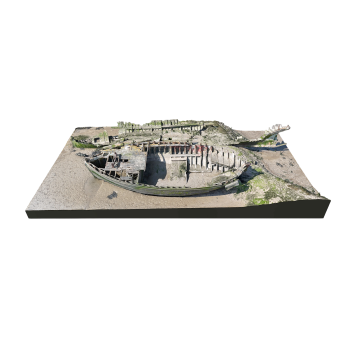
3D scanning model of sunken ship
This is a 3D scanned model of a sunken ship. It depicts the wreckage of two wooden vessels in the intertidal zone of Bahrain Hall Creek, near Bahrain, Essex, England. The image is a digital model created by photogrammetry. This technology takes a large number of overlapping photos, and then uses professional software to combine them into a detailed 3D image. The ships are moored in a "ship graveyard," and archaeologists use this 3D modeling technique to document and analyze archaeological sites, especially for objects like shipwrecks that are fragile or difficult to access consistently.
Cougar Skull
This is the skull of a cougar (American Lion). The cougar (Panthera leo atrix) is an extinct species of feline, one of the largest known. They lived during the Pleistocene (Pleistocene) and became extinct about 10,000 years ago. The cougar was found primarily in North America, from Alaska to Mexico, and was a predator at the top of the North American food chain at the time. As pure carnivores, their tooth structure is ideal for piercing and tearing meat, and their canines are large.
The skeleton of an Edwards' giant lemur
This is the gypsum skeleton of an extinct species of giant lemur, the Edwards' giant lemur. Edwards' giant lemur weighs about 50 kilograms and is one of the largest lemurs. They are slow-moving, large in size and similar in posture to modern koalas. These animals once lived on the island of Madagascar. The arrival of humans to the island 2,300 years ago led to a rapid decline in the species, which eventually went extinct about 500 years ago.
Skeleton of the Dinosaur
This is a skeleton model of Moa. The moa is an extinct group of giant, non-flying, flat-breasted birds that were once widely distributed in New Zealand. Dinosaurs are the tallest known birds, with species of the genus Dinosaur (Dinornis) standing up to more than 3 metres tall and weighing about 250 kilograms. They are characterized by a small head, a long, powerful neck and thick legs. Unlike most birds, the moa has no trace of its wings at all. Before the arrival of humans, there were no medium to large mammals in New Zealand, and the moa was the main herbivore in the local forest ecosystem.
The Yellow Glazed Dragon Pattern Wadang of the Ming Dynasty
This is a yellow glazed dragon wadang from the Ming Dynasty (1368-1644), an ancient Chinese royal architectural component. Tadang, commonly known as "tile head", is the circular drooping part of the front end of the half-tube tile in ancient Chinese architecture. Play the role of protecting the wooden eaves of the building and beautifying the contours of the roof. In the Ming and Qing dynasties, yellow glazed tiles were the special color of imperial palaces and mausoleums, symbolizing imperial power and dignity, and were strictly prohibited from being used by the people. The high relief on the tile has a five-claw dragon pattern. The dragon chases a burning pearl between the auspicious clouds and flames, with a powerful and full tension. The five-clawed dragon is also a royal special decoration.
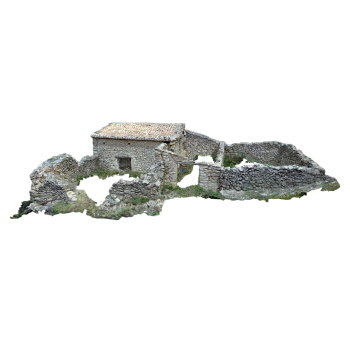
Spanish Stone Building Site (Corral Agreret)
This is a photo-scale 3D scan of Corral Agreret. The site of this stone building is located near the town of Beniain the province of Alicante, Spain. "Corral" means corral or paddock in Spanish. The building may have originally been an old farm building, used as a fence or shelter for livestock. The model shows the typical Mediterranean country stone architecture style, with heavy stone walls and red tile roofs, but is currently in a dilapidated state of ruin.
Kneeling Terra Cotta Warriors
The Terra Cotta Warriors in Shaanxi are world-famous, with thousands of people and thousands of faces. Among them, the kneeling and shooting figurines in Pit 2 of the Terra Cotta Warriors are the best. He knelt on his right knee, crouched on his left leg, and his eyes were bright and focused forward. His cold and stern face, as well as his fierce and heroic spirit holding a bow and crossbow, seemed to be the best interpretation of Qin Shi Huang's achievement of unified hegemony. When visiting the Terra Cotta Warriors Pit, tour guides and museum interpreters often say, "On the map of China's political districts, Shaanxi is like a kneeling shooting figurine."
Galena
Galena is a common mineral that is a sulfide with a metal (lead) to sulfur ratio of 1:1. It is the most important ore for lead and also an important source of silver. Galena is one of the most abundant and widely distributed sulfide minerals. Galena (also known as lead sulfide) is a common mineral and an important ore mineral for extracting lead. It is the most widely distributed lead mineral. Galena is a gray lead sulfide, and China has been extracting lead from galena since before the Shang Dynasty. Galena has a cubic shape, and many of these cubic crystals come together to form granules or blocks.
Random Model
Lamborghini Venevo supercar
1101 View
a worn-out electric fan
1130 View
Zhong Kui - Bamboo Root Carving
811 View
Mount Ruapehu, New Zealand
911 View
World of Tanks T95E6 Tank
1009 View
Outdoor hiking travel bag 3D model
954 View