Nature/Plants
Lavandula angustifolia
Narrow leaved lavender is a perennial herb or small shrub in the family Lamiaceae, with a height of up to 40 centimeters. Cluster with multiple branches, fragrant throughout the plant; Spike inflorescence grows at the top, with small blue purple flowers; Leaves alternate, narrow and shallow feather like, gray green in color, with a delicate texture; The flowering period is from June to August. Narrow leaved lavender is native to the Mediterranean region and is cultivated in China, mainly in Xinjiang. It prefers light, heat and cold resistance, drought and poverty resistance, and is resistant to waterlogging and humidity. It prefers well drained soil. The general propagation methods are sowing, splitting, or cutting propagation.
Rhododendron
Rhododendron simsii Planch. is a deciduous shrub of the Rhododendron genus in the Ericaceae family, standing 2-5 meters tall with numerous and slender branches. The leaves are leathery and often gather at the ends of branches, forming an oval, elliptical, or inverted shape. The front end is short and gradually becomes pointed, and the edges of the leaves are slightly curled and have fine teeth. The upper part is dark green, and the lower part is light white; The corolla is broad funnel-shaped and inverted, usually 2-6 clusters growing at the top of the branch, with rose, bright red or dark red colors. The flowering period is from April to May, and the fruiting period is from June to August.
Wild carrot flower
Daucus carota L. is a biennial herbaceous plant belonging to the family Apiaceae and the genus Carrot, with a height of up to 120 centimeters. The stem is solitary and has white coarse hairs throughout. The basal leaves are thin and membranous, with oblong leaves and two to three fully lobed lobes. The final lobes are linear or lanceolate, with sharp tips and small pointed tips. The stem leaves are nearly sessile, with leaf sheaths, and the final lobes are small or slender. Compound umbel inflorescence, with rough and hard hairs on the inflorescence stem; The bracts are mostly leaf shaped, with feather like division and linear lobes. The flowers are usually white and sometimes light red in color; The flower stalks are not of equal length, and the fruit is round and oval in shape. It blooms from May to July.
Phlox
Phlox drumondii Hook. is a plant species in the family Fabaceae, also known as Little Sky Blue Hydrangea, Wild Goose Red, and Golden Mountain Begonia. Annual herb, with upright stems and a height of 15-45 centimeters. Sexual preference for warmth, slightly cold resistant, avoid extreme heat. Native to Mexico, it is cultivated in gardens throughout China. Fluke has a rich variety of colors and can be used as plant material for flower beds, flower borders, and rock gardens. It can also be used as a potted plant for indoor decoration. Varieties with higher plant height can be used as cut flowers.
Red Tulip Blossoms
Tulipa gesneriana L. is a herbaceous plant in the Liliaceae family, belonging to the tulip genus. Tulip bulb ovate; The bark of the bulb is paper, with sparse hairs on the top and base of the inner surface; Leaves are lanceolate or ovate lanceolate in shape; The flower is single and grows at the top, large and beautiful; The flower petals are red or mixed with white and yellow, the filaments are hairless, there is no style, and the stigma is cockscomb; The flowering period is from April to May. Tulip is named "Ocean Lotus" because its flowers (especially petals) resemble lotus flowers and it is native to the Mediterranean coast.
Consolida ajacis
In addition to being the name of the species Consolida ajacis (Linn.) Schur, the Flying Swallow Grass is also a nickname for other species in the Ranunculaceae family, such as the Crested Swallow Grass and the Short footed Crested Bird Flower. It is also a nickname for the Pingwu Purple Violet. The flowering period of Swiftgrass is from July to August, and the flowering time varies depending on the planting time. It blooms from July to August when planted in spring, and in May of the following year when planted in autumn.
Blue Lily Flower
Hyacinth flowers (scientific name: Hyacinth non scripta (L.) Chouard) are bulbous plants of the Asparagaceae family and the genus Hyacinth. The stem is up to 50 centimeters tall, with 3-6 linear leaves, measuring up to 50 centimeters in length and 2.5 centimeters in width. Each stem hangs down and bends towards the tip, with 4-16 flowers blooming along one side. The drooping and fragrant flowers are purple blue in color, rarely pink or white. Petals and sepals are tubular bell shaped, measuring 14-20 millimeters in length, with lobes curled at the tips. The anthers are creamy in color. The fruit pod is membranous, nearly spherical, and 3-lobed. Seeds 3-30, black.
Bluebell flower seedlings
Hyacinth flowers (scientific name: Hyacinth non scripta (L.) Chouard) are bulbous plants of the Asparagaceae family and the genus Hyacinth. The stem is up to 50 centimeters tall, with 3-6 linear leaves, measuring up to 50 centimeters in length and 2.5 centimeters in width. Each stem hangs down and bends towards the tip, with 4-16 flowers blooming along one side. The drooping and fragrant flowers are purple blue in color, rarely pink or white. Petals and sepals are tubular bell shaped, measuring 14-20 millimeters in length, with lobes curled at the tips. The anthers are creamy in color. The fruit pod is membranous, nearly spherical, and 3-lobed. Seeds 3-30, black.
Aloe Vera Flower
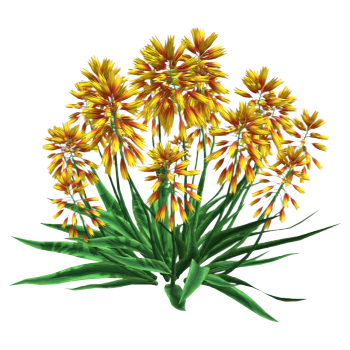
Aloe vera (L.) Burm f. It is a herbaceous plant of the family Aphrodiaceae in the order Liliales. Perennial, evergreen, with short above ground stems; The leaves are thick and juicy, with a narrow lanceolate shape, a wide pink green base, and thorny small teeth on the edges; Flowers have yellow or red spots; The fruit is triangular in shape; The flowering period is at the end of winter. The character "lu" in aloe vera means black, while the character "hui" means gathering. Aloe vera is named "aloe vera" because the liquid that drips down from the cut of its leaves will change from coffee color to black and gradually coalesce.
Daisy
Daisy (Bellis perennis L.) is a perennial or annual herbaceous plant in the Asteraceae family, characterized by a stalk like appearance. Its height is about 10 centimeters, and its leaves are spoon shaped. The top is round, and the upper part has sparse dull or wavy teeth; The total flower bud is hemispherical or broadly bell shaped, with a layer of tongue shaped flowers and more tubular flowers; The achene is oblong, flat, with veins but no crest. The flowering period is from March to June. The name daisy is related to its morphology, as its flower shape is smaller than that of ordinary chrysanthemums, resembling an immature chrysanthemum, hence the name daisy.
Chuju Cong
Daisy (Bellis perennis L.) is a perennial or annual herbaceous plant in the Asteraceae family, characterized by a stalk like appearance. Its height is about 10 centimeters, and its leaves are spoon shaped. The top is round, and the upper part has sparse dull or wavy teeth; The total flower bud is hemispherical or broadly bell shaped, with a layer of tongue shaped flowers and more tubular flowers; The achene is oblong, flat, with veins but no crest. The flowering period is from March to June. The name daisy is related to its morphology, as its flower shape is smaller than that of ordinary chrysanthemums, resembling an immature chrysanthemum, hence the name daisy.
Tea plum specimen
Camellia is a small tree in the Camellia genus of the Theaceae family. Branches sparse, tender branches hairy; Leaves leathery, elliptical in shape, dark green and shiny when dried on top, brownish green below, hairless; The flowers vary in size, with soft hairs on the flower buds and sepals, and wide, inverted petals that are red in color; Capsule spherical, seed brown, hairless; The flowering period is from November to March of the following year. Because its flower shape combines the characteristics of plum blossom and camellia, it is named Camellia. Camellia prefers warmth and moisture, prefers light but is slightly tolerant to shade, and avoids strong light. It is a semi negative plant and is suitable for growing in well drained, humus rich, and moist slightly acidic soil. The main propagation method of Camellia sinensis is through cutting propagation.
Purple Cloud English Specimen
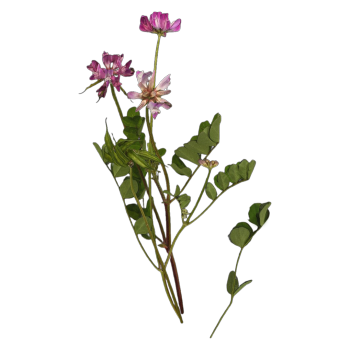
Ziyun Ying is an annual or over annual herb of the Astragalus genus in the legume family; Enlarged roots and well-developed fibrous roots; The stem is light green or light purple red, soft and hollow; The leaves are odd feathered compound leaves, green or light green; The flowers are umbels with colors ranging from light purple red to purple red, occasionally white; The pods are slender and have a triangular cross-section; The seeds are kidney shaped, shiny, and yellow green in color; Flowering period from February to April; The fruiting period is from March to May.
Wild chrysanthemum specimen
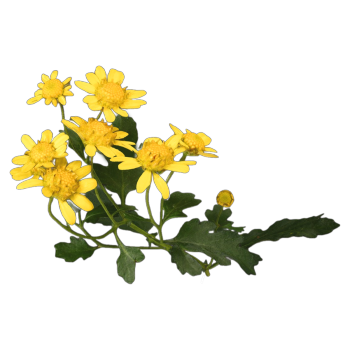
Wild chrysanthemum is a perennial herbaceous plant belonging to the Asteraceae family, with underground creeping stems and sparsely hairy stems and branches; The central stem and leaves are ovate, elongated ovate, or elliptical ovate in shape, with light green on both sides; The flowers are arranged in dispersed umbrella shaped or umbrella shaped inflorescences, with white brown edges and yellow tongue shaped flowers. The flowering period is from June to November.
Orchid
Orchid (scientific name: Cymbidium ssp.): is a general name for monocotyledonous plants, orchids and orchids. Chinese people have always regarded orchids as a symbol of elegance and elegance, and they are juxtaposed with "plum, bamboo and chrysanthemum" and are called "four gentlemen". Usually "Lanzhang" is used as a metaphor for the beauty of poetry and "Lanjiao" is used as a metaphor for the truth of friendship. There are also people who use orchid to express pure love, "the spirit is like orchid and will not change for a long time, the heart is like orchid and will not change for a long time", "find a bosom friend of orchid newspaper, and give a dream to Xiaoxiang one by one". In May 1985, the orchid was named four of China's top ten famous flowers.
Phnom Penh Lily Bamboo
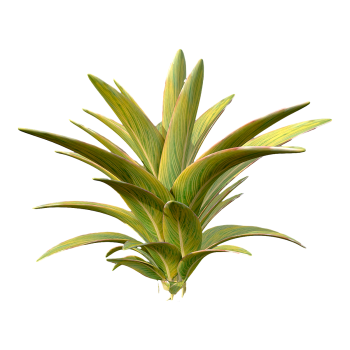
Phnom Penh lily bamboo (Dracaena reflexa 'Variegata'), a plant of the genus Asparagaceae.
Crocus (Saffron)
Crocus (Crocus sativus L.) is a perennial herb in the genus Crocus in the family Iridaceae. Crocus is native to southern Europe and Asia Minor along the Mediterranean coast. Crocus was first recorded in the "Ebbers Paper cursive", is the ancient Egyptians used to treat gastrointestinal diseases of herbs, and Indian women since ancient times with its beauty, beauty, anti-aging. Crocus sativa is sweet in taste and flat in nature. It has the effects of promoting blood circulation, removing blood stasis, cooling blood and detoxification, and relieving depression and soothing the nerves. The various glycosides it contains can increase the blood flow of the coronary arteries, regulate blood circulation, resist fatigue, and resist aging.
Begonia
Begonia (Begonia grandis Dryand.) is a perennial herbaceous plant of the genus Begonia in the family Begonia. Rhizome subglobose, stem erect, up to 60cm tall, longitudinal ribs glabrous. Cauline leaves alternate, leaf outline broadly ovate to ovate on both sides of the unequal, above the brown green, often blush, below the light color, with purple red, Stipules oblong to lanceolate membranous, scapes with longitudinal ribs, glabrous.
pine cones
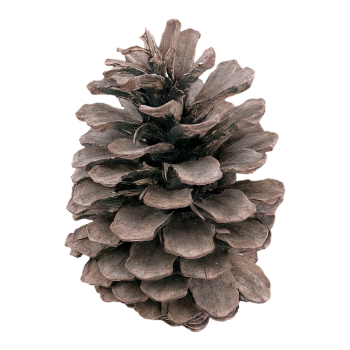
The pine cones are the seeds of the pine family and are ripe with pine seeds. Plant sources are widely distributed in my country, such as Korean pine in Northeast China, Pinus tabulaeformis and Pinus sylvestris in North China and Northwest China, Huashan pine in Southwest China, Masson pine in Central China, Yunnan pine and Simao pine in Sichuan and Yunnan. As we all know, the edible value of pine seeds is very high, and the distribution of edible pine tree species and natural distribution in the world accounts for a large part.
Japanese mallow
Japanese mallow (five-horn mallow) is a variety introduced from Japan. After trial planting from 1999 to 2000, it shows strong adaptability, easy cultivation, high yield and wide product market. It is also an important variety of Chinese vegetables entering the markets of Europe, America and Southeast Asia. Regular consumption of five-horn mallow has the effect of strengthening the stomach and regulating the intestines. It is a healthy and nutritious vegetable and has good development prospects in the structural adjustment of planting industry.
Red Liriodendron Aquatic Plant 3D Model
Candle (Anthurium andraeanum Linden) is a perennial evergreen herb of the genus Candle in the family Asteraceae. Stem nodes short; leaves emerging from base, green, leathery, entire, oblate-cordate or ovoid-cordate. Petiole slender, spathes flat out, leathery and waxy luster, orange-red or scarlet; fleshy spike inflorescence yellow, can bloom all year round.
Candles are native to tropical rainforest areas such as Costa Rica and Colombia. Often epiphytic on the tree, sometimes epiphytic on the rock or directly grow on the ground, sexual like warm, humid, semi-overcast environment, avoid direct sunlight.
Fleshy Plants 3D Garden Green Plant Flowers Jade plant AR

Succulent plant (succulent plant) refers to the plant's root, stem, leaf three kinds of vegetative organs in the leaves are thick and juicy and have the function of storing a lot of water plants, also known as "pulpy plants". It has at least one kind of fleshy tissue. This tissue is a living tissue. Among other functions, it can store available water. When the soil moisture condition deteriorates and the plant root system can no longer absorb and provide the necessary water from the soil, It enables the plant to temporarily separate from the external water supply and survive independently. According to rough statistics, there are more than 10,000 species of succulents in the world, which belong to more than 100 families in classification.