Building
German Outdoor Museum
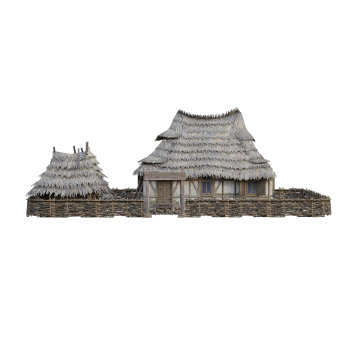
It is an outdoor museum located near Trier, Germany. This museum aims to showcase the traditional way of life and culture of rural communities in Germany. In this museum, you can see the reconstruction or original sites of buildings, farms, workshops, and other facilities in German rural communities from the 19th and early 20th centuries. One of the exhibition areas is Dorfrathaus, which stands for village houses, showcasing the architectural styles and interior layouts of traditional village houses from different historical periods and regions. In addition, the museum also displays other types of buildings such as farms, barns, workshops, schools, and churches.
Carolingian Chapel
Carolingian Chapel refers to a church built in Europe during the Carolingian dynasty (8th to 9th centuries). It is a special type of medieval European architecture, whose design and decorative style were influenced by the Carolingian dynasty at that time. These chapels were usually built by Charlemagne and his successors for religious ceremonies and prayers of the royal family, nobility, or monasteries. The architectural style is usually simple and balanced, incorporating elements of Roman and Byzantine architecture. It is an important component of medieval European architecture with unique historical and cultural value.
Rinnb ö ck family private small church
The Rinnb ö ck Family Church is a small church located in Austria. Located in Upper Austria, Austria, near the city of Linz. It is a small church with a long history, named after the local Rinnb ö ck family. The church may have been built as a private church for the Rinnb ö ck family, providing them with a place for prayer and religious ceremonies. It is usually used by local residents and pilgrims, and may have certain religious and historical significance. May have unique architectural styles and decorations that reflect local culture and religious traditions.
Strei Church in Romania
Strei Church is an important church located in Romania. There is a small town called Strei located in Hornt County, Romania. It is an Eastern Orthodox church that enshrines the Virgin Mary (Maica Domnului). Built in the 15th century, it is a building with historical and cultural value. It showcases the traditional architectural style and artistic details of Romania. The appearance of the church is exquisite, with unique spires and carved decorations. It is one of the popular attractions visited by local residents and tourists. It is not only a religious site, but also an important part of Romanian history and culture.
Krishnabai Temple
The Krishnabai Temple is located on Mount Mahabali in Maharashtra, India, and is a highly respected ancient temple. This temple enshrines the Hindu deity Krishna, hence it is also known as the Krishna Temple. Built in the 13th century, it is a beloved place among pilgrims and tourists. It is renowned for its unique architectural style and magnificent landscape. The temple is located on a mountaintop at an altitude of 1294 meters, surrounded by beautiful natural scenery and mountains. It is a must visit destination for pilgrims and tourists heading to Mount Mahabali.
Johannes Pusey's Honorary Cemetery
Johannes Prix was a renowned Austrian architect, born in 1941 and passed away in 2011. He and his partner WolfD Prix co founded the architectural firm CoopHimmelb (l) au. With its avant-garde and innovative design concepts, it has made a name for itself in the architecture industry. His works are renowned for their unique forms and spatial designs, breaking through the limitations of traditional architecture. Pusai's design works integrate art, technology, and social significance, showcasing his unique insights into architectural language and materials. He is widely praised for his contributions and innovations in the field of architecture.
Afsharom Tomb
The Tomb of Absalom is an ancient tomb located in Jerusalem, Israel, believed to be one of the holy sites in Jewish tradition. This tomb is believed to be the burial site of Absalom, the son of King David of the Jewish kingdom in the 1st century BC. Afsharom was the third son of King David and one of his most beloved sons. According to the Bible, during the reign of David, Afsharom was ambitious and attempted to usurp the throne, ultimately leading to conflicts with his father. Afsharom was ultimately killed in a battle. It is an important tourist attraction in Jerusalem.
Vienna Merge Monument
The merger monument is located on Heldenplatz Square in the center of Vienna, Austria. This monument was built to commemorate the Anschluss event of 1938, the historical event of Nazi Germany's annexation of Austria. Created by Austrian sculptor Alfred Hrdlicka, it was unveiled in 1988. The intention is to remind people of past history and warn future generations not to repeat such mistakes. Its existence is to commemorate those who were persecuted and died during the Nazi era, as well as the Austrian people's reflection and memory of this history.
Lincoln Infield Square Water Dispenser in London
Lincoln's Inn Fields is a historic square located in the center of London, north of Trafalgar Square. It is one of the four largest ancient squares in London and also one of the oldest public gardens in London. Owned and managed by Lincoln Court, which is one of the four law schools in the United Kingdom. This square existed in the 17th century and has become the residence of many important figures. Around the square, there are some historic buildings, including the Lincoln Court building, Birkbeck College, University of London, and the Royal Society London site.
Ruins of St. Alphard's Church
The ruins of St. Alphard's Church are an ancient church site located in Berkshire, England. This church was built in the 12th century and is dedicated to Saint Alphard. It is the religious center of the local residents. Due to historical wars and other natural disasters, the Church of Saint Alphard suffered severe damage. Now, the church has become a ruin, but still retains some impressive architectural elements. Representing a part of British history and cultural heritage, it showcases the glory of the past and traces of time, which is of great significance for studying and understanding local history.
Trepol St. James Church
É glise Saint Jacquesdu Tr é port is a religious building located in the center of Tr é pol, Nord department, France, and is also one of the iconic buildings in the area. The church was built in the 12th century and belongs to the Gothic architectural style, with a long history and rich cultural heritage. The appearance is magnificent, presenting typical features of Gothic architecture. Its main features include tall spires, pointed arches, and exquisite flying buttresses. As a landmark building in the city of Treble, the Church of Saint James is not only a symbol of religious faith, but also an important part of French culture and history.
Teaching Building of Moscow State University
Moscow State University, officially known as Moscow State Mikhail Vasilyevich Lomonosov University, also known as Moscow State Lomonosov University, abbreviated as Moscow University, Moscow University. Top European and world-renowned higher education institutions, member of the International Forum of Public Universities, European Capital University Alliance, and European University Association. The predecessor was the Moscow Imperial University, initiated and founded by Tsarist Russian educator Mikhail Vasilyevich Lomonosov in 1755. It is the oldest and most prestigious public comprehensive research-oriented higher education institution in Russia. Thirteen Nobel laureates and six Fields Medal winners have been born.
moscow state university
Moscow State University, officially known as Moscow State Mikhail Vasilyevich Lomonosov University, also known as Moscow State Lomonosov University, abbreviated as Moscow University, Moscow University. Top European and world-renowned higher education institutions, member of the International Forum of Public Universities, European Capital University Alliance, and European University Association. The predecessor was the Moscow Imperial University, initiated and founded by Tsarist Russian educator Mikhail Vasilyevich Lomonosov in 1755. It is the oldest and most prestigious public comprehensive research-oriented higher education institution in Russia. Thirteen Nobel laureates and six Fields Medal winners have been born.
St. Petersburg Mariinsky Theatre
The Mariinsky Theatre (Russian: Маринскийтеатр), formerly known as the State Opera and Ballet Academy from 1920 to 1935 and the Kirov Theatre from 1935 to 1992, is a historic opera and ballet theatre located in St. Petersburg, Russia. Since 1988, the director of the theater has been Valery Gergiev, and previously Yuri Temirkanov served as the director of the theater. The original ballet and opera theater in St. Petersburg was a wooden structure. In addition, there is an Hermitage Theater outside the Winter Palace, which was used by the Tsar to invite nobles to watch performances.
Persian Garden
The Persian Garden in Iran, designated as a World Cultural Heritage site in 2011, consists of nine gardens located in nine provinces. These nine gardens were constructed at different times, with the earliest dating back to the 6th century BC. The main design concept of Persian gardens highlights the symbolic imagery of the four elements of Eden and Zoroastrianism - sky, water, earth, and plants. All gardens are divided into four parts, and water plays an important role in irrigation and decoration. Pavilions, pavilions, walls, and precise water flow irrigation systems are important features of gardens.
Random Model
VHS Tape
841 View
Broken Off-Road Motorcycle Boots
564 View
Yellow-skinned onion
726 View
Manta Ray 3D Model Animation
1073 View
Quiet corner
444 View
Sony PlayStation 2 game console
840 View