


Freecreat category
Nature/Plants
Browse models in this category, preview details, then continue to download when ready.

Fake Betel Nut
The fake betel nut (scientific name: Archontophoenix Alexander), also known as the Alexander coconut, is a species of the genus Archontophoenix in the palm family. The scientific name of fake betel nut is named after Princess Alexandra of Denmark, and is not related to the world name Alexander the Great. Therefore, using Alexandra coconut as the Chinese name seems to have more cultural significance. The native habitat of fake betel nut is Australia, with a cylindrical trunk that stands tall and upright, and leaves clustered at the top of the trunk. Its slender and unique appearance has become a popular landscape tree or roadside tree.

baobab tree
The baobab tree, belonging to the Kapok family, is a deciduous tree with a thick trunk, no more than 20 meters high, a diameter at breast height of over 15 meters, and a crown diameter of over 50 meters. Its wood is very loose and conducive to water storage; The flower is solitary at the tip of the stem, and the corolla has 5 thin fleshy white petals; The leaves are palmately compound leaves composed of 37 leaflets; The fruit is oblong in shape; The flowering period is from May to August. After the dried fruit of the baobab tree matures, its flesh is very similar to bread. When its fruit matures, monkeys come in groups, climb up the tree to pick the fruit and eat it, hence the name "baobab tree".

Monkey bread sapling
The baobab tree, belonging to the Kapok family, is a deciduous tree with a thick trunk, no more than 20 meters high, a diameter at breast height of over 15 meters, and a crown diameter of over 50 meters. Its wood is very loose and conducive to water storage; The flower is solitary at the tip of the stem, and the corolla has 5 thin fleshy white petals; The leaves are palmately compound leaves composed of 37 leaflets; The fruit is oblong in shape; The flowering period is from May to August. After the dried fruit of the baobab tree matures, its flesh is very similar to bread. When its fruit matures, monkeys come in groups, climb up the tree to pick the fruit and eat it, hence the name "baobab tree".

Bengali Banyan
Ficus bengalensis, also known as Indian Banyan in English. The transliteration of Chinese Buddhist scriptures is: Nikhulu Tree, Nikhulu Tree, Nikhulu Tree, Nikhulu Tree, etc. Bengali fig is a member of the mulberry family and genus Ficus, native to the Indian Peninsula in South Asia.
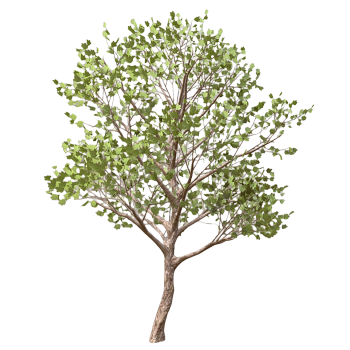
maple
Maple, a deciduous tree species belonging to the Acer genus in the Acer family. Its plants can grow up to 17 meters tall; Leaves opposite each other, with no hairs on the leaf axis; Small leaf paper, oblong elliptical or oblong ovate in shape, with a long and gradually pointed tip, serrated, and dark green on top; The seeds have a glossy appearance, ranging from olive green to yellow; The flowering period is in May every year, and the fruiting period is in August every year. Maple trees are named after the wind shaking their leaves, and when the wind blows, the leaves make a rustling sound, hence the name maple tree.

An'er Ke fruit
Lithocarpus Haipinii Chun, also known as An'er Ke, is a plant species in the family Fabaceae, with a height of up to 30 meters. The bark is not cracked, dark gray brown, the inner layer is light reddish brown, the leaves are thick, hard and brittle, wide elliptical, oval, inverted or inverted oval, and the leaf edges are rolled back. Male inflorescence with multiple spikes arranged in a conical shape; The female inflorescence is relatively short. The young shell of the nut is fully wrapped, with short bracts and mature shell shaped discs or pots; Nuts are nearly spherical and slightly flattened, with a flat bottom and chestnut brown color. When fully ripe, they have longitudinal cracks and a concave navel,. The flowering period is from July to August, and the fruit matures at the same time the following year. The fruit contains 58% starch.

Mango saplings
Mango tree (scientific name: Mangifera indica), also known as lemon fruit tree or mango fruit tree, is a plant of the mango genus. Its fruit is mango, native to northeastern South Asia and the Indochinese Peninsula. It is called ā mra in Sanskrit, transliterated as "anluo". It prefers high temperature and dry weather, and the most suitable temperature for its nutritional growth period (roots, stems, leaves) is 24-30 ℃. When the temperature drops below 18 ℃, it grows slowly and stops growing below 10 ℃. During the reproductive growth period (flowers, fruits), higher temperatures are required, and sandy soil with good drainage and humus content is most suitable, with a pH value of 5.5-7.5.

The mango tree
Mango tree (scientific name: Mangifera indica), also known as lemon fruit tree or mango fruit tree, is a plant of the mango genus. Its fruit is mango, native to northeastern South Asia and the Indochinese Peninsula. It is called ā mra in Sanskrit, transliterated as "anluo". It prefers high temperature and dry weather, and the most suitable temperature for its nutritional growth period (roots, stems, leaves) is 24-30 ℃. When the temperature drops below 18 ℃, it grows slowly and stops growing below 10 ℃. During the reproductive growth period (flowers, fruits), higher temperatures are required, and sandy soil with good drainage and humus content is most suitable, with a pH value of 5.5-7.5.
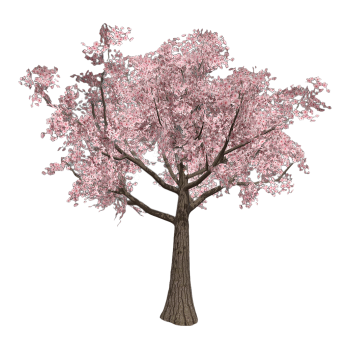
cherry tree
Cherry blossom or cherry blossom tree is a general term for plants in the Prunus subgenus Cerasus of the Rosaceae family. According to different contexts, cherry blossoms sometimes refer to the plant itself, and sometimes to the flowers that bloom. The cherry blossoms commonly referred to by people are ornamental cherry blossoms, not cherry blossoms that produce edible fruits.

Elephant Foot King Lan
Elephant footed king orchid is an evergreen woody plant of the genus Cymbidium in the family Tequila. Plant height of 4-6 meters; The stem is thick and upright, with the base often swollen and slightly grayish brown in color; The leaves are narrow lanceolate in shape, with sharp tips at the ends and densely clustered on the stem in a whorled pattern; Milk white flowers, conical inflorescence; The flowering period is summer and autumn. Elephant footed king orchid is native to North America and distributed in southern and northern China. I prefer a warm, humid, and sunny climate environment, and am tolerant to shade, drought, waterlogging, and cold. It is suitable for planting in loose, fertile, and well drained sandy soil, with a suitable growth temperature of 15-25 ℃. The general method of propagation is through cutting propagation.
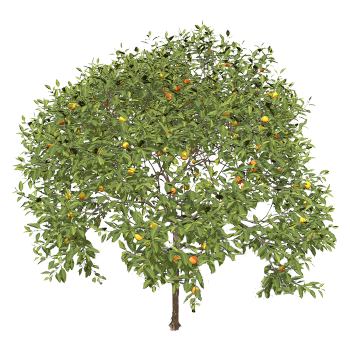
Sour Orange
Citrus × aurantium Engl. is a small tree in the Rutaceae family, belonging to the citrus genus. Its racemes have few flowers, sometimes accompanied by axillary single flowers; The fruit is spherical or flattened in shape, with a thick skin that is difficult to peel off. It is orange yellow or vermilion in color, with large oil cells and uneven surfaces. The flesh has a sour and sometimes bitter taste; Leaves ovate oblong or elliptical, entire margin or with shallow teeth, petioles and wings ovate; The flowering period of lime is from April to May, and the fruiting period is from November to December.

delonix
Delonix regia, also known as Shadow Tree, Phoenix Tree, Phoenix Flower, Golden Phoenix, Fire Phoenix, Western Jacaranda, Red Jacaranda, Fire Tree, Red Fire Jacaranda, Flame Wood, Forest Flame, Panxia Na, etc., is a plant of the Phoenix Wood genus in the legume family. The flowering time of Phoenix Wood is around May to July in Hong Kong and early summer in Taiwan, often around the graduation season of schools. It stands out with its gorgeous flowers and fern like green leaves. It grows in many tropical and subtropical regions of the world as a decorative and sun shading tree.
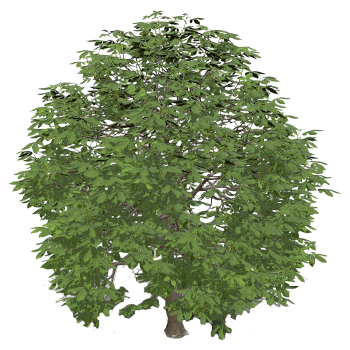
European Seven Trees
European seven leaf tree, scientific name: Aesculus x carnea, also known as Horse Chestnut, is an authentic angiosperm in the Sapindaceae family of the Sapindaceae order. It is a horticultural variety with a tree height of 5-15 meters, palm shaped compound leaves, 5 leaves, long petioles, serrated leaf edges, and a cone-shaped floral inflorescence with a height of 15-25 cm. The flowers are dark pink/red in color and bloom from May to June with a diameter of 1.5-2.5 cm. The fruit season is in October. It is a street and park viewing tree.
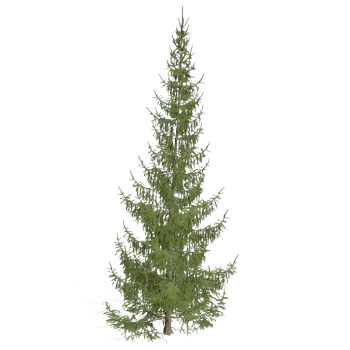
European spruce
European spruce (scientific name: Picea abies (L.) H. Karst.) It is a tree of the spruce genus in the pine family. The plant can reach a height of 60 meters and a breast height diameter of 4-6 meters; Young trees have thin bark, while old trees have thick bark that splits into small thin pieces; Branches often droop, young branches are light reddish brown or orange red, hairless or sparsely hairy, persistent bud scales at the base are significantly rolled back, and winter buds are conical in shape; Leaves are square shaped with four edges, straight or curved, pointed at the tip, oblique in cross-section, and have pink white stomatal lines on all four sides; The cone is cylindrical in shape, with seeds about 4 millimeters long and wings about 16 millimeters long.

North American Red Oak saplings
North American red oak is a native plant of North America, also known as red oak, red oak, or northern red oak, as a distinction from southern red oak. It is also the state tree of New Jersey and the provincial tree of Prince Edward Island. The distribution area extends north to the Great Lakes region, south to Georgia, Mississippi, Alabama, and Louisiana, east to Nova Scotia, west to Oklahoma, Kansas, Nebraska, and Minnesota in the eastern and central United States, as well as southeastern and central southern Canada. North American red oak has now been introduced to a small part of Western Europe as an ornamental tree species for planting in gardens and parks.

red oak
North American red oak is a native plant of North America, also known as red oak, red oak, or northern red oak, as a distinction from southern red oak. It is also the state tree of New Jersey and the provincial tree of Prince Edward Island. The distribution area extends north to the Great Lakes region, south to Georgia, Mississippi, Alabama, and Louisiana, east to Nova Scotia, west to Oklahoma, Kansas, Nebraska, and Minnesota in the eastern and central United States, as well as southeastern and central southern Canada. North American red oak has now been introduced to a small part of Western Europe as an ornamental tree species for planting in gardens and parks.

North American Mountain Hemlock
Tsuga mertensiana, also known as the North American mountain hemlock, is a species of hemlock native to the west coast of North America, found between central southern Alaska and central southern California. Cedar is a large evergreen coniferous tree that can grow up to 20 to 40 meters in height, with special individuals reaching up to 59 meters in height. Their trunk diameter is as high as 2 meters. The bark is about 3 centimeters thick, with square cracks or wrinkles, and a color ranging from purple brown to gray. The crown of young trees is a neat, slender cone shape, with slanting or drooping lead buds, while the crown of old trees becomes cylindrical. At all ages, it is characterized by slightly drooping tips of small branches.

Black poplar
Black poplar is a deciduous tree with a height of 30 meters; The tree crown is wide oval shaped. The bark is dark gray and cracks when old. Branches round, light yellow, hairless. The bud is ovate in shape, rich in mucilage, reddish brown in color, and the tip of the flower bud is curved outward. The flowering period is from April to May, and the fruiting period is in June. Black poplar naturally grows on riverbanks and river bays, and is rarely found on coastal sand dunes. Often formed into strips or patches of forest. Cold resistant, light loving, not tolerant to salt and alkali, not tolerant to drought, grows well on alluvial sandy soil. Produced in Xinjiang, China, it is distributed in northern China and northern Asia. The black poplar has a cylindrical crown, with a tall and upright tree shape and a graceful posture; Can be planted in clusters or rows on lawns, squares, schools, hospitals, and other places.
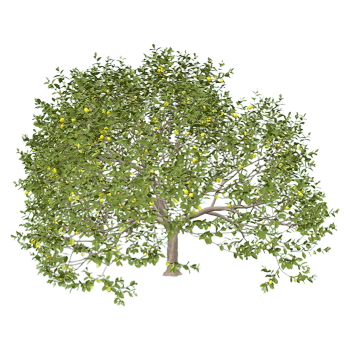
lemon
Lemon Rutaceae is a woody plant belonging to the citrus genus, with few or almost no thorns on its branches, and its tender leaves and flower buds are dark purple red; Leaves are oval or elliptical in shape; The petals are light purple red on the outside and white on the inside; The fruit is oval or ovoid in shape, with a thick skin and a lemon yellow color; The flowering period is from April to May; The fruiting period is from September to November. Lemons are native to southeastern and southern Asia, and are cultivated in China south of the Yangtze River. Currently, they are mostly grown in tropical and subtropical regions. Lemon prefers warmth and is not cold resistant. It does not have strict requirements for soil, but it is best to use slightly acidic soil with deep and loose soil layers, rich organic matter, strong moisture and fertility retention, good drainage, and low groundwater level.
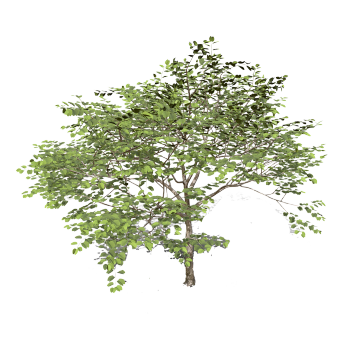
Hong Kong Orchid Tree
Red flowered sheep hoof beetle is a tree plant belonging to the legume family and the sheep hoof beetle genus. Thick and robust branches; Leaves leathery, oblong, glossy; The petiole is slender and hairless; The bracts of the umbrella inflorescence are lanceolate and pouch shaped; Flowers are slightly larger and denser; Elliptical flower bud; The receptacle is cylindrical with slightly enlarged base; Petals with long stalks; The ovary is densely covered with red silky soft hairs, and the fruit is not visible; The flowering period is from February to April. Native to China, it is cultivated in the Yellow River Basin in Sichuan, Yunnan, Guangdong, Guangxi and other places. Red flowered sheep hooves prefer warm, humid, rainy climates and sunny environments, as well as deep, fertile, and well drained acidic sandy loam soils.

Tamarix gallica
Red flowered multi branch tamarisk, Tamarix gallica, is a plant of the genus Tamarix in the family Tamaricaceae. The tree species introduced from the United States by the Beijing Shuimu Zhongtian Institute of Plant Science in 1998. The willow branches are slender and soft, with a graceful posture and leaves that grow alternately. The raceme inflorescence gathers at the top of the branches in the same year to form a cone-shaped inflorescence, and blooms in summer and autumn, which is quite beautiful.

Plumeria rubra
Red flowered Burmese gardenia is a deciduous plant of the Eggflower genus. It is native to Mexico, Central America, Colombia, and Venezuela, and is widely cultivated in subtropical and tropical climates around the world. It is a popular garden and park plant. It grows like a sprawling tree to 7-8 meters (23-26 feet) high and wide, and blooms with fragrant pink, white, and yellow flowers in summer and autumn. Red flowered Burmese gardenia belongs to the genus Dogweed and grows as a spreading shrub or small tree, with a height of 2-8 meters (5-25 feet) and similar width.

Silver spruce
Silver spruce (scientific name: Picea engelmannii Parry ex Engelm.) is a plant of the pine family and the spruce genus. Evergreen trees. Up to 60 meters in height and 200 centimeters in diameter at breast height. The tree crown has a narrow conical shape. The bark is gray to reddish brown. The small branches are thick and robust. The buds are orange brown, and the leaves are 1.6-3 centimeters long. The cone is purple or dark purple, light brown when ripe, and 3-7 centimeters long; The scales are diamond shaped to oval shaped, with the widest part above the middle. Native to the Rocky Mountains from British Columbia to northern Mexico. Growing on various mountainous soils, including calcareous and non calcareous soils.

Bottle orchid
Beaucarnea recuvitata is a plant of the Asparagaceae family, belonging to the genus Beaucarnea. It is a small evergreen tree with ornamental leaves. Potted planting is generally 0.5-1.0 meters. Its underground roots are fleshy, with upright stems resembling wine bottles; The swollen stem has a thick layer of bark, which is gray white or brown in color. Leaves grow on the top of the stem, slender and linear, leathery and drooping, with fine serrated edges. The old plant's epidermis will crack, resembling a turtle shell, which is quite distinctive. Leaves linear, whole or fine toothed, soft hanging, white flowering.

Callistemon viminalis
Chuanqianliu is a small evergreen tree in the family Myrtle, belonging to the genus Melastomataceae. Plant height 2-5 meters; Bark cracking; The tender branches are cylindrical in shape, with slender and drooping branches; The leaves are leathery, ranging from lanceolate to linear lanceolate, with a pointed or short apex and a narrowed base. Both sides are densely covered with black glandular dots; The spike shaped inflorescence is dense, with silk hairs on the inflorescence axis, membranous petals, nearly circular in shape, light green in color, and numerous stamens arranged densely; Capsule bowl shaped or hemispherical Flowering period from April to September; The fruiting period is from May to October. Due to the dense brush bottle like formation at the top of the spike shaped inflorescence, it is also known as the "bottle brush subtree".

Blue pink spruce
Blue pink spruce is an evergreen tree of the spruce genus in the pine family. The plant reaches a height of 15 meters; Conical or columnar crown; The leaves are four edged, sharp and thick, with a blue-green color. They are arranged in a spiral shape on the gray twigs and grow upwards, with gray green wax powder; Male bulbous flowers are oval shaped and solitary, large and yellow green in color, clustered at the top of new branches. The flowering period is late April, and the cones mature from September to October. Blue pink spruce is native to the United States and was introduced to China in the late 1990s. It was introduced to Tieling City in 2002. Introduced and cultivated in Beijing, Liaoning and other places in China, and widely planted as ornamental trees in North America and Northern Europe. Cold resistant, drought resistant, air pollution resistant, light loving, slightly shade tolerant.

Fuyuye Luan
Fuyuye Luan is a plant of the Sapindaceae family and the Luan genus. Trees can reach a height of over 20 meters. Leaves spread flat, bipinnate compound leaves, 9-17 leaflets, alternate. The inflorescence is large, with petals that are oblong lanceolate in shape. The filaments are white and the anthers have short sparse hairs; The capsule is light purple red in color, with nearly spherical seeds. It blooms from July to September and bears fruit from August to October. Distributed in provinces and regions such as Yunnan, Guizhou, Sichuan, Hubei, Hunan, Guangxi, and Guangdong in China. Born in sparse forests at an altitude of 400-2500 meters in mountainous areas.
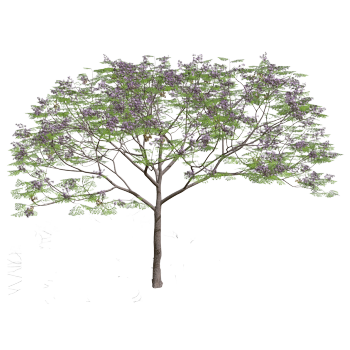
Melia azedarach wood
Melia azedarach (Latin name: Melia azedarach.), also known as China Berry in English. Deciduous trees, reaching up to 10-20m in height. Its bark is longitudinally split, dark brown, purple old branches, and has a large number of small pores. As a positive tree species, it prefers warm and humid climates, prefers light, is not tolerant to shade, and has strong cold resistance. The soil requirements are not strict, and it can grow in acidic, neutral, calcareous soil and saline alkali soil (with a salt content of less than 0.3%), but it does not grow as fast as on fertile and moist loam or sandy loam soil; Poor growth on dry, waterlogged, and poor soil conditions.

Red Thousand Layer Tree Seedlings
Callistemon rigidus R. Br. is an evergreen small tree species in the family Myrtle, belonging to the genus Callistemon rigidus. The bark of the red bark is hard, gray brown, and the tender branches have edges. At first, there are long hairs, but soon it becomes hairless; Leaves are hard and leathery, linear; The spike shaped inflorescence grows at the top of the branch, with green, oval shaped petals, bright red stamens, dark purple anthers, and elliptical shapes; Half spherical capsule; Seed strip; The flowering period is from June to August.
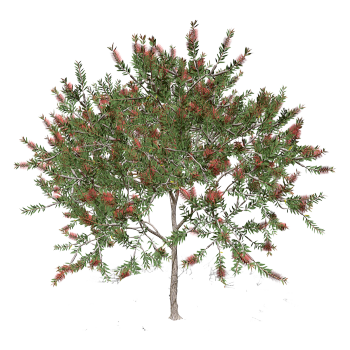
Red Thousand Layers
Callistemon rigidus R. Br. is an evergreen small tree species in the family Myrtle, belonging to the genus Callistemon rigidus. The bark of the red bark is hard, gray brown, and the tender branches have edges. At first, there are long hairs, but soon it becomes hairless; Leaves are hard and leathery, linear; The spike shaped inflorescence grows at the top of the branch, with green, oval shaped petals, bright red stamens, dark purple anthers, and elliptical shapes; Half spherical capsule; Seed strip; The flowering period is from June to August.

Jacaranda mimosifolia
Jacaranda mimosifolia D. Don is a deciduous tree belonging to the Jacaranda family and the Jacaranda genus. Its leaves are opposite, with small leaves ranging from elliptical lanceolate to elliptical rhombic in shape, with a sharp apex and a wedge-shaped base; Blue flowers, calyx tube shaped, corolla tube slender, blue, lobes circular; Shuo fruit is woody and flattened oval in shape; The flowering period is from May to June. Native to Brazil in South America, it is cultivated in regions such as Guangxi, Yunnan, Fujian, and Taiwan in China. Jacaranda prefers sunny and warm, humid climates, with well-developed roots. It grows well on loose soil with deep soil layers, good drainage, and abundant humus.

Black Poplar in Autumn
Black poplar is a deciduous tree with a height of 30 meters; The tree crown is wide oval shaped. The bark is dark gray and cracks when old. Branches round, light yellow, hairless. The bud is ovate in shape, rich in mucilage, reddish brown in color, and the tip of the flower bud is curved outward. The flowering period is from April to May, and the fruiting period is in June. Black poplar naturally grows on riverbanks and river bays, and is rarely found on coastal sand dunes. Often formed into strips or patches of forest. Cold resistant, light loving, not tolerant to salt and alkali, not tolerant to drought, grows well on alluvial sandy soil. Produced in Xinjiang, China, it is distributed in northern China and northern Asia. The black poplar has a cylindrical crown, with a tall and upright tree shape and a graceful posture; Can be planted in clusters or rows on lawns, squares, schools, hospitals, and other places.

Black Poplar in Winter
Black poplar is a deciduous tree with a height of 30 meters; The tree crown is wide oval shaped. The bark is dark gray and cracks when old. Branches round, light yellow, hairless. The bud is ovate in shape, rich in mucilage, reddish brown in color, and the tip of the flower bud is curved outward. The flowering period is from April to May, and the fruiting period is in June. Black poplar naturally grows on riverbanks and river bays, and is rarely found on coastal sand dunes. Often formed into strips or patches of forest. Cold resistant, light loving, not tolerant to salt and alkali, not tolerant to drought, grows well on alluvial sandy soil. Produced in Xinjiang, China, it is distributed in northern China and northern Asia. The black poplar has a cylindrical crown, with a tall and upright tree shape and a graceful posture; Can be planted in clusters or rows on lawns, squares, schools, hospitals, and other places.

White wax sapling
Fraxinus chinensis Roxb. is a deciduous tree in the Oleaceae family. Its underground rhizomes are relatively developed and have deep rootedness; The bark is gray brown with longitudinal cracks on the surface; Twigs are yellow brown, rough, hairless or sparsely covered with long soft hairs and grooves; Leafy ovate, ovate oblong to lanceolate; The flowers are dioecious, with dense, bell shaped male flowers and distant, barrel shaped female flowers; The fruit is a winged fruit, shaped like the wings of a dragonfly, and the nut is cylindrical. The flowering period is from April to May, and the fruiting period is from July to September.

Ash trees
Fraxinus chinensis Roxb. is a deciduous tree in the Oleaceae family. Its underground rhizomes are relatively developed and have deep rootedness; The bark is gray brown with longitudinal cracks on the surface; Twigs are yellow brown, rough, hairless or sparsely covered with long soft hairs and grooves; Leafy ovate, ovate oblong to lanceolate; The flowers are dioecious, with dense, bell shaped male flowers and distant, barrel shaped female flowers; The fruit is a winged fruit, shaped like the wings of a dragonfly, and the nut is cylindrical. The flowering period is from April to May, and the fruiting period is from July to September.

Random Model


Samsung Gear VR 2nd Generation
1137 View


Toy Tiger Cat 3D Animation Model
902 View
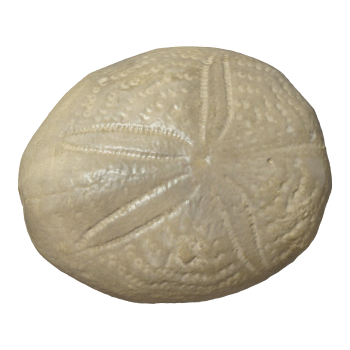
Fossil of hard shell sea urchin
944 View

