A Spanish general's helmet at the end of the 19th century

A Spanish general's helmet at the end of the 19th century

British Royal Infantry Guard Grenadier Side Cap

British Royal Infantry Guard Grenadier Side Cap

"British Royal Infantry Guard Grenadier Side Hat" is a very representative military dress in the military history of Europe from the 18th to the 19th century, which is closely related to the rise and fall of "Grenadier" (Grenadier). It is not only a practical carrier of military equipment, but also the identity and honor of the Royal Infantry Guard.
Persian Gold Round Shield

Persian Gold Round Shield

1861 José María Fontes crowned his double horned hat

1861 José María Fontes crowned his double horned hat

"José María Fontes's Coronation in 1861" is a representative ceremonial headdress in Spanish history in the 19th century, which is closely related to Spanish politics, military and aristocratic culture. This double-horned hat (Bicorne) is not only a symbol of Fontes's personal identity, but also a visual epitome of the power and glory of the Spanish "Restauraci" (Renaissance) in the 19th century, carrying a period of "coronation ceremony" and "national identity" "Historical memory.
French Le Bell revolver

French Le Bell revolver

"French Lebel revolver" (usually referred to as Lebel M1892 revolver, Lebel M1892 Revolver) is one of the core equipment of French army and police from the end of 19th century to the beginning of 20th century. It was developed by famous French gun designer Nicolas Lebel (Nicolas, 1838-1910). It is not only a milestone in the autonomy of French light weapons, but also a "personal guard" of French soldiers in the First World War, carrying the double memory of French military history and industrial history.
Franco Commander-in-Chief Side Cap

Franco Commander-in-Chief Side Cap

The "Franco-Commander-in-Chief Side Cap (1938)" is an iconic side cap worn by the Spanish dictator Franco (Francisco) as "Commander-in-Chief of the Nationalist Forces" (Captain General) at the end of the Spanish Civil War (1936-1939). This hat is not only a symbol of Franco's personal authority, but also a microcosm of political and military power in the late Spanish Civil War, carrying complex memories of special historical periods.
Flint Pistol

Flint Pistol

The flint pistol (Flintlock Pistol) is a front-loaded firearm widely used in Europe and the world from the 16th to the 19th century. With "flint ignition" as the core principle, it is one of the key weapons in the transition from cold weapons to hot weapons. It is not only an important equipment in military history, but also a microcosm of mechanical technology and technology before the industrial revolution. It is still regarded as "the representative of classical firearms".
Crossbow

Crossbow

This crossbow is in the collection of the Stranraer Museum.
The military uniform of the Spanish general Francisco Espoz y Mina

The military uniform of the Spanish general Francisco Espoz y Mina

Francisco Espoz y Mina (Francisco Espoz y Mina,1781-1836) was one of the most legendary military leaders in Spanish history in the 19th century. He was famous for his outstanding command in the Spanish War of Independence (1808-1814, against Napoleon's invasion) and the First Carlos War (1833-1840, preserving Isabella II's inheritance).
The sword of the polar explorer Sir John Ross

The sword of the polar explorer Sir John Ross

Sir John Ross (1777-1856) was one of the most legendary British polar explorers of the 19th century, known for his in-depth exploration of the Arctic. The many Arctic expeditions he commanded not only promoted human understanding of Arctic geography, but also went down in history with achievements such as "discovering polar bears" and "locating the magnetic North Pole. This "Sir John Ross Ritual Sword" is a symbol of his exploration career and honor. It is not only a symbol of personal identity, but also a material carrier of the spirit of polar exploration in the 19th century.
The military cap of the Spanish general Juan Prim

The military cap of the Spanish general Juan Prim

It has a chin strap and an Imperial visor in patent black leather. It was tied with six gold thread embroidered cockscomb, with two buttons on either side, and lined with white silk. Collected in the National Army Museum of Spain.
British World War II Airborne Helmet

British World War II Airborne Helmet

British airborne helmets are mostly developed based on MK III helmets (installed in 1941). They reduce the weight (about 1.1kg) by thinning the thickness of the steel shell (about 1.1-1.2mm) while maintaining effective protection against shrapnel (they can resist 7.92mm rifle shrapnel within 50 meters).
Bilbao Civilian Resistance Auxiliary Volunteer Beret

Bilbao Civilian Resistance Auxiliary Volunteer Beret

As an industrial and port town in the Basque Country, Bilbao is an important stronghold of the Republican government (against the Franco dictatorship). In the early days of the war, the Franco forces blockaded Bilbao, and the city faced shortages and medical collapse. The local people spontaneously set up "auxiliary volunteer" groups, wearing berets with unified logo to participate in the rescue, which became one of the symbols of "civilian resistance" in the war.
Arab Antique Aden Dagger

Arab Antique Aden Dagger

19th Century Qing Dynasty Cultural Relics Guan Dao

19th Century Qing Dynasty Cultural Relics Guan Dao

Red copper gun barrel
Red copper gun barrel

It was a red-copper artillery barrel with the insignia of Count Henrik Brühl engraved on it. This exhibit is in the collection of the Krakow City History Museum.
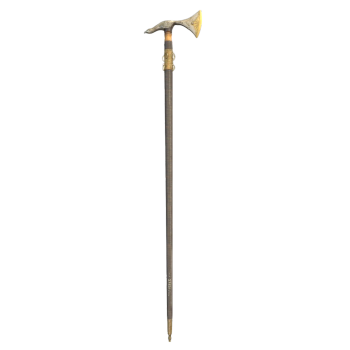
Nineteenth Century Crafts Shepherd's Cane Axe
Nineteenth Century Crafts Shepherd's Cane Axe

This cane-axe was made in 1868 in Zakopane (Zakopane), Poland, by Józef Krzeptowski. Its design was inspired by the Highland Shepherd's axe for support while hiking. The cane is made of long, narrow maple wood with a French-polished finish. They are called "ciupagas" (shepherd's axe) in the Podehalle area, and young shepherds often throw them at targets or in the air and catch them while dancing to demonstrate their agility.
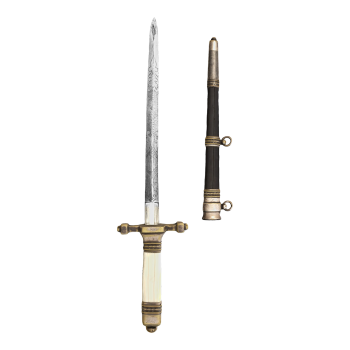
Polish naval dagger during World War I

Polish naval dagger during World War I

This Polish naval dagger is currently in the Polish Aviation Museum in Poland. A naval dagger is a short sword commonly used in close combat and self-defense. Its exquisite design and sharp blade make it suitable for use in small spaces. The handle of the dagger is usually decorated with elaborate patterns.
Eighteenth Century Bone Double-barrelle Flintlock Pistol

Eighteenth Century Bone Double-barrelle Flintlock Pistol

This pistol is currently collected in the Museum of the Academy of Fine Arts in Krakow. This pistol is a product of the 18th century. It is made of bone, brass, iron, wood and other materials through casting, forging and riveting.
18th century Polish cavalry breastwork

18th century Polish cavalry breastwork

This is a Polish cavalry breastpiece from the Museum of Fine Arts of the Academy of Fine Arts in Krakow.
Polish Wing Cavalry Helmet

Polish Wing Cavalry Helmet

The Winged Cavalry Helmet is the characteristic helmet used by the Polish Winged Cavalry (Hussars) and has a very distinctive exterior design. The Polish Wing Cavalry was a very famous and elite cavalry unit in the Polish and Lithuanian Commonwealth (1569-1795), they were known for their fighting skills and unique equipment.
North Caucasus Sabre Shaskar

North Caucasus Sabre Shaskar

A single-edged, one-handed, unarmed saber from the North Caucasus, widely used by Cossack cavalry and became the standard weapon for Russian cavalry in the 19th century.
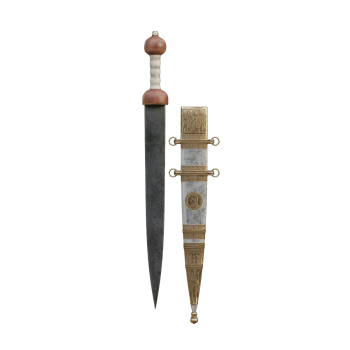
The Sword of Tiberius in Ancient Rome

The Sword of Tiberius in Ancient Rome

It is a famous ancient Roman sword and its scabbard, discovered near the Rhine River in Mainz, Germany. Since 1866, it has been a collection of the British Museum, donated to the museum by philanthropist Felix Slade. This sword is made of iron, and its scabbard is made of bronze plated with tin and gold. The decoration on the scabbard depicts the scene of Tiberius ceding military victory to Augustus after a successful Alpine campaign. Augustus, half naked, sat in Jupiter's seat, flanked by the Roman goddess of victory and the god of Mars Urtor, while Tiberius, dressed in military uniform, presented a small statue of the goddess of victory to Augustus.
Moorish helmet

Moorish helmet

A 16th century Moorish helmet collected in the Heiligenkreis Monastery Museum. Morion helmet, an open helmet without armor. Composed of two pieces.
Ancient Japanese Warrior Armor - Spanish National Army Museum

Ancient Japanese Warrior Armor - Spanish National Army Museum

Also known as Japanese armor, it was a type of armor in Japan during the Edo period (1603-1868). It is part of the collection of Romero Ortiz, and its 1888 catalog is related to the background of Daniel Dato and the Philippine War. In ancient Japan, warriors or samurai were military elites who served daimyos or feudal lords. Their armor, as the foundation of their defensive clothing, consisted of different components covering the entire body, which evolved into forms of great display and precious decoration, especially during the Edo period. It is currently housed in the National Army Museum of Spain.
Arched whale skull

Arched whale skull

The bowhead whale is a mammal belonging to the family of right whales in the order Cetiformes, also known as the Arctic whale, North right whale, or Arctic right whale. The body is spindle shaped; Head large, covered with keratoma; Whale whiskers are long and thin, with strong elasticity; Unclear neck; Back width; No dorsal fin. The body surface is black brown, the abdominal color is lighter, and the fins and tail fins are both black. Adult females have a slightly larger body size than males. Named after having an arched head. Life expectancy exceeds 100 years. Bow headed whales are one of the rarest populations in the whale family, with less than 6000 individuals worldwide, and are strictly prohibited from being hunted. Among the four species of the right whale genus, the bowhead whale is the largest species.
Ancient Greek Macedonian Kingdom warrior helmet
Ancient Greek Macedonian Kingdom warrior helmet

The Kingdom of Macedonia (Ancient Greek: Μακεδονία) refers to a kingdom located in the northwest of Greece from 808 BC to 168 BC. During the reign of Philip II, it basically completed the unification of the Greek mainland. During the reign of Alexander the Great, it continued to expand outward, successively occupying the entire territory of Egypt and annexing the Persian Empire. Its army reached the Indus River Basin, and its territory reached its peak. At this time, the Kingdom of Macedonia was later known as the Alexander Empire.
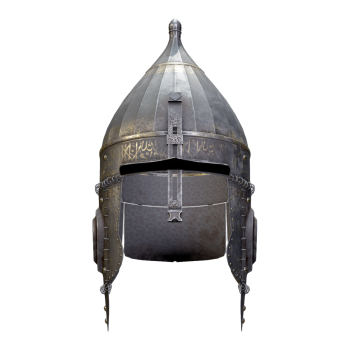
Ottoman warrior conical pointed metal helmet

Ottoman warrior conical pointed metal helmet

The Ottoman Empire (English: 1299-1923) is a multi-ethnic empire established by the Turks, named after its founder, Ottoman I. The metal helmet with a conical tip is mainly used by Ottoman cavalry and elite infantry to avoid some cold weapons and arrow damage to the head through the curvature of the conical tip. The higher the military level, the higher the defense level
Ancient Greek Spartan armor

Ancient Greek Spartan armor

Among the most powerful city states in ancient Greece, Athens ranked first and Sparta ranked second. The so-called city-state is a country that centers around a city and is surrounded by towns and villages. Sparta is located on the plain of Lagonia in the southern part of the Greek peninsula. Around the 11th century BC, a group of Greek tribes called Dorians invaded Lagonia and destroyed the original city states. They settled here, which became the Spartan city of Dorians - but it had neither walls nor decent streets. Spartans refer to the white people who came here - Dorians.
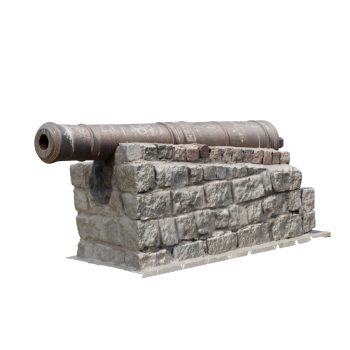
1628 Soviet Bronze Field Gun

1628 Soviet Bronze Field Gun

Artillery Museum located in St. Petersburg, Russia
Photogrammetry of ancient artillery, turrets, and cannons

Photogrammetry of ancient artillery, turrets, and cannons

Armor Set

Armor Set

Armor is a tool used by humans to protect their bodies during armed conflicts, also known as armor or armor. Both helmets and armor refer to protective gear for the head; Armor and armor are protective gear for the body, mainly used to protect important organs in the chest and abdomen. Armor, from the unearthed objects, ancient war armor was mostly made of leather such as rhinoceros and shark, and painted on top; Leather armor consists of a body, sleeves, and skirt; The stitching method of the nail plate is to horizontally press the left plate against the right plate, and vertically press the lower plate against the upper plate; The armor is also woven with eighteen pieces of armor.
British steel combat helmet Brody helmet during World War I

British steel combat helmet Brody helmet during World War I

The Brody helmet is a steel combat helmet designed and patented by John Leopold Brodie in London in 1915. Its improved form became the British helmet, steel helmet, Mark I, and the American M1917 helmet. Simply put, it is known as the shrapnel helmet, combat pitcher, Tommy helmet, tin hat, and in the United States, it is called the Dough Boy helmet. It is also known as a disc hat, tin hoop hat, washbasin, combat bowling (when worn by officers), and Kelly helmet.
Third century Roman Empire helmet "Inlaid Golden Cavalry Helmet Nidbieber Style"

Third century Roman Empire helmet "Inlaid Golden Cavalry Helmet Nidbieber Style"

The type of cavalry helmet is the Niederbieber style, with hinged X-bars and long neck guards. Fold the edge of the neck protector (upwards) to create a clear edge impression. The helmet is currently housed in the Nijmegen Museum in the Netherlands.
World War II steel helmets for American soldiers

World War II steel helmets for American soldiers