Animals/Organics
Red-mouthed Phoenix Snail Specimen
The red-mouthed Phoenix snail (Strombus luhuanus) is a tropical marine gastropod mollusk of the genus Phoenix snail in the family Phoenix snail, commonly known in Chinese as the Lu's Phoenix snail or the red-mouthed Phoenix snail. Widely distributed in the Indo-Pacific Ocean, including the South China Sea (Hainan, Taiwan), the Philippines, Indonesia, Malaysia, Australia, the Great Barrier Reef and Pacific Islands (such as Fiji, Solomon Islands), intertidal to shallow waters (0-20 meters), common Sandy or coral sand bottom.
Samoan Octopus Specimen
The Samoan octopus (scientific name: Octopus minorSasaki, 1920) is a shallow marine species with unusually slender brachiopods in the octopidae. It is also called or "Samoan octopus" because its body size is smaller than the octopus (Octopus vulgaris) distributed in the same domain ". It is distributed in the shallow waters of the Northwest Pacific, including Japan (southern Hokkaido to Okinawa), the Korean Peninsula, the East China Sea (along the coasts of Zhejiang and Fujian), Taiwan and the Sea of Japan. Preference is made to rock crevices, sand-mud mixing areas, seaweed beds (e. g. Kumbulin), water depth 0-50 m, water temperature 5-25°C (diving into deep water in winter).
Specimen of the thick-cled live hermit crab
The thick-chelated live hermit crab (DardanusCrassimanus) is the dominant species in the Indian Ocean-Pacific tropical beach and reef junction area (0-10 m water depth), distributed in the western Pacific: Japan (Hokkaido to Okinawa), Korean Peninsula, East China Sea (Zhejiang, Fujian beach), Philippines, Indonesia. Indian Ocean: Gulf of Thailand, Bay of Bengal coast. Diet omnivorous partial rot food, body length (including shell) 5-8cm, body width 3-5cm.
White Rhino (3D animated model)
The white rhinoceros is a mammal of the genus White Rhinoceridae in the order Rhinoceridae. The body is round and thick, the skin is thick and smooth, and the body surface is similar to gray. The head is very long, the incisors and canines are degraded, and the developed 7 pairs of cheek teeth have a very thick calcareous layer. There are two horns, one large and one small, one in front and the other. The horns are not bone, but derivatives of epithelial tissue, which are accumulated by keratinous fibers, the medullary spines are connected with ligaments to support the head. The limbs are thick and strong, with three toes in the front and rear limbs. The upper lip is flat and wide, square, so it is called wide kiss rhinoceros and square kiss rhinoceros. The male weighs more than the female.
Moose (3D animated model)
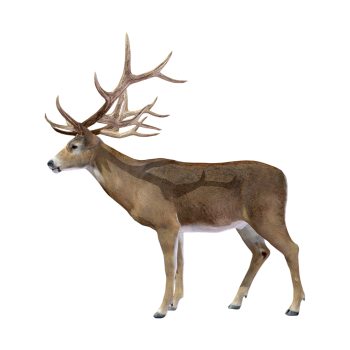
The moose is a mammal of the genus Camelidae in the order Artiodactyla. Moose is larger, generally 2-2.6 meters long.. The moose is named for its hump-shaped back hump and its horn-shaped mandible. Moose is distributed in Russia, Northern Europe, North America and other sub-frigid regions, and also in the northeast of China, the big and small Xing'an Mountains. Moose have a high status in many cultures. However, due to hunting and habitat destruction, moose is now included in China's "National Key Protected Wildlife List" and is recognized as a national first-level key protected animal.
Realistic raccoon (3D animated model)
Raccoon (scientific name: Procyon lotor): a mammal of the order carnivora and raccoonidae, with an adult body length of 40-65cm, a tail length of 20-40cm, a weight of 4-10kg, and a male slightly larger than a female. Smaller body size. The face has black eye spots, the image is funny, nicknamed "masked thief"; the tail has 5 to 7 black and white ring patterns. The hair is dense, the whole body hair color is gray brown mixed, also can see the albino varieties. The claws cannot be contracted and are not sharp, but are very sensitive and can catch flying bugs.
Taiwan Beautiful Butterfly (3D animation model)
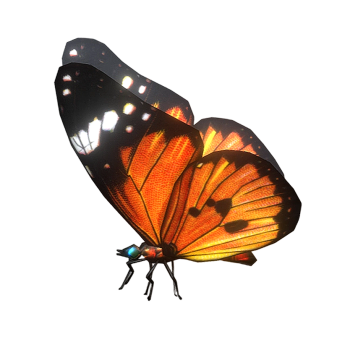
Taiwan's Celaenorrhinus taiwanus is a small and medium-sized butterfly of the genus "Noucaidae" (Celaenorrhinus) and is endemic to Taiwan, China (some classification systems regard it as a subspecies of Southeast Asian populations, but the mainstream view recognizes its endemic status in Taiwan). The "taiwanus" in its scientific name directly points to the model origin-Taiwan, which is a common representative species of butterfly in Taiwan's low-altitude forest and grassland ecosystem. The Taiwan butterfly is the dominant butterfly species in Taiwan's low-altitude (500-1500 m) forest edge grassland shrubs and brook woodlands.
crown of thorns starfish
The crown-of-thorns starfish is a well-known top predator of coral reefs in the Asteroidea class (starfish). Its scientific name is now mostly classified as Acanthaster planci (often translated as "crown-of-thorns starfish" or "coral starfish" in Chinese). This kind of starfish is called "the nightmare of coral reefs" because its large-scale outbreak can lead to the death of large-scale bleaching coral reefs, is a key regulator of tropical coral reef ecosystems
Flat Coral
Flat coral is the "invisible cornerstone" of coral reefs-its dense skeleton, symbiotic relationship with zooxanthellae, and support for biodiversity make it a core species for maintaining reef health. In the face of climate change and man-made air disturbance, protecting this "flat engineer" is essentially injecting resilience into the entire coral reef ecosystem. Every gentle guardian of a coral reef is an investment in the future of the ocean.
leafy Monterey coral
The leafy Monterey Coral is the elegant "leafy builder" of tropical coral reefs-its flaky skeletons, tiny coral polyps and zooxanthellae symbionts that together form the core framework of the coral reef ecosystem. However, climate change and man-made air disturbances are putting these "seafloor leaves" at risk of disappearing. Protecting foliated Montipora is essentially protecting the health of the entire coral reef ecosystem.
Rhino
The core highlight is the real expression of skin texture-the skin surface presents rough granular texture, full of fine wart-like protrusions and deep folds (the depth of folds varies with body parts, such as neck and shoulder folds, which are more obvious); The color is mostly dark gray, black gray or brown gray, which may have local traces of soil adhesion (simulating the activity state in natural environment); There is shadow transition at the skin folds, enhance the skin's heaviness and three-dimensional sense; The texture of horny horn is different from the skin, showing the characteristics of hard, smooth and with subtle growth lines, and the base of the horn is naturally connected with the head skin.
High Detail Brown Horse
It presents the standard proportions of adult horses-shoulder height, body length, coordinated length of limbs, strong trunk, straight back or slightly natural radian, slender and powerful neck, moderate head proportion (natural connection with trunk), overall posture may be standing, walking or trotting (muscle tightness conforms to sports mechanics), restoring the horse's sense of strength and elegant posture.
Details of the structure: muscle lines are clearly visible, such as the deltoid of the shoulder, back
Shrimp
The body is naturally curved and streamlined, divided into three parts: head, chest and abdomen. The front end of the head has slender tentacles (simplified to several smooth lines), the eyes are protruding and spherical, the chest is connected with multiple pairs of walking feet (simplified to block or strip structure), the abdomen is composed of multiple sections, and the tail is a fan-shaped tail fan (outlined by a small number of triangular surfaces), the overall proportion fits the biological characteristics of real shrimp, ensuring high recognition under low mold.
black beetle
"Eleodes" is a class of insects in the family Coleoptera, commonly known as "black beetle (darkling beetle)". It is widely distributed in arid and semi-arid areas and is characterized by its hard exoskeleton, black or dark brown body color and unique ecological adaptability. The model focuses on restoring the biological morphology, anatomical structure and detailed characteristics of these insects, which is both scientific and realistic, and may be used for biological teaching, ecological simulation or science visualization.
Elephant and Lion Statue
Combination and sense of scene: Elephant and lion statues may be presented in the form of collocation (such as juxtaposition, interaction or forming a specific scene). The base design may be simple or with decorative lines. The overall atmosphere tends to be solemn, majestic or natural theme, which is suitable for virtual construction requirements such as garden landscape, interior decoration and cultural scene.
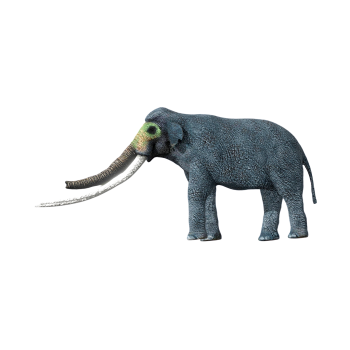
Mammoth
On the whole, the scheme may take regional characteristics and natural symbols as the core, and create design works with unique recognition and emotional resonance through the integration of materials, shapes and themes.
Sallia cono specimen
Conus Sallia (scientific name: Conus lampas sauliae) is a highly toxic marine gastropod mollusk of the conus family Conus. It is classified as a subspecies of the lamp snail, named for its type specimens collected from the Saliya Archipelago in Indonesia. Sallia conus is known for its unique shell shape, bright body color and deadly venom, and is one of the most representative "marine poison kings" in the conus family. It is distributed in the tropical waters of the Indian Ocean-Pacific Ocean, mainly in Indonesia, the Philippines, Malaysia, northern Australia and the west coast of India. Sandy, muddy or coral reef bottoms with a preference for water depths of 1-50 m
Cranus giant specimen
Crocea (Tridacna crocea) is a very distinctive marine shellfish in the bishell class, named after the orange-red markings on the surface of the shells. As a smaller member of the genus, it is still a key species in tropical coral reef ecosystems.
Skipjack specimen
Bonito (Katsuwonus pelamis) is a large pelagic fish widely distributed in the global tropical-subtropical waters, and belongs to one of the most economically valuable species of tuna. It is named for its dark stripes on the sides of the body ("skipjack" originally means "jumping mackerel") and active cluster habits. Bonito is a typical pelagic migratory fish with a streamlined spindle-shaped body and is adapted to high-speed swimming. The tropical-subtropical waters (40 ° N to 40 ° S) of the three global oceans (Pacific Ocean, Atlantic Ocean, and Indian Ocean) are concentrated on both sides of the equator.
Giant webbed-footed octopus specimen
Giant webbed-footed octopus is a typical cephalopod mollusk. The giant webbed-footed octopus (Callistoctopus macropus) of Octopaceae family has no shell, soft body and highly flexible body. It is a warm benthic cephalopod, widely distributed in tropical-temperate waters of the world, and prefers complex habitat to avoid predators. Mainly preys on crustaceans (crabs, shrimps), mollusks (shellfish, squid) and small fish. It often inhabits coral reef crevices, rock caves, shipwrecks or sandy seabed in shallow seas (water depth 1-100 meters). It is hidden during the day and active at night.
long neck medaka specimen
Long-necked medaka (Vietnamese Giraffe Loach, scientific name: Leptobotia rubripinnis) is a freshwater fish of the genus Cyprinidae (Cyprinidae) Long-necked medaka (Leptobotia) in the order Cyprinidae (Cypriniformes). It is named after its dark markings similar to giraffes on its body. It is a rare freshwater fish that is unique to Southeast Asia (especially Vietnam).
Lipid Carp Specimen
Although its name contains "Malabar", it is actually distributed in the tropical freshwater basin of South America and is an important member of the Amazon River, Orinoco River and other water systems. Malabar carp is a medium-sized freshwater fish of the family Lipid Cyprinidae, named after type specimens found on the coast of Malabar, India (now Kerala, India).
Salmon Specimen
Pacific salmon is one of the most important groups in the family Salmonidae, including 8 species of large migratory fish widely distributed in the North Pacific Ocean. Because of its delicious meat, high economic value and key ecological role, it is called "the silver gold of the Pacific".
Random Model
San Francisco Bay, USA
306 View
a pile of chopped logs
191 View
Shiva shrine model
123 View
Silver vein noble bed potted plant
304 View