


Popular Science Education

Fossilized Tooth of Hornosaurus
Caueratosaurus is also translated as Cryptocoratosaurus, which means "face with slender horns" in Greek. Like all the lower order dinosaurs, the hornophorosaurus was a herbivorous dinosaur. During the Cretaceous period, flowering plants spread across the continent, and Coriolus probably fed on dominant flowering plants, as well as ferns, cycads, and coniferous plants. Coriatops may have used their sharp beak-like beaks to bite off leaves or needles. The fiber-hornosaurus is 2 meters long and may weigh between 68kg and 200kg.

Fossil teeth of Triceratops
Triceratops, a herbivorous dinosaur of the genus Triceratops, is a bird-buttock hornosaurus. Triceratops is a kind of dinosaur like rhinoceros. It has heavy appearance, thick legs, three horns on its head, a large bone plate extending backward at the back of its skull to form a neck shield, a short horn above its beak and two long horns above its orbit. Triceratops horns are defensive weapons and can scare off predators. Its tail is short and sharp, and its feet are like hooves.
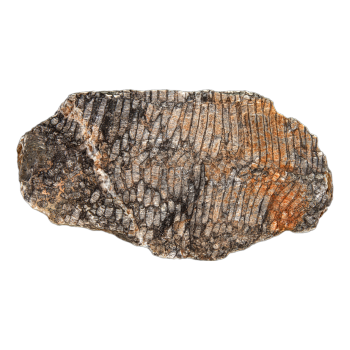
Silicified coral

Dinosaur skull fossil of Euphorbia
Halbersaurus, also known as Spiny Shield Ceratopsian, lived in the late Cretaceous period and is a type of herbivorous ceratopsian dinosaur. The neck shield halbersaurus had a large head and beautiful shield shaped circular decorations on its neck. Around the shield shaped ornament, there are six long horns of different sizes, which form the terrifying neck shield of the halberd dragon. This neck shield can not only scare the enemy. This neck shield usually looks spectacular and beautiful on strong and powerful males, but is not well-developed on females, so experts speculate that its main function is to showcase and attract the attention of the opposite sex. Because this neck shield looks very similar to a halberd in ancient Chinese weapons, it was named Jilong figuratively.

Southern giant terror bird skeleton
The southern giant terror bird (Dinornis robustus) is a species of terror bird, also known as the South Island giant terror bird. Like other terror birds, they cannot fly. The origin of these birds may be due to the early ancestors of terror birds being able to fly and reach the South Island of New Zealand. The southern giant terror bird is the largest among terror birds. Adult female birds can reach a shoulder height of up to 2 meters and a total height of 3.6 meters, making them the tallest known bird species. It lives in the lowlands of the South Island of New Zealand. It may have become extinct as early as the 13th century.

14 million year old scorpionfish fossils
Scorpion fish is one of the most venomous and inconspicuous fish species in the ocean. These ambushing predators are experts in integrating into the environment, sitting patiently at the top of coral reefs waiting for unsuspecting prey to swim over. The color of scorpionfish ranges from dull brown and yellow to bright red and orange, perfectly matching the surrounding coral and even exhibiting feather like fins or flaps to better camouflage with neighboring corals.

Titan python fossil
The Titan Python belongs to the Python family. Titan pythons lack external and middle ears, resulting in delayed hearing; The olfactory organ grows on the tongue; Without eyelids, one cannot close their eyes; There are lungs. The fossils of the Titan Python can be traced back to the Guajira Peninsula in northeastern Colombia, South America, approximately 60 to 58 million years ago. The Titan Python dominated the Earth for at least 10 million years. Titan pythons are cold-blooded animals with a habit of sunbathing and hunting after their bodies become warm. According to researchers' analysis, the food of the Titan Python includes blunt nosed crocodiles weighing half a ton, lungfish up to three meters long, and some large turtles.

Panosaurus fossil
Banlong is an ancient dinosaur from the Triassic period, which lived between 222 million and 200 million years ago. It was the first giant dinosaur to appear on Earth. Before the appearance of the Banosaurus, the largest herbivore had a body size as big as a pig, while the Banosaurus was much larger, with a body the size of a bus. Banlong, meaning "flat reptile," is an ancient dinosaur that lived 210 million years ago during the Late Triassic period. It has a body length of 6-8 meters, a height of 3.6 meters, and a weight of about 5 tons. According to archaeological research, it was the first giant dinosaur that lived on Earth and ate plants.

Fossil of Trilobite with Round Shield
The round shield trilobite lived during the Devonian period and was mainly distributed in Morocco. The round shield trilobite is known for its unique appearance, with slender eye stalks, prominent spines, and a round, uneven head.

Former Bavarian terror elephant skeleton
The Bavarian terror elephant is an extinct long nosed animal belonging to the Deinoteridae family. It lived during the Early Miocene and Middle Miocene periods and was distributed in Africa, Europe, and Asia. The body size of this animal is similar to modern Asian elephants, with a shoulder height of about 2.7 meters. Unlike modern elephants, the Bavarian terror elephant does not have long upper teeth, but instead has a pair of downward curved lower teeth. These long teeth may be used to grab food or move tree branches.

Ancient Danube Gastropod Shell Gravel

Gastropod shell fossils
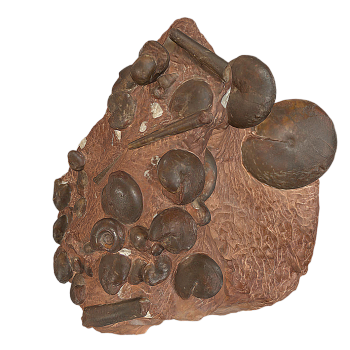
ammonite fossil
Kikushi, a collective term for cephalopods and ammonites in the phylum Mollusca, is a group of extinct marine organisms. Kikushi lived from the early Devonian to the late Cretaceous period, and its shell is often preserved in the form of fossils in the strata. The outer shell of ammonite is a single petal, consisting of three parts: the fetal shell, the gas shell, and the living room. It usually spirals around the fetal shell along a plane, with each revolution forming a spiral ring. Adult ammonite shells generally have 5 to 9 spiral rings, symmetrical on both sides, and can be straight, curved, or even irregular.

Lianglong skeleton
Lianglong is a dinosaur belonging to the family Lianglong in the order Saurischia. The neck is long, the head is small, and the position of the nostrils is higher than the eyes; The front of the mouth has flat teeth, while the sides and back have no teeth; Strong limbs, short forelimbs, long hind limbs; The buttocks are higher than the front shoulders; Each palm has 5 fingers (toes); The tail is longer than the neck and gradually narrows towards the end, forming a whip like shape, with over 10 human bones in the middle. The name Shuanglianglong comes from two protrusions that protrude from the top of the human character bone, resembling double beams, and is commonly referred to as Lianglong.

Actinoceras
It is an ancient marine organism belonging to the subclass Nautilus in the order Cephalopoda, and its fossils are mainly found in the Ordovician strata. One of its prominent features is that the outer shell is straight and the body tube is prominent, with flat and wide body tube sections resembling beads. The structure of the neighboring wall is complex, with the neck of the neighboring wall bending outward at an angle of approximately 45 degrees. There is calcium filling inside the body tube, which is an important basis for paleontologists to study its classification and evolution. Widely distributed, it has been found in Asia and North America, especially in the Ordovician strata of northern China. Understanding ancient marine ecosystems and geographical environments holds significant scientific value.

Psittacosaurus mongoliensis
Mongolian parrot billed dragon is a kind of parrot billed dragon with regional characteristics found in the the Inner Mongolian Plateau, which belongs to the suborder ceratops, parrot billed dragon family, and parrot billed dragon genus. It has a small number of teeth on its skull, short forelimbs, long and strong hind limbs, walks on two legs, and feeds on plants.

Fossil of jawbone under horse

Allosaurus skeleton
Allosaurus is one of the most famous large carnivorous dinosaurs, occupying the top of the food chain in late Jurassic terrestrial ecosystems. Its model species, the fragile Allosaurus, was created by the great American paleontologist Osnil in the 20th century Marsh described the naming in 1877. They are also the most abundant and widely distributed predators discovered in the Late Jurassic period. Adult Allosaurus can grow up to 9 meters in length, with a few individuals believed to reach up to 12 meters. Although not as robust as the Tyrannosaurus rex, the body proportions of the Allosaurus are more symmetrical, with more developed forelimbs, making it appear more agile.

Abel Pinsdorf's Footprints
This is the name of a fossil footprint, a footprint fossil left by ancient animals.
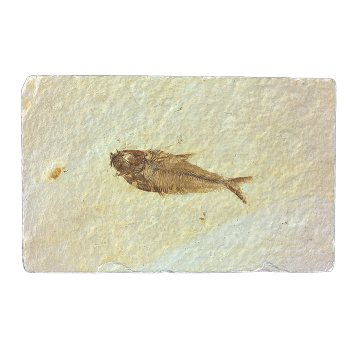
Fossil of ray finned fish
Ray finned fish, a major evolutionary branch of bony fish, is characterized by its fins being fan-shaped membranes supported by spoke shaped bony/keratinous spines, which differ from the paddle shaped fleshy fins supported by multi jointed appendicular bones in meat finned fish or by cartilage columns in cartilaginous fish.

Saber toothed tiger skeleton
The saber toothed tiger is a carnivorous mammal belonging to the genus saber toothed tiger in the order Felidae. The saber toothed tiger was once widely distributed on the continents of Asia, Europe, and America. It appeared in the Oligocene 35 million years ago and became extinct in the Pleistocene one million years ago. Their living period was during the Quaternary glacial period, when herbivores were slow-moving and easily hunted. But the ice age has ended, and cold resistant large herbivores cannot adapt to climate change and migrate northward, dying due to insufficient food. The saber toothed tiger lost its food source, did not have an advantage in hunting, and even became a prey for humans. In the end, it could only go extinct with the extinction of large thick skinned animals.

Juvenile Tyrannosaurus Rex skull
Tyrannosaurus rex, also known as Tyrannosaurus rex, is a type of theropod dinosaur and the most representative large theropod dinosaur. Tyrannosaurus rex once roamed an island continent called Laramidia (now located on the eastern foothills of the Rocky Mountains in western North America). The distribution range of tyrannosaurs is wider than other members of the tyrannosauridae family. Its fossils were discovered in various strata of the Late Cretaceous Maastrichtian stage (approximately 68 to 66 million years ago). Tyrannosaurus is the last known member of the Tyrannosauridae family before the Cretaceous Paleogene extinction event, and is also one of the latest non avian dinosaurs to go extinct. Tyrannosaurus rex is currently the heaviest known carnivorous dinosaur.

Giant lemur skeleton
The weight of the giant lemur is about 50 kilograms, making it one of the largest lemurs in history. It is a slow-moving, bulky creature with a body posture similar to modern koalas. These animals used to inhabit the island of Madagascar. 2300 years ago, humans arrived on the island, causing the species to rapidly decline and eventually become extinct approximately 500 years ago. This skeleton is housed in the Vienna Museum of Natural History.

Fossil of true palm fin fish
The Eusthenopteron lived in the Devonian period 400 million years ago. It is a freshwater fish that feeds on aquatic animals.

Oyster reef fossils
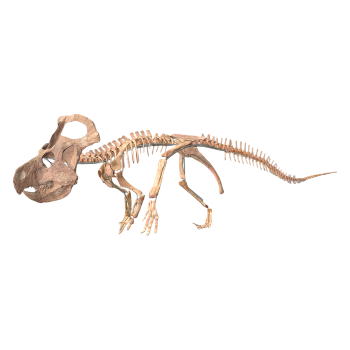
Ancestral ceratopsian skeleton
Anshihara ceratopsian is less than 3 meters long, with no horns on its head, small protrusions on its nose bone, and a neck shield; The mouth and nose resemble those of a parrot billed dinosaur, with teeth on the front of the mouth; Short limbs and obese body.
Random Model

USS Essex
158 View


Indian Spice Rice Chicken Biryani
138 View

Hereford Cattle 3D Animation Model
301 View

Marshall DSL15C Guitar Speaker
109 View

ZenvoTSR-S supercar 2020 model
294 View
3D model of pallet truck
246 View


Indian Curry Flavor BBQ Package
139 View