Simulation of the Moon Model

Simulation of the Moon Model

Wilder T4 astronomical theodolite

Wilder T4 astronomical theodolite

"Wilder T4 astronomical theodolite" is a high-precision angle measuring instrument designed for astronomical observation. It is mainly used to determine the position, trajectory and atmospheric refraction of celestial bodies (such as stars, planets, comets). In its name, "Wild" usually refers to the manufacturer of traditional astronomical instruments in Germany or Switzerland. "T4" is the model code and represents its technical iteration version. "Astronomical Theodolite" defines its core function-to realize precise measurement of azimuth and altitude of celestial bodies through telescope and dial system.
Earth rotation animation

Earth rotation animation

Universal solar ring for astronomical instruments in the eighteenth century

Universal solar ring for astronomical instruments in the eighteenth century

This instrument was manufactured around 1760 and was one of the most advanced astronomical measurement tools of the time. By using the Universal Dayring, astronomers can accurately measure the position of the sun during the day to determine time and orientation. This instrument was widely used in the 18th century to help astronomers with celestial observation and navigation.
eighteenth-century astronomical equipment reflecting telescope

eighteenth-century astronomical equipment reflecting telescope

The main component of a reflecting telescope is a concave mirror (primary mirror), which reflects light to the focal point. Unlike refracting telescopes, reflecting telescopes use mirrors instead of lenses to focus light, which avoids chromatic aberration problems. Common reflecting telescope designs include the Newtonian and Cassegrain telescopes. Reflecting telescope design was further developed in the 18th century, particularly with large aperture and high power reflecting telescopes. The use of a parabolic mirror allows the light rays parallel to the optical axis of the objective lens to be accurately focused on the focal point, thereby greatly improving the image quality.
16th century astronomical instrument sundial
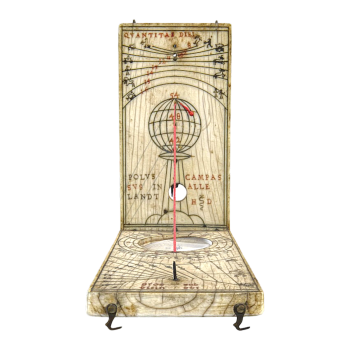
16th century astronomical instrument sundial

Seventeenth Century Astronomical Instrument Hand-held Folding Ivory Sundial

Seventeenth Century Astronomical Instrument Hand-held Folding Ivory Sundial

Seventeenth Century Astronomical Instruments Small Ring Sundial

Seventeenth Century Astronomical Instruments Small Ring Sundial

The ring sundial was a sophisticated instrument used to measure time at the time. Its design combines science, technology and art, symbolizing the era's quest for time and astronomical knowledge. The working principle of the ring sundial is based on the position of the sun, and the time is determined by reading the projection of the sun on the dial.
Eighteenth-century astronomical instrument cube sundial

Eighteenth-century astronomical instrument cube sundial

The cube sundial is a scientific instrument used to determine time. In the 18th century, the sundial was an important time-measuring tool that scientists and explorers relied on for astronomical observation and navigation.
Vintage copper shell astronomical telescope

Vintage copper shell astronomical telescope

Cabin Creek Meteorite
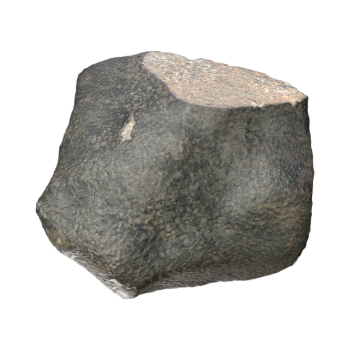
Cabin Creek Meteorite

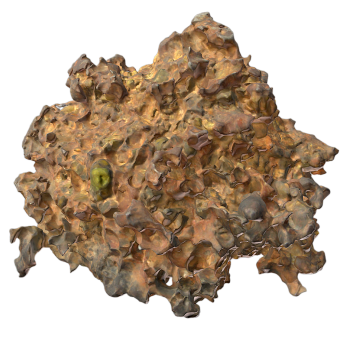
The Cabin Creek meteorite is a well-known iron meteorite that landed in Arkansas, United States, in 1886. It belongs to Class IIIAB iron meteorites with a mass of about 48.5kg. The directional landing characteristics of this meteorite are very obvious, with different depths of air marks and flow lines on the surface, and it maintains a fixed flight orientation when passing through the atmosphere.
Stein meteorite

Stein meteorite

The Stein meteorite fell on May 22, 1808, in the Moravian village of Stonarov (known as Stein in German) in today's Czech Republic. This type of meteorite is classified as part of the HED meteorite family, possibly from asteroid 4 Vesta, and belongs to the gabbro achondrite subgroup.
Krasnoyarsk meteorite

Krasnoyarsk meteorite

The Krasnojarsk meteorite is a famous type of stony iron meteorite, belonging to the Pallasite category. It was discovered in the Krasnoyarsk Krai of Russia in 1749. In 1749, local blacksmith Yakov Medvedev and mining foreman Yi Kai Metich discovered this meteorite about 145 miles south of Krasnoyarsk. In 1772, this meteorite was presented to scholar P.S. Pallas and was named after it.
Stannern meteorite

Stannern meteorite

Stannern meteorite is a type of achondrite belonging to the HED meteorite, originating from asteroid 4 Vesta. The meteorite fell around 6am on May 22, 1808, in the village of Stona ř ov in Moravia, Czech Republic today. These meteorites are mainly composed of silicate minerals such as pyroxene and plagioclase, similar to basalt on Earth. The total weight of the meteorite is about 52 kilograms, with the largest fragment weighing 6 kilograms. This is the largest fragment preserved in the Vienna Museum of Natural History.
Halley's Comet

Halley's Comet

Halley's Comet (catalog number 1P/Halley) is a periodic comet that orbits the Sun once every 76.1 years and is visible to the naked eye. Named after British physicist Edmund Halley (1656-1742) who first measured its orbital data and successfully predicted its return time. The orbital period of Halley's Comet is 76-79 years, and its next perihelion will be on July 28, 2061. Halley's Comet is the first recorded periodic comet in human history, dating back to at least 240 BC or 466 BC. There are clear records of this comet appearing in China, ancient Babylon, and medieval Europe.
International Space Station Serenity Node Three

International Space Station Serenity Node Three

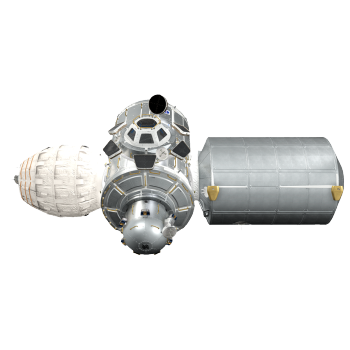
Node 3 Tranquility is a module of the International Space Station (ISS). It was launched by the Space Shuttle Endeavour on February 8, 2010 and docked with the International Space Station on February 12, 2010.
Lunar probe 25

Lunar probe 25

In October 1998, Russian Academy of Sciences academician Galimov proposed the concept of conducting another lunar exploration mission after Luna 24 at the Moscow International Lunar Exploration Conference, which is regarded as the beginning of modern Russia's return to the moon program. However, based on budget constraints, the authorities have listed the Phobos Earth probe and the Spectral Astrophysics Observatory as higher priority tasks, and lunar exploration has been temporarily put on hold. In early 2018, the Space Research Institute of the Russian Academy of Sciences announced that the probe was scheduled to be launched in 2019 and a possible landing site had been selected.
Earth 3D Animation Model

Earth 3D Animation Model

It is the third planet in the solar system, a vibrant and beautiful planet with a unique blue appearance and abundant natural resources. With a diameter of approximately 12742 kilometers, it has the only known environment in the solar system with widespread liquid water. Most of these water resources are concentrated in the oceans on Earth, forming the well-known 'Blue Planet'. The atmosphere is mainly composed of nitrogen and oxygen, suitable for biological respiration. It is the home of humanity. Human civilization has developed a rich and diverse culture, technology, and social structure on Earth. Earth is the only known planet in the universe capable of nurturing and sustaining life.
Apollo 11 Command Module

Apollo 11 Command Module

Apollo 11 was the fifth manned mission in NASA's Project Apollo program and the first human lunar landing mission. On July 20, 1969, Armstrong and Aldrin became the first humans to step on the moon.
Medieval flat star chart

Medieval flat star chart

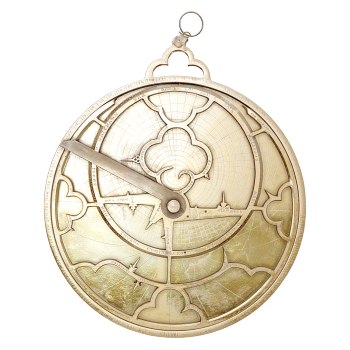
The star chart is an ancient astronomical instrument, which can be said to be a handheld model of the universe. Its various functions also make it a sophisticated inclinometer and an analog computing device capable of solving several problems in astronomy. In its simplest form, it is a metal disk with patterns of wires, cuts, and perforations, allowing users to accurately calculate the position of celestial bodies. Astronomers throughout history have used it to measure the height of celestial bodies on the horizon, both during the day and at night; It can be used to identify stars or planets, determine the local latitude at a given local time, measure or conduct triangulation.
Sun, Shield UY and Stevenson 2-18 (3D model with proportional comparison)
Sun, Shield UY and Stevenson 2-18 (3D model with proportional comparison)

UY Scuti, also known as UY Scuti, is a red supergiant located in the constellation of Scuti. The radius is approximately 1708 ± 192 times that of the Sun. Despite its large volume, its mass is only about 7-10 times that of the Sun,. The brightness of UY in the constellation of Shield is 340000 times that of the Sun, making it one of the most luminous stars. Stevenson 2-18 is a red supergiant located in the direction of the constellation of Shield. It is about 20000 light-years away from Earth and is located in the line of sight of the Stephenson open star cluster. The diameter of this star is about 2158 times that of the Sun, making it one of the largest known stars in terms of volume.
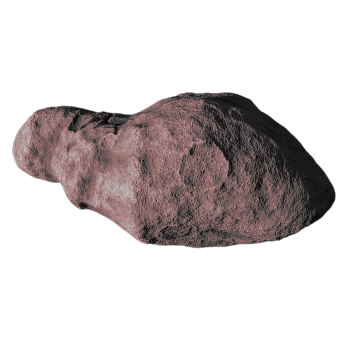
Tutatis asteroid

Tutatis asteroid

Toutatis, asteroid number 4179, is a slender rocky asteroid and slow-moving body classified as a potentially hazardous near Earth asteroid in the Apollo and Alinda groups, with a diameter of approximately 2.5 kilometers. In 1989, French astronomer Christian Pollas discovered this asteroid in Koussors, named after Toutatis in Celtic mythology. Tutotis approached Earth again in 2016, but there is no risk of impact before 2069.
A moving solar system model (3D demonstration animation)

A moving solar system model (3D demonstration animation)

Mars captured by the Insight mission

Mars captured by the Insight mission

The spacesuit worn by Franz Vierb ö ck

The spacesuit worn by Franz Vierb ö ck

Franz Vierb ö ck was Austria's first astronaut who traveled to the MIR space station on October 2, 1991 aboard the Soyuz TM-13 rocket. The Sokol spacesuit he is wearing is a soft pressure suit designed and manufactured by NPP Zvezda. The main purpose of this spacesuit is to maintain the life of astronauts in the event of an unexpected depressurization of the spacecraft.