
United States Constitution Class II Railgun Destroyer DDR-2000

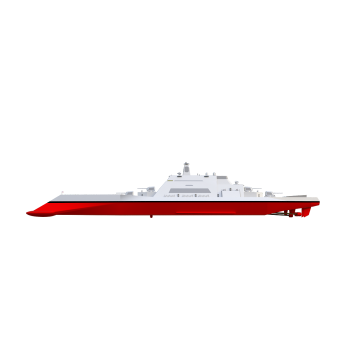
United States Constitution Class II Railgun Destroyer DDR-2000

It is a next-generation main surface ship designed by the U.S. Navy to meet the needs of the future battlefield. From the 2041 Navy RFP, it aims to build the next generation of main surface ships to replace the aging Zumwalt-class and Arleigh Burke-class destroyers, as well as a limited number of Oregon-class warships. The design takes full advantage of the progress made in rail gun, laser and sensor technology in the past 30 years. The ship recommends artillery as the primary weapon system and focuses less on full stealth and more on balanced hull design and firepower. It was the first warship in history to incorporate railguns as a major aspect of its design.
U.S. PumaVFAV Amphibious Armored Vehicle

U.S. PumaVFAV Amphibious Armored Vehicle

It is a fast attack vehicle equipped by the U.S. Marine Corps for offshore and river combat missions. It is an amphibious armored vehicle that can move quickly on water and land to provide maneuverability and fire support to the Marine Corps. Equipped with machine guns and machine guns, it can provide effective fire support against enemy infantry and light armored vehicles. It has excellent mobility and can quickly cross various terrains, including beaches, swamps and jungles. It is a light armored vehicle, but it still has a certain degree of armor protection, can resist the attack of small caliber weapons and shell fragments. Ideal for performing tasks in complex environments
Hummer Military Vehicle

Hummer Military Vehicle

The High Mobility Multipurpose Wheeled Vehicle is a lightweight, four-wheel drive tactical vehicle manufactured by AMGeneralCorporation. Known for its excellent mobility and versatility, it can adapt to a variety of terrain, including crossing trenches, steep slopes and deep waters. Equipped with a four-wheel drive automatic transmission device, it can be carried and airdropped by helicopter or transport aircraft, with extremely high mobility and deployment flexibility. Built on the common M998 chassis, the chassis is a steel frame with the main body made of aluminum, which not only reduces weight but also provides high corrosion resistance. The industry is known as the "king of off-road vehicles".
Russian 2K22Tunguska Self-propelled Air Defense System
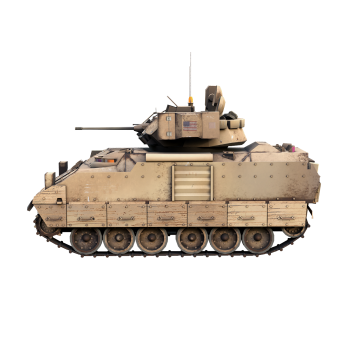
Russian 2K22Tunguska Self-propelled Air Defense System

It is a self-propelled air defense system developed by Russia, and the NATO code name is SA-19 "Grisom". It integrates the capabilities of anti-aircraft guns and surface-to-air missiles, and is designed to provide infantry and tank regiments with all-weather low-altitude defense against low-flying aircraft, helicopters and cruise missiles. It was designed and produced by the KBP Instrument Design Bureau between 1970 and 1980, and was officially put into use in 1982. The main weapons include two 30mm 2A38 double-mounted automatic guns, which are effective against fast-moving targets. Based on a GM-352M tracked chassis, it is operated by four people.
United States M2Bradley Infantry Fighting Vehicle
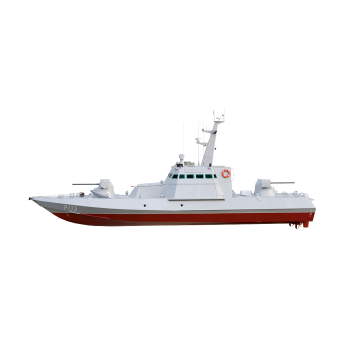
United States M2Bradley Infantry Fighting Vehicle

It is an infantry fighting vehicle equipped by the United States Army and the United States Marine Corps. Since its first deployment in 1981, it has become an important part of the US military's mechanized forces. Manufactured by BAE Systems, it is designed to transport infantry and provide fire support. The armor is composed of aluminum alloy and additional composite armor, which provides a certain degree of protection. It is also equipped with a nuclear, biological and chemical protection system and an automatic fire extinguishing system, which improves the survivability of the battlefield. M2Bradley series combat vehicles play an important role in the modern battlefield with their versatility, firepower and protection capabilities.
Ukrainian Gyurza-M-class gunboat

Ukrainian Gyurza-M-class gunboat

It is a series of small armored gunboats in service with the Ukrainian Navy. Built by KuznyanaRybalskomu Shipyard, the first two began construction in October 2012. The armament consists of 2 x BM-5M.01 "Katran-M" remote-controlled weapon stations, each equipped with a 30mm automatic grenade launcher. It is also equipped with a 30mm ZTM-1 automatic gun, a 7.62mm CT machine gun and a laser-guided man-portable air defense missile system, as well as two "Barrier" anti-tank missiles. Built with bulletproof steel, it provides a degree of protection.
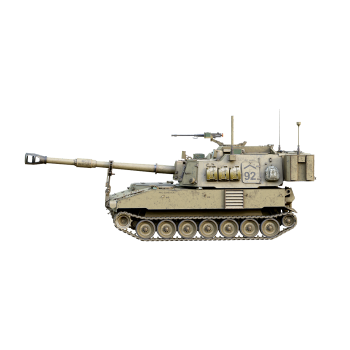
United States M109A6 Paladin self-propelled artillery system

United States M109A6 Paladin self-propelled artillery system

It is a self-propelled artillery system of the United States Army, produced by United Defense Corporation (now BAE Systems Land and Armaments Division). Since its first deployment, the system has been known for its advanced fire control system and navigation capabilities. Equipped with a 39-caliber 155mm M284 howitzer, depending on the ammunition, the range can reach 24 to 30 kilometers. Auxiliary armament consisted of a 12.7mm M2 machine gun on the right side of the turret. The design focuses on occupant safety. The occupants stay in the car at all times during the mission, and enjoy the nuclear, biological and chemical protection system and temperature control air. The turret is lined with Kevlar bulletproof panels to improve its ability to resist light weapons.
German VK1602 "Leopard" reconnaissance tank

German VK1602 "Leopard" reconnaissance tank

It was a light reconnaissance tank designed by Germany in 1942, but ultimately failed to enter mass production. Designed jointly by MIAG and Daimler-Benz, it is intended to replace the earlier No. 2 tank, providing stronger firepower and better armor protection. The design was influenced by the Leopard tank, with a sloping front armor, which helped improve protection. The main armament was a 50mm KwK39/1L/60 gun supplemented by a 7.92mm MG34 or MG42 machine gun. Despite some advanced features in the design, the project was canceled in 1943 for a number of reasons.
Chinese VT-5 main battle tank

Chinese VT-5 main battle tank

It is a light main battle tank developed by China North Industries Group Corporation for the export market. It is known for its lightweight and excellent maneuverability. Capable of crossing trenches and vertical walls. Equipped with 105mm anti-tank guns, 12.7mm machine guns and 35mm grenade launchers and other weapons, combat capability comparable to the main battle tank. Modular armor is used, which can be configured according to threats and mission needs, including explosive reactive armor, ceramic composite armor, grille armor and other armor components. The design emphasizes survivability and firepower on the modern battlefield, making it a high-performance foreign trade light tank.
Brazil Astros II rocket launcher

Brazil Astros II rocket launcher

It is a self-propelled rocket launcher system developed by the Brazilian Aerospace Industry Corporation. It was developed in the 1980 s and equipped with the Brazilian Army in 1983 for artillery surface saturation rocket attack missions. It can be equipped with three launch boxes of different calibers: 32 127mm rocket launch boxes, 16 180mm rocket launch boxes and 4 300mm rocket launch boxes, all using 10 tons (6 × 4) off-road vehicle chassis. The maximum range is 30km, 35km and 60km respectively, and it can attack targets within a depth of 9 to 60km, including artillery positions and cluster targets.
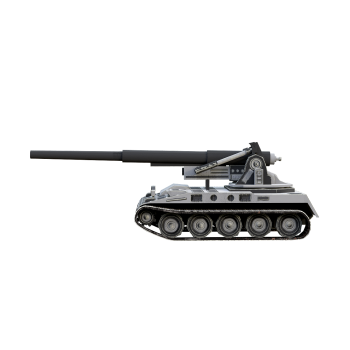
American M107 Self-Propelled Artillery
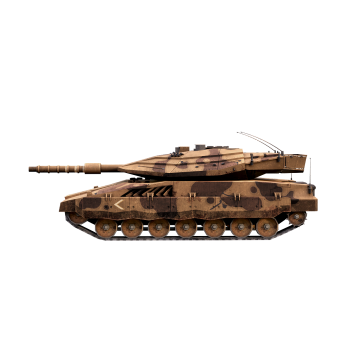
American M107 Self-Propelled Artillery

It is a tracked self-propelled artillery developed by the United States in the 1960 s. It is mainly used for long-range attacks on enemy command, control and communication centers and supply trains. It is equipped with a 175mm M113 cannon, which has a diameter of 61 times and can fire 66.6kg shells with a maximum range of 32.8 kilometers. Its open body design reduces weight, but also sacrifices protection. It has excellent mobility and can quickly change positions after firing to avoid enemy counterattacks. It played an important role in the Vietnam War, using its long-range advantage to destroy key targets behind enemy lines.
Israeli MerkavaMk4 main battle tank

Israeli MerkavaMk4 main battle tank

It is the fourth generation main battle tank of the Israel Defense Forces and entered service in 2004. Known for its superior protection, firepower, mobility and combat control. Modular armor is used, providing additional clearance armor for anti-tank missiles, and allowing quick replacement of damaged armor, easy to upgrade. It is also the first main battle tank to remove the loading hatch to enhance the protection at the top of the turret. Equipped with advanced nuclear, biological and chemical protection systems and air conditioning, as well as automatic fire detection/suppression systems. The design concept emphasizes survivability and firepower in modern warfare, making it one of the most protected main battle tanks in the world.
Israeli MerkavaMkIV main battle tank

Israeli MerkavaMkIV main battle tank

It is the fourth generation of the Israeli Merkava main battle tank series and entered service with the Israel Defense Forces in 2004. In terms of firepower, protection and mobility, it has significantly improved compared to the previous generation MkIII, while retaining the unique design of the Merkava series. It is equipped with a 120mm smoothbore gun capable of firing a variety of munitions, including tail-stabilized shell-piercing shells, high-explosive anti-tank shells and gun-launched missiles. Modular armor is used, and armor modules can be quickly replaced or upgraded according to threats. It is also equipped with advanced nuclear, biological and chemical protection systems and air conditioning, as well as automatic fire detection/suppression systems.
Israeli Magach6 Tanks

Israeli Magach6 Tanks

It is Israel's name for the American M60 tank series, of which more advanced variants such as the M60A1 are called Magach6A. It was in response to a new type of threat created by the Soviet Union. After arriving in Israel in 1971, it was deployed to the force and was loved by its crew for its extra firepower and maneuverability. Its inadequate protection against chemical weapons such as ATGMs and RPGs was evident during the Yom Kippur War and suffered significant losses. Equipped with a 105mm M68 gun, it is capable of firing APDS and HEAT-FS ammunition, relying specifically on its firepower rather than maneuverability or armor.
Israeli Magach7C main battle tank

Israeli Magach7C main battle tank

It is Israel's main battle tank based on the improvement of the US M60Patton tank. First in service in the mid-1980s, it is known for its reinforced armour and modern fire control systems. The turret and the front of the car body are equipped with composite armor plates, which provide better protection than early explosive reactive armor, especially against chemical and kinetic energy attacks. It is equipped with a 105mm rifling gun capable of firing a variety of ammunition, such as the M426 armor-piercing projectile and the M156 high-explosive armor-piercing projectile. The design and upgrade reflect Israel's innovative capabilities in modernizing the tank, making it an important main battle tank in the Israel Defense Forces.
Howitzer Tank 3D Scan

Howitzer Tank 3D Scan

Also known as self-propelled howitzer, is a howitzer mounted on the chassis of a tank with armored protection and self-propelled artillery system. Equipped with large-caliber howitzers, it can launch a variety of ammunition such as high-explosive bombs, armor-torn bombs, and incendiary bombs to adapt to different combat environments. It combines the mobility of tanks and the firepower of artillery, capable of rapid deployment and transfer on the battlefield. With a certain degree of armor protection, able to survive and fight in complex environments. It can not only provide fire support in war, but also play a role in non-war military operations. With its powerful firepower, good mobility and protection ability, it plays an important role in the modern battlefield.
Japanese Type90Kai main battle tank

Japanese Type90Kai main battle tank

It is an improved model of the Type 90 main battle tank equipped by the Japanese Ground Self-Defense Force. The Type 90 tank is the third-generation main battle tank that Japan began to equip in 1990, and Type90Kai has carried out a series of modernization upgrades on this basis. The armor uses composite armor technology to improve the protection of modern anti-tank weapons, especially the protection of the tail stable shell-piercing projectile. It is equipped with a 120mm smoothbore gun capable of firing a variety of munitions, including tail-stabilized shell-piercing shells. While maintaining the excellent performance of the original 90 tank, it also adapts to the needs of the modern battlefield.
French AMX-13 Light Tank

French AMX-13 Light Tank

It is the first generation of light tanks developed by France after World War II. It was designed in 1946 and officially put into production in 1952. It is named for its weight of 13 tons, has a sturdy and reliable chassis, and is equipped with a rotary magazine-type swing turret produced by GIAT Industrial Group (now NexterSystems). The design positioning is used for reconnaissance and has certain anti-tank capabilities. Its chassis is small and compact, suspended by torsion bars, and each side has five load wheels and two supporting wheels. The biggest feature is its swing turret design, the gun is fixed on the upper part, and the lower part is installed on the turret seat ring.
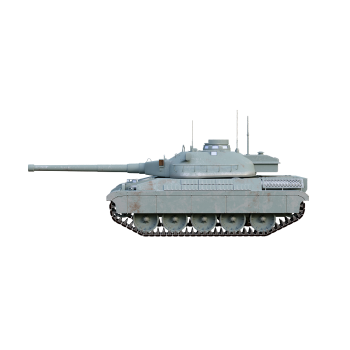
French AMX-40 main battle tank

French AMX-40 main battle tank

It is a third-generation main battle tank prototype developed by France in the early 1980 s and intended for export markets as a successor model for AMX-30B and AMX-32. Built by GiatIndustries, four prototypes were built, from 1983 to 1985. Significant improvements in firepower, protection and mobility over its predecessors failed to attract any orders and the project was eventually canceled in 1990. It was equipped with a 120mm bore smoothbore gun, which was very powerful at the time, with welded steel armor and hardened steel composite armor plates in the front arc.
French AMX10RCR Tank Destroyer

French AMX10RCR Tank Destroyer

It is an upgraded version of the French AMX-10 series of wheeled tank destroyers, mainly used for reconnaissance and anti-tank missions. This 6x 6 wheeled armored vehicle began to equip the French Army in the late 1970 s and is known for its high mobility and firepower. The main weapon is a 105mm rifled gun capable of firing a wide range of ammunition, including tail stabilized shell-piercing shells, armor-piercing shells and grenades. The advanced fire control system, including laser rangefinders and a variety of ballistic correction sensors, enables the vehicle to aim at the first target in only 10 seconds after starting the aiming and shooting system. It has excellent mobility and firepower.
Japanese Type10 main battle tank

Japanese Type10 main battle tank

It is the fourth-generation main battle tank equipped by the Japanese Ground Self-Defense Force and manufactured by Mitsubishi Heavy Industries. Development began in the 1990 s and production began in 2010 to replace or supplement the Type 74 and Type 90 main battle tanks in active service. It is equipped with a 120mm smoothbore gun, produced by Nippon Steel, capable of firing new armor-piercing shells and all standard NATO 120mm ammunition. The armor consists of modular sections that can provide varying degrees of protection depending on the mission configuration and weight requirements. A liquid-gas suspension system is also used, which can adjust the attitude of the tank according to the terrain, absorb the recoil force during shooting, and can install a bulldozer.
French AMX-30 main battle tank

French AMX-30 main battle tank

It is the second-generation main battle tank developed by France in the 1960 s and was developed by the Isi Lemurino Manufacturing Plant. In 1967 officially listed as the French army standard equipment, began to gradually replace the M47 tank. Equipped with a 105mm rifling gun, it has long-range firepower and good maneuverability, but the armor protection is relatively weak. The fire control system includes an artillery telescopic sight, a laser rangefinder, a computer and various sensors, and a low-light television system is used for night operations. It has good maneuverability and working ability in high temperature environment. The design idea is to strike a balance between firepower and mobility at the expense of some armor protection.
French AMX-30Roland Missile Launcher

French AMX-30Roland Missile Launcher

It was a self-propelled surface-to-air missile launcher developed by France based on a AMX-30 tank chassis, specifically designed to operate the Roland missile, which was jointly developed with West Germany. It was officially adopted in 1977 and a total of 183 vehicles were produced. It is intended to provide the troops with additional anti-aircraft protection, covering areas well beyond anti-aircraft guns. The main structure was completely revamped to integrate missile launchers. The mobility of the AMX-30 is retained, making the vehicle have good all-terrain mobility and agility. The design and equipment demonstrate France's deep understanding of innovation and combat needs in air defense weapon systems, making it an important air defense platform during the Cold War.
Soviet T-80UD main battle tank

Soviet T-80UD main battle tank

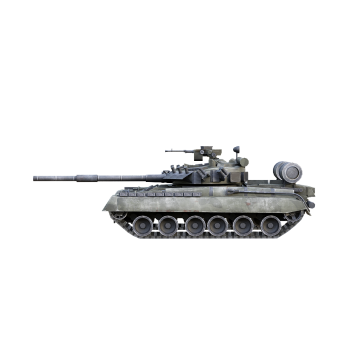
It is a tank designed by Ukraine's Kharkov Morozov Mechanical Design Bureau in the early 1980 s during the Soviet era and mass produced by the Marishev factory in 1985. It is famous for its advanced fire control system, which can achieve high-precision strikes on fixed and moving targets by gunners or vehicle commanders in a stationary or moving state. Multi-layer armor and explosive reactive armor packages are used to provide it with a high level of battlefield survivability. You can also disguise yourself by releasing smoke or aerosol screens, with four electric smoke grenade launchers on each side of the turret. The design and performance made it an important main battle tank in the Soviet army during the Cold War.
Israeli M51IsraelSuperSherman main battle tank

Israeli M51IsraelSuperSherman main battle tank

It is a main battle tank modified and upgraded by Israel in the 1960 s based on American M4Sherman tanks. It is mainly used to deal with the tank threat in the Middle East war, especially against the Soviet IS-3 heavy tank and the British Centurion tank. It was equipped with a powerful French 105mm D1508 L/51 gun. Capable of firing high-explosive anti-tank shells with a penetration of up to 400mm armor. A new turret, designed by the French arsenal of Bourges, with a larger gun shield and a unique muzzle retractor was also used. Designed and used to showcase Israel's modernization of military equipment.
United States HummerArmy Multipurpose Wheeled Vehicle

United States HummerArmy Multipurpose Wheeled Vehicle

That is, the military Humvee, is a high-mobility multi-purpose wheeled vehicle produced by the US AMGeneral Company for the US military. Known for its excellent mobility, off-road performance, reliability and durability, it is widely used in various military operations. It can adapt to a variety of terrains, has high ground clearance and a powerful four-wheel drive system, and can carry a variety of military equipment, such as machine guns, grenade launchers and anti-tank missiles. Has excellent load and transport capacity. The design takes into account the car family, with more than 30 types of variant vehicles, including personnel/material delivery vehicles, light combat vehicles, anti-tank missile launch vehicles, etc.
British GKNSankeySimba armored personnel carrier
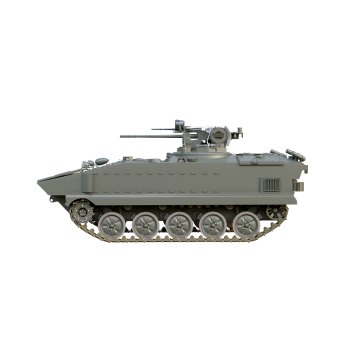
British GKNSankeySimba armored personnel carrier

It is an armored personnel carrier designed by British company GKN, mainly serving the Philippine army. It entered service in the 1990 s and is still in use today. Designed for export market sales, it was originally intended to complement GKNSaxon armored vehicles. It is considered an upgraded version of Saxon for its larger size and improved performance. The 4x 4 chassis and large-size wheels, combined with a good power-to-weight ratio, make it have good performance in both road and off-road conditions. The Philippines is the only user of Simba, and the United Kingdom does not use this type of armored vehicle. A total of 150 Simba were procured.
French AMX-10P Infantry Fighting Vehicle

French AMX-10P Infantry Fighting Vehicle

It was developed by the French AMX manufacturer in 1965 according to the requirements of the French army to replace the old AMXVCI infantry fighting vehicle. The first prototype was made in 1968, production began in 1972, and the first batch of vehicles were delivered to the French army in 1973. The car body is welded with aluminum alloy, the engine is front, and the cockpit is located on the left side of the front of the car body. With full amphibious capability, it is propelled by water jets on both sides of the rear of the vehicle in the water. Before entering the water, the front anti-wave plate of the vehicle is erected and the bilge drainage pump is turned on. AMX-10P infantry fighting vehicles have been used in several conflicts.
Soviet 2K12 "Kub" surface-to-air missile

Soviet 2K12 "Kub" surface-to-air missile

It is a mobile medium-and low-altitude, medium-range field surface-to-air missile system developed in the Soviet Union. Designed by the OKB-15GKAT to protect ground forces, especially armored forces, from low-and mid-flying aerial attacks. It is installed on the crawler chassis and has good maneuverability. It officially entered service in 1967 and was widely deployed in the 1970 s. He has proved his effectiveness in many conflicts. The design makes it a low-to-hollow interceptor, and its tracking characteristics ensure that it can be deployed anywhere to defend critical installations.
Israeli Merkava Main Battle Tank

Israeli Merkava Main Battle Tank

It is the main fighting vehicle of the Israel Defense Forces armored force and is known for its unique design and excellent protection capabilities. The design began in 1970, and the first model of the Merkava Mark1 was officially put into service in 1979. The design focuses on occupant protection. The front-engine design not only increases frontal protection, but also provides additional protection for occupants to a certain extent. The main weapon is a 105mm or 120mm calibre smoothbore gun, capable of firing a variety of munitions including LAHAT anti-tank missiles. It is a symbol of Israel's military power and a manifestation of the technological progress of its armored fighting vehicles.
American LAV-25 Infantry Fighter

American LAV-25 Infantry Fighter

It is a type of wheeled infantry fighting vehicle developed and equipped by the United States in the early 1980 s. It is a Piranha wheeled armored vehicle produced by the diesel engine division of General Motors of Canada under the license of Movag of Switzerland. It belongs to the category of light wheeled armored vehicles, with a total combat weight of only 13.4 tons. It can be airdropped by C- 130 transport aircraft and has the capability of amphibious operations. The main weapon is a 25mm "Viper" chain cannon, equipped with advanced two-way stabilization devices, so that the cannon can maintain a continuous fire output during the movement of the armored vehicle. Designed with a focus on rapid deployment and mobility.
Japanese Type 90 main battle tank

Japanese Type 90 main battle tank

It is the third-generation main battle tank equipped by the Japanese Ground Self-Defense Force. It was designed and manufactured by Mitsubishi Heavy Industries to replace Type 61 and some Type 74 tanks. It entered service in 1990 and is known for its superior firepower, mobility and protection. Equipped with a 120mm smoothbore gun of German Rheinmetall licensed by Japan, equipped with an automatic loader, a laser rangefinder integrated in the gun's long sight, and a thermal imager, with the ability to shoot between marches and at night. The main parts adopt composite armor or interval armor, with three-proof device, automatic fire extinguishing device and laser detection and alarm device, which enhances the survivability of the tank.
missile boat

missile boat

It is a small, fast, and usually missile-equipped military ship designed for rapid strike and defense missions in offshore or coastal waters. Known for its high speed, agility and concealment, it is able to maneuver quickly between complex coastlines and islands, posing a threat to enemy ships. The main weapon is the cruise ship-to-ship missile. It plays an important role in modern navies, especially in local conflicts and coastal defense. Able to use speed and concealment to conduct surprise attacks on enemy ships. The design usually focuses on stealth performance to reduce the radar cross-sectional area and improve survivability.
US AH-64D "Longbow Apache" gunship

US AH-64D "Longbow Apache" gunship

It is the main armed helicopter of the United States Army and is manufactured by Boeing (formerly Hughes Helicopter Company). It is an improved version based on the AH-64A model, with significantly improved performance and capabilities. Known for its all-weather combat capability and powerful firepower, it is one of the world's deadliest, most survivable, most deployed and best-maintained multi-mission helicopters. Equipped with advanced sensors, power and weapons systems, it can detect, classify, prioritize and strike enemy targets at long distances in adverse weather conditions. With its superior performance and firepower, it has become an indispensable part of the military of the United States and its allied countries.
Soviet S-75 missile launchers

Soviet S-75 missile launchers

NATO codenamed SA-2 "Sam -2", is a Soviet-era development of a surface-to-air missile system. It is composed of missile launchers, radar units and command vehicles, and is mainly used to deal with aerial targets such as bombers, fighter jets and reconnaissance aircraft. With a maximum range of about 45 miles and up to 100000 feet, the missile is equipped with a high-explosive warhead that causes significant damage to its target. It is known for its excellent range and altitude performance. It was widely deployed during the Cold War and used in multiple conflicts, including the famous downing of a U-2 spy plane. Despite more advanced missiles, S-75 are still considered valuable in modern conflicts.