Children's outdoor slide combination

Children's outdoor slide combination

This is a children's outdoor slide combination with slide and tunnel function. It combines a traditional slab slide (slide) and three cylindrical crawling tunnels (drill holes) with a staircase at the top for climbing. The entire facility is made of metal with green paint on the surface, but it has been severely worn, rusted, graffiti and stains, showing a discarded and obsolete state. This combination design is designed to provide a diversified amusement experience, integrating climbing, sliding, drilling and other actions, which helps to exercise children's balance and coordination.
Outdoor Wooden Swing

Outdoor Wooden Swing

This wooden swing has a sturdy A- shaped support frame that allows the swing to stand independently on the lawn, courtyard or terrace. The entire structure is made of weathered rough wood poles, and the surface retains the natural texture and knots, showing a rustic, rustic style.
a pile of old red bricks

a pile of old red bricks

This is a pile of old red bricks (also known as recycled bricks or weathered bricks). Brick is an ancient building material, usually fired from raw materials such as clay, shale or coal gangue. The surface of these bricks has scuffs, stains, moss and weathering marks, and the color ranges from orange red to dark gray. They look like they were removed from old buildings, ready for recycling or for landscaping projects (such as paving edges or trails).
Simple Shed

Simple Shed

It is a simple temporary shelter, often used for wilderness survival or camping. It usually consists of a long, strong pole as the roof pole, leaning obliquely between two trees or strong supports. The frame is made of sticks or branches, and the covering can be tarpaulin, canvas, or natural materials such as leaves and branches. It can provide the functions of shading, rain shelter and wind protection. A fire on the open side can reflect heat and help keep you warm.
An original style tent

An original style tent

It is an improvised A- line shelter, using thick branches or logs as a support frame. The top of the branches are crossed and tied together to form an entrance. The frame was covered with a rough, off-white fabric, secured by ropes to wooden posts. The overall style design imitates the humble shelters built from local materials in ancient, tribal or field living environments.
Old-fashioned roof utility room

Old-fashioned roof utility room

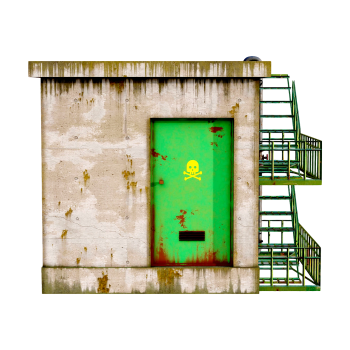
Tires
Tires

It is suitable for game scene construction (such as abandoned factory, outdoor ruins, auto repair factory environment), film and television special effects background, 3D rendering practice, etc., as environmental details props to enhance the reality of the scene, and the "free" attribute makes it easy to obtain and use.
Arena

Arena

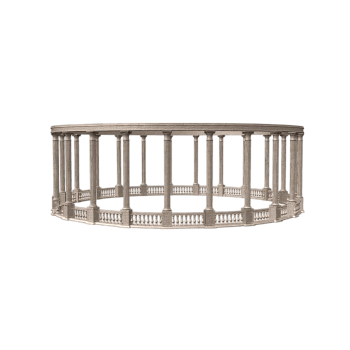
It presents an oval or semicircular open field structure. The core is the competition area (flat sand or stone ground, used for gladiators, sports competitions or public gatherings), and the periphery is surrounded by multi-layer stands (step-by-step ascent, divided by levels The seating area), the outside of the stand is surrounded by a continuous doric colonnade (forming an annular enclosed space), and the entrance has a magnificent column arch or gatehouse, which is distributed symmetrically along the central axis.
Pyramid

Pyramid

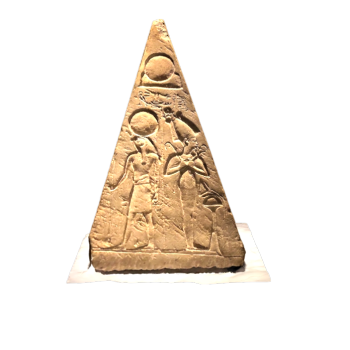
If limestone shell exists, the surface is smooth and flat, and the edges are slightly weathered and peeled (exposing internal stones); the bottom of the negative lines of relief and inscription is flat and slightly rounded due to weathering; the interior of the tunnel and tomb is dark due to light avoidance, which may have dark traces of water seepage or erosion; the ground may be covered with gravel (simulating desert environment), which contrasts with the hard texture of the stone.
Dachet Drinking Water Fountain

Dachet Drinking Water Fountain

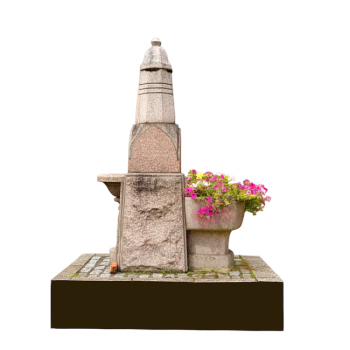
The stone base and column show rough grain texture, with natural weathering marks on the surface (such as moss adhesion, water marks washed by rain), and the color is light gray, beige and other stone primary colors, with different shades of color spots and cracks, restoring the natural aging state of long-term exposure to the outdoors.
Chinese Tianma

Chinese Tianma

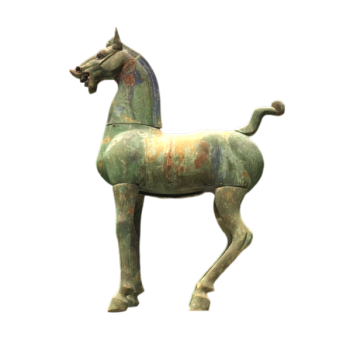
The body is strong and slender, with both the agedness of a horse and the extraordinary sense of the gods. The head is high, the mane is elegant and flying, the tail is stretched or curled, the muscles of the limbs are smooth and powerful, and the posture may be galloping, stepping on the clouds or looking back quietly, showing the dynamic tension of "unrestrained style. Some designs may incorporate wing elements (such as light wings on the shoulders or legs), or hoof steps on auspicious clouds to reinforce mythical attributes.
Abandoned Ferris Wheel

Abandoned Ferris Wheel

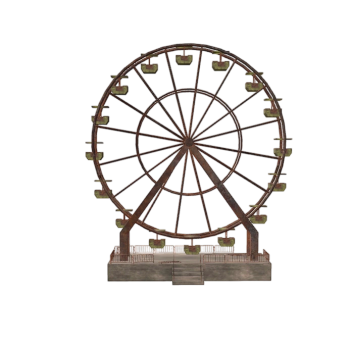
Strictly retain the core mechanical structure of the ferris wheel: towering bracket (A-shaped or annular support), circular wheel disc, evenly distributed cockpit bracket and cockpit, and residual traces of driving gear and chain can be seen on the edge of the wheel disc. However, the whole presents the feature of "abandonment"-the bracket may tilt or partially break due to corrosion, and the surface of the wheel disc is covered with rust and depressions, part of the cabin falls off or is skewed (the hanging cabin glass is broken, the shell is corroded and perforated), and there are obvious weathering cracks at the joints of the metal structure, restoring the decaying state of long-term unmanned maintenance. The proportion of the structure conforms to the sense of scale of the real Ferris wheel
Indian marble temple column

Indian marble temple column

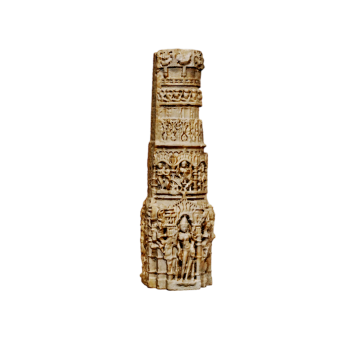
The overall atmosphere is solemn and sacred. Through the purity of the material (white or light gray background color of marble) and the sacred symbols of carving, the solemnity and awe of the religious space are conveyed. It may be matched with light and shadow effects (such as sunlight shining on the column body through the temple skylight, forming mottled light and shadow) to highlight the layering of the carving, making the model not only the restoration of architectural components, but also bearing the spiritual connotation of Indian religious art.
Chinese Wooden Pagoda

Chinese Wooden Pagoda

Wuhan shadowless tower

Wuhan shadowless tower

The shadowless tower, also known as Xingfu temple tower, is located in Hongshan Park, 509 Wuluo Road, Wuchang District, Wuhan City, Hubei Province. It was built in the sixth year of Xianchun in the Southern Song Dynasty (1270) and moved to Hongshan Park in 1962.
Ayoka Temple Pagoda

Ayoka Temple Pagoda

A (ā) Yuwang Temple (Ayuwang [Ashoka] Temple) is located under the peak of Taibai Mountain at the foot of Baozong, Wuxiang Town, Yinzhou District, Ningbo City, Zhejiang Province. It was founded in the third year of Taikang, Emperor Wu of the Western Jin Dynasty (AD 282) and has a history of more than 1700 years. In the second year of Yuan Jia (425) and the twelfth year of Yuan Jia (435) of the Southern Dynasty, the temple was built twice, thus laying the foundation for the scale of the temple. Liang ordinary three years (522 years) to Ashoka temple, temple name established.
Ashoka Temple Stone Pagoda

Ashoka Temple Stone Pagoda

A (ā) Yuwang Temple (Ayuwang [Ashoka] Temple) is located under the peak of Taibai Mountain at the foot of Baozong, Wuxiang Town, Yinzhou District, Ningbo City, Zhejiang Province. It was founded in the third year of Taikang, Emperor Wu of the Western Jin Dynasty (AD 282) and has a history of more than 1700 years. In the second year of Yuan Jia (425) and the twelfth year of Yuan Jia (435) of the Southern Dynasty, the temple was built twice, thus laying the foundation for the scale of the temple. Liang ordinary three years (522 years) to Ashoka temple, temple name established.
Hanging Temple of Datong City

Hanging Temple of Datong City

Hanging Temple (Xuankong Temple ), originally called "Xuankong Pavilion", is located on the west side of Cuiping Peak, 4 kilometers southeast of Hunyuan County, Datong City, Shanxi Province. It is a Confucian, Buddhist and Taoist temple complex. The hanging temple is about 60 meters high from the ground, with a cultural relic building area of 472 square meters, a platform area of 726 square meters in front of the temple, covering an area of about 921 square meters, and a total area of about 8.83 hectares.
Chinese style stone pavilions

Chinese style stone pavilions

Chinese mahogany pavilion

Chinese mahogany pavilion

The Ming Great Wall of the 14th Century

The Ming Great Wall of the 14th Century

The Great Wall is a general term for the massive military projects built in ancient China at different times to resist the invasion of the northern nomadic tribal alliance. The Great Wall stretches for tens of thousands of miles from east to west, so it is also called the Great Wall. The existing Great Wall relics are mainly the Ming Great Wall, which was built in the 14th century, starting from Jiayuguan in the west and reaching Hushan in Liaodong in the east, with a total length of 8851.8 kilometers, an average height of 6 to 7 meters and a width of 4 to 5 meters.
Zhaoqing Guanyin Hall Aunt House

Zhaoqing Guanyin Hall Aunt House

The aunt's house was a unique folk term in Guangdong during the Ming and Qing dynasties, which specifically referred to the place where the group of self-combing women who did not marry for life lived together. Members form an alliance through the ceremony of "combing up" and swear not to marry, forming a female life community independent of traditional marriage.
Zhaoqing forever hall aunt's house

Zhaoqing forever hall aunt's house

The aunt's house was a unique folk term in Guangdong during the Ming and Qing dynasties, which specifically referred to the place where the group of self-combing women who did not marry for life lived together. Members form an alliance through the ceremony of "combing up" and swear not to marry, forming a female life community independent of traditional marriage.
Xu Village Ancient Building Group

Xu Village Ancient Building Group

Xu Village ancient buildings are located 20 kilometers northwest of Shexian County, Anhui Province, where Xu Village is located-Xu Village. At the end of the Tang Dynasty, the Xu family moved to a large family and then changed its name to Xu Village. During the Ming and Qing Dynasties, Huizhou merchants flourished. Since then, village construction has developed rapidly. In Gaoyang Village, Dongsheng Village and Huanquan Village, Xu Village, Xu Village, Xu Village, Shexian County, there are a large number of more than 100 ancient buildings from the Ming, Qing and Republic of China periods. Xu Village is "two dragons play with pearls" and "pour water gourd" in the form of feng shui. Fang and Xi Erxi meet under the Gaoyang Bridge and flow into the Lianjiang River. The village in the Ming Dynasty has a large number of buildings and complete categories, preserving more architectural practices of the Song and Yuan dynasties.
Tomb of Xu Guangqi

Tomb of Xu Guangqi

Xu Guangqi Tomb, located in Guangqi Park, No. 17 Nandan Road, Xuhui District, Shanghai, covers an area of about 10000 square meters. It was built in the 14th year of Chongzhen in Ming Dynasty (1641). Xu Guangqi's tomb faces south and covers an area of about 10000 square meters. There are 10 tombs in total. Xu Guangqi, his wife Wu and four pairs of grandchildren are buried separately. The main buildings include Huabiao, Stone Bridge, Stone Archway, Shinto, Shi Yang, Shi Hu, Shi Ma, Shi Wengzhong, Cross, Zhao Chi and Tuoshan at the back of the tomb.
Guangzhou Xihua Lane Old Building

Guangzhou Xihua Lane Old Building

Wumafang, Wenzhou City

Wumafang, Wenzhou City

Wumafang, now known as Wuma Street, is a landmark shopping pedestrian street in Wenzhou City. It was first named in the Eastern Jin Dynasty. It was named after the allusion that Wang Xizhi was too punctual for Yongjia and "the five horses in the court. The block is located in the core area of Lucheng District, Wenzhou City. The total length of the main street is 424 meters. The building combines the amorous feelings of the Republic of China and the combination of Chinese and Western styles. Since the Qing Dynasty, shops such as Wuweihe (1882) and Jin Sanyi (1859) have gathered for 100 years, with more than 180 merchants. In 2021, it was selected as the first batch of "high quality Pedestrian Street in Zhejiang Province", with an annual passenger flow of 20.8 million.
Xingsheng Temple Tower

Xingsheng Temple Tower

Xingsheng Temple Pagoda is located in Fangta Garden, No. 235 Zhongshan East Road, Zhongshan Street, Songjiang District, Shanghai. It is also commonly known as "Fangta" because of its square body. The tower was built during the years of Xining and Yuanyou in the Northern Song Dynasty (1068-1094), with a total of 9 floors and a height of 42.65 meters. The Xingsheng Temple Pagoda is a brick-and-wood pagoda with a brick body and a square plane. The underground palace under the tower unearthed a large number of artifacts including relics and ancient coins. On November 20, 1996, Xingsheng Temple Pagoda was announced by the the People's Republic of China State Council as the fourth batch of national key cultural relics protection units.
Tangjiasan Temple, Tangjiawan Town

Tangjiasan Temple, Tangjiawan Town

Tangjia San Temple is located in the northwest of Datong Road, Tangjia Village, Tangjiawan Town. It is composed of Shengtang Temple, Wenwu Emperor Hall and Jinhua Temple, so it is called "Tangjia San Temple". It is the largest and oldest temple building in Zhuhai. It has profound historical and cultural connotations and high architectural artistic value. It is a precious material for the study of Zhuhai's local history and folk history. It is also a symbol of the feelings and thoughts of the villagers at home and abroad in Tangjiawan area. In May 2010, it was selected as the sixth batch of cultural relics protection list in Guangdong Province.
Shouchang Bridge, Deqing County

Shouchang Bridge, Deqing County

Shouchang Bridge, located in Erdu Village, Xiazhuhu Street, Deqing County, Huzhou City, Zhejiang Province, is a traffic bridge from Wukang to Hangzhou Ancient Post Road across Shangzhu River. It was built in the Southern Song Dynasty. Shouchang Bridge runs from north to south and is a single-hole solid abdominal arc stone arch bridge. The current bridge is about 50 meters long (the original bridge is 32.85 meters long), 9.45 meters high, 17.4 meters clear span, 7.16 meters tall, 4.25 meters wide foundation and 2.74 meters wide top of the bridge. It is divided layer by layer from bottom to top. It is the largest and most well-preserved single-hole stone arch bridge of the Song Dynasty found in Zhejiang and even the Yangtze River Delta.
Nanshan Temple Tower, Linhai City

Nanshan Temple Tower, Linhai City

Located in Linhai City, Zhejiang Province, Nanshan Temple Tower is a building of the Ming and Qing Dynasties. In October 2019, the list of the eighth batch of national key cultural relics protection units of the Nanshan Temple Tower was incorporated into the seventh batch of national key cultural relics protection units, the Thousand Buddha Pagoda, and was renamed the Towers Group.
Shanghai Zhenru Temple Hall

Shanghai Zhenru Temple Hall

Zhenru Temple, commonly known as Great Temple and Great Temple, is located at 399 Lanxi Road, Zhenru Town Street, Putuo District, Shanghai. During the Jiading years of the Southern Song Dynasty, after the reconstruction of the officialdom, the monk Yongan was named Zhenru Yuan. In the seventh year of Yuan Yanyou, the monk's wonderful heart moved from the former site of Baoshan Dachang to the current site. The area is 158 square meters. The main hall of Zhenru Temple is basically square in plan, with 3 rooms wide from east to west, 13.4 meters wide, 6.1 meters wide from Ming to Ming, and 3 rooms deep from north to south, totaling 13 meters. Ten of the 16 pillars in the temple are cypress pillars of the Yuan Dynasty, and six of the stone pillars are old objects of the Yuan Dynasty. ZhenRu Temple is a well-preserved ancient wooden structure of the Yuan Dynasty with a history of more than 700 years.
Guifang Bridge, Hangzhou

Guifang Bridge, Hangzhou

Guifang Bridge (Guifang Bridge), commonly known as "Dongmao Bridge", also known as "Dongmao Bridge", is a river crossing channel in Linping District, Hangzhou City, Zhejiang Province, China. It crosses the Shangtang River waterway, a tributary of the Beijing-Hangzhou Grand Canal, from north to south. The earliest construction of Guifang Bridge is unknown. According to records, it can be traced back to the Southern Song Dynasty. After several repairs and reconstruction in the Yuan, Ming and Qing dynasties, the bridge was rebuilt in the 28th year of Qing Daoguang (1848). In 1983, Guifang Bridge was announced as a cultural relic protection unit in Yuhang County by the People's Government of Yuhang County; on April 20, 2009, Guifang Bridge was announced as a municipal cultural relic protection unit in Hangzhou by the People's Government.
Grand View Pavilion, Xu Village, Shexian County

Grand View Pavilion, Xu Village, Shexian County

Daguan Pavilion is located on the north side of Gaoyang Langqiao, Xu Village, Shexian County, Anhui Province. It was built in the 30th year of Jiajing of the Ming Dynasty (1557) and is a three-story brick-wood structure pavilion-style building. The ground floor of the building is octagonal, covering an area of 64.6 square meters. It is built across the street to form a north-south passage, which has both traffic and rest functions. The existing main structure integrates Ming and Qing construction techniques, and the project of reducing dryness and improving fire fighting capacity will be implemented in 2022, which will remain intact after heavy rain in 2024. It is now a provincial-level key cultural relic protection unit in Anhui Province, and has been included in the national key cultural relic protection unit system as the core component of the Xucun ancient building complex.
Grand View Pavilion and Shuangshou City Square

Grand View Pavilion and Shuangshou City Square

Daguan Pavilion is located on the north side of Gaoyang Langqiao, Xu Village, Shexian County, Anhui Province. It was built in the 30th year of Jiajing of the Ming Dynasty (1557) and is a three-story brick-wood structure pavilion-style building. The ground floor of the building is octagonal, covering an area of 64.6 square meters. It is built across the street to form a north-south passage, which has both traffic and rest functions. The existing main structure integrates Ming and Qing construction techniques, and the project of reducing dryness and improving fire fighting capacity will be implemented in 2022, which will remain intact after heavy rain in 2024. It is now a provincial-level key cultural relic protection unit in Anhui Province, and has been included in the national key cultural relic protection unit system as the core component of the Xucun ancient building complex.