Nineteenth-century 10-inch theodolite

Nineteenth-century 10-inch theodolite

Periodic Table of Elements-Covalent Radius

Periodic Table of Elements-Covalent Radius

Periodic Table-Atomic Radius Reduction

Periodic Table-Atomic Radius Reduction

Crystal structure of diamond

Crystal structure of diamond

Diamond (Diamond) is an atomic crystal with a cubic crystal system composed of carbon (C) elements, and its structure is one of the hardest natural materials in nature. Crystal system cubic crystal system (equiaxed crystal system) space group Fd3m (face centered cubic structure) unit cell parameter a ≈ 3.57 Å (unit cell edge length) The number of atoms in each unit cell is 8 carbon atoms, and each carbon atom is connected to another 4 carbon atoms through covalent bonds to form a tetrahedral configuration. All carbon atoms are located in the apex and face-centered positions of the cubic unit cell, as well as the four inner positions (alternating distribution).
Early twentieth century measuring instruments antique theodolite

Early twentieth century measuring instruments antique theodolite

Triangulation theodolite made in 1902

Triangulation theodolite made in 1902

The triangulation theodolite is a precision measuring tool used to measure horizontal and vertical angles, especially in the field of geographic mapping and engineering. The triangulation theodolite of 1902 is the representative of the advanced surveying and mapping technology at that time, with higher accuracy and stability.
Eighteenth-century measuring instrument theodolite

Eighteenth-century measuring instrument theodolite

A theodolite is a precision instrument used to measure horizontal and vertical angles. It was made in 1752 and is commonly used in geographic mapping and engineering. Theodolite belongs to the early measuring instrument, which is very precise in design and technology, which laid the foundation for the later measuring instrument. In the 1752 theodolite, craftsmen used precision machining techniques to ensure the accuracy of the measurement. These early theodolites played an important role in geographic mapping, engineering construction and astronomical research, helping people to accurately determine position and angle.
Winslet Machine Experiment

Winslet Machine Experiment

The Winslet machine is an electrostatic generator invented by James Winslet in the late 19th century. It generates high voltage through two relatively rotating insulating disks and a series of metal brushes and electrodes. In experiments, the Winslet machine can demonstrate electrostatic phenomena such as electric sparks and corona discharges, which are commonly used in teaching and demonstrating the principles of electrostatics.
Principle of Transformer (3D Experimental Animation)
Principle of Transformer (3D Experimental Animation)

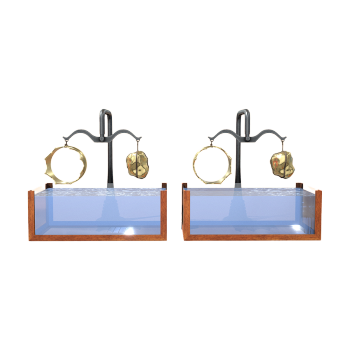
Archimedes' Law - True and False Golden Crowns (3D Demo Animation)

Archimedes' Law - True and False Golden Crowns (3D Demo Animation)

According to legend, King Hera II of Syria suspected that the gold crown he ordered might have been mixed with other cheap metals, so he asked Archimedes to verify its composition without damaging the crown. Archimedes determined the density of the golden crown by measuring its mass in air and water, using the principle of buoyancy, and found that it was not pure gold.
Oscillator Principle Experiment (3D Experimental Animation)

Oscillator Principle Experiment (3D Experimental Animation)

The LC circuit mainly consists of capacitors and inductors, which oscillate freely through the mutual conversion of electric field energy and magnetic field energy. To maintain oscillation, an amplification circuit with positive feedback is required. LC oscillators are divided into transformer coupled and three-point oscillators. Many quartz crystal oscillators are used, and LC oscillators composed of integrated operational amplifiers are also used. Due to the fact that the parameters of the device cannot be exactly the same, the states of the two transistors change at the moment of power on. This change, due to the increasingly strong positive feedback effect, leads to reaching a temporary steady state.
Joule Meter Principle Experiment (3D Experimental Animation)

Joule Meter Principle Experiment (3D Experimental Animation)

In 1847, Joule designed a more ingenious experiment by placing water in a calorimeter, installing a rotating shaft with blades in the middle, and then letting a descending weight drive the blades to rotate. Due to the friction between the blades and water, both the water and the calorimeter heated up. Based on the height of the heavy object falling, the converted mechanical work can be calculated; Based on the temperature rise of water in the calorimeter, the increase in internal energy of water can be calculated. By comparing two numbers, the accurate value of thermal energy equivalent can be obtained.
The prototype of Galileo's pendulum clock (3D experimental animation)
The prototype of Galileo's pendulum clock (3D experimental animation)

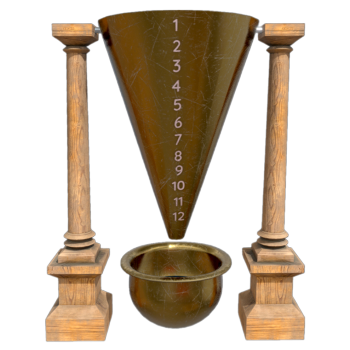
Water Clock Physics Experiment (3D Experimental Animation)

Water Clock Physics Experiment (3D Experimental Animation)

Power Wave Schematic Machine (3D Experimental Animation)

Power Wave Schematic Machine (3D Experimental Animation)

Atomic particles (microscopic 3D schematic diagram)

Atomic particles (microscopic 3D schematic diagram)

Spiral arranged nanowires (microscopic 3D schematic diagram)

Spiral arranged nanowires (microscopic 3D schematic diagram)

Spiral arranged nanowires are a type of nanomaterial with a helical structure, typically formed by self-assembly or guided growth of one-dimensional nanowires. This structure has important applications in materials science and nanotechnology.
Porous sphere structure

Porous sphere structure

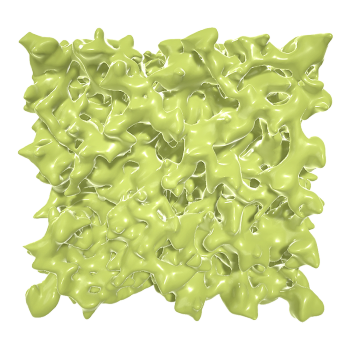
Irregular porous cube
Irregular porous cube

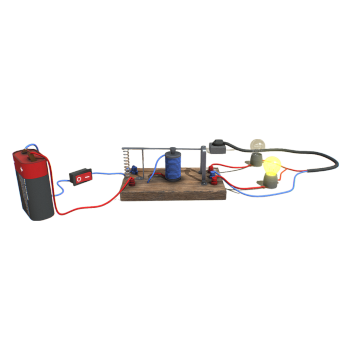
Principles of Current Relay Physics (3D Experimental Animation)

Principles of Current Relay Physics (3D Experimental Animation)

The Principle of Electric Bell (3D Experimental Animation)

The Principle of Electric Bell (3D Experimental Animation)

The process of hourglass falling (3D experimental animation)

The process of hourglass falling (3D experimental animation)

Electromagnetic Physics Experiment (3D Experimental Animation)

Electromagnetic Physics Experiment (3D Experimental Animation)