
Onion ball diameter clay cup

Onion ball diameter clay cup

The "Onion Ball Diameter Pottery Cup" is a glass made of clay, shaped like the bulb of an onion and decorated with slight grooves. The production period was in the 9th century BC, during the late period of European bronze ware. The discovery was made in Brison Saint Innocent, Gr é sine station, and Lac du Bourget in the Savoy department of France. The dimensions are height: 21 centimeters, width: 13.7 centimeters, depth: 4.5 centimeters. It is currently housed in the National Museum of Archaeology in France.
Madonna Statue

Madonna Statue

The statue of the Virgin Mary is a female statue from the Ceccaldi collection. The statue can be traced back to the Iron Age in the 6th century BC. This statue was discovered in Cyprus and is now housed in the National Museum of Archaeology in France. The size of this statue is 18.3 centimeters high and 5.3 centimeters in diameter.
Alexander the Great's Drachma Silver Coin

Alexander the Great's Drachma Silver Coin

The Great Emperor of Lishan's silver tetradrachma coin was made between 325 BC and 320 BC. Coins were minted in Side (now Türkiye). The obverse of this coin features the portrait of a young Hercules wearing a lion skin helmet. Hercules is a hero in Greek mythology known for his strength and courage. On this coin, he is depicted as a young man wearing lion skin, which is his emblem. This Delacroix silver coin is collected by the French National Archaeological Museum.
Saint Germain kettle

Saint Germain kettle

This kettle comes from Saint Germain en Laye and can be traced back to the early Middle Ages, which is the high school century. This kettle is now housed in the National Archaeological Museum of France. The collection of this museum includes various technological and artistic works since the emergence of humans in France. The size of this' kettle 'is 8.7 centimeters high and 15.6 centimeters wide.
Saint Germain single ear wine jug

Saint Germain single ear wine jug

The Saint Germain single eared wine jug was discovered in the archaeological site of Saint Germain en Laye, and this cup can be traced back to the 6th century AD. The name 'Saint Germain' comes from the Catholic saint Paris, who was born in Outan and served as the Bishop of Paris from 555 to 576, during which time he built the Abbey of Saint Germain de Prey. The Saint Germain Cup is currently housed in the National Museum of Archaeology in France.
Saint Germain high footed round cup

Saint Germain high footed round cup

The Saint Germain double eared cup was discovered in the archaeological site of Saint Germain en Laye and can be traced back to the 6th century AD. The name 'Saint Germain' comes from the Catholic saint Paris, who was born in Outan and served as the Bishop of Paris from 555 to 576, during which time he built the Abbey of Saint Germain de Prey. The Saint Germain Cup is currently housed in the National Museum of Archaeology in France.
Saint Germain Double Ear Cup

Saint Germain Double Ear Cup

The Saint Germain double eared cup was discovered in the archaeological site of Saint Germain en Laye and can be traced back to the 6th century AD. The name 'Saint Germain' comes from the Catholic saint Paris, who was born in Outan and served as the Bishop of Paris from 555 to 576, during which time he built the Abbey of Saint Germain de Prey. The Saint Germain Cup is currently housed in the National Museum of Archaeology in France.
Queen Angongde's belt

Queen Angongde's belt

The Belt of Queen Arnonde "is a precious artifact discovered in 1959 at Saint Denis Cathedral. It is a belt made of goat skin with rich decorations. The belt was found in Tomb 49, which belonged to Queen Arnonde of Francia. Aregade was the third wife of Clovis I and passed away between 580 and 590 AD at the age of 70 to 80. The items found in her tomb include a brown red silk robe decorated with gold embroidery, a pair of round slender pins inlaid with garnet, and a pair of shoes made of leather.
Gallic knight Roman

Gallic knight Roman

The Gallic Knight Roman "is an artwork created by Emmanuel Fremit (1824-1910). This is a sculpture depicting a Gallic knight It was created in the 1860s for the National Archaeological Museum of Saint Germain in France. It is a bronze sculpture cast by Barbedienne Foundry in the early 20th century. Its dimensions are 36.5 centimeters high, 9.5 centimeters long, and 9.6 centimeters wide. This sculpture is now housed in the Mus é e d'Orsay in France. Emmanuel Fr é met is a French sculptor known for his animal sculptures.
Gallic knights

Gallic knights

The 'Gallic Knight' is an artwork created by Emmanuel Fremit (1824-1910). This is a sculpture depicting a Gallic knight It was created in the 1860s for the National Archaeological Museum of Saint Germain in France. It is a bronze sculpture cast by Barbedienne Foundry in the early 20th century. Its dimensions are 36.5 centimeters high, 9.5 centimeters long, and 9.6 centimeters wide. This sculpture is now housed in the Mus é e d'Orsay in France. Emmanuel Fr é met is a French sculptor known for his animal sculptures.
Carved bronze bracelet

Carved bronze bracelet

This carved bronze bracelet comes from the R é allon region of the High Alps department in France. Archaeological relics were discovered there. This bracelet can be traced back to the post Bronze Age from the 10th century BC to the 9th century BC. This bracelet is now housed in the National Museum of Archaeology in France.
The Staff of Command of Louis Nicolas Davout

The Staff of Command of Louis Nicolas Davout

This scepter belongs to Louis Nicolas Davout. Louis Nicolas Davout (May 10, 1770- June 1, 1823), also known as Davout, was a French military commander and imperial marshal who served during the French Revolutionary War and the Napoleonic Wars. His war talent, as well as his reputation as a strict disciplined individual, earned him the nickname 'Iron Marshal' (Le Mar é chal de fer). He was listed as one of Napoleon's most outstanding commanders. His loyalty and obedience to Napoleon were absolute.
Olas Sebastiani's baton

Olas Sebastiani's baton

Olas Sebastiani (November 11, 1771- July 20, 1851) was a French general, diplomat, and politician who served as Minister of the Navy, Minister of Foreign Affairs, and Minister of State during the July Monarchy. He joined the French Revolutionary Army at a young age, rose to prominence in its ranks, and later became a supporter of Napoleon Bonaparte. He was once an envoy sent by the French consulate to the East, mainly responsible for formulating plans to reconquer Ottoman Egypt, and later served as the ambassador to the Ottoman Empire during the empire. The Marshal's Staff of Orlas Sebastiani is a 19th-century French artifact.
Ferdinand Foch's Staff of Command

Ferdinand Foch's Staff of Command

This scepter belongs to Ferdinand Foch. Ferdinand Foch (October 2, 1851- March 20, 1929) was a French Marshal and a member of the French Academy. He performed outstandingly as the Supreme Allied Commander on the Western Front during World War I. He stopped Germany's attack and launched a counterattack to win the war. In November 1918, Marshal Foch accepted the German ceasefire and attended the ceasefire agreement of November 11, 1918. This scepter was awarded to Foch by French President Raymond Poincar é on August 23, 1918.
Bamboo springs imitating bronze artifacts

Bamboo springs imitating bronze artifacts

It is a traditional handicraft made using Baoqing bamboo carving technique, which was carefully completed by Zhang Zongfan, inheritor of intangible cultural heritage, and his students. Baoqing bamboo carving is a traditional handicraft in Shaoyang City, Hunan Province, China, known for its exquisite carving and unique artistic expression. The size is 10 centimeters wide and 34 centimeters high, imitating the texture and color of ancient bronze ware in appearance. Through the exquisite craftsmanship of bamboo spring carving, it showcases the exquisite patterns and historical charm of bronze ware. It is a technique that uses the internal reeds of bamboo for multi-level carving, which requires craftsmen to have superb skills and precise control over details
Marshal Gabriel Morito's baton

Marshal Gabriel Morito's baton

This baton belongs to Gabriel Morito. Gabriel Molito (March 7, 1770- July 28, 1849) was a French Marshal. He joined the French Revolutionary Army during the outbreak of the French Revolution, initially as a captain of a militia. In 1793, he was appointed as a brigade commander and participated in the battles of Kaiserslautern and Wiesenburg under General Horch. In 1799, he was sent to Switzerland to fight against the Austrian Russian coalition led by Alexander Suvorov under the command of General Andrei Massena. In 1801, he was promoted to the rank of division general.
French Marshal's baton

French Marshal's baton

The "Louis Georges Erasme, Marquis de Contades' Marshal's Rod and Sleeve" is a historical artifact that is currently housed in the Military Museum in Paris, France. The production date of this Marshal's baton is approximately 1758. One end is adorned with the national emblem of France, featuring a relief of the Marquess's Crown 1, while the other end is adorned with the coat of arms of the Contades family
Carved vase of 'Blossoming in a Prosperous Age'

Carved vase of 'Blossoming in a Prosperous Age'

It is an artwork made using Baoqing bamboo carving techniques, carefully carved by Zhang Zongfan, inheritor of intangible cultural heritage, and his students. Baoqing bamboo carving is a traditional handicraft in Shaoyang City, Hunan Province, China, known for its exquisite craftsmanship and unique artistic style. This work is 50 centimeters wide and 118 centimeters high, showcasing the theme of "blooming flowers in a prosperous era" with its exquisite carving techniques, symbolizing prosperity and beauty. Bamboo spring carving technology is a traditional technique that uses the internal spring leaves of bamboo to carve at multiple levels. It requires craftsmen to possess superb skills and precise control over details.
Ancient stone tablet sculpture

Ancient stone tablet sculpture

It is a replica of an ancient stone tablet collected in the Louvre Museum in Paris, France. This replica is made of hand colored resin material by Rmn-PP (Louvre and Osay Museum Picture Agency), with dimensions of 106 centimeters high, 34 centimeters wide, and 33.5 centimeters thick. The surface with inscriptions is 35 centimeters high. The original material of the stone tablet is marble. The decoration of the stone tablet includes lotus leaves and inscriptions. There are inscriptions in Greek and Phoenician on it, which mention Hercules of Tyrian and offer a dedication to the gods.
The baton of Marquis Cassagnet

The baton of Marquis Cassagnet

The baton of the Marquis of Cassagnet (B â ton de command du Marquis de Cassagnet) is a historical artifact currently housed in the Military Museum in Paris, France. The production date of this baton is approximately 1679. Its main body is a wooden cylinder, once covered in deep blue velvet, but now only the base remains. The circumference of the cylinder is embedded with partially gold-plated silver nails, and the nail heads take on the shape of lilies. The decorations at both ends are spiral shaped and made of partially gold-plated silver.
Egyptian female statue

Egyptian female statue

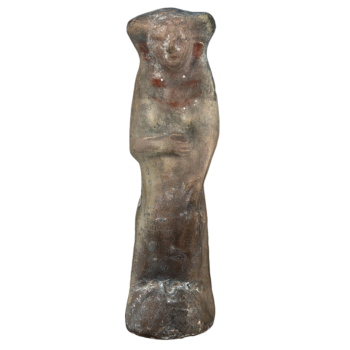
It usually refers to the female images of ancient Egypt, who held important positions in art, society, and religious life. In ancient Egyptian art, female images were often depicted as graceful and dignified postures, reflecting the respect and noble status of women in ancient Egyptian society. These images can be sculptures, murals, or paintings on pottery, depicting the daily lives, clothing, jewelry, and roles of ancient Egyptian women in their families and society. It also plays an important role in religious ceremonies, sometimes depicted as worshippers of gods or individuals directly associated with gods.
Male Head Sculpture

Male Head Sculpture

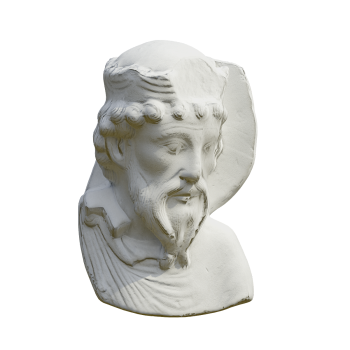
It is the generic name for a series of paintings and sketches created by Pablo Picasso, which includes his various explorations and expressions of portraits. Pablo Picasso was a Spanish born artist and is considered one of the most influential artists of the 20th century, known for pioneering cubism and breaking traditional forms of two-dimensional representation. This work demonstrates his profound understanding of form and structure, as well as his unique ability to integrate different perspectives and elements into the same picture. These works often convey the spirit and emotional state of the characters through the combination of geometric shapes and innovative techniques.
Sculpture of the discus thrower

Sculpture of the discus thrower

It is a famous sculpture created by the ancient Greek sculptor Myron in the 5th century BC. Although the original work is lost, through replicas from the Roman period, we can glimpse the charm of this artistic masterpiece. This work depicts the moment when an athlete throws a discus, showcasing the perfect combination of strength and beauty. Athletes are naked, with clear muscle lines and leaning forward, in a tense and dynamic posture, reflecting ancient Greece's pursuit of human beauty and dynamic beauty. It is a model of ancient Greek sculpture art and has had a profound influence on artists in later generations.
Female idol sculptures in the Cyclades Islands

Female idol sculptures in the Cyclades Islands

The female idols of the Cyclades Islands, also known as "Cycladic idols," are a series of marble sculptures made on the Cyclades Islands in the Aegean Sea during the early Bronze Age from 3000 BC to 2000 BC. Known for its simple geometric shapes and highly abstract style, it is typically depicted as a standing female figure with feet together, arms crossed in front of the chest, an oval shaped head, simplified facial details, and usually only the nose protruding. Collected in museums around the world, including the Louvre in Paris, they are an important part of ancient art and cultural heritage, as well as important physical evidence for studying ancient Aegean civilization.
Statue of Buddha teacher Ajuthia

Statue of Buddha teacher Ajuthia

It is a replica of a 19th-century Cambodian style bronze Buddha statue. This statue depicts the posture of Buddha in teaching, with a dignified sitting posture and hands placed flat, showing a sense of tranquility and wisdom. Ajutya was the ruler of the Peacock Dynasty in ancient India, who had a significant influence on the spread of Buddhism, especially during his reign when Buddhism was greatly promoted. The original of this statue is collected at the Jimei National Museum of Asian Art in Paris. The replica was made by the National Museum Art Studio using the same bronze material as the original, aiming to provide museums and art enthusiasts with opportunities for collection and research.
Female Head Sculpture

Female Head Sculpture

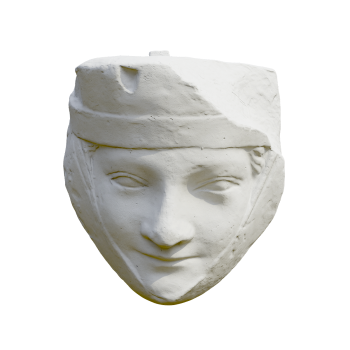
The female portrait (T ê tef é minine) is a replica of a sculpture collected at the Cath é drale Notre Dame de Reims in France. This replica is made of plaster material by Rmn-P (Louvre and Osay Museum Photo Society) and is a three-dimensional reproduction of the original sculpture. Originally part of sculptural art, it may have originated from a specific historical or cultural background, showcasing the facial features and expressions of women.
Ancient Egyptian Fish Shaped Palette

Ancient Egyptian Fish Shaped Palette

It is an ancient Egyptian artifact that can be traced back to the Nagada II period from 3500 BC to 3300 BC. Discovered in El Amrah (located on the west coast from Asgard to Thebes) and currently housed in the Louvre Museum in Paris, France. This color palette is made of sandstone and features carving techniques. It measures 16 centimeters in length, 8.6 centimeters in width, and 1.1 centimeters in thickness. Unique design, often associated with ancient Egyptian makeup culture, as it was used to grind and mix pigments for body painting. It may also have ceremonial or symbolic significance, closely linked to the religious and cultural customs of ancient Egypt
Madonna and Child Relief

Madonna and Child Relief

It is a sculpture depicting the Virgin Mary and the young Jesus. This type of theme is very common in Christian art, usually depicting the Virgin Mary embracing the little Jesus, conveying maternal love and divine care. Relief sculpture, as a form of sculpture, represents works by carving raised images on a flat surface, giving the image a sense of three dimensionality while maintaining a connection with the background. This image of the Virgin and Child was particularly popular in European art during the Middle Ages and Renaissance, often used as a decoration for churches or as an object of private prayer. Not only does it have significant religious significance, but it also reflects the social, cultural, and aesthetic tendencies of the time.
Mira's dancer's terracotta statue

Mira's dancer's terracotta statue

It is a red clay statue from ancient Greece, currently housed in the Louvre Museum in Paris. Created by Athenian potters around 350 BC. It depicts a dancer dressed in a transparent robe, whose theme shares similarities with statues created by other studios in the Hellenistic world at that time (330-31 BC). Early sculptures of this kind were sometimes believed to depict Nymphs (related to the god Pan), but they were also considered mortal, meaning future brides who participated in the sacred wedding dance.
Sleeping Tagra Girl Sculpture

Sleeping Tagra Girl Sculpture

It is a replica of an ancient Greek style terracotta statue, originally created by an ancient Greek artist between the late 5th century BC and the 3rd century BC, and now housed in the Louvre Museum in Paris, France. These statues are known for their naturalistic features, preserved pigments, diversity, and charm, and are commonly referred to as Tanagra statues, named after the large number of such statues discovered in the ancient city of Tagra in the state of Viotia in central Greece. Most of them depict fashionable women or girls elegantly wrapped in sheer cloaks, sometimes wearing wide brimmed hats, holding flower garlands or fans.
White Bone Top Chicken Bronze Statue

White Bone Top Chicken Bronze Statue

Foulque is a replica of a bronze sculpture, the original of which is housed in the Fine Arts Museum in Dijon, France. This replica was made of resin material by Rmn-P (Louvre and Osay Museum Picture Agency) and belongs to the studio of the art museum. The dimensions of this artwork are a height of 27 centimeters, a width of 18.5 centimeters, and a depth of 9.5 centimeters.
Little Royal Sphinx

Little Royal Sphinx

It is a 3D model replica collected in the Louvre Museum in Paris, France. Originally made of plaster material, it was jointly completed by the National Museum Art Studio and Rmn-P (Louvre and Osay Museum Picture Agency). This small sphinx is 13 centimeters high, 18 centimeters wide, and 5.3 centimeters deep. It is one of the representatives of ancient Egyptian art, showcasing the pursuit of mystery and symbols of power in ancient Egyptian civilization. The replica has not only been adjusted in size for easier exhibition and research, but also strives to be faithful to the original in details, allowing the public to experience the charm of ancient Egyptian art up close.
Chinese style bronze lion sculpture

Chinese style bronze lion sculpture

Bamboo root carving of 'Kirin'

Bamboo root carving of 'Kirin'

Bamboo root carving is a traditional handicraft made from bamboo roots, mainly produced in Nanjing, Jiangsu and Jiading, Shanghai. It was once divided into the "Jiading School" and the "Jinling School". Chinese artworks made from bamboo include bamboo carvings, bamboo root carvings, bamboo bonsai, bamboo armrests, etc. In the southern region, there are dense bamboo forests growing. Bamboo, as a plant, had extraordinary significance for ancient literati. The phrase 'It is better to eat without meat than to live without bamboo' was used by the Song dynasty literary giant Su Dongpo to express his spiritual world, but it also reflects the great poet's love for bamboo.
Ke Guo

Ke Guo

Lithocarpus glaber (Thunb.) Nakai is a tree in the family Fabaceae. The plant reaches a height of 15 meters; Leaves are leathery or hard papery in texture, oblong or oblong in shape, with 2-4 shallow teeth on the entire margin or near the tip. The lower part of the old leaves is hairless or almost hairless and covered with a waxy scale layer; Flowers have small branches, young petioles, and the underside of leaves and inflorescence axis are densely covered with grayish yellow short hairs; The fruit is disc-shaped or shallow bowl shaped, with triangular scales, and is covered with gray soft hairs. The fruit is elliptical in shape; The flowering period is from September to October; The fruiting period is from September to October of the following year.