Japanese forest frog

Japanese forest frog

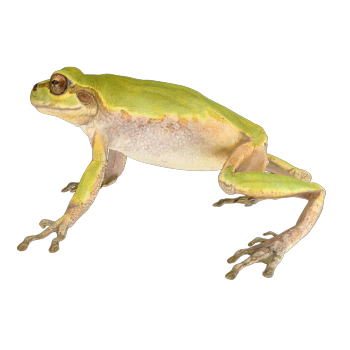
The Japanese forest frog (scientific name: Rana japonica) is a species of amphibian in the family Ranidae. Male frogs have a body length of 34-59mm, while female frogs have a body length of 39-67mm. Head length is greater than width; The snout end is blunt and pointed, located in the lower jaw. The snout edge is blunt, and the cheek is slightly inclined outward. The cheek surface is concave, and the nose is located between the snout and eyes. Near the snout end, the distance between the eyes is smaller than the distance between the nose, and the temporal folds are thin and weak. The eardrum is large and round. The plow bone teeth are located between the internal nostrils, sloping backwards towards the midline without touching each other. The tongue is oval in shape, with a free posterior end and deep incisions.
Damo Pond Frog

Damo Pond Frog

The scientific name of the Damo pond frog is Pelophalax porosus. It is a species of amphibian belonging to the frog family. The average body length of males is 3.5 to 6.2 centimeters, while the average body length of females is 3.7 to 7.3 centimeters.
Japanese River Toad

Japanese River Toad

The Japanese river toad, also known as the Honshu toad, is a species of toad in the family Bufonidae. In 1976, during his research at Kyoto University, Masanori Matsui first described it as a "medium to large toad" with "peculiar color patterns" and "stream dwelling habits".
Black spotted side folded frog male

Black spotted side folded frog male

The black spotted side folded frog is a species of amphibian in the family Ranidae, also known as the spiny male toothed frog or black frog. Head length is greater than head width; The snout is slightly pointed, the snout tip is blunt and round, protruding from the lower lip, the nostrils are in the middle of the kissing eye, and the distance between the noses is equal to the width of the eyelids; The eyes are large and prominent, with a narrow distance between them, smaller than the distance between the nose and the width of the upper eyelid; Short forelimbs, with forearm and hand lengths less than half of body length; The skin on the back is relatively rough, with obvious folds on the back side, and multiple longitudinal ridges of varying lengths between the folds. There are round warts and mole particles on the back, perianal area, and lower back of the thigh; Smooth belly surface. The back of the body has a variety of colors, including light green, yellow green, dark green, gray brown, etc., mixed with many black horizontal stripes of different sizes.
Japanese wrinkled frog male

Japanese wrinkled frog male

The Japanese wrinkled frog is a true frog native to Japan, introduced to Hawaii in the late 19th century. It is sometimes considered a single species, similar to the Imienpo station frog found on the East Asian continent. The difference between these two species and others lies in their rough and uneven skin. It lives and reproduces in various freshwater environments, including ponds, streams, and wetlands. The International Union for Conservation of Nature does not consider this species to face any significant threats.
Japanese wrinkled frog female

Japanese wrinkled frog female

The Japanese wrinkled frog is a true frog native to Japan, introduced to Hawaii in the late 19th century. It is sometimes considered a single species, similar to the Imienpo station frog found on the East Asian continent. The difference between these two species and others lies in their rough and uneven skin. It lives and reproduces in various freshwater environments, including ponds, streams, and wetlands. The International Union for Conservation of Nature does not consider this species to face any significant threats.
Male Ueno Brown Frog

Male Ueno Brown Frog

The Ueno brown frog Rana Uenoi is a species of amphibian belonging to the family Ranidae in the order Anura. This type of frog is called the Ueno Brown Frog. It is related to two other brown frogs in South Korea (R. huanreinsis and R. coreana), and researchers used species distribution modeling techniques to predict the distribution range of these frogs under future climate change based on observation points and environmental variables.
Female Ueno Brown Frog

Female Ueno Brown Frog

The Ueno brown frog Rana Uenoi is a species of amphibian belonging to the family Ranidae in the order Anura. This type of frog is called the Ueno Brown Frog. It is related to two other brown frogs in South Korea (R. huanreinsis and R. coreana), and researchers used species distribution modeling techniques to predict the distribution range of these frogs under future climate change based on observation points and environmental variables.
Male Field Frog

Male Field Frog

The Tianzi frog, scientific name Rana tagoi, is a species of frog in the family Ranidae of the order Anura in the class Amphibia. It lives in forests ranging from low mountains to altitudes below 2000 meters. The diet is animal food, including insects, spiders, land snails, etc. Before metamorphosis, young children consume the yolk in their bodies to sustain their lives. The basal subspecies lays 60-110 eggs from January to February or April to May, the subspecies キタゴガエ from February to March, and the subspecies クシマタゴガエ from October to April in areas such as puddles near streams or streams.
Female Field Frog

Female Field Frog

The Tianzi frog, scientific name Rana tagoi, is a species of frog in the family Ranidae of the order Anura in the class Amphibia. It lives in forests ranging from low mountains to altitudes below 2000 meters. The diet is animal food, including insects, spiders, land snails, etc. Before metamorphosis, young children consume the yolk in their bodies to sustain their lives. The basal subspecies lays 60-110 eggs from January to February or April to May, the subspecies キタゴガエ from February to March, and the subspecies クシマタゴガエ from October to April in areas such as puddles near streams or streams.
Male Shuleigelin frog

Male Shuleigelin frog

The Rhacophorus schgelii frog is a species of frog in the family Frogidae, order Anura, of the class Amphibia. It is a unique species in Japan, distributed in Honshu, Shikoku, Kyushu and surrounding islands, but not on Tsushima Island. The scientific name means' Mr. Schuyler's Frog ', which comes from Hermann, the director of the Royal Museum of Natural History in Leiden, Netherlands.
Shuleigelin frog female

Shuleigelin frog female

The Rhacophorus schgelii frog is a species of frog in the family Frogidae, order Anura, of the class Amphibia. It is a unique species in Japan, distributed in Honshu, Shikoku, Kyushu and surrounding islands, but not on Tsushima Island. The scientific name means' Mr. Schuyler's Frog ', which comes from Hermann, the director of the Royal Museum of Natural History in Leiden, Netherlands.
Flying Frog

Flying Frog

The tree frog is a species of amphibian belonging to the Rhacophoridae family. This kind of frog breeds in a special way. They make foam nests underground. They will crawl on the edges of rice paddies and swamps, and dig caves above the water surface. The female carries the smaller male on her back, and both are buried in a hole that is 6-9 centimeters wide and 10-15 centimeters above the water surface. The interior of this nest is smoothed out through female movement, and then at night, it is filled with white material filled with air bubbles.
Xiashan pepper fish

Xiashan pepper fish

The male length of Xiashan pepper fish is 8.4-11.9 centimeters. The length of the head and torso is 4.7-6.7 centimeters. The tail is very short, accounting for approximately 69.5% of the length of the head and body. There are 13 wrinkles (ribs) on the side of the body. The species nickname Nebula means "cloud like" in Latin. Yellow stripes appear on the back of the tail and the outer edge of the abdomen.
Creek tree frog

Creek tree frog

The brook tree frog (scientific name: Buergeria robusta) is an amphibian belonging to the tree frog family and the brook tree frog genus, which is endemic to Taiwan, China, China. Head width is greater than head length; The tip of the kiss is slightly pointed, with distinct edges; The cheeks tilt outward; Nostrils slightly closer to the snout; The width of the upper eyelid is smaller than the distance between the eyes; Obvious tympanic membrane; The plow bone teeth are short rod-shaped; The tongue is larger. The forearm is thick and robust; Microwebbed between fingers; The palmar process is not obvious.
Buergeria oxycephala

Buergeria oxycephala

The Hainan Creek Tree Frog (scientific name: Buergeria oxycephala) is a species of amphibian belonging to the Tree Frog family and the Creek Tree Frog genus, endemic to China. The body is flat and narrow in length, with a pointed snout end and distinct snout edges. The nostrils are slightly closer to the snout end, and the distance between the upper eye face and the eyes is equal. The eardrum is obvious, the plow bone teeth are slender, and the tongue is large. The lateral metatarsal fins are well-developed; The inner metatarsal process is small and there is no outer metatarsal process. The skin on the back is smooth or has small warts; The temporal folds are obvious. The abdomen is covered with flat warts, and the throat is relatively smooth. In strong sunlight, the back of the lower body appears gray, and in dark and humid environments, the color darkens, with some appearing dark brown or brownish red.
Red eared turtle

Red eared turtle

The red eared turtle (Latin name: Trachemys scripta elegans), also known as the Brazilian turtle or the painted turtle, is a species of red eared painted turtle in the reptile class. The head, neck, limbs, and tail of the red eared turtle are covered with uneven yellow green inlaid stripes. There are two thick red stripes on both sides of the head, and the cornea of the eyes is green with a black dot in the center. The snout is blunt, and there are irregular yellow green inlaid spots in the center of each shield of the dorsal and ventral shells. Red eared turtles are lively and sensitive to water and vibration, and prefer to inhabit clear ponds. The red eared turtle is mainly distributed in the Mississippi River and Grand River systems in the United States and Mexico.
Japanese female toad

Japanese female toad

The Japanese toad (Bufo japonicus) is a species of toad native to freshwater waters in Japan. The Japanese use it to make toad oil. The length of the head and tail is 17.5 cm (7 inches), and females are slightly larger. The webbed toes are not obvious, and the body is gray brown, yellow brown, or dark brown. During the breeding season, the body color is slightly lighter.
Northeast Rain Frog

Northeast Rain Frog

The Northeast Rain Frog (scientific name: Hyla japonica) is a species of amphibian in the Rain Frog family. Distributed in Hokkaido and Yakushima in Japan, as well as along the Heilongjiang River in North Korea and Northeast China, including Heilongjiang, Liaoning, Jilin, and Inner Mongolia. The type locality of this species is in Japan. In 1990, Japanese astronaut Toyohiro Akiyama brought some Northeastern rain frogs to the Soviet Union's Mir space station.
Male Japanese toad

Male Japanese toad

The Japanese toad (Bufo japonicus) is a species of toad native to freshwater waters in Japan. The Japanese use it to make toad oil. The length of the head and tail is 17.5 cm (7 inches), and females are slightly larger. The webbed toes are not obvious, and the body is gray brown, yellow brown, or dark brown. During the breeding season, the body color is slightly lighter.
frog

frog

Frogs are amphibians belonging to the family Ranidae, with a slightly triangular head that grows wider; Large and protruding eyes; The forelimbs are short, the fingertips are blunt and pointed, the hind limbs are short and thick, and the toes are almost fully webbed. It is most common and abundant in the plains and hilly areas from North China to South China; It is also distributed in Japan, the Korean Peninsula, Russia and other places. Suitable for living in amphibious environments, it mostly inhabits low-lying and humid places such as rivers, ponds, streams, ditches, lakes, and shallow waters with abundant aquatic plants; During the day and at night, they move around and search for food; Both juvenile and adult frogs are carnivorous and typically prey on rice pests.
frog

frog

Hawksbill turtle (juvenile)
Hawksbill turtle (juvenile)

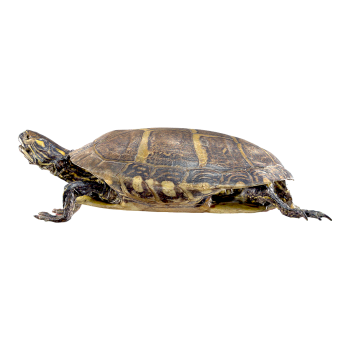
The hawksbill turtle is a reptile belonging to the family Turtles and the genus hawksbill. The hawksbill turtle inhabits tropical and subtropical oceans. Most of the time in their lives, hawksbill turtles live alone, and they only meet for mating. The hawksbill turtle has strong migratory ability and a wide range of living environments. The hawksbill mainly feeds on coral reefs and also preys on some crustaceans, algae, and fish. Distributed in vast sea areas, mainly found in tropical regions of the Atlantic and Pacific Oceans. The crawling speed of hawksbill turtles is slow and they are easily hunted and killed by humans. The beaches that serve as nesting areas for hawksbill turtles are often destroyed, and the required years for sexual maturity are long, resulting in a low reproductive rate. Therefore, the population is extremely difficult to recover.
tortoise

tortoise

Turtle is a reptile belonging to the family Turtles in the order Turtles and the genus Turtles. Also known as grass turtle, mud turtle, golden turtle, fragrant turtle, etc. Turtles are distributed in various provinces in southern China, with the highest number in the Yangtze River Basin. They are also found in countries such as Korea and Japan. They prefer to inhabit streams, lakes, rice paddies, and aquatic plants. Turtles are semi aquatic, omnivorous, and ectothermic animals. I enjoy eating animal based foods such as insects, worms, small fish and shrimp, as well as plants such as tender leaves, duckweed, grass seeds, and rice. In ancient China, turtles were revered as objects of worship and were particularly fond of raising turtles. The turtle is also known as one of the "Four Spirits".
Mexican blunt mouthed salamander

Mexican blunt mouthed salamander

The Mexican salamander is a species of amphibian in the family Salamandridae. Bare skin without scales; Both limbs and feet are short; Without vocal cords, unable to produce vocalizations; There are six external gill whiskers on both sides of the head, so it is also called a hexagonal dinosaur. The Mexican blunt mouthed salamander is distributed in central Mexico and is an endemic species of Mexico, famous for its unique appearance and juvenile continuation. The Mexican salamander is classified as critically endangered (CR) on the IUCN Red List of Threatened Species. In China, it is legal to buy and sell artificially bred Mexican salamanders as pets, but it is not allowed to buy and sell wild Mexican salamanders.
Koolasuchus

Koolasuchus

Kurasaurus, a carnivorous amphibian resembling a salamander, lived in the Antarctic region during the Pre Cretaceous period. The body length is about five meters, the height is about thirty centimeters, and the weight is about 0.5 tons. Kularosaurus was the only amphibian species living in polar regions at that time, usually living in water or hiding itself in the soil. Although they can also walk on land with four limbs, they prefer to live in water and swim like fish and freshwater crayfish.
Cobalt blue arrow poison frog

Cobalt blue arrow poison frog

Cobalt Blue Arrow Poison Frog, a subspecies of Dendrobates tinctorius Stained Arrow Poison Frog, is a species of the genus Ranunculus in the family Ranunculidae. Enjoys humid environments, has a wide range of food, strong reproductive ability, and is relatively easy to raise. Although it is a large poison dart frog, its body length is only about 4 centimeters, and it is covered in fluorescent blue, which is considered a rare color exception in the animal kingdom. In fact, many poison dart frogs have the same dazzling colors, and these special and gorgeous colors have a strong warning effect on predators (warning colors). Listed on the World Conservation Union's Red List of Endangered Species.
Ichthyostega

Ichthyostega

The fish salamander is one of the oldest known terrestrial vertebrates and also the earliest known amphibian. According to the discovered fossils, they lived approximately 360 million years ago. Compared with the spiny salamander, the limb joints of the fish salamander are very flexible, and the ribs are wide, which is conducive to supporting its body to walk on land. Its spine has also grown joint processes, which can allow the spine to bend and move.
Jumping Japanese Forest Frog

Jumping Japanese Forest Frog

The Japanese forest frog (scientific name: Rana japonica) is a species of amphibian in the family Ranidae. Male frogs have a body length of 34-59mm, while female frogs have a body length of 39-67mm. Head length is greater than width; The snout end is blunt and pointed, located in the lower jaw. The snout edge is blunt, and the cheek is slightly inclined outward. The cheek surface is concave, and the nose is located between the snout and eyes. Near the snout end, the distance between the eyes is smaller than the distance between the nose, and the temporal folds are thin and weak. The eardrum is large and round. The plow bone teeth are located between the internal nostrils, sloping backwards towards the midline without touching each other. The tongue is oval in shape, with a free posterior end and deep incisions.
African Bullbox Head Frog

African Bullbox Head Frog

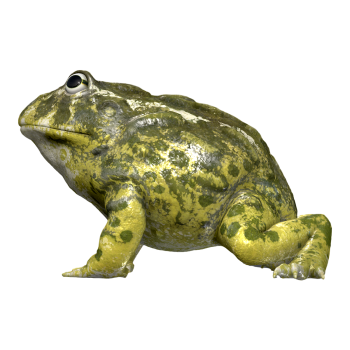
The African bullfrog is a member of the family Ranidae in the order Anura. Also known as African bullfrog. Large and bulky in size; Wide head and large mouth; Thick hind limbs; There are hard wart particles on the hind toe. The body color is olive green, with dark green, brown, or black stripes or spots along the skin ridges. It is the largest frog in the world. The African bullfrog is distributed south of the Sahara Desert in Africa. Habitat in tropical and subtropical savannas, wet grasslands, shrubs, intermittent freshwater lakes, swamps, farmland, pastures, canals, and ditches. Highly aggressive, heat-resistant but not cold resistant. Mainly feeds on insects, birds, small reptiles, amphibians, rodents, etc.
Red Arrow Poison Frog

Red Arrow Poison Frog

The fiery red arrow poison frog, also known as the "strawberry arrow poison frog", belongs to the family of arrow poison frogs in the order Anura, which covers about 180 species of arrow poison frogs. It is a small frog with a body size of only about 2 centimeters. The poison dart frogs, including the fiery red poison dart frog, mainly inhabit the tropical rainforest ecosystems of Nicaragua, Peru, and Brazil in Central America. They are named after the indigenous people of Central and South America who have used frog venom to make poisonous weapons such as poison arrows and darts since ancient times.
Andrias japonicus

Andrias japonicus

It is an amphibian with a tail order and a family of hidden gill salamanders. It is an aquatic and nocturnal amphibian, the world's second largest baby fish with a large body size. The male has a total length of 627.5 millimeters and the female has a length of 665.1 millimeters. The head is large and flat, slightly longer than the width, with a blunt and rounded snout slightly protruding from the lower jaw; The nostrils are small and very close to the tip of the kiss; Small eyes without eyelids, large cleft mouth, and obvious lip folds at the corners of the mouth. The Chinese giant salamander and the Japanese giant salamander have very similar body shapes, with the main difference being that the former has small and regularly arranged warts on their heads, while the latter has large and irregularly arranged warts.
Giant sea toad

Giant sea toad

The giant sea toad, also known as the sea toad, is an amphibian reptile belonging to the family Bufonidae in the order Anura. It is usually considered the largest toad in size. Giant sea toads are native to North and South America and prefer to inhabit open grasslands and forests. They hunt at night and feed on insects, moths, snails, maggots, and other insects. Giant sea toads secrete a white venom called bufotoxin, and sometimes they even spray the venom directly; In order to control the harm of sugarcane beetles, Australians introduced giant sea toads into their local sugarcane plantations in the 1930s. However, pest infestations have not been resolved, and Australia's ecology has suffered as a result.
Brown Frog Resting 3D Animated Model

Brown Frog Resting 3D Animated Model

Frogs are amphibians of the genus Frogaceae. [14] Their heads are slightly triangular and longer than wide. Large and protruding eyes; The forelimbs are short, the toes are blunt, the hind limbs are short and thick, and the toes are almost completely webbed. The back is rough, blue-green, yellow-green, dark green, gray-green, taupe, etc. in life, with irregular black spots, and white ventral skin, smooth, without spots.