Galapagos Tortoise Specimen

Galapagos Tortoise Specimen

The scientific name of Galapagos tortoise (Galapagos giant tortoise): Chelonoidis nigra, tortoidae, is one of the largest tortoises with a shell height of 1.2 meters and a weight of 417 kilograms. The carapace is dome-shaped or saddle-shaped and is differentiated according to subspecies. The life span can reach more than 150 years. Cactus, vines, grass as staple food, gastric acid strong acid decomposition of wood fiber. The rainy season replenishes petals and fruits, and the dry season relies on lichen and prickly pear cactus.
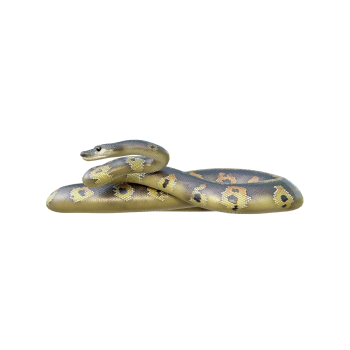
Japanese brocade snake 3D model animation

Japanese brocade snake 3D model animation

The Japanese brocade snake, also known as the "green general", is a non-venomous snake of the genus Snake, mainly distributed in Japan, is a local species. More habitat in the plains, mountains, forests, grasslands, waterfront or farmland, good at climbing trees, but more activities on the ground. A wide range of activities, even into the sewers to chase rodents, sometimes into the homes. Feeding mainly on birds, eggs and small mammals, young snakes also feed on amphibians and other reptiles. In Iwakuni City, Yamaguchi Prefecture, Japan, there is a special albino Japanese brocade snake, known as "Iwakuni White Snake", which is one of the natural monuments designated by the Japanese state.
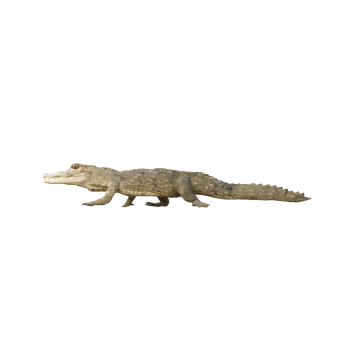
American Alligator 3D Model Animation

American Alligator 3D Model Animation

The American alligator, also known as the Mississippi crocodile and the Mihe crocodile, is the largest crocodile species in the Western Hemisphere and the ninth largest crocodile. It mainly inhabits fresh water, marshes, ponds, lakes, rivers, streams and wetlands, and even canals and ditches. It is usually a burrowing cave, which can be a hole or tunnel in a riverbank or a crocodile hole at the bottom of a pond. Young crocodiles feed on invertebrates, frogs and fish, while as adults they eat turtles, waterbirds and mammals. In order to catch a bird on the water for food, it sometimes suddenly stands up with its tail supporting its body.
Komodo dragon 3D model animation

Komodo dragon 3D model animation

The Komodo dragon, also known as the Komodo dragon, is a reptile of the giant lizard family and is the largest living lizard. It mainly lives on Komodo Island, Linka Island, Flores Island and other islands in the Lesser Sunda Islands of Indonesia. The skin is rough, dark brown, with bony scales, which can effectively resist attack. Forked tongue, can sense smell, used to find prey. Is the top predator, mainly to carrion for food, will also prey on wild boar, deer, monkeys and other animals. Saliva contains venom and a large number of bacteria that can infect prey through bites and eventually die. It is a solitary animal that only gathers during the breeding season.
Eastern Brocade Turtle FBX Model 3D Animation

Eastern Brocade Turtle FBX Model 3D Animation

The eastern brocade turtle is a small terrapin, belonging to the genus brocade turtle family. The dorsal armor is smooth, flat-oval, usually dark brown to nearly black. It is the only turtle in North America with a dorsal shield arranged in rows, and its vertebral and rib shields are arranged in rows, making it easy to identify among extant turtles. It is an omnivorous animal. Its food includes snails, insects, crayfish, small fish, carrion, algae and aquatic plants. Young brocade tortoises tend to be more carnivorous, while adult individuals tend to be more plant-fed. Likes to inhabit slow-moving ponds, swamps, streams and lakes. It is a diurnal animal that sleeps at night on the bottom of the water or on objects partially immersed in water.
Leatherback Turtle 3D Model Animation

Leatherback Turtle 3D Model Animation

The leatherback turtle, also known as the leather turtle, the seven leatherback turtle, the sampan turtle, and the swallow turtle, is the largest species in the extant turtle order and the third largest reptile in the world today. The dorsal nail is covered with soft, leathery skin and fatty flesh, and is covered with seven ridges that run through the dorsal nail. The forelimb is particularly developed, with a maximum record of 2.7 meters when opened, making it extremely fast when swimming in the water, reaching 35 kilometers per hour. Inhabiting mainly in the pelagic tropical waters, distributed in the Atlantic, Pacific and Indian Ocean tropical waters, occasionally found in temperate waters. It is an omnivore and is now listed as an endangered species.
Gecko 3D animated model GLB model

Gecko 3D animated model GLB model

The gecko is a small reptile belonging to the family Squamiidae, the reptilia. The body is slender, usually between a few centimeters and a dozen centimeters in length, and the surface of the body is covered with tiny scales and various colors. There is a special suction cup structure at the bottom of the toes, which enables the gecko to crawl easily on vertical walls, ceilings and even smooth glass surfaces. The tail is slender and easy to break. When in danger, the tail will automatically fall off, which can confuse predators and regenerate after breaking the tail. It is a nocturnal animal, mainly feeding on small arthropods such as insects and spiders. Sharp eyesight, able to catch fast-moving prey in the dark.
European Tarantula 3D Model Animation

European Tarantula 3D Model Animation

European tarantula is a species of tarantulae, widely distributed in Europe. It usually has a gray-brown body color, a strong and spiny body, stout feet, and three claws at the end. The eyes are arranged in three columns, the vision is sharp, mainly rely on visual hunting. Good at running and jumping, quick action, fierce temperament. Mostly in the ground activities, common in the grass, ridges, streams, ditch, mountains and grasslands and other environments. It is usually active at night and hidden under stones or in earth crevices during the day. A large amount of predation is an important natural enemy of pests in farmland. The egg bag is spherical or oblate, and the mother spider will carry the egg bag in the abdomen until the young spider hatches.
3D model animation of tarantula

3D model animation of tarantula

The tarantula is a large, fierce nature of the spider. The body length can reach more than 10cm, and the foot can reach 25-30cm. The body surface is covered with fine fluff, and the color and pattern vary depending on the type. It is mainly distributed in the tropical, subtropical and semi-mountainous areas south of the Tropic of CapCity. It is a nocturnal animal, usually active at night and hidden in caves or tree holes during the day. It is an ambush-type predator that feeds mainly on insects, small reptiles, and other invertebrates. The venom is very effective on small animals, but for humans, it is relatively toxic and usually does not cause serious harm.
Tarantula 3D Model Animation

Tarantula 3D Model Animation

Tarantulas are a family of spiders, named for their good running, jumping, agility and ferocious sex. The body is 3-25mm long, has 8 eyes, arranged in 3 columns, stout feet, prickly feet, and 3 claws at the end. Most of the wandering safari, a few netting, common on the ground, ridges, ditches, farmland and plants. A large amount of predation is an important natural enemy of pests in farmland. The egg bag is spherical or oblate, synthesized by two hemispherical silk membranes and carried on the end spinner of the mother spider. After hatching, the young spider climbs on the back of the mother spider's abdomen and leaves the mother camp to live independently after about 3-7 days. Tarantulas are distributed all over the world except Antarctica, mostly in the Americas.
Tarantula crawling 3D model animation

Tarantula crawling 3D model animation

Tarantulas are a family of arachnid spiders, named for their agility, ferocious temperament, and ability to run and jump. They usually do not form nets, but prey on insects by hunting. The eyes are arranged in three columns, with 8 eyes, of which the second column is the most prominent. The foot is stout and prickly, with 3 claws at the end, suitable for fast movement on uneven ground. Body size difference is larger, body length 3-25mm. The body color is mostly gray-brown, which helps to camouflage in the natural environment. Predation behavior is very unique, relying on excellent eyesight and agile action to catch prey. During breeding, male tarantulas attract females through complex courtship behaviors.
Scorpion 3D Model Animation

Scorpion 3D Model Animation

The scorpion is an ancient arthropod belonging to the order Arachnid Scorpion. The body is divided into cephalothorax, anterior abdomen and posterior abdomen, and the body surface is covered with a hard chitin shell. It is a nocturnal animal, nocturnal, fond of tide and afraid of dry, fond of darkness and afraid of strong light stimulation. Hibernation habit, usually in the middle and late April, hibernation began in early November, the annual activity time is about 6 months. It is a carnivorous animal that feeds on small invertebrates such as insects and spiders, and uses stingers to hunt and defend. Most scorpion toxins are not fatal to humans, but can cause severe pain. Widely distributed, there are about 1700 species in the world and more than 15 species in China.
Australian Redback Spider 3D Animation Model

Australian Redback Spider 3D Animation Model

The Australian redback spider is a highly toxic spider, mainly distributed in Australia, but also in New Zealand, Southeast Asia and Japan. The female spider is about 1cm long and has a black body with red or orange stripes and hourglass marks on her abdomen. The male spider is smaller and lighter in color. The venom contains a neurotoxin that can cause severe pain, swelling, and nausea after being bitten, but antivenom can be an effective treatment. It prefers to inhabit dark, dry environments, such as under rocks, firewood or outdoor furniture, and is nocturnal. Females live up to 2-3 years, males usually only 6-7 months.
Five-line slippery-tailed scorpion

Five-line slippery-tailed scorpion

The five-line slippery-tailed scorpion, also known as the Israeli golden scorpion or death scorpion, is a highly venomous scorpion that lives in North Africa and the Middle East. The body length is usually between 7 and 8cm, and the body color is yellowish brown or dark brown. The venom contains a strong neurotoxin that is potentially deadly to humans. The habitat is mostly dry desert areas, often digging caves under rocks or in sand dunes. Predators are mainly other insects and small invertebrates. Due to the strong toxicity of its venom, the five-line smooth-tailed scorpion is considered one of the most toxic species in the scorpion kingdom.
Emperor Scorpion 3D animation model

Emperor Scorpion 3D animation model

The emperor scorpion, also known as the African emperor scorpion or overlord scorpion, is one of the largest scorpions in the world, with a body length of up to 20cm. It is dark black and has strong chelicerae and red tail spines. This species of scorpion is found mainly in the rainforests of central and western Africa. It is a nocturnal animal that feeds on insects and other small arthropods. Although the venom is not a deadly threat to humans, it has a certain degree of defense. It grows slowly and needs to be grown by multiple shelling. Due to habitat destruction and illegal capture, the field population of the emperor scorpion is threatened and has been listed in the Convention on International Trade in Endangered Species of Wild Fauna and Flora.
Crawling spider 3D animated model

Crawling spider 3D animated model

Turtle Model 3D Animation

Turtle Model 3D Animation

It is a type of reptile that lives in the ocean, belonging to the order Turtles and family Turtles. Distributed in tropical and subtropical waters around the world, it feeds on seagrass, jellyfish, mollusks, and crustaceans. Long lifespan, some individuals can live to over 100 years old. The body is streamlined and the limbs have evolved into paddle shaped fins, making it very suitable for swimming in water. The shell is divided into the carapace and the plastron, with the carapace being their main protective structure and the plastron providing stability during swimming. The breeding method is special. Females will build nests and lay eggs on the beach, then bury the eggs in the sand and rely on the heat of the sun to naturally hatch. Many species are listed as endangered.
Saltwater Crocodile 3D Animation

Saltwater Crocodile 3D Animation

Also known as estuarine crocodile or saltwater crocodile, it is a crocodile that lives in the Indo Pacific region, extending from Sri Lanka, India, Bangladesh, and eastern Myanmar to the Solomon Islands and Vanuatu, and all the way to the northern coast of Australia. It is currently the largest reptile in the world, known for its fierce nature and powerful attacking abilities. He is a nocturnal hunter who can hunt almost any animal he can catch, including humans and other saltwater crocodiles. Often appearing suddenly underwater, attacking unguarded prey and dragging them into the water to devour. The nostrils and ears have active valves, indicating that they have adapted to aquatic and terrestrial life.
chameleon

chameleon

Chameleon is a reptile, a very peculiar animal with various characteristics and behaviors suitable for arboreal life. The body length of the avoidant is about 15-25 centimeters, with a flattened body, a spine on the back, and a blunt triangular protrusion on the occipital part of the head. The limbs are very long, and the fingers and toes merge into two opposing groups. The first three fingers of the forelimbs form the inner group, while the fourth and fifth fingers form the outer group; The hind limbs form an inner group with one and two toes, and the peculiar three toes form an outer group, which is very suitable for grasping tree branches. Its tail is long and can wrap around tree branches. It has a long and sensitive tongue that extends beyond its body length. Chameleon mainly relies on the strong suction generated by the tip of its tongue to attract prey during hunting
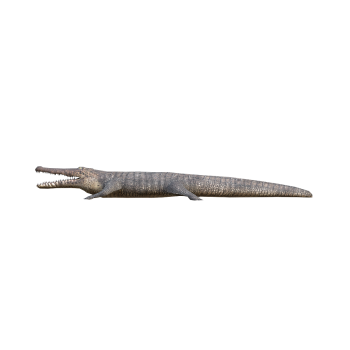
Henghe crocodile cubs

Henghe crocodile cubs

The Henghe crocodile is a reptile belonging to the family Alligatoridae in the order Crocodiles, also known as the fish eating crocodile or the long snouted crocodile. The back is dark olive brown, and the belly is light in color. Kiss slender; There are 27-29 teeth on each side of the upper jaw and 25-26 teeth on each side of the lower jaw, with the same size of teeth; The body is covered with scales, and there is soft skin between each piece, which is easy to bend and stretch; The scales in the middle of the spine are angular and extend to the tail end; Fully webbed between toes. The juvenile is pale in color and has dark markings on it.
Henghe crocodile specimen

Henghe crocodile specimen

The Henghe crocodile is a reptile belonging to the family Alligatoridae in the order Crocodiles, also known as the fish eating crocodile or the long snouted crocodile. The back is dark olive brown, and the belly is light in color. Kiss slender; There are 27-29 teeth on each side of the upper jaw and 25-26 teeth on each side of the lower jaw, with the same size of teeth; The body is covered with scales, and there is soft skin between each piece, which is easy to bend and stretch; The scales in the middle of the spine are angular and extend to the tail end; Fully webbed between toes. The juvenile is pale in color and has dark markings on it.
Dwarf crocodile

Dwarf crocodile

The dwarf crocodile is the smallest crocodile in the world. They are mainly distributed in West and Central Africa, and due to congenital factors, their body proportions are severely imbalanced. Dwarf crocodiles live in rivers and swamps, and they often climb trees to bask in the sun. The dwarf crocodile has a very small body shape, and the length of an adult dwarf crocodile is only about one meter, which is one-fifth of other adult crocodiles. It is simply a miniature version of a crocodile, so it is named the dwarf crocodile.
American crocodile cub (with 3D animated model)

American crocodile cub (with 3D animated model)

Also known as the American crocodile, it is a freshwater crocodile that lives in North America and is mainly distributed in rivers, swamps, and wetlands in the southeastern United States. It is one of the two largest existing crocodiles, second only to saltwater crocodiles. Large in size, adult individuals can grow up to 4 to 5 meters in length and weigh up to 450 to 1000 kilograms. Having a powerful jaw and sharp teeth, it is a top predator. Food includes fish, birds, small mammals, and other reptiles. Their skin is dark in color, usually black or dark olive, which helps them camouflage in water. The tail is strong and powerful, and is the main tool for swimming and movement.
3D model of leatherback turtle with animation

3D model of leatherback turtle with animation

Also known as the leather turtle or stingy turtle, it is the largest surviving hard shell sea turtle in the world, renowned for its unique skin and massive size. Their characteristic is having a carapace without a bony shell, replaced by a layer of leathery skin covered in seven longitudinal ridges, which makes them very unique among sea turtles. Widely distributed in tropical and subtropical waters around the world, their living habits mainly involve swimming in the ocean, with jellyfish as their main source of food. The beak is particularly adapted to prey on jellyfish and can easily cut and swallow these soft prey. Large in size, it can grow to over 1.5 meters and weigh hundreds of kilograms.
Crocodile 3D model animation glb

Crocodile 3D model animation glb

It is an ancient and powerful reptile belonging to the crocodile order, distributed in tropical and subtropical regions around the world. It is one of the oldest surviving reptiles with strong adaptability, able to survive in both freshwater and saltwater environments. The body structure is adapted to hunting and diving, with strong jaws and sharp teeth that can easily capture and tear prey. The skin is thick and covered with bony scales, providing excellent protection. The eyes, ears, and nostrils are located at the top of the head, allowing them to observe and breathe underwater. He is an opportunist with a wide range of diets, including fish, birds, mammals, and other reptiles.
Ball Python (Black Yellow) 3D Model Animation

Ball Python (Black Yellow) 3D Model Animation

The ball python has a sturdy body, a triangular head, large and bright eyes, and vertical pupils. The skin is smooth and has a variety of colors, often with various patterns such as stripes, spots, or marble textures. Feed on small mammals such as mice and rabbits. When hunting, they will use powerful muscles to quickly wrap and strangle the prey, and then swallow it whole. The breeding method is egg laying, and females can lay 20 to 50 eggs per year. They are usually active at night, but their activity time may vary in artificial breeding environments. Due to its gentle temperament and easy to raise characteristics, ball pythons are a very popular choice among pet snakes.
Ball Python (Yellow White) 3D Model Animation

Ball Python (Yellow White) 3D Model Animation

The ball python has a sturdy body, a triangular head, large and bright eyes, and vertical pupils. The skin is smooth and has a variety of colors, often with various patterns such as stripes, spots, or marble textures. Feed on small mammals such as mice and rabbits. When hunting, they will use powerful muscles to quickly wrap and strangle the prey, and then swallow it whole. The breeding method is egg laying, and females can lay 20 to 50 eggs per year. They are usually active at night, but their activity time may vary in artificial breeding environments. Due to its gentle temperament and easy to raise characteristics, ball pythons are a very popular choice among pet snakes.
Shooting turtle (with 3D animated model)

Shooting turtle (with 3D animated model)

It is a small to medium-sized freshwater turtle belonging to the family Turtles. Native to North America, especially the waters of the southeastern United States and northeastern Mexico. Known for their vibrant shell and skin patterns, they typically have yellow or orange stripes that form unique patterns on their shells, which is also the origin of their name. It is an omnivorous animal, and its diet includes aquatic plants, algae, insects, small fish, and worms. In the wild, ray turtles usually inhabit water bodies such as rivers, lakes, swamps, and ponds, and are good at swimming and diving. They are also popular pet turtles because they have a gentle personality and are easy to raise.
Hawksbill turtle (with 3D animated model)

Hawksbill turtle (with 3D animated model)

It is a large sea turtle widely distributed in tropical and subtropical waters around the world. The carapace presents a unique brown or black color with yellow or orange markings, hence the name "hawksbill turtle". The lifespan can reach 70 to 80 years, or even longer. It feeds on seagrass, algae, and other marine plants, and occasionally preys on fish and crustaceans. The breeding habits are very unique, usually returning from the ocean to the beach every 2 to 3 years to lay eggs. Female hawksbill turtles will come ashore at night, choose a suitable location to dig sand pits, and lay hundreds of eggs. After hatching, young turtles will quickly head towards the sea and begin their journey of survival.
Galapagos Turtle 3D Animation Model

Galapagos Turtle 3D Animation Model

It is a large land turtle living on the Galapagos Islands in Ecuador, belonging to the family Turtles. It is one of the largest surviving turtles in the world, with an adult body weight of up to 300 kilograms and a lifespan of over 150 years. Known for its massive size and slow movement speed, its carapace is dome shaped or saddle shaped, adapting to different ecological environments on the island. The significant differences in body shape and living habits among different islands in the archipelago are important evidence for Darwin's theory of evolution. Mainly feeds on plants, including herbaceous plants, leaves, and cacti. Currently listed as an endangered species and protected by international conservation organizations.
Madagascar Land Turtle 3D Model Animation

Madagascar Land Turtle 3D Model Animation

It is an endemic species only found on the island of Madagascar. The body is large, with an adult's shell length of up to 90 centimeters and a weight of up to 130 kilograms. The shell is dark brown or black with yellow or orange markings on it. The head and limbs are usually gray or yellow. It is a herbivorous animal that mainly feeds on leaves, herbaceous plants, and fruits. Living in the tropical rainforests and swamps of Madagascar, these areas provide abundant food sources and suitable habitats. The slow reproduction rate and relatively low survival rate of young turtles make population recovery more difficult. Currently listed as critically endangered species.
Green Turtle 3D Model Animation

Green Turtle 3D Model Animation

It is a relatively large sea turtle belonging to the family Turtles. Widely distributed in tropical and subtropical seas worldwide. The name comes from the color of its fat layer, not its outer shell, which is usually olive or brown, while the fat layer is green. It is a herbivorous animal that mainly feeds on seagrass, and sometimes also consumes aquatic plants and algae. Known for its long-distance migration, it swims from foraging grounds to breeding grounds, sometimes covering distances of thousands of kilometers. The breeding cycle usually takes place at night, and females dig holes on the beach to lay eggs, then cover and leave, allowing the heat of the sun to naturally hatch.
Turtle (cub) 3D model animation

Turtle (cub) 3D model animation

It is a larger species in the family Turtles. Widely distributed in warm waters around the world, it mainly feeds on seagrass and seaweed, and occasionally consumes jellyfish and mollusks. The shell is elliptical in shape, with colors ranging from olive green to dark brown. The scales on the shell are arranged neatly, providing excellent protection. The lifespan is relatively long, generally reaching around 80 years old. The breeding season usually occurs in summer, and females return to their place of birth to lay eggs, with each egg laying up to a hundred or more. Due to overfishing and habitat destruction, green sea turtles are currently listed as endangered species and require more protection measures.
Snake (with 3D animated model)

Snake (with 3D animated model)

It is a legless reptile belonging to the snake suborder, with over 3000 different species. The body is slender and covered with scales, which help protect the skin and reduce friction. Vision is usually not very good, but they have other senses to compensate for this deficiency, such as detecting odors in the air through tongue signals and perceiving the surrounding environment by sensing ground vibrations. They have a diverse diet, some feed on small mammals, while others prey on birds, fish, or insects. Some snakes are poisonous, and they use their venomous fangs to inject venom to capture or kill their prey. Most snakes, on the other hand, are non-toxic and prey on them by coiling or swallowing
Crocodile (with 3D animated model)

Crocodile (with 3D animated model)

It is an ancient and powerful reptile belonging to the crocodile order. Known for its powerful jaw force and unique lifestyle habits. Usually living in tropical and subtropical waters such as rivers, swamps, and lakes. It is a top predator that feeds on fish, birds, mammals, and even other reptiles. The body structure is adapted to aquatic life, with a streamlined body and strong limbs that can move quickly in water. The skin is covered with hard scales that not only provide protection but also help regulate body temperature. The eyes, ears, and nostrils are located at the top of the head, allowing them to breathe underwater and observe their surroundings.
1 2 3 Next