Crane relief in the forest

Crane relief in the forest

Japanese Red Ghost Wooden Mask

Japanese Red Ghost Wooden Mask

Musashino Six Screens

Musashino Six Screens

This is a six-fan screen depicting the Musashino region of Japan, and they usually appear in pairs. The screen may display a beautiful natural landscape and rich cultural elements.
Ray's Vase

Ray's Vase

The "Lei vase" (Lei vase) was made around 1580 and is now in the collection of the Cernuschi Museum. This vase is famous for its unique design and exquisite craftsmanship.
Japanese fox wooden mask

Japanese fox wooden mask

North Caucasus Sabre Shaskar

North Caucasus Sabre Shaskar

A single-edged, one-handed, unarmed saber from the North Caucasus, widely used by Cossack cavalry and became the standard weapon for Russian cavalry in the 19th century.
Japanese Red Ghost Wooden Mask

Japanese Red Ghost Wooden Mask

Cloisonne enamel vase

Cloisonne enamel vase

Brook Chrysanthemum Screen

Brook Chrysanthemum Screen

It is a screen painting with the theme of chrysanthemums and streams, which is commonly found in traditional Japanese art.
Hangzhou Ancient Temple Relief Mural

Hangzhou Ancient Temple Relief Mural

South China Sea Guanyin Stone Carvings

South China Sea Guanyin Stone Carvings

Guofeng handmade paper plum blossom fan

Guofeng handmade paper plum blossom fan

During the Qing Dynasty, Fang Ding-style copper incense burner

During the Qing Dynasty, Fang Ding-style copper incense burner

Japanese Togou Wooden Mask

Japanese Togou Wooden Mask

A dog is a type of monster in Japanese folklore that has the shape of a half-human, half-bird, usually with a long nose and a red mask. The dog has a rich symbolic meaning in Japanese culture. It is regarded as a mountain god and protector, and is also regarded as a troublemaker and disaster-causing existence.
Stone Lion Statue

Stone Lion Statue

Cast copper antique national style incense burner

Cast copper antique national style incense burner

Chinese copper official kiln pottery cock

Chinese copper official kiln pottery cock

Tongguan Kiln, located in Changsha City, Hunan Province, is one of the famous ceramic kiln sites in ancient China and is famous for its exquisite ceramic products. The pottery cock is one of the typical works. This pottery cock is made with exquisite craftsmanship and vivid shape, and is often used as an ornament or gift. The image of the rooster has a rich symbolic meaning in Chinese culture, usually representing auspiciousness, bravery and hard work. This pottery cock is currently in the collection of Changsha Tongguan Kiln Ceramic Research Institute.
Japanese-style Cast Iron Teapot

Japanese-style Cast Iron Teapot

Jingdezhen Blue and White Porcelain Cup-shaped Vase

Jingdezhen Blue and White Porcelain Cup-shaped Vase

This Chinese cultural relic is a porcelain vase from the Kangxi period of the Qing Dynasty (1662-1722). The vase process is a transparent colorless blue and white porcelain with cobalt pigment under the glaze, which was fired by Jingdezhen.
Jingdezhen Blue and White Porcelain Mallet Vase with Lid

Jingdezhen Blue and White Porcelain Mallet Vase with Lid

This Chinese cultural relic is a porcelain vase from the Kangxi period of the Qing Dynasty (1662-1722). The vase process is a transparent colorless blue and white porcelain with cobalt pigment under the glaze, which was fired by Jingdezhen.
Jingdezhen Blue and White Porcelain Mallet Vase

Jingdezhen Blue and White Porcelain Mallet Vase

This Chinese cultural relic is a porcelain vase from the Kangxi period of the Qing Dynasty (1662-1722). The vase process is a transparent colorless blue and white porcelain with cobalt pigment under the glaze, which was fired by Jingdezhen.
Peony pattern water container

Peony pattern water container

This artwork called "Peony Pattern Water Container" was created by Japanese artist Seif ū Yohei III (1851-1914), and was made between 1900 and 1914. It is made of porcelain, with a molded and carved design on the surface, and a green glaze. The overall height is 17.8cm (7 inches) and the diameter is 16cm (6 5/16 inches). The artwork is currently in the collection of the Cleveland Museum of Art and was donated by James and Christine Hoysinger.
Crane and Snake

Crane and Snake

The artwork, titled "Crane and Snake", is from Changsha, Hunan Province, China, and belongs to the Warring States Period (475-221 BC) and the State of Chu (about 1046-223 BC). It is made of painted wood and has overall dimensions of 132.1 x 124.5cm (52 x 49 in). The artwork is currently in the collection of the Cleveland Museum of Art.
18th Century Chinese Cloisonne Vase

18th Century Chinese Cloisonne Vase

Cloisonne, also known as cloisonne enamel, is a traditional Chinese metal handicraft. It originated in the Ming Dynasty and reached its peak in the Qing Dynasty. Cloisonne products are usually bright colors, exquisite patterns, common themes are flowers, birds, auspicious patterns and so on. It is not only practical, but also has a high artistic value, known as the "mother of porcelain".
Pottery Figurines of Horse Riding in Tang Dynasty

Pottery Figurines of Horse Riding in Tang Dynasty

Commonly known as the Tang Sancai, it is a treasure of ancient Chinese ceramic firing technology. With its rich colors and vivid modeling, it reflects the prosperity of the Tang Dynasty society and the importance of horses. The production process is complex. It provides people with valuable material materials to understand the historical value of Chinese Tang culture, and also makes batch after batch of Chinese and foreign collectors fall in love with its artistic charm. It is one of the most common themes in the culture and art of the Tang Dynasty. The discovery of the terracotta warriors of the Tang Dynasty has enriched our understanding of the culture and art of the Tang Dynasty, and also demonstrated the outstanding achievements of the Tang Dynasty in ceramic craftsmanship.
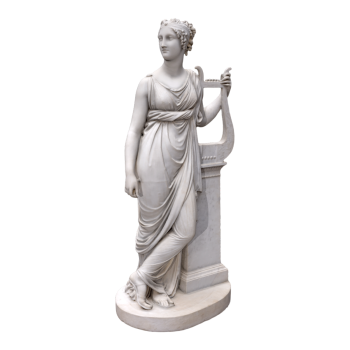
Statue of Goddess Tralock

Statue of Goddess Tralock

In Aztec culture, the name of Chalchiutlikue means "the woman in the jade dress", and she is not only Trellock's wife, but is sometimes considered his sister. Her image often appears in water-related sculptures and artifacts, symbolizing the vitality and purifying power of water. These sculptural artifacts usually show her wearing an ornate jade skirt, symbolizing her deep connection to water. She is believed to be able to trigger storms and whirlpools, protect navigators, and is worshipped in agricultural rituals as a goddess who can make the land fertile.
Emblem of the Russian Empire

Emblem of the Russian Empire

It is a badge with rich history and symbolic significance, and its core element is the double-headed eagle. The design can be traced back to the 15th century AD. The double-headed eagle was originally the emblem of Constantine I of the Byzantine Empire, symbolizing the unity between the two continents and the union of various ethnic groups. On the chest is a small shield, above which is a knight and a white horse, representing the capital Moscow. The knight faced to the right, wearing silver armor and a pale blue cloak, holding a golden spear in his hand and stabbing a black serpent-like monster. The double-headed eagle, looking at the east and west, represents that Russia is a country that crosses the continents of Asia and Europe. Three crowns symbolize the unity of the Russian Federation
Stone Bergamot

Stone Bergamot

Gilded Record Hanging

Gilded Record Hanging

four stacks of gold coins

four stacks of gold coins

Stone Statues of Buddha Sitting on All Sides of the Northern Wei Dynasty

Stone Statues of Buddha Sitting on All Sides of the Northern Wei Dynasty

In 1957, the stone statues of Buddha sitting in the four niches of the Northern Wei Dynasty unearthed in Nanniwan, Qin County, were collected by the Nanniwan Stone Carving Museum in Qin County. There are 4 niches and 4 statues of Buddha.
clay pot

clay pot

An earthenware jar found in northern Motala, Sweden. About 105mm tall.
Buddha

Buddha

The image of Buddha. Generalized including Bodhisattva, Rohan, Ming Wang, and so on. Although there are two kinds of statues, sculptures and portraits (pictorial), only sculptures are called Buddha statues, while portraits are called images. In ancient India, it was believed that carving Buddha statues was a blasphemy, so ancient carvings such as Shanqi (Sanskrit ^ nchi ^) only symbolized Buddha with the marks of Buddhism, Bodhi tree, Buddha's footprints, etc. Later, with the rise of Mahayana Buddhism, the sculpture of Buddha began to prevail, so there are many records about the cause of the statue and its merits in the Mahayana classics.
Medieval silver goblet

Medieval silver goblet

EarthSong statue-Miloš Axman

EarthSong statue-Miloš Axman

Created in 1986 by Czech artist Miloš Axman, this sculpture uses sandstone as the material. Located in the Kohoutovice district of Brno, Czech Republic, this sculpture is not only one of the masterpieces of his artistic career, but also an important cultural landmark of the region. Known for his outstanding contributions to the art of sculpture, his work covers a wide range of areas from small interior works to large monumental sculptures. With its unique artistic style and profound cultural connotation, it has become an indispensable part of Brno's urban landscape.