
Starling specimen

Starling specimen

Also known as black starling, a bird of the genus starling family. The body is large, 23-28cm long, black throughout, with a long and vertical feather cluster on the forehead, resembling a crown. The tail feathers and the overlying feathers under the tail have white end spots. The mouth is milky yellow and the feet are yellow. Sounds like starling, trained to imitate human language, is a famous cage bird. It feeds on insects such as locusts and flies, and also eats plant foods such as grains, plant fruits and seeds. It is a social bird that likes to move with its peers. It will form a group of dozens to hundreds of birds, forage and inhabit together, and maintain the relationship between the groups through complex communication methods.
Exquisite female wood carving

Exquisite female wood carving

A bronze statue of a Buddhist monk sitting in meditation

A bronze statue of a Buddhist monk sitting in meditation

Bronze Buddha Avatar

Bronze Buddha Avatar

GeneraalChass Bronze Bust

GeneraalChass Bronze Bust

GeneraalChass was a Dutch military figure whose career was filled with adventure. Initially, he worked for Dutch patriots, French revolutionaries, and Emperor Napoleon. After 1814, he switched to serving the Netherlands. In 1832, he commanded the city's forts during the French siege of Antwerp, thus gaining the status of national hero, and was subsequently appointed commander of the Breda fortress. He died in 1849 and was buried in the Ginneken cemetery. In 1899, the municipality of Breda offered a bust of this GeneraalChass.
Balinese Women Wood Carvings

Balinese Women Wood Carvings

Bone Buddha

Bone Buddha

Woman and dragon exquisite wood carving

Woman and dragon exquisite wood carving

The Head of Van Gogh-The Creations of Andrea Schaller

The Head of Van Gogh-The Creations of Andrea Schaller

Andre Schaller is a Swiss artist known for his deep understanding of Vincent van Gogh and his unique artistic style. His work "The Head of Van Gogh" is a tribute to Van Gogh's legendary life, showing Van Gogh's complex emotional and spiritual world through sculpture. It is not only a reproduction of Van Gogh's appearance, but also a profound interpretation of his inner world. Through the texture and form of the sculpture, the viewer can feel Van Gogh's pain, passion and endless pursuit of art. This work is often seen as an exploration of Van Gogh's spiritual dimension and a reflection on his dual identity as an artist and an individual.
Ammonite fossil

Ammonite fossil

It is an extinct marine cephalopod mollusk, belonging to the subclass ammonites, which lived from the Devonian to the end of the Cretaceous. It is known for its unique spiral shell, which usually presents complex patterns and designs, is made of calcium carbonate, and is divided into chambers separated by thin walls called partitions. The diameter of the ammonites varies from a few centimeters to more than two meters, and the shapes are varied, from tightly coiled forms to more open and loosely coiled forms. One of the most abundant and successful sea creatures of its time, it was an active predator, catching prey with its tentacles. The rapid evolution and wide distribution of ammonite make it an important standard fossil for stratigraphic division and correlation
Guanyin Statue

Guanyin Statue

Guanyin Bodhisattva is one of the four great bodhisattvas in Chinese Buddhism. According to legend, his birthday is on the 19th day of the second lunar month, the day of enlightenment is on the 19th day of the sixth lunar month, and the day of Nirvana is on the 19th day of the ninth lunar month. It is said that the Taoist temple is Mount Putuo. The belief in Guanyin has had a profound influence in China, leading to various folk legends about Guanyin Bodhisattva, such as the widely circulated belief that Guanyin is Princess Miaoshan, the third princess of King Miaozhuang of Xinglin Kingdom. This kind of female Guanyin legend can first be seen in Zhu Ben's "Qu Yu Jiuwen" during the Song Dynasty. Afterwards, Guan Daosheng's biography "Biography of Guanyin Bodhisattva" became a complete biography during the late Song and early Yuan dynasties.
Guanyin Statue

Guanyin Statue

Guanyin Bodhisattva is one of the four great bodhisattvas in Chinese Buddhism. According to legend, his birthday is on the 19th day of the second lunar month, the day of enlightenment is on the 19th day of the sixth lunar month, and the day of Nirvana is on the 19th day of the ninth lunar month. It is said that the Taoist temple is Mount Putuo. The belief in Guanyin has had a profound influence in China, leading to various folk legends about Guanyin Bodhisattva, such as the widely circulated belief that Guanyin is Princess Miaoshan, the third princess of King Miaozhuang of Xinglin Kingdom. This kind of female Guanyin legend can first be seen in Zhu Ben's "Qu Yu Jiuwen" during the Song Dynasty. Afterwards, Guan Daosheng's biography "Biography of Guanyin Bodhisattva" became a complete biography during the late Song and early Yuan dynasties.
【 Wood Carving 】 Avalokitesvara Bodhisattva (3D printable)

【 Wood Carving 】 Avalokitesvara Bodhisattva (3D printable)

Avalokitesvara Bodhisattva, also known as Avalokite ś vara in Sanskrit, is a transliteration of the Sanskrit word Avalokite ś vara. It is also translated as "Avalokitesvara" or "Avalokitesvara" and transliterated as "Avalokitesvara" or "Avalokitesvara". Amitabha Buddha's left attendant, one of the "Three Saints of the West". Buddhism believes that Avalokitesvara Bodhisattva is a compassionate and benevolent bodhisattva. When suffering beings recite his name, the Bodhisattva immediately observes his voice and goes to save and liberate them, hence the name. During the Tang Dynasty, due to the taboo of using the name of Emperor Taizong Li Shimin, the character "shi" was removed and he was briefly referred to as "Guanyin".
Shuiyue Guanyin

Shuiyue Guanyin

Shuiyue Guanyin, also known as Water Auspicious Guanyin or Water Auspicious Bodhisattva, is the corresponding incarnation of Guanyin's thirty-three phases of observing water with one heart. The name 'Shuiyue' is not derived from early Buddhist scriptures, but rather from the fusion of Buddhism with local culture after it was introduced to China. There are different theories about the origin of Shuiyue Guanyin, but it is currently unanimously believed to be related to the mid Tang painter Zhou Fang. According to Xuanzang's "Records of the Western Regions of the Great Tang Dynasty", Zhou Fang created the body of Guanzi Bodhisattva in the Bu'luojia Mountain, which is described as "a marvelous creation of water and moon". This painting depicts a full moon surrounding Guanyin, surrounded by a bamboo forest. Since the Tang Dynasty, the image of Shuiyue Guanyin has been constantly evolving, and its sitting posture has also undergone several changes.
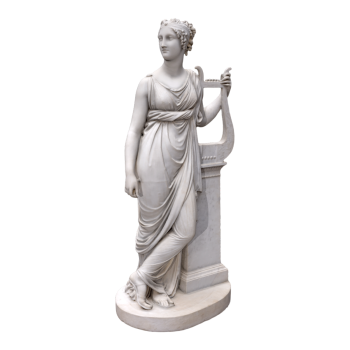
Statue of Nike, the Greek goddess of victory

Statue of Nike, the Greek goddess of victory

Niki (Greek: Νίκ η, "victory"; Latin transliteration: Nike) is the goddess of victory in Greek mythology, corresponding to Victoria in Roman mythology. According to Hesiod's Theogony, she was the daughter of the Titan gods Pallas and Styx, as well as the sister of Kratos (power), Biya (strength), and Zeros (passion), all of whom were companions of the main god Zeus. Despite coming from the Titan tribe, she still stood by the side of the Olympian gods in the Titan Wars, bringing them victory.
Red Horse Ceramics

Red Horse Ceramics

Zhou Qingding's sculpture "Elephant"

Zhou Qingding's sculpture "Elephant"

Zhou Qingding (1896.4.1-1984.11.12), born in Anren County, Hunan Province, was a modern sculptor and the founder of animal porcelain carving in China. After the establishment of the People's Republic of China, he served as the head of the Sculpture Department at Zhejiang Academy of Fine Arts (later renamed as the head of the Folk Art Department), dedicated to the research, creation, and teaching of animal sculpture, and achieved remarkable achievements. He inherits the tradition of realistic sculpture in France, attaches great importance to imitating nature, emphasizes the expression of animal vitality, strives to have both form and spirit, does not attach too much importance to ornamentation, uses concise and vivid language, is full of interest, and is full of poetic and picturesque charm.
Fortune, Fortune, Longevity, and Three Stars (Yellow Peach Woodcarving)

Fortune, Fortune, Longevity, and Three Stars (Yellow Peach Woodcarving)

The Three Stars of Fortune, Fortune, and Longevity originated from people's natural worship of ancient stars. In the beginning of spring, in the south, there are three stars that are closely spaced and connected in a straight line. Chinese people call these three stars "Lu, Fu, and Shou", and regard them as three auspicious stars that respectively govern the blessings, longevity, and other aspects of the world, known as the "Three Stars of Fu, Lu, and Shou". As the saying goes, "Three stars shine high, and the New Year is coming!" When three stars hang high in the southern sky at night, it is the time of Chinese Spring Festival. This is a belief belonging to the Chinese people. They have a great influence in the Han people. The three immortals of happiness, wealth and longevity have become a true portrayal of the Han people's secular life ideal.
Sun Wukong Bamboo Root Carving Crafts (available for download in STL format and 3D printing)

Sun Wukong Bamboo Root Carving Crafts (available for download in STL format and 3D printing)

Sun Wukong (also known as the Monkey King, the Monkey King, the Monkey King, the Monkey King, and the Fighting Buddha) is a character in the classical Chinese mythological novel "Journey to the West". The inspiration for the origin of the Monkey King predates novels and can be traced back to the Indian epic Ramayana and the Song Dynasty monkey god Hanuman. In the novel, he is a stone born monkey who has gained supernatural powers through Taoist cultivation. After resisting the Way of Heaven and being imprisoned by the Buddha at the foot of the mountain, he subsequently accompanied Tang Sanzang to the West (Indian subcontinent) where the Buddha and his followers lived to retrieve Buddhist scriptures.
Bodhidharma (boxwood carving)

Bodhidharma (boxwood carving)

The works of Chinese arts and crafts master Liang Fengzhu, created in 2015, are now collected at the Liang Fengzhu Arts and Crafts Museum in Nanyue, Hengyang, China. The wooden carving is 31 centimeters high and 8 centimeters wide. Bodhidharma was a semi legendary Buddhist monk who lived in the 5th or 6th century. He is traditionally considered the disseminator of Zen Buddhism in China and is regarded as the first Chinese master of Zen Buddhism. According to Chinese legend, he also began physical training for Shaolin monks, thus creating Shaolin Kung Fu. In Japan, he is called Daruma. His name in Sanskrit means' the law of awakening (bodhi) '.
Bronze Cup of the Shang Dynasty

Bronze Cup of the Shang Dynasty

Jue, also known as Jue Cup, is an ancient type of drinking vessel in Chinese bronze ware. According to historical records, noble people were granted titles as a reward by ancient emperors when they divided the feudal lords. Later on, "jue" became the abbreviation for "title", and "promotion to a higher rank" came from this. The cup of nobility is in hand, occupying the favorable timing, location, and people's harmony, symbolizing the victory over difficulties, invincible in all directions, promotion to higher positions, and celebration of victory.
Eastern Han Dynasty pottery figurine for storytelling

Eastern Han Dynasty pottery figurine for storytelling

Eastern Han Dynasty pottery figurine for storytelling. Also known as rap figurines. Excavated in Chengdu, Sichuan Province in 1957. Sitting storytelling figurine: 56 centimeters high, made of clay red pottery, molded. Wearing a scarf and a tassel, with floral decorations in front of the forehead. The belly is bulging, the facial expression is humorous and comical, there are several wrinkles on the forehead, and the mouth is open with teeth exposed. Like a very vivid image of a rap artist.
Terra Cotta Warriors in the Mausoleum of the Qin Emperor

Terra Cotta Warriors in the Mausoleum of the Qin Emperor

The Terra Cotta Warriors, namely the Terra Cotta Warriors in the the Mausoleum of the First Qin Emperor, also referred to as the Terra Cotta Warriors or the Terracotta Warriors, are the first batch of national key cultural relics protection units and the first batch of Chinese world heritage sites. They are located in the Terra Cotta Warriors pit 1.5 kilometers east of the the Mausoleum of the First Qin Emperor in Lintong District, Xi'an, Shaanxi Province. More than 200 foreign heads of state and government have visited and toured, becoming a golden business card of China's ancient glorious civilization and also known as one of the world's top ten rare ancient tombs.
Terra Cotta Warriors

Terra Cotta Warriors

The Terra Cotta Warriors is a category of ancient tomb sculptures. In ancient times, human sacrifice was practiced, and slaves were considered as accessories of the slave owner during their lifetime. After the slave owner's death, the slaves were buried as sacrificial objects with the slave owner. The Terra Cotta Warriors are burial objects in the shape of soldiers and horses (chariots, horses, soldiers). It is an important part of the first batch of national key cultural relics protection units and the world cultural heritage "Mausoleum of Qin Shi Huang and Terracotta Warriors".
Kneeling Shooting Terracotta Warriors

Kneeling Shooting Terracotta Warriors

The kneeling shooting terracotta warrior is dressed in a battle robe and armor, with a bun tied on the left side of their head. Their feet are aligned with the square mouth and their head is raised with pointed shoes. Their left leg is crouched and bent, their right knee is on the ground, and their upper body is slightly turned to the left. Their hands are raised and lowered on the right side of their body in a bow holding posture, showing a solo practice movement of holding a bow. In the sculpture art of kneeling and shooting terracotta warriors, one thing that is very valuable is that their shoe soles and meticulously crafted stitches reflect an extremely strict realistic spirit, allowing future viewers to feel a strong sense of life from the Qin Dynasty warriors. Among all the Terra Cotta Warriors unearthed, the kneeling shooting Terracotta Warriors are the only Terra Cotta Warriors that were extremely complete when they were found.
Armored warrior figurines from the Sixteen Kingdoms period (collected by Xi'an Museum)

Armored warrior figurines from the Sixteen Kingdoms period (collected by Xi'an Museum)

The Sixteen Kingdoms (304-439 AD) was a period of great division in Chinese history. This period began in 304 when Li Xiong and Liu Yuan respectively established Chengguo (Chenghan) in the Han region of Bashu and Han Zhao (Former Zhao) in the Central Plains, and lasted until 439 when Emperor Taiwu of Northern Wei, Tuoba Tao, conquered Beiliang and unified the north.
Imperial Purple Butterfly Specimen

Imperial Purple Butterfly Specimen

It is a temperate butterfly mainly distributed in forests of Europe and Asia. Often soaring high on the top of the forest, male butterflies are sometimes attracted to decaying corpses on the ground because they need to absorb minerals from the corpses. Adult butterflies have dark brown wings with white lines and small orange rings on them. Male butterflies have a shiny blue purple luster, while females do not have this luster. The larvae are green in color, with white and yellow spots on them, and have two large antennae. They are larger in size than ordinary butterflies. The surface of its wings is covered with transparent scales, which reflect light to form interference patterns, causing the human eye and brain to perceive it as purple.
Elephant hawk moth specimen

Elephant hawk moth specimen

It is a very common moth in Europe, known for its unique appearance and behavior, and is known as the "four unlike" of the insect kingdom. It has a very beautiful appearance, with soft golden and magenta scales covering its wings and body, resembling a futuristic jet plane. The larval stage usually appears dark, sometimes bright green, and is said to resemble the trunk of an elephant, but is more often compared to pet feces. It is a nocturnal creature that feeds on nectar, has a keen sense of smell and color vision, and can find flowers in the dark. Belonging to the family of hawk moths, it is known for its fast wing flapping and acrobatic flight.
Large Blue Butterfly Specimen

Large Blue Butterfly Specimen

It is a butterfly distributed in Europe, known for its unique ecological habits and conservation needs. The adult body length is approximately between 35 and 40 millimeters, with bright blue wings and black and white spots on the edges. The larval stage is very special, and there is a symbiotic relationship with ants. They will spend time in specific ant nests, where ants protect their larvae and provide food. Larvae will mimic the appearance and behavior of ants to gain their acceptance. This unique lifecycle makes the Blue Butterfly very demanding of its habitat, requiring specific plants as a food source and habitat adjacent to ant nests.
Emperor moth caterpillar specimen

Emperor moth caterpillar specimen

The emperor moth is a large moth species known for its spectacular wings and unique life cycle. The wings can extend up to 20 to 30 centimeters, making it one of the largest species of moths with wings. The larval stage is spent in a very narrow cocoon, and when they are ready to transform into adults, they must pass through a cocoon opening that is relatively small to their own body. For them, it is a huge challenge because only through this difficult process can the wings obtain sufficient blood supply and thus acquire the ability to fly. The mouthparts of adult insects will degrade after metamorphosis, so they cannot eat and can only rely on the energy stored during the larval stage for survival.
Dragonfly specimen

Dragonfly specimen

He is one of the strongest members in the insect kingdom in terms of flying ability, known for his agile flying skills and hunting ability. The body size ranges from small to large, and is divided into three parts: head, chest, and abdomen. The head usually has a pair of large and prominent compound eyes, providing excellent visibility. The wings are transparent or semi transparent, with two pairs, the forewings and hindwings, which can quickly adjust the angle during flight, achieving high difficulty movements such as hovering, quick turning, and diving in the air. Larvae live in water and feed on small aquatic animals, while adults prey on other flying insects in the air. The hunting method is very unique, able to chase and capture prey in the air.
Green Haired Butterfly Specimen

Green Haired Butterfly Specimen

It is a small butterfly belonging to the family Nymphalidae. It is known for the bright green and white stripes at the bottom of its wings, while the upper part of its wings is a relatively dull brown. Males may perform spiral flight near shrubs, while females are less conspicuous and are usually detected during egg laying. Larvae mainly feed on plants such as rock roses and common bird footed grasses, which grow on calcareous grasslands. Distributed on various soil types, but strongly associated with areas with shrubs and shrubs. Widely distributed in the UK and Ireland, but not for garden visitors, it is usually difficult to spot. It is a medium priority species for butterfly conservation.
Grassland brown butterfly specimen

Grassland brown butterfly specimen

Also known as the eye butterfly, it is a butterfly commonly found on the grasslands of Europe and Asia. Belonging to the Lepidoptera family, it is a small to medium-sized butterfly with brown wings and distinct circular eye spots that may be used to scare or confuse predatory birds. Larvae typically have a velvet like brown or green color and small, forked tail like appendages on their bodies. The tips of adult antennae gradually thicken, but not significantly; Forefoot degeneration, no need for contraction, males only have one tarsi, females have 4 to 5 tarsi, and claws are completely degenerated. The underside of the wings often has numerous eye shaped circular markings near the outer edge. It appears extensively in summer, especially on the grasslands of the United States and Europe.
Leopard moth specimen

Leopard moth specimen

Also known as garden tiger moth, it is a widely distributed moth species in Europe and Asia, also found in North America. It is named "caterpillar" because of its bright orange and black markings on the adults and the long, dense black and ginger yellow hair covering the larvae. Active during the summer months of July to August, especially in shrub covered sand dunes, forest edges, wetland grasslands, parks, and gardens. Larvae mainly feed on nettles, soursop, and other garden plants, which provide a rich source of food. Adults feed on nectar and fly at night, possessing a protective coloration to warn predators of their unpleasant taste. It can also generate harsh sounds by rubbing its wings to resist natural enemies
Pearl edged butterfly specimen

Pearl edged butterfly specimen

It is a medium-sized butterfly known for its pearl shaped white spots at the bottom of its wings and bright orange wings. It appears very early in spring and can be found in forest clearings or rough slopes with ferns in April. Usually flying near the ground, often stopping to smoke spring flowers such as snowballs. The conservation status of this butterfly is highly valued in the UK, and its population is rapidly declining in the UK and Wales, currently in a highly threatened state. Larvae mainly feed on plants of the Violaceae family and require sufficient food. Plants grow in short and sparse vegetation, with abundant fallen leaves.