Wamalina Benedictine Monastery

Wamalina Benedictine Monastery

"Wamalina Benedictine Monastery" (Monastero benedettino di Valmarina) is a medieval Benedictine monastery in the town of Wamalina, Treviso Province, Veneto Region (Veneto) in northern Italy. It is located in the hilly area at the southern foot of the Alps and adjacent to a tributary of the "Brenta River. It is an important witness to the history of the "religion-agriculture-culture" trinity in the Veneto region, and it is also a typical sample for studying the interaction between the Benedictine monastic system and local society in the Middle Ages in Italy.
Astino Monastery Astino Valley

Astino Monastery Astino Valley

"Astino Valley Astino Monastery" (Monastero di Astino) is a medieval monastery in the Astino Valley (Valle d'Astino) in the province of Bergamo, Lombardy, Italy. Its origin can be traced back to the 12th century. It is located in the hilly area in the southern foothills of the Alps, adjacent to the ruins of "Astino Castle. It is an important witness to the history of the trinity of "religion-lord-agriculture" in the Lombardy region, and it is also a typical sample for studying the interaction between Italian medieval monastic culture and local society.
Medieval retreat of San Coroma, Albendigo, Spain

Medieval retreat of San Coroma, Albendigo, Spain

The St. Kolomar Temple dates back to the 10th-11th centuries. After the 4th century, Christianity was widely spread in Europe, and some believers chose to stay away from the city and express their piety to God by ascetic in remote mountainous areas. This "reclusive life" was particularly prevalent in the Iberian Peninsula in the 8th-10th centuries. Albendigo is located at the junction of Navarre and the Basque region, with dense forests and inconvenient transportation, making it an ideal choice for hermits. The retreat is located on the hillside of the "Koroma Hill" on the northwest side of the town of Albendigo, about 850 meters above sea level, surrounded by fir forests and terraces. The site selection takes into account both "concealment" and "sanctity".
Medieval Church of New Calatrava, Spain

Medieval Church of New Calatrava, Spain

The "Medieval Church of Calatrava la Nueva" () is a medieval religious building in the municipality of Real, in the autonomous region of Castilla-La Mancha, central Spain, located in the center of the town of "Calatrava la Nueva", adjacent to the site of the former "Castle of Calatrava. It is an important witness to the history of Spain's "recovery of lost land movement" and "Calatrava Knights", and it is also a typical sample of the study of medieval religious architecture and local culture in the Iberian Peninsula.
Church of Santa Maria Immaculate Grace

Church of Santa Maria Immaculate Grace

"The Immaculate Church of Santa Maria in Bergamo Province" (Chiesa Santa Maria Immacolata delle Grazie) is a medieval to Renaissance Catholic church in Bergamo Province (Provincia di Bergamo, referred to as "BG") in Lombardy Region of Italy. With the theme of "Immaculate Virgin", it is an important landmark of "religion-art-community" integration in Bergamo region. The Church of the Immaculate Grace of Santa Maria dates back to the 13th century.
Church of Santa Maria, Barengo Campania

Church of Santa Maria, Barengo Campania

The "Church of Santa Maria di Campagna" (Chiesa Santa Maria di) is a medieval to Renaissance Catholic church in the municipality of Ballego, Piedmont, Italy. It is located in the core area of the old town of Ballego (Città Vecchia), adjacent to the "Castello di Barengo" (Piazza San Rocco), it is an important landmark in the "history-religion-life" triangle of Ballengo.
Church of Santa Maria del Cerf, Monza

Church of Santa Maria del Cerf, Monza

"Monza Santa Maria Delle Selve Church" (Chiesa di Santa Maria delle Selve) is a medieval to Renaissance Catholic church in Monza, Lombardy, Italy. It is located in the core area of the old city of Monza, adjacent to "Monza Cathedral" and "Royal Villa". It is an important landmark of Monza's "history-religion-culture" triangle.
St. George's Church, San Salvatore, Almeno

St. George's Church, San Salvatore, Almeno

"Chiesa di San Giorgio" is the core religious building of the town of Provincia di Bergamo (Comune di Almenno San Salvatore) in the province of Bergamo (Almeno di Como) in Lombardy, Italy. It is located in the hilly area on the west bank of Lake Bergamo (Lago di Como), adjacent to the historical trade route of "Bergamo-Crema", and it is the core of "religious culture-life area of Almeno.
Church of San Bernardo, Ronkora

Church of San Bernardo, Ronkora

"The Church of Ronkola San Bernardo" (Chiesa di San Bernardo) is a Catholic church from the Middle Ages to the Renaissance in the town of Ronkola, Bergamo Province, Lombardy, Italy. It is located in the hills on the west bank of Lake Bergamo (Lago di Como), adjacent to the "Como-Bergamo" historical trade route. It is the core landmark of "religion-culture-life" in Ronkola region. It has witnessed the rise and fall of rural churches in northern Italy in the Middle Ages and the faith inheritance of local communities. It is also an important building for the study of folk religious art in Lombardy region.
Spanish ancient building Consuegra Castle

Spanish ancient building Consuegra Castle

The history of Consuegra Castle can be traced back to the 10th century, and the Moors regarded it as the key node of the "Southern Defense Line. It was mainly used to defend against the attacks of the Christian kingdoms of the north and to control rivers and trade routes. In 1085, after King Alfonso VI of Castile captured Toledo, the castle was included in the Christian sphere of influence and gradually transformed from a military fortress to a "frontier defense center". With the gradual weakening of the military function of the Spanish unified Consuegra Castle, it was transformed into an aristocratic residence and administrative center. The local nobility, the "Kongsuegra family", became the actual controller of the castle through marriage with the royal family.
Italian ancient architecture Groscio San Faustino Castle

Italian ancient architecture Groscio San Faustino Castle

The castle dates back to the 12th century and was built under the auspices of the Lords of Grosio, a branch of the local aristocracy, the Visconti family. Its core function was to control the main transportation routes of the Valtellina Gorge and guard against predators from northern Europe and feudal rivals from the south. In the 13th century, the castle was given to the "San Fastino Monastery" and became a "religious-military complex". After the 15th century, with the unification of Lombardy by the Principality of Milan, the castle gradually lost its military function and was transformed into a noble summer palace and administrative center. During the rule of the Austrian Empire in the 18th century, some buildings were demolished for the construction of roads but the core structure was preserved.
Alco Castle, an ancient Italian building

Alco Castle, an ancient Italian building

The history of Alco Castle can be traced back to the 12th century, when the town of Alco became a battleground for military strategists because it was located in the Trento Basin and Lake Garda. At the end of the 12th century, the local aristocracy, the "Alco family", began to build the castle in order to consolidate their control over the territory. After the 15th century Alco Castle was incorporated into Venice's "border defense system". The Venetians reinforced the walls and added batteries on the original basis. During the Napoleonic Wars in the 18th century, the castle was briefly occupied by the French army, and then annexed to the Austrian Empire with Trento (1815), gradually losing its military function.
Old Calatrava of Real City

Old Calatrava of Real City

The Knights of Calatrava were founded in 1158 by King Alfonso VII of Castile (Alfonso VII) and the Knights Templar in order to resist Moorish domination of the Iberian Peninsula (I. e., the "Recapture Movement"). The name "Calatrava" comes from a castle near the city of Real (originally "Calatrava la Vieja"), which was the original headquarters of the Knights. Old Calatrava La Vieja served as the "mother fort" of the Knights at the time ".
Pagliari Borgo village in the small town of Carona

Pagliari Borgo village in the small town of Carona

"Borgo di Pagliari-Carona" () is a historical village in the municipality of Provincia di Como (Comune di Carona) in the Italian province of Lombardy, located in the hills on the west bank of Lake Como (Lago di Como). It is not only a core component of Carona's "Lake Mountain Town", but also a vivid witness to the "aristocratic manor culture" and "lakeside life" in Lombardy, combining natural beauty, historical heritage and local lifestyle.
Teso Borgo, Cornellode, City of Bégamo

Teso Borgo, Cornellode, City of Bégamo

"Borgo Cornello dei Tasso" is a historical block in the upper Bergamo of Bergamo (Città Alta) in Lombardy, Italy. It takes the manor and architectural heritage of the noble family "Tasso" from the 15th to 16th century as the core, and is an important carrier of the historical style of "Upper City" in Bergamo's "Double City Pattern. It not only retains the architectural essence from the Middle Ages to the Renaissance, but also witnesses the key history of Bergamo's transformation from a "free city-state" to a "noble territory.
Clagton Church in the Galloway region of Scotland

Clagton Church in the Galloway region of Scotland

Clagton Church is a historic country church in the Galloway area of south-west Scotland, located near the town of Clagton on the north shore of Clyde Bay. It is not only an important witness to the spread of Christianity in Galloway, but also a living carrier of "frontier culture" and rural history in Scotland. The Church of Clagton dates back to the 12th century and its origins are closely linked to the spread of "Celtic Christianity" in Scotland. The Galloway area was at the forefront of Scottish-Irish cultural exchange in the Middle Ages, where early missionaries were active, and Clagton Church may have originally been an improvised place of worship established by Celtic monks.
Jinshan Temple in Fuzhou

Jinshan Temple in Fuzhou

Jinshan Temple in Fuzhou is located on the Wulong River near Hongtang Village in the western suburbs of Fuzhou, Fujian. It is the only water temple in Fuzhou.
Japanese Shrine

Japanese Shrine

Shinto shrines are social houses that worship and honor various deities in Shintoism, and are the oldest type of religious architecture in Japan. Due to the close connection between Shintoism and the daily life of the Japanese people, shrines are very common. Since the 7th century, shrines have implemented a "replacement" system, which means they are rebuilt every few decades. Shinto shrines generally do not have incense offerings, whether it is a traditional tradition or a modern evolution. When people go to a shrine, they usually first clean their hands with a long handled wooden spoon by the pool in front of the shrine, then go to the shrine worship halls on both sides of the ridge, throw some change into the donation box with wooden bars, pat their hands a few times, and pray together.
Ancient Japanese temples

Ancient Japanese temples

3D model of Windsor Castle in the UK

3D model of Windsor Castle in the UK

It is one of the main official residences of the British royal family, located in the Royal Borough of Windsor Maidenhead in Berkshire, southeastern England. This historic castle was first built in 1070 by William I to protect the safety of ships and the royal family on the Thames River. After expansion and renovation by successive monarchs, Windsor Castle has become one of the largest inhabited castles in the world. Not only is it the administrative residence of the British monarch, but also the venue for their official and private activities. Queen Elizabeth II often spends weekends in the castle, which is also frequently used to receive foreign heads of state. He is a witness to British history.
Palazzo Borromeo, Italy

Palazzo Borromeo, Italy

It is a magnificent palace located on Lake Maggiore in northern Italy. It is the property of the Borromeo family, renowned for its exquisite architecture and rich art collection. Built in the 17th century, designed by renowned architects and designers including Carlo Belloto and Pietro Massajo. The architectural style embodies the luxury and delicacy of the Baroque period, with interior decorations including murals, tapestries, sculptures, and precious artworks. Not only is it the private residence of the Borromeo family, but it is also a treasure trove of art and culture, attracting thousands of visitors every year. Tourists can get a glimpse of the history of the Borromeo family and their love for art.
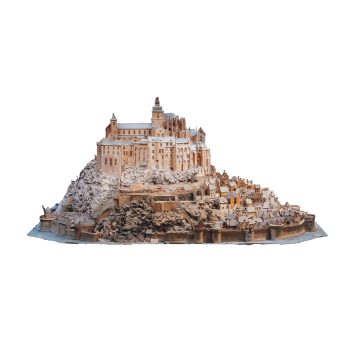
Mont Saint Michel, Normandy, France

Mont Saint Michel, Normandy, France

It is an iconic historical landmark in the Normandy region of France, located on a rocky island about 1 kilometer from the coast. Renowned for its unique natural landscapes and rich historical and cultural heritage, it has been listed as a World Cultural Heritage Site by UNESCO. The history can be traced back to the 8th century when a monastery was built on the island, which later developed into an important religious center. The monastery complex on the island includes Romanesque, Gothic, and Renaissance architectural styles, and is an outstanding representative in the history of French architecture. Mont Saint Michel is not only a destination for religious pilgrimage, but also an important location for military defense.
Model of Montserrat Palace in Spain

Model of Montserrat Palace in Spain

It is a historic architectural complex located in the Montserrat Mountains near Barcelona, Spain. Located on a picturesque mountaintop, overlooking the surrounding countryside and the distant Mediterranean Sea. The history can be traced back to the Middle Ages, initially as a monastery, which was later converted into a palace in the 19th century. The name comes from the patron saint of Catalonia, Saint Montserrat, which is not only a religious holy site but also a center of art and culture. The architectural style combines Gothic and Baroque elements. There is also a museum showcasing art works from ancient to modern times, including paintings, sculptures, and ceramics.
Saint Pierre Church in France

Saint Pierre Church in France

It is a Gothic building located in the Pyr é n é es department in eastern France, with a history dating back to the 17th century. It is a Gothic building located in the Pyr é n é es department in eastern France, with a history dating back to the 17th century. Construction began in 1606 and was not completed until 1696, replacing a smaller Romanesque church. The bell tower retains the Romanesque style, while the main building showcases the Gothic style of the 17th century. The interior decoration is magnificent, featuring a rich collection of artistic works and religious relics, including a large Baroque altar created by Catalan sculptor Joseph Sunier in 1699.
Chinese ancient multi story official residence

Chinese ancient multi story official residence

Chinese ancient double-layer warehouse

Chinese ancient double-layer warehouse

Chinese ancient smelting plant

Chinese ancient smelting plant

Chinese style bronze bell ancient architecture

Chinese style bronze bell ancient architecture

Chinese ancient architecture, double layered palace

Chinese ancient architecture, double layered palace

Proportional model of St. Peter's Basilica in Trier

Proportional model of St. Peter's Basilica in Trier

The Hohe Domkirche St. Peter in Trier is the cathedral of the Roman Catholic Diocese of Trier, measuring 112.5 meters (369 feet) in length and 41 meters (135 feet) in width, located in Trier, Germany. This church is the oldest cathedral in Germany, spanning over a decade and incorporating design elements from different generations.
Trier in 1945

Trier in 1945

Trier is the oldest city in Germany, with a history dating back to the Roman Empire. 1945 holds significant importance in Trier's history as it marked the end of World War II. The Second World War caused serious damage to Trier. Between December 16, 1944 and January 2, 1945, the United States Air Force and the Royal Air Force dropped a total of 1467 tons of bombs, resulting in the complete destruction of 1600 houses and the destruction of many ancient buildings.
Temple Bel

Temple Bel

The Temple of Bel is an ancient temple located in Palmyra, Syria. This temple was built to worship the god Bell of Mesopotamia, who was worshipped alongside the moon god Aglibol and the sun god Yarhibol in Palmyra, forming the center of Palmyra's religious life. The temple was built in 32 AD to offer sacrifices to the gods.
Independent residences during the Soviet era

Independent residences during the Soviet era

The history of Soviet era architecture can be traced back to the Kievan Rus period, when the architectural style blended features of Eastern Roman and pagan architecture. In 988, Kievan Rus converted from their previous pagan beliefs to Eastern Orthodoxy, and subsequent buildings were mainly of the church type. This style combines Slavic and Byzantine styles, with the main buildings built of brick and stone and a rich variety of decorative art forms. Originally built by Greek and Byzantine masters, it was later adopted and slightly modified by local craftsmen.
St Mary's Church

St Mary's Church

St. Mary's Church is a church located in Berlin, Germany. It is located in Karl Liebknecht Stra ß e (formerly Kaiser Wilhelm Stra ß e) in the center of Berlin, near Alexanderplatz. The original building age of this church is uncertain, but a record from 1243 mentions the location where a Jewish person was accused of stealing holy cakes. This church is also recorded in the German chronicles of 1292, suggesting that it was built in the early 13th century.
The church in Josef Schroll's tomb

The church in Josef Schroll's tomb

The Mausoleum of Josef Schroll (Mauzoleum pr ů mysln í ka Josefa Schroll) is a luxurious cemetery located in Srdov, Czech Republic, designed and built by architect Ludwig Zetl between 1880 and 1900. The Schroll family owned a large estate in Lib ě š ice from 1871 to 1945.