
Popular Science Education
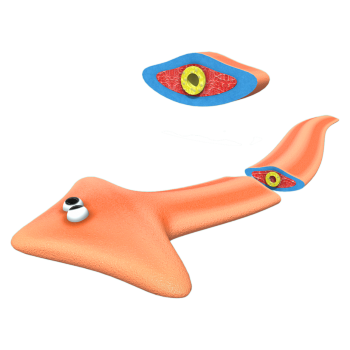
Vortex Worm (3D Structural Diagram)
Vortex worms are flatworms belonging to the family Trichomycteridae in the order Trichomycteria. The body of the vortex worm is soft and flat, symmetrical on both sides, and divided into dorsal, ventral, and anterior posterior parts; The back is slightly convex, mostly black brown in color, the ventral color is light, the front end is triangular, with one ear protrusion on each side, two black eye points on the back of the head, and no anus; The ventral surface of the body is densely covered with cilia, and the movement of cilia and muscles can enable rotifers to swim and crawl on objects. It is named after its vortex like motion when it swings.
Halley's Comet
Halley's Comet (catalog number 1P/Halley) is a periodic comet that orbits the Sun once every 76.1 years and is visible to the naked eye. Named after British physicist Edmund Halley (1656-1742) who first measured its orbital data and successfully predicted its return time. The orbital period of Halley's Comet is 76-79 years, and its next perihelion will be on July 28, 2061. Halley's Comet is the first recorded periodic comet in human history, dating back to at least 240 BC or 466 BC. There are clear records of this comet appearing in China, ancient Babylon, and medieval Europe.
Geomorphic structure of Niujiaohu Lake
The Cowbow Lake is called the Cowbow Lake because its shape resembles that of a cow's yoke. They are mostly distributed in the the Middle and Lower Yangtze Valley Plain and the Northeast Plain. Generally, it is a freshwater lake with a crescent shaped shape, an open water surface, a developed economy around the lake, abundant cultural and historical relics, and high tourism value. Many large oxbow lakes in China are formed by natural levees blocking tributaries due to river fluctuations, such as Dongting Lake, Poyang Lake, Baiyangdian Lake, Hongze Lake, etc.
Cell lysosome (microscopic 3D perspective view)
Lysosomes are generally organelles in eukaryotic cells; A sac like structure with a single-layer membrane coating, with a size (mostly spherical under electron microscopy, but with the presence of olivine spheres) and a diameter of approximately 0.025-0.8 micrometers; Contains multiple hydrolytic enzymes, specifically designed to decompose various exogenous and endogenous macromolecular substances. Discovered by Belgian scholar Cristian de Duve (1917-2013) and others in mouse liver cells in 1955.
Chlamydomonas reinhardtii (microscopic 3D profile)
Chlamydomonas, also known as "unicellular algae". Chlorophyta, Chlamydomonas family. The algal body is a single cell, spherical or oval in shape, with two equally long flagella at the front end, and can swim. There are two flexible vesicles at the base of the flagella; There is also a red eye spot near the front end of the cell. Large cup-shaped color carrier with one starch core. Asexual reproduction produces 2, 4, 8, or 16 motile spores; Sexual reproduction includes homogamy, heterogamy, and ovogenesis. Under unfavorable living conditions, cells stop swimming and undergo multiple divisions, forming a temporary population called an "indeterminate population" with a thick glial sheath on the periphery.
Archaea Profile (Microscopic 3D Model)
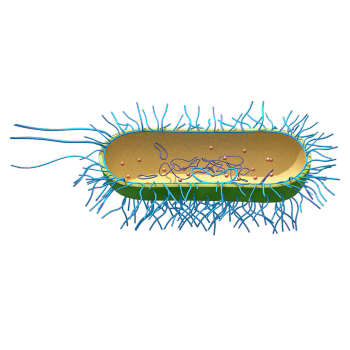
As a group, archaea are diverse in physiology and morphology. They can be aerobic, facultative anaerobic, or strictly anaerobic. Nutritionally, they range from chemoautotrophic inorganic organisms to organic trophic organisms. Some are mesophilic organisms; Others are hyperthermophiles that can grow above 100 ℃. Archaea are also diverse in morphology, and some archaea can proliferate through mechanisms such as binary division, budding, or others. Some of them are single cells, but they can also form mycelia or aggregates.
Stella's large manatee skeleton
The Stella manatee is a member of the pangolin family in the order Manatees. Its body is huge, with a length of 600-1000 centimeters and a weight of 5000-6400 kilograms; The head is small, the front end is flat, the kiss is extended forward, the mouth is opened downwards, densely covered with mustaches, and there are no teeth; The eyes and ears are very small, without ear shells; The body is brownish gray, the skin is thick, hard, and solid, with many wrinkles; The sparse fur on the back often attracts shellfish parasites, which often attract seabirds to help clean these shellfish; The forelimbs are very short, resembling eels, with horseshoe shaped toe hooves remaining at the ends. It is distributed along the North Pacific coast.
Random Model
3D model of Acacia tree
944 View
Nike Air Max 90 Olive Green sneaker
674 View
Japanese-style shop scene
738 View
(mantis) specimen
823 View
Chinese style stone pavilions
830 View
Renault 6
1025 View
Merrell moab speed GORE-TEX®Sneaker
729 View
A bowl of strawberries 3D scan
892 View
Ancient Egyptian Sun Ship Model
412 View