Popular Science Education
Opal stone
Opal, as a gemstone, is a hydrate of silicon dioxide with a chemical composition of SiO2 · nH2O. It has an amorphous structure and therefore does not have a specific shape. Its fracture surface is shell like, mainly formed by the colloidal precipitation of silicon dioxide. In mineralogy, it belongs to the opal class and contains two types of gemstones: variable color and invariant color. It is a hydrated amorphous silica.
marble
Marble originally refers to white limestone with black patterns produced in Dali, Yunnan Province. Its cross-section can form a natural ink landscape painting. In ancient times, marble with formed patterns was often selected to make painting screens or inlaid paintings. Later on, the name marble gradually evolved to refer to limestone with various colors and patterns used as building decoration materials. White marble is generally called White Marble, but it is also called marble for the white marble used to make statues in the West. There is a saying about the name of marble - in the past, Dali in China had the best quality marble. Named after it.
manganese nodule
Manganese nodules, also known as polymetallic nodules, are solidified products of seabed rocks, produced by the solidification of iron or manganese hydroxides in a core. Its core may be extremely small and may completely transform into manganese minerals due to crystallization. When manganese nodules are visible to the naked eye, they may be small microfossils (Radiolaria or Foraminifera organisms) shells, phosphorylated shark teeth, basalt remains, or fragments of early solidified material.
Tellurium ore
The chemical symbol Te, atomic number 52, is a silver white shiny quasi metallic element. Belonging to Group 16 (oxygen group) in the periodic table, it usually exists in a hexagonal crystal form and has a metallic luster. The melting point is 449.8 ℃, the boiling point is 989.9 ℃, and the density is between 6.1 and 6.27 grams per cubic centimeter. The chemical properties are similar to antimony, but more stable and not easily oxidized by air. It mainly exists in the form of sulfide minerals in nature, such as chalcopyrite and tellurides. It is usually extracted as a by-product in the copper ore smelting process. The main uses include as semiconductor materials.
Malachite
Malachite is a carbonate mineral mainly composed of Cu2 (OH) 2CO3, with a color ranging from dark green to bright green, silky or glassy luster, semi transparent to opaque, and a Mohs hardness of 3.5-4.5. Malachite is produced on the surface of copper mines, near the surface oxidation zone, and coexists with chalcopyrite, azurite, chalcopyrite, and siliceous malachite. It is an important mineral for prospecting primary copper mines and also a type of jade material.
Laita Limestone
Leta limestone is a geological formation mainly distributed in Austria, Czech Republic, Hungary, and Poland. This type of limestone was formed during the Middle Miocene to Late Miocene period (approximately 16 to 7.2 million years ago). The name Laita Limestone comes from the Laita Mountains in Austria. This limestone is known for its rich fossil content, including sharks, rays, manatees, and whales.
lapis lazuli
Lazurite is a framework silicate mineral containing sulfate ions, sulfur ions, and chloride ions. Its chemical formula is (Na, Ca) 8 [(S, Cl, SO4, OH) 2 | (Al6Si6O24)]. Belonging to the feldspar like mineral group of sodalite minerals, the crystal system is equiaxed, and intact crystal forms are extremely rare, mostly in the form of blocks. Most of them exist in Qingjin Rock in nature. The English word 'Lazrite' comes from the Persian word 'lazward', which means blue.
Javanese Rhinoceros Specimen
The Javan rhinoceros is a mammal of the Rhinoceros genus in the Rhinoceros family, also known as the small unicorn rhinoceros. Strong and robust physique. The skin is mostly brown black, gray black, and has wart like protrusions. Except for obvious hair on the tips and tails of the ears, the rest of the body is almost hairless. The average weight is around 1500 kilograms. The body length is 2-3.5 meters, and the shoulder height is about 1.5 meters. The ears are oval in shape, with a thick and long head and a short and thick neck. The upper part of the nose has a low solid horn, which is usually not prominent in adult females. Its horn is smaller than that of the Indian rhinoceros, hence it is also known as the small unicorn rhinoceros. The lifespan is around 40 years. The Javan rhinoceros is the smallest of the five existing rhinoceros species, with less than 100 individuals, and is on the brink of extinction in the wild.
Fossil of Trilobite with Round Shield
The round shield trilobite lived during the Devonian period and was mainly distributed in Morocco. The round shield trilobite is known for its unique appearance, with slender eye stalks, prominent spines, and a round, uneven head.
Former Bavarian terror elephant skeleton
The Bavarian terror elephant is an extinct long nosed animal belonging to the Deinoteridae family. It lived during the Early Miocene and Middle Miocene periods and was distributed in Africa, Europe, and Asia. The body size of this animal is similar to modern Asian elephants, with a shoulder height of about 2.7 meters. Unlike modern elephants, the Bavarian terror elephant does not have long upper teeth, but instead has a pair of downward curved lower teeth. These long teeth may be used to grab food or move tree branches.
ammonite fossil
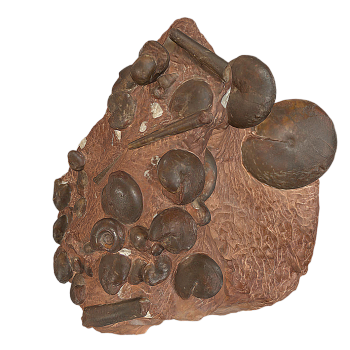
Kikushi, a collective term for cephalopods and ammonites in the phylum Mollusca, is a group of extinct marine organisms. Kikushi lived from the early Devonian to the late Cretaceous period, and its shell is often preserved in the form of fossils in the strata. The outer shell of ammonite is a single petal, consisting of three parts: the fetal shell, the gas shell, and the living room. It usually spirals around the fetal shell along a plane, with each revolution forming a spiral ring. Adult ammonite shells generally have 5 to 9 spiral rings, symmetrical on both sides, and can be straight, curved, or even irregular.
Green curtain stone amphibolite
Green mud amphibolite schist is a metamorphic rock formed by regional metamorphism, including basalt, tuff, gabbro, diabase, and other rocks. It represents a metamorphic environment of about 500-600 degrees Celsius and a pressure of less than ten kilobars. Its main minerals are chlorite and amphibole, with amphibole content greater than 40%. It may also contain small amounts of minerals such as plagioclase, epidote, biotite, pyrite, etc. Green mudstone, dark green in color, carved into small pieces with a small knife to appear light green, extremely fine and scaly. Hornstone schist is a common rock in orogenic belts and ancient metamorphic terrains, and is a characteristic feature of regional metamorphic amphibolite facies.
Lianglong skeleton
Lianglong is a dinosaur belonging to the family Lianglong in the order Saurischia. The neck is long, the head is small, and the position of the nostrils is higher than the eyes; The front of the mouth has flat teeth, while the sides and back have no teeth; Strong limbs, short forelimbs, long hind limbs; The buttocks are higher than the front shoulders; Each palm has 5 fingers (toes); The tail is longer than the neck and gradually narrows towards the end, forming a whip like shape, with over 10 human bones in the middle. The name Shuanglianglong comes from two protrusions that protrude from the top of the human character bone, resembling double beams, and is commonly referred to as Lianglong.
COVID-19 Covid-19 (microscopic 3D structure diagram)
Coronavirus disease 2019, abbreviated as COVID-19, is an infectious disease caused by severe acute respiratory syndrome coronavirus type 2 (SARS-CoV-2), which has led to a sustained outbreak and become one of the deadliest epidemics in human history.
Chromite ore
Chromite is a mineral formed by magmatic processes, often occurring in ultrabasic rocks and coexisting with olivine; Also found in sand mines. It looks very similar to magnetite in appearance, usually in the form of block or granular aggregates. In the metallurgical industry, chromite is mainly used to produce ferrochrome alloys and metallic chromium. Chromium iron alloy is used as an additive to produce various high-strength, corrosion-resistant, wear-resistant, high-temperature resistant, and oxidation resistant special steels. Chromium metal is mainly used for smelting special alloys with elements such as cobalt, nickel, and tungsten. Chromite is a scarce mineral with limited reserves and low production. In industry, similar minerals such as chromite, chromite spinel, rich chromite spinel, and hard chromite spinel are often collectively referred to as chromite.
Chloride silver ore
Chlorargyrite, with a chemical composition of AgCl and a molecular weight of 143.32. The production environment is in a partially oxidized silver deposit, with colors of purple gray, green, white, and colorless. Chlorite can be used as a mineral raw material for extracting silver.
Babylonian cuneiform inscription "Caillou Michaux"
Caillou Michaux "is a Babylonian cuneiform inscription that records a contract made by a father, Nirah nasir, to donate farmland to his daughter Dur Sharrukinaia'itu. This inscription adopts an ancient writing style, symbolizing ancient and famous writing traditions. It provides a detailed description of the donated land, the names of the donors and beneficiaries, and includes a series of sacred curses to prevent the inscription from being destroyed or the donation from being questioned.
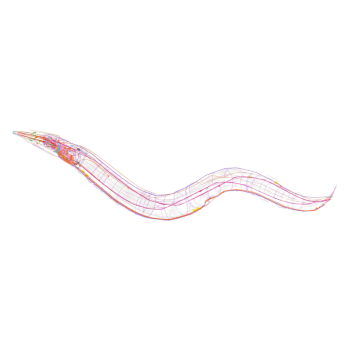
The nervous system of Caenorhabditis elegans
Caenorhabditis elegans (C. elegans) is a non-toxic and harmless nematode that can survive independently. It is small in size, with an adult length of only 1.5mm, and is hermaphrodites. Male individuals make up only 0.2% of the population and can undergo self fertilization or bisexual reproduction; The average life history at 20 ℃ is 3.5 days, and the average reproductive capacity is 300-350; But if mated with male insects, it can produce up to 1400 or more offspring.
Bronze decorative axe
Bronze decorative axe discovered in Tomb 697 at the Hallstatt Cemetery in Austria.
Besikti ankylosaurus skeleton
Bissektipelta (genus name: Bissektipelta, meaning "shield armor of Bissektipelta") is a genus of armored dinosaurs in the subfamily Ankylosauridae, which lived in Asia during the Late Cretaceous period. Fossils were discovered in the Bissektipelta Formation in present-day Uzbekistan. Besiktivosaurus is a monotypic genus that only includes the type species B. archibaldi.
Blue antelope specimen
The Blue Antelope is a member of the Oxidae family, with a shoulder height of approximately 102-120 centimeters and a weight of around 180 kilograms. Its gray fur appears blue gray under strong sunlight. Distributed in South Africa, it became extinct in 1799 AD.
Black Swan Specimen
The black swan is a bird species belonging to the family Cynoglossidae in the order of geese. The black swan is covered with flocculent gray feathers on its back; The neck is slender and often curved into an elegant "S" shape; The beak is bright red with a "V" - shaped white discharge at the front end; The iris is reddish red, and the tarsus and fins are black. Its physical characteristics are that except for a small part of the primary feathers that are white, the rest of the body's feathers are bright and black, hence the name.
Arsenic ore
A non-metallic mineral primarily composed of arsenic sulfide. Arsenic has three allotropes: yellow, gray, and black brown. Its gray crystals are metallic, brittle, and hard. The main minerals are realgar, orpiment, and arsenopyrite; Arsenic is the main component, with a cut-off grade of 5% for the former and 3-5% for the latter; The industrial grade is 10% for the former and 5% to 6% for the latter. There are also arsenic nickel ore, arsenic antimony ore, arsenic pyroxene, orthorhombic arsenic iron ore, etc. Generally, underground mining method is used for mining, and flotation method is used for beneficiation.
Silver sulfide ore
The chemical composition is Ag2S, containing 87.1% Ag. Isometric. The crystal is cubic or octahedral, usually in the form of dense blocks. The color and stripes are both lead gray. The fresh fracture surface has a metallic luster. Mohs hardness is 2-2.5. Density 7.2-7.4. Has weak extensibility. It is a mineral of hydrothermal origin, formed above 173 ℃. Below this temperature, it transforms into spiral shaped sulfide silver with the same composition. It is a mineral raw material for silver smelting, but the main source of silver is obtained as a by-product from copper lead zinc ores.
Wenshi mineral
Wenshi is a carbonate mineral. The component is CaCO3. Also known as aragonite, it is homogeneous and resembles calcite and other minerals. The rhombohedral system is characterized by columnar or lance shaped crystals, commonly exhibiting pseudo hexagonal symmetry in three connected crystals. Collectives are often in the form of shells, concretions, beans, spherical particles, etc. Usually white or yellow white in color. Glass gloss, with a grease gloss on the fracture surface. Incomplete cleavage of the board surface. Shell shaped fracture. Mohs hardness is 3.5-4.5. The specific gravity is between 2.9 and 3.0. In nature, aragonite is unstable and often transforms into calcite. Mainly formed under exogenous conditions, occurring in modern seabed sediments or clay; In limestone caves.
Actinoceras
It is an ancient marine organism belonging to the subclass Nautilus in the order Cephalopoda, and its fossils are mainly found in the Ordovician strata. One of its prominent features is that the outer shell is straight and the body tube is prominent, with flat and wide body tube sections resembling beads. The structure of the neighboring wall is complex, with the neck of the neighboring wall bending outward at an angle of approximately 45 degrees. There is calcium filling inside the body tube, which is an important basis for paleontologists to study its classification and evolution. Widely distributed, it has been found in Asia and North America, especially in the Ordovician strata of northern China. Understanding ancient marine ecosystems and geographical environments holds significant scientific value.
Winslet Machine Experiment
The Winslet machine is an electrostatic generator invented by James Winslet in the late 19th century. It generates high voltage through two relatively rotating insulating disks and a series of metal brushes and electrodes. In experiments, the Winslet machine can demonstrate electrostatic phenomena such as electric sparks and corona discharges, which are commonly used in teaching and demonstrating the principles of electrostatics.
Paramecium (Microscopic 3D Structure Diagram)
Paramecium is a ciliate belonging to the family Paramecidae in the order Hymenostomes. The body of paramecium is small, cylindrical, and composed of only one cell. It is a unicellular animal, hermaphrodite. The most common is Paramecium, with a body length of only 80-300 micrometers. The surface of the body is covered with a membrane, densely covered with many cilia. The paramecium is named after its body shape, which looks like an inverted sole from a flat angle.
Random Model
Tesla Model 3 electric car white
203 View
Kitt Lake Hayden Tower
358 View
Korean Goryeo period celadon teapot
382 View
Cruise Motorcycle
106 View
Saint George Dragon Slayer Statue
500 View
Domestic Bamboo Turtle Green Plant
221 View
Game Gear Sega handheld game console
389 View