Popular Science Education
Black Swan Specimen
The black swan is a bird species belonging to the family Cynoglossidae in the order of geese. The black swan is covered with flocculent gray feathers on its back; The neck is slender and often curved into an elegant "S" shape; The beak is bright red with a "V" - shaped white discharge at the front end; The iris is reddish red, and the tarsus and fins are black. Its physical characteristics are that except for a small part of the primary feathers that are white, the rest of the body's feathers are bright and black, hence the name.
Paramecium (Microscopic 3D Structure Diagram)
Paramecium is a ciliate belonging to the family Paramecidae in the order Hymenostomes. The body of paramecium is small, cylindrical, and composed of only one cell. It is a unicellular animal, hermaphrodite. The most common is Paramecium, with a body length of only 80-300 micrometers. The surface of the body is covered with a membrane, densely covered with many cilia. The paramecium is named after its body shape, which looks like an inverted sole from a flat angle.
Amoeba (microscopic 3D schematic)
Amoeba is a unicellular animal belonging to the genus Amoeba in the family Proteaceae of the order Proteobacteria. There is only a thin plasma membrane on the surface of the body, and the cytoplasm inside the membrane is relatively transparent, which can be clearly distinguished into two parts: endoplasmic and extracellular; Pseudo feet are shaped like fingers, leaves, or needles; Insects can undergo special deformation movements through pseudopodia, which change with the expansion and contraction of pseudopodia; Pseudo foot not only has the function of movement, but also has the function of feeding. After wrapping food, it undergoes intracellular digestion. Named after the constant changes in body shape caused by the movement of the parasite's cytoplasm.
Blue algae (microscopic 3D schematic diagram)
Cyanobacteria, also known as blue-green algae, are a type of large single-cell prokaryotic organism with a long evolutionary history, Gram negative staining, no flagella, containing chlorophyll-a but not chloroplasts (different from eukaryotic algae), and capable of oxygen producing photosynthesis. The difference from photosynthetic bacteria is that photosynthetic bacteria (red snails) undergo more primitive photosynthetic phosphorylation and do not release oxygen during the reaction process, making them anaerobic organisms, while cyanobacteria can carry out photosynthesis and release oxygen.
Spiral protease
Spiral protease is a type of protease with a spiral structure that participates in the degradation and metabolism of proteins. Spiral proteases typically have alpha helix or beta helix structures, which contribute to the stability and function of proteases.
Immunoglobulin (Microscopic 3D Schematic)
Antibody (Ab), also known as immunoglobulin (Ig), is a large Y-shaped protein mainly secreted by plasma cells and used by the immune system to identify and neutralize foreign substances such as bacteria, viruses, and other pathogens. It is only found in the extracellular fluid of vertebrates, such as plasma, and on the cell membrane surface of B cells. An antibody can uniquely recognize a specific foreign target through its variable region, which is called an antigen.
Staphylococcus aureus (microscopic 3D schematic)
Staphylococcus aureus (S. aureus), also known as "Staphylococcus aureus", belongs to the genus Staphylococcus and is a representative of Gram positive bacteria. It is a common foodborne pathogenic microorganism. The most suitable growth temperature for this bacterium is 37 ℃, pH 7.4, high salt tolerance, and can grow in an environment with a salt concentration close to 10%. Staphylococcus aureus often parasitizes the skin, nasal cavity, throat, gastrointestinal tract, abscess, and purulent sores of humans and animals, and is also ubiquitous in environments such as air and sewage.
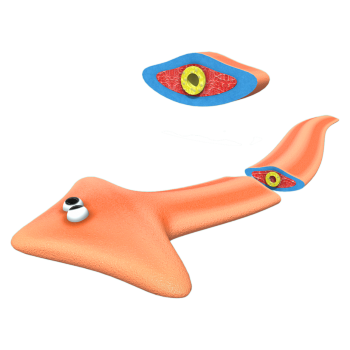
Vortex Worm (3D Structural Diagram)
Vortex worms are flatworms belonging to the family Trichomycteridae in the order Trichomycteria. The body of the vortex worm is soft and flat, symmetrical on both sides, and divided into dorsal, ventral, and anterior posterior parts; The back is slightly convex, mostly black brown in color, the ventral color is light, the front end is triangular, with one ear protrusion on each side, two black eye points on the back of the head, and no anus; The ventral surface of the body is densely covered with cilia, and the movement of cilia and muscles can enable rotifers to swim and crawl on objects. It is named after its vortex like motion when it swings.
Cell lysosome (microscopic 3D perspective view)
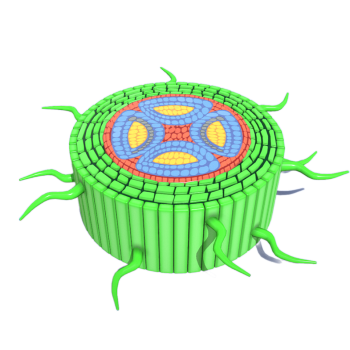
Lysosomes are generally organelles in eukaryotic cells; A sac like structure with a single-layer membrane coating, with a size (mostly spherical under electron microscopy, but with the presence of olivine spheres) and a diameter of approximately 0.025-0.8 micrometers; Contains multiple hydrolytic enzymes, specifically designed to decompose various exogenous and endogenous macromolecular substances. Discovered by Belgian scholar Cristian de Duve (1917-2013) and others in mouse liver cells in 1955.
Chlamydomonas reinhardtii (microscopic 3D profile)
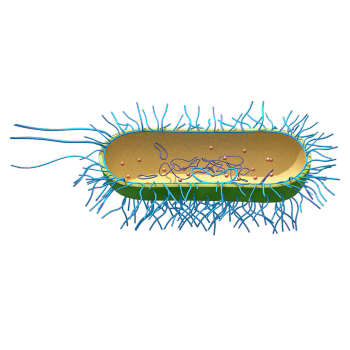
Chlamydomonas, also known as "unicellular algae". Chlorophyta, Chlamydomonas family. The algal body is a single cell, spherical or oval in shape, with two equally long flagella at the front end, and can swim. There are two flexible vesicles at the base of the flagella; There is also a red eye spot near the front end of the cell. Large cup-shaped color carrier with one starch core. Asexual reproduction produces 2, 4, 8, or 16 motile spores; Sexual reproduction includes homogamy, heterogamy, and ovogenesis. Under unfavorable living conditions, cells stop swimming and undergo multiple divisions, forming a temporary population called an "indeterminate population" with a thick glial sheath on the periphery.
Archaea Profile (Microscopic 3D Model)
As a group, archaea are diverse in physiology and morphology. They can be aerobic, facultative anaerobic, or strictly anaerobic. Nutritionally, they range from chemoautotrophic inorganic organisms to organic trophic organisms. Some are mesophilic organisms; Others are hyperthermophiles that can grow above 100 ℃. Archaea are also diverse in morphology, and some archaea can proliferate through mechanisms such as binary division, budding, or others. Some of them are single cells, but they can also form mycelia or aggregates.
Stella's large manatee skeleton
The Stella manatee is a member of the pangolin family in the order Manatees. Its body is huge, with a length of 600-1000 centimeters and a weight of 5000-6400 kilograms; The head is small, the front end is flat, the kiss is extended forward, the mouth is opened downwards, densely covered with mustaches, and there are no teeth; The eyes and ears are very small, without ear shells; The body is brownish gray, the skin is thick, hard, and solid, with many wrinkles; The sparse fur on the back often attracts shellfish parasites, which often attract seabirds to help clean these shellfish; The forelimbs are very short, resembling eels, with horseshoe shaped toe hooves remaining at the ends. It is distributed along the North Pacific coast.
Hacker Bird (Restoring 3D Model)
Phorusrhacidae is a large carnivorous bird species. The closest relative to them today is the crane family. The terror bird, also known as the terror bird, is a bird like carnivorous animal that lived alone during the same period as the saber toothed tiger. It is about 1-3 meters tall. Terror birds have hard leg bones and strong muscles, which can completely crush the bones of medium-sized prey and slowly feed on the nutrient rich bone marrow in the prey's bones. According to scientists' estimates, terror birds can reach speeds of up to 97 kilometers per hour, and the extinction of terror birds is believed to be related to wolf packs and disasters.
㺢㹢狓 specimen
㺢㹢狓 (hu ò ji ā p ī) (Latin name: Okapia johnstoni, English name: Okapi), also known as the African unicorn, is a chordate animal of the genus Hoga in the family of deer. It is listed as an endangered species on the IUCN Red List and is one of the few mammals that can lick its own ears.
Dodo Bird (3D Restoration Model)
The dodo bird (Raphus cuculatus) is an extinct bird species in the pigeon family of the pigeon order. The body shape is comparable to that of a swan, and there are also obvious sexual dimorphism. Body length 70-90 centimeters, weight 17-28 kilograms. It is a large bird with a plump body, covered with soft gray feathers, which are brown or gray in color. The female bird has lighter fur than the male bird. There is a white feather on the tail. Their wings are too small and weak to lift the Dodo off the ground. Because they cannot fly, the female bird lays one egg at a time, which is co hatched by the female and male birds. Eating fruits and seeds.
Random Model
Japanese hand water bowl
286 View
3D model of jujube
359 View