Saint Leopold

Saint Leopold

The clay sculpture of Saint Leopold depicts him wearing a ducal hat and holding a model of a church. This clay sculpture model is now housed in the Heiligenkreis Monastery Museum and later became the prototype for the statue carved on stone along the Heiligenkreis Cross Road. It has a height of 32.5 centimeters and was made between 1740-1745.
Ceramic containers in animal form - Bonn Collection in the Americas

Ceramic containers in animal form - Bonn Collection in the Americas

It is a type of pottery with animal characteristics, usually designed in the shape of animals or decorated with animal images. It is a work from the Bonn Collection in the Americas, which is a circular expansion casting container with angled spout connected in a stirrup shape. It was painted in colorful colors. The eye area, as well as the nose and ears in animal form, were depicted in detail and painted with additional eye and facial decorations. The origin is unknown, but it is collected in Teddy Hahn's collection. Not only does it have practical functions, but it also reflects the artistic aesthetics and cultural characteristics of ancient civilization.
Saint Catherine

Saint Catherine

The Bozzetto of St. Catherine's clay sculpture depicts her wearing a crown and holding a broken wheel. In the past, all wheels had to rest on St. Catherine's Day, including spinning wheels, mill wheels, carriage wheels, and later bicycles. This clay sculpture model is now housed in the Heiligenkreis Monastery Museum and later became the prototype for stone sculptures made along the path of the cross.
Colorful oval anthropomorphic pottery - Bonn Collection of the Americas

Colorful oval anthropomorphic pottery - Bonn Collection of the Americas

On a colorful oval pottery in the Bonn Collection in the Americas, there is a human figure sitting on it with legs crossed. This image is depicted on a black body with a white face, holding a musical instrument or corn in the hand. The main body is decorated with geometric patterns on both sides of the character, consisting of deep stripes and light reddish brown dotted triangles, which are alternately surrounded by red stripes and black lines. At the bottom of the character, an element is drawn as an oblique black line, forming a mesh like pattern. The origin of this pottery is unknown and belongs to Teddy Hahn's collection.
Ancient Greek Terracotta Vase

Ancient Greek Terracotta Vase

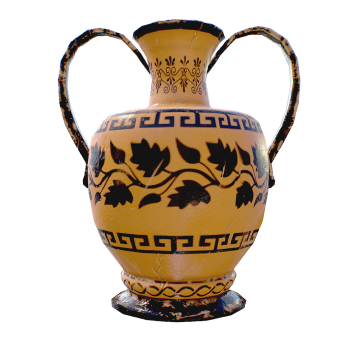
The terracotta vases of ancient Greece are outstanding representatives of ancient art and craftsmanship. These vases are usually made of red clay, a type of clay that has been fired at high temperatures and has a hard and durable texture. The ancient Greeks used these vases to store liquids such as wine, olive oil, and water, as well as for religious ceremonies and as burial objects. The ancient Greek terracotta vase not only played an important role in practicality, but also an important component of Greek culture and social life. They reflect the aesthetic concepts, religious beliefs, and social customs of ancient Greeks, and are valuable materials for studying ancient Greek civilization.
Goldhard

Goldhard

Goldhard (960-1038) was a respected German bishop. He played an important role in the development of Hildesheim and played a key role in the imperial movement to reform and restructure the Bavarian Church. His revered place extends from Italy and Croatia all the way to Scandinavia, and the Gotthard Pass in Switzerland is one of the most important cross-border passages in the Alps, named after him.
Frog shaped vessels of the Moche civilization in Peru - collected in Bonn, America

Frog shaped vessels of the Moche civilization in Peru - collected in Bonn, America

The frog shaped vessel is a cultural relic from the Moche civilization in Peru, and is included in the Bonn Collection in the Americas. This unique ceramic vessel, shaped like a frog, not only showcases the exquisite craftsmanship of the Moche people, but also reflects their profound understanding and reverence for the natural world. The Moche civilization is an important cultural period in South American history, known for its exquisite pottery, metal crafts, and murals. This frog shaped vessel is part of the collection of G ö tzVon Houwald, a collector who loves American art. Not only did it provide physical materials for studying the Moche civilization, but it also provided an opportunity for people to appreciate ancient American art.
Anfula vase

Anfula vase

Originating from the pottery containers of ancient Greece and Rome, they are renowned for their unique double ear design and are commonly used for storing and transporting liquids. In Barcelona, the design of this ancient container is reinterpreted by modern artists and designers, creating decorations that have both classical charm and modern aesthetics. The Anfula vase in Barcelona blends the city's rich historical and cultural heritage with modern art styles. These vases are not only displayed as artworks, but also commonly used to decorate spaces, adding beauty and cultural atmosphere to the interior.
Saint George and the Dragon Fight

Saint George and the Dragon Fight

This statue depicts the legend of Saint George fighting against a dragon. According to this legend, George was a Roman officer who discovered a town threatened by a dragon. In order to rescue the town, George fought against the dragon and ultimately killed it. In return, the people in the city agreed to undergo baptism. This legend first appeared in the 12th century and was recorded in the medieval text collection "Legenda aurea". This statue is part of the Fountain of St. George, located in the courtyard of the Archbishop's Palace, which was once the residence of the Archbishop.
Animal shaped Decorative Ceramic Containers - Bonn Collection in the Americas

Animal shaped Decorative Ceramic Containers - Bonn Collection in the Americas

The container decorated with animal forms in the Bonn Collection of America is a uniquely shaped and colorful pottery. This container is spherical in shape, with multiple colored patterns of dark brown, beige, red earth, and green painted on the surface. It has two water outlets connected in the shape of stirrups and is decorated with two animal shaped sculptures. The main body displays a personified face, which is likely a symbol of the sun. This container may have originated from the Moche culture and was collected by Teddy Hahn. Not only is it a practical liquid dispenser, but it is also a masterpiece that blends art and culture.
Hercules

Hercules

The statue of Hercules (a hero in Greek mythology) is located in front of the royal palace wing in Vienna, Austria, near the passage leading to Hofburg. This statue was created by Italian sculptor Lorenzo Matieri as part of the Baroque style Hofburg expansion project. This statue depicts the heroic feat of Hercules capturing a Cretan bull and was created in 1728.
A pottery jar with a red background, black lines, and a base

A pottery jar with a red background, black lines, and a base

The Parita style ceramics from the Greater Cockley region, of the "Arnon" variety, date back approximately between 1150 and 1400 AD. This ceramic jar is characterized by a base and a closure. Its stylistic feature is coated with red paint on the body, decorated with black horizontal lines that run through the can body and base. This decorative technique is a typical representative of Parita style ceramics, reflecting the aesthetic characteristics and craftsmanship level of ceramic art in the region at that time.
Red line decorative pottery jar

Red line decorative pottery jar

It is an ancient ceramic container from the field of archaeology in Panama. This type of pottery jar is characterized by red line decoration, which constitutes its main visual element, showcasing a concise and rhythmic aesthetic. Decorative lines are usually horizontally distributed, which may surround the middle of the pottery jar or create a contrast at the mouth and bottom, thereby enhancing the visual effect and cultural expression of the vessel. This decorative technique not only reflects the craftsmanship level of the craftsmen at that time, but also reflects the unique style and aesthetic tendency of ceramic art in ancient Panama.
Francisco Borja

Francisco Borja

Francisco Borja was a Spanish Jesuit priest born in 1510. He was the great grandson of Pope Alexander VI and King Ferdinand II of Aragon, as well as the Duke of Gandia and a prominent figure in Spain. After his wife's death, Borja gave up his title and became a priest of the Jesuit order, later also holding a position in the Jesuit general assembly. The statue of Francisco Borja depicts him sitting next to a skull on his right leg. This saint is dressed in the attire of a Jesuit monk, wearing a hat and cloak. The front of the statue base is engraved with the words: San Francisco Borja, please pray for us.
Ceramic disc holder with animal image

Ceramic disc holder with animal image

It is a ceramic plate with a base, belonging to the Parita style, dating back to approximately 1150 to 1400 AD. This ceramic style is characterized by black horizontal lines decorated on a red primer, which run through the plate and base. The Parita style ceramics are significantly different from the colorful ceramic decorative styles of the region before. Many previous decorative elements such as "YC", spiral patterns, design saturation, claws, and lizards have disappeared, but animal shaped decorations are still preserved. This type of plate is a typical representative of Parita style due to its unique base.
The Roman Soldiers Fighting the Fire

The Roman Soldiers Fighting the Fire

The Roman soldier fighting the fire depicted a Roman soldier holding a spear, extinguishing a burning house with a bucket of water. This clay sculpture model is now housed in the Heiligenkreis Monastery Museum and later became the prototype for stone sculptures made along the path of the cross. It has a height of 34.5 centimeters and was made between 1740-1745.
Cup shaped ceramic container - Bonn Collection of America

Cup shaped ceramic container - Bonn Collection of America

The cup-shaped container in the Bonn Collection of America is a pottery with a unique shape and color. This container is cup-shaped and coated with red and black pigments on the surface, with vivid colors and visual impact. Originating from the Canelo region of Ecuador, it was collected by Erich Wustmann and included in his personal collection. Not only is it a practical drinking vessel, but it also reflects the artistic and cultural characteristics of pottery making in ancient Ecuador. The combination of red and black may be related to local religious beliefs or social customs, reflecting the aesthetic concepts and lifestyle of ancient residents.
Hercules and the Lion Fight

Hercules and the Lion Fight

Hercules and the Lion Fight "is a set of sculptures depicting the scene of Hercules and the lion fighting, depicted in a clay sculpture by John Giuliani collected in the Heiligenkreis Monastery Museum in Austria. This scene originates from one of the twelve tasks completed by Hercules: he bravely defeated the lion sent by his archenemy, King Oresteos, to threaten the southern region of Bohemia. This clay sculpture model has a height of 32.5 centimeters and a width of 24 centimeters, and was made around 1735.
Tray with base coated with clawed lizard

Tray with base coated with clawed lizard

This artifact belongs to the Macaracas style and appeared around 1000-1150 AD. Its characteristics are geometric and animal image design, with the left half showcasing Conte style black and purple borders, and thick lines on red and cream backgrounds; The right half showcases Macaracas style saturated decorations, with a central image of a clawed lizard in a color similar to Conte style.
A beautiful blue vase

A beautiful blue vase

Mammalian shaped stirrup pot - Bonn Collection, America

Mammalian shaped stirrup pot - Bonn Collection, America

In the Bonn American Collection, there is a mammalian shaped stirrup pot. The main design of this pot imitates the image of a lying, curled mammal, with a very large stirrup relative to the body and a long neck. The origin of this stirrup pot is not yet clear, it was collected by Teddy Hahn. The stirrup jar is an ancient pottery commonly used to hold liquids such as oil or wine, and its design and production techniques reflect the level of craftsmanship and aesthetic style of ancient civilization. It is not only a practical container, but also a work of art that embodies the creativity and skills of ancient craftsmen.
Plato with pedestal like plate

Plato with pedestal like plate

It is a ceramic plate with a base, and this style of ceramic work originated in the Panama region and was made around 1150 to 1400 AD. These plates usually present exquisite painted decorations. These plates were not only used as practical eating utensils, but also reflected the aesthetic taste and cultural beliefs of the society at that time. In the Gran Cocl é culture, similar ceramic works are important archaeological discoveries that showcase the ceramic art and craftsmanship of the region during the pre Columbian period.
The Holy Family Statue

The Holy Family Statue

In the city of Znojmo in the Czech Republic, there is a statue called the "Holy Family Statue". This statue depicts the Holy Family, including Jesus, his mother Mary, and adoptive father Joseph. This is an important theme in the Catholic tradition, showcasing the family relationships of Jesus.
Camel Ceramic Container - Bonn Collection

Camel Ceramic Container - Bonn Collection

It is a ceramic artwork from the Bonn Collection in the Americas. This vessel features animal shaped decorative elements and a handle decorated with white paintings and five llama patterns. Its exact origin is unknown, but it comes from Johanna Sch ö pp's collection. The llama decoration on this ceramic vessel may be related to the ancient Andean civilization, which has a long history in South America, with the most famous being the Inca Empire. Camels play an important role in local culture, not only as a means of transportation and food source, but also with cultural and religious significance. Due to a lack of detailed information, we are unable to determine the exact origin of this vessel.
Gold inlaid art vase

Gold inlaid art vase

Relief Cup - American Bonn Collection Series

Relief Cup - American Bonn Collection Series

Collected in the Bonn Collection in the Americas, the surface is coated with delicate orange and features relief decorations. There are two opposing rectangular patterns on the outer side of the cup, which are similar in design and both depict a male image and a side view of a snake. In both patterns, men are wearing a variety of headpieces, waistbands, and different forms of chains. This cup comes from Carassia, El Salvador, and belongs to the Maya culture. It is one of the collections of Mera de Fernandez Shafer.
3D design vase

3D design vase

Monument to Baron Friedrich von Schmidt

Monument to Baron Friedrich von Schmidt

The Friedrich von Schmidt Memorial is located in the First District of Vienna. This monument was designed by Edmund Hoffman von Aspenberg and Julius Dininger and unveiled in May 1896 to commemorate the builders of the Vienna City Hall. Originally, this statue stood on a pedestal with railings on both sides. But after multiple movements, only the 3.3-meter-high statue and the upper part of the pedestal remained. Friedrich Wilhelm Schmidt was a German Austrian architect during the era of the Ring Road, who established the Neo Gothic style. Starting from 1886, he was granted baronial status.
Archduke Albrecht

Archduke Albrecht

The Archduke Albrecht is a monument to the Archduke Albrecht located on a slope in front of Vienna's First District. This equestrian statue was built in 1899 to commemorate Archduke Albrecht, who was the Marshal and Inspector General of the Austro Hungarian army. This statue was created by sculptor Caspar von Zubushi and was officially unveiled on May 21, 1899, the 90th anniversary of the Battle of Aspern. In the Battle of Aspern, Albrecht's father gave Napoleon his first defeat. The pedestal of this statue is made of granite near Pozhar, Czech Republic, designed by Carl Konig.
Bull shaped pottery - Goetz von Howald Collection of the Americas

Bull shaped pottery - Goetz von Howald Collection of the Americas

It is an exquisite artwork made of clay and adorned with colorful paintings. From Pucara, an ancient civilization site located in South America, renowned for its unique pottery. This pottery belongs to Goetz von Howald's collection of America, and the Pucara culture is known for its exquisite pottery skills and vivid representation of animal images. This ox shaped pottery is a representative work among them. Not only does it showcase the superb skills of ancient craftsmen, but it also reflects the worship and cultural value of animals in society at that time. As a collectible, it has significant historical and artistic value for studying the pottery techniques and cultural traditions of ancient American civilizations.
Archangel Michael

Archangel Michael

Archangel Michael "is a statue of Archangel Michael located on the path of the cross at the Holy Cross Monastery. This clay design was created by Josef Schnitzer. The archangel held a burning sword and a shield. The right forearm, hand, and sword have been partially broken and replaced. The height of this clay design is 32.8 centimeters, created between 1740-1745.
Virtual synthetic vase

Virtual synthetic vase

Angel "

Angel "

The Angel statue was designed by Giovanni Giuliani and is located in the Holy Cross Abbey in Lower Austria, Austria. This design is for the podium of the winter restaurant in the monastery. In this design, an angel stands on a pedestal, supporting a cushion that serves as a podium. The statue is currently housed in the monastery museum and is made of clay. It is 36.7 centimeters tall and was created in 1719.
The Holy Sepulchre of the Cross - Accordion City and Cultural Heritage Center in Thule, France

The Holy Sepulchre of the Cross - Accordion City and Cultural Heritage Center in Thule, France

Made of wood, copper, gold-plated iron, and enamel. It was manufactured around 1200 in the Limousin region and exhibited at the Saint Pierre Church in Tours. It is a precious medieval artwork, whose design and production reflect the religious beliefs and artistic level of the time. It is usually used to preserve relics of saints or other religious relics, and the design of human form may symbolize the image of saints or some religious symbol related to saints. It is an important collection of the Saint Pierre Church in Toulouse, Limousin region, France. Collected in the accordion city and cultural heritage center of Toulouse, France.
Ancient American culture humanoid stirrup jar - Bonn Collection, America

Ancient American culture humanoid stirrup jar - Bonn Collection, America

It is a type of pottery in ancient American culture, characterized by a tank shaped like a human, usually with facial features or the entire body shape of a person. Design not only embodies the artistic creativity of ancient craftsmen, but also reflects the profound understanding of human nature, religious beliefs, and daily life in ancient society. They have significant value in archaeology as they provide us with a window to understand the lifestyle and cultural characteristics of ancient civilizations. It is a precious historical artifact in the Bonn Collection of the Americas.