Stone Carving of the Northern Wei Vows Buddha Pagoda during the Northern Wei Dynasty in the 4th Century

Stone Carving of the Northern Wei Vows Buddha Pagoda during the Northern Wei Dynasty in the 4th Century

This Buddhist scripture pillar engraved with sacred Buddhist scriptures belongs to a group of miniature pagodas (scenic pagodas), which are only found in the Gansu Corridor in northwest China. Their age ranges from 426 AD to 36 AD, some of which bear the names of Buddhist donors who entrusted them at home. A pagoda is a circular building built to worship Buddhist relics. Miniature pagodas may be commemorating visits to holy sites or representing donations to religious groups and sites.
Making pottery from the Song Dynasty

Making pottery from the Song Dynasty

This is a pottery tile from Shitatou, Hangzhou City, Zhejiang Province, China, made around the Song Dynasty. Wadang refers to the front end of the cylindrical tile covering the eaves of ancient Chinese architecture; The entire tile at the front end of the eaves can also be called a tile, with a patterned hanging circular stopper on the tile surface. This tile is now located in the Komata Museum at the University of Tokyo in Japan.
Panlong Pillar Stone Carving, located in Zhonghe Guangji Palace, Xinbei City, Taiwan, China, China

Panlong Pillar Stone Carving, located in Zhonghe Guangji Palace, Xinbei City, Taiwan, China, China

Shilongzhu is a traditional form of Chinese architecture that has been carved from natural stone throughout history. It is commonly used in ancient palaces, corridors, tombs, and other places. In modern times, it is often installed in squares, temple corridors, and ancestral halls to provide load-bearing and decorative effects. Due to the carving of dragon patterns on its pillars, it is called a stone dragon pillar or a stone carved coiled dragon pillar. The stone dragon pillar is usually carved from lapis lazuli, with a circular or square base, known as the Sumeru or Lotus Seat. The pillar is engraved with a coiled dragon rising and falling to look at each other, and decorated with auspicious cloud patterns. The bottom of the pillar is engraved with water patterns or mountains, symbolizing auspiciousness, wealth, and prosperity.
The Tiberius Monument at the Niejmegenwalhof Museum in the Netherlands

The Tiberius Monument at the Niejmegenwalhof Museum in the Netherlands

The Tiberius Pfeiler Monument in Nijmegen is a historical monument located in the Dutch city of Nijmegen. This monument was built in memory of Emperor Tiberius of the ancient Roman Empire. Built in the 1st century, it is one of the ruins of the Roman era. It is built of stone and sandstone, with a height of about 4.5 meters. The monument was originally part of a temple, dedicated to commemorating the achievements and reign of Emperor Tiberius. It is the largest and oldest Roman monument in the Netherlands, and can now be seen at the Warhof Museum.
The head of the sarcophagus of Vice King Merimose, a cultural relic from the 18th Dynasty of Egypt, is a limestone coffin

The head of the sarcophagus of Vice King Merimose, a cultural relic from the 18th Dynasty of Egypt, is a limestone coffin

Cultural relics from the 18th Dynasty of the New Kingdom of Egypt, consisting of fragments of the head of the sarcophagus of Vice King Merimose, were made during the reign of Amenhotep III from 1390 BC to 1352 BC and are currently housed in the British Museum.
Moxijia Fire Snake Stone Carving

Moxijia Fire Snake Stone Carving

This sculpture showcases all the features of the fire snake Xiuhcoatl, blending reality and mythical creatures, including its snake head, short legs, claws, and curved nose. The end of the tail of the fire snake is composed of the traditional Mexican year symbol (xihuitl): a triangle resembling a sun ray symbol and two intertwined trapezoids. This work may be used to decorate buildings. According to Mexican antique collector Guillermo Dupex, it comes from Texcoco, a city on the east coast of Lake Mexico where the Mexican capital of Tenochtitlan was founded. This sculpture is currently located at the British Museum
Bratislava Angel Sculpture

Bratislava Angel Sculpture

This statue is in the image of an angel, holding a wreath and an inverted torch, with a skull on its pedestal. This statue is located in Gaistor Cemetery in Bratislava, a former Protestant cemetery that is now classified as an ancient building and was built in 1783.
Granite stone pillar from the 18th Dynasty of ancient Egypt, carved with inscriptions on papyrus paper
Granite stone pillar from the 18th Dynasty of ancient Egypt, carved with inscriptions on papyrus paper

This cultural relic is a papyrus column made of gray granite. Its style suggests that its production date may have been in the early 18th dynasty, and all inscriptions were carved later. In ancient Egyptian religion, a papyrus pillar was a talisman symbolizing freshness, youth, vitality, and the continuation of life. This talisman is made of glazed pottery or various types of stones, shaped like the stem and bud of papyrus paper. Its significance may stem from its pictographic value, as, just like plants themselves, they have vitality and growth, so people wearing papyrus paper pillar amulets will also possess these qualities. The papyrus columns are collected in the National Museum of Egypt.
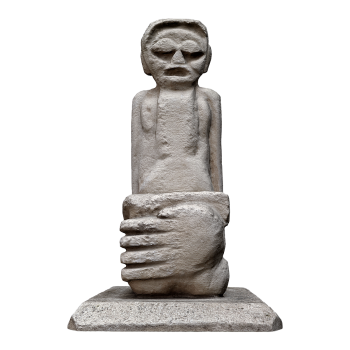
A humanoid sculpture in a clinic in Vienna

A humanoid sculpture in a clinic in Vienna

This sculpture is located in the Otaklin Clinic in Vienna's 16th arrondissement and depicts a seated humanoid figure.
Honduras' stone monument 'Chronometer Stele of Copan Square'

Honduras' stone monument 'Chronometer Stele of Copan Square'

This statue is a replica of a stone monument in Copan Plaza, Honduras. The image of the statue is Vasacarahorn Ubaa Cavell. The statue is now housed in the British Museum in London. The original stone tablet was made in 730 AD. Archaeological investigations have shown that wooden pillars and stone tablets may have been used to measure time and perform related rituals in the north of the main square of Copan Archaeological Park. The shadow of this stone tablet can be used as a marker for different dates of the year, such as to, to, and from the point of direct sunlight, as well as for the size and direction of its projection at different times of the day. The residents of Copan use it to accurately track tropical years.
Babylonian Cyrus Cylinder

Babylonian Cyrus Cylinder

The Cyrus Column is one of the most famous icons in the ancient world. It was excavated in Babylon in 1879. This cylinder was ordered to be inscribed in Babylonian cuneiform script by King Cyrus the Great of Persia after occupying Babylon in 539 BC. This cylinder records in detail how Cyrus the Great conquered Babylon, how he restored various temple statues removed by the former Babylonian king Nabonidus, and his work in Babylon. This cylinder is now preserved in the British Museum.
Ancient Mayan limestone lintel

Ancient Mayan limestone lintel

This limestone lintel is a very important ancient Maya artifact, showcasing the hallucination stage of Ms. K'ab'al Xook during the blood sacrifice ceremony. The dimensions of this lintel are 121 centimeters high, 85.50 centimeters wide, and 13.50 centimeters deep. This lintel was originally stored in the Victoria and Albert Museum in 1885 (until 1899 it was called the South Kensington Museum). This lintel was transferred to the British Museum in 1923.
Lion Fountain Statue at the Entrance of the British Museum
Lion Fountain Statue at the Entrance of the British Museum

This sculpture is one of many lion statues decorated at the north entrance of the British Museum. Legend has it that these lions will come to life at midnight, stretch lazily, yawn, and drink water.
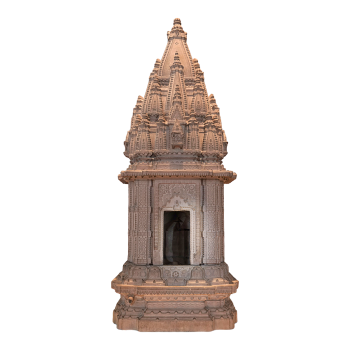
Ś iva Temple Indian Sandstone Model

Ś iva Temple Indian Sandstone Model

This is a red sandstone model of the Temple of Shiva, hidden in the British Museum, with Linga inside. There is a short elephant headed statue on the lintel above the door. This model was made between the 18th and 19th centuries. Ś iva is one of the main deities in Hinduism, primarily worshipped by followers of the Indian Shiva religion.
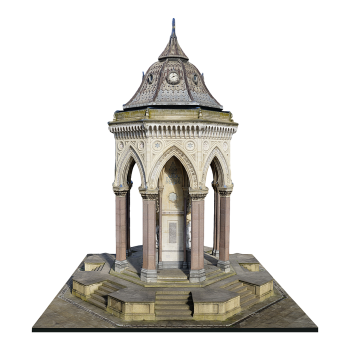
The Victoria Fountain, a 19th-century building in Victoria Park, London

The Victoria Fountain, a 19th-century building in Victoria Park, London

The fountain was designed by Henry Astley Dabushill in 1862 and built by Baroness Bernhardt Kutz at a cost of £ 5000. The fountain is made of granite and is an octagonal shape with a diameter of 8.5 meters, featuring 18 meter red granite columns in Gothic style. It is located near Hackney Gate in Victoria Park, London. The opening ceremony of the fountain in 1862 was attended by 10000 spectators. In the second year after the installation of the fountain, the Illustrated London News called Victoria Park the best people's park in London because its facilities included a fountain.
Ancient Indian marble temple columns

Ancient Indian marble temple columns

This marble temple column originated from the Jain temple in ancient India, where Jainism is an ancient religion and its community mainly engages in commercial and banking activities. This cultural relic is currently housed in the British Museum.
Carvings from the Byzantine Empire period titled 'Talisman Stone in Memory of Scandinavian Mercenaries'

Carvings from the Byzantine Empire period titled 'Talisman Stone in Memory of Scandinavian Mercenaries'

The large talisman from Sweden is a classic example of how to preserve past stories. This talisman monument was carved around 1050-1100 AD to commemorate a father and son who were Scandinavian mercenaries serving the Greek Byzantine Emperor. It is currently housed in the Ashmolean Museum in Oxford. The Eastern Roman Empire was originally the eastern half of the Roman Empire and was more inclined towards Greek culture. After splitting from the Western Roman Empire, it gradually developed into a country based on Greek culture, Greek language, and later Eastern Orthodoxy. Greece was the core component of the Byzantine Empire and shaped the cultural identity of modern Greece.
Anglo Saxon Cross Axis

Anglo Saxon Cross Axis

This cultural relic is made of sandstone and can be traced back to the early 9th century AD. The head of this cross shaft has been lost, and the back was hollowed out later. The cross decorated with free standing stones plays an important role in Anglo Saxon Christian churches. In 1924, this cross shaft was donated to the British Museum.
The Angel Tomb with Lost Hands in Vienna Central Cemetery

The Angel Tomb with Lost Hands in Vienna Central Cemetery

The Zentralfriedhof is a famous cemetery in Vienna, Austria, and is one of the largest cemeteries in the world. The cemetery was built in 1874 and covers an area of over 2.5 square kilometers. It houses many well-known figures, including composer Beethoven and writer Stefan Zweig. In the Vienna Central Cemetery, there are many angel tombs with unique shapes. These angel shaped tombs are often regarded as works of art because they showcase exquisite sculptures and architectural craftsmanship.
Beijing Temple of Heaven Circular Hill Drainage Head Stone Carving

Beijing Temple of Heaven Circular Hill Drainage Head Stone Carving

Ancient Egyptian Sphinx on Basalt Column Foundation

Ancient Egyptian Sphinx on Basalt Column Foundation

The statue belongs to the period of the 18th or 19th dynasty of ancient Egypt and depicts a Sphinx with the body of a lion and the head of a human being. The Sphinx has important symbolic significance in ancient Egyptian culture, and is considered a symbol of power, wisdom and protection. The statue is generally considered to be a product belonging to the period of Pharaoh Amenhotep III (Amenhotep III). However, the exact time of creation and the producer are still controversial. The statue is currently in the ancient Egyptian collection of the Pergamon Museum in Berlin
University of Applied Arts Vienna Holy Cross Courtyard Marble Portal

University of Applied Arts Vienna Holy Cross Courtyard Marble Portal

The entrance to the University of Applied Arts in Vienna, Austria, is part of the Holy Cross Courtyard, a courtyard complex in the center of Vienna. It is located between the streets of the beautiful Lantern and Grashov, and is today surrounded by a complex of monastery courtyards, abbeys, houses of worship and apartment buildings. The courtyard of the Holy Cross is often called the oldest apartment building in Vienna. It was built in the 13th century and has since then belonged to the Sist Monastery of the Holy Cross. Most of the chapel of the courtyard and the courtyard of the abbot were demolished during the Baroque period and rebuilt by order of the abbot of the Abbey of the Holy Cross between 1659 and 1676.
Holy water basin in the church of Launceston, Cornwall, UK

Holy water basin in the church of Launceston, Cornwall, UK

The holy water basin, also known as the baptismal basin, is used to hold holy water in Christian churches and is used for baptism ceremonies. It is usually located at the entrance of the church or in the baptismal hall for believers to use when entering or leaving the church. Believers can dip their fingers in holy water and then cross themselves or make personal prayers. It is usually made of stone or metal and has a shallow basin-like or bowl-like shape, often with carvings and decorations. These holy water basins not only have religious significance, but also are one of the important elements of Romanesque architecture.
Germany Heidelberg Baroque wind red sandstone carved column

Germany Heidelberg Baroque wind red sandstone carved column

British Museum Collection of Ming Dynasty Dragon Peony Glaze

British Museum Collection of Ming Dynasty Dragon Peony Glaze

This set of 20 exquisite tiles, originally used in two buildings, is made of coarse pottery and decorated with Fa Hua, showing the excellent craftsmanship of the 15th to 16th sessions of the Ming Dynasty. Each tile vividly depicts the three-claw dragon playing between lotus and peony, showing the unique charm of traditional Chinese art. These tiles once formed a screen, with a total of 20 pieces in four rows, showing a very artistic sense and exquisite craftsmanship. This series of tiles is a treasure of Chinese architectural art, witnessing the glorious history of architectural decoration in the Ming Dynasty
British Museum Collection of Ming Dynasty Dragon Glaze
British Museum Collection of Ming Dynasty Dragon Glaze

This series of Ming Dynasty architectural tiles is one of the cultural relics of the British Museum. This set of 20 exquisite tiles, originally used in two buildings, is made of coarse pottery and decorated with Fa Hua, showing the excellent craftsmanship of the 15th to 16th sessions of the Ming Dynasty. Each tile vividly depicts the three-claw dragon playing between lotus and peony, showing the unique charm of traditional Chinese art. These tiles once formed a screen, with a total of 20 pieces in four rows, showing a very artistic sense and exquisite craftsmanship. This series of tiles is a treasure of Chinese architectural art, witnessing the glorious history of architectural decoration in the Ming Dynasty.
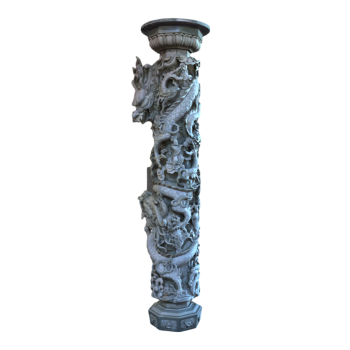
Stone carving dragon pillar 3D model

Stone carving dragon pillar 3D model

The dragon column is a traditional building of the Chinese nation with a long history. The pillar is covered with a cloud dragon wrapped around the pillar, and a beautiful cloud board is worn across the pillar, as if the cloud has been inserted into the cloud. The crouching beast at the top of the dew tray comes to life. Known as auspicious, luxury, honesty and other reputation, is the unit, company, home, office decoration, garden appreciation, gifts and other good products! Standing on the side of the square has become a landscape and landmark.
Easter Island Moai Statue Sculpture 3D Model

Easter Island Moai Statue Sculpture 3D Model

Totem pole 3D scan AR

Totem pole 3D scan AR

【British Museum】India Siva Shrine sandstone model 3D

【British Museum】India Siva Shrine sandstone model 3D

A sandstone model of the Shiva Temple/Holy Land from India, housed at the British Museum in London. The Ganesha statue can be seen above the door.