Philippine World War II Memorial Three Heroic Soldiers Monument

Philippine World War II Memorial Three Heroic Soldiers Monument

The memorial is dedicated to three heroes of Philippine history: Soldiers Elloso, Velena and Placino. During World War II, they led the resistance movement for the country's freedom and helped the United States take back land from Japanese troops. The Philippines was a strategic location in World War II, and 80 percent of the capital Manila was destroyed in the bombing. 5% of the population died in the war.
Albanian Cultural Heritage Lenin Statue

Albanian Cultural Heritage Lenin Statue
A statue of Lenin with a missing arm, located in Tirana, Albania.
Statue "Law" at the Bopbon Palace Square in Paris, France"

Statue "Law" at the Bopbon Palace Square in Paris, France"

The sculpture, entitled "Law", was created by French sculptor Jean Jacques Feuchère (1807-1852). It is located in the Place du Palais-Bourbon in Paris, in front of the French National Assembly building (National Assembly). The statue is a symbolic depiction of the law: her right hand holds a scepter representing the hand of justice, and her left hand holds a stone slab engraved with the text of the law.
The statue "Victorious France" in the garden of Carrousel, Paris, France"

The statue "Victorious France" in the garden of Carrousel, Paris, France"

"La France Victorieuse" () is a towering statue located in the Carrousel Garden in Paris. The statue was created by artist Antoine-François Gérard (1760-1843).
France Alexander III bridge statue "Renaissance France"

France Alexander III bridge statue "Renaissance France"

The sculpture is called "France of the Renaissance" and was created by sculptor Jules Coutan (1848-1939). It is located on one of the most magnificent bridges in Paris, the Alexander III Bridge (Alexandre III). The bridge is known for its exquisite decorations, including Art Nouveau lighting, adorable angels, mythical water sprites, and winged horses.
Statue of Victory Square, Paris, France King Louis XIV of France

Statue of Victory Square, Paris, France King Louis XIV of France

This statue of Louis XIV, located in the Place de la Victoire in Paris, was created by François Joseph Bosio and unveiled in 1822.
French 17th century statue King Louis XIV of France

French 17th century statue King Louis XIV of France

This statue was made in the seventeenth century, Louis XIV, Louis the Great, the Sun King, was the King of France. His reign was the longest of any sovereign monarch in history. He consolidated France's system of absolute monarchy, which lasted until the French Revolution. He made France a leading European power, often maintaining its military might.
Albania Tirana statue guerrilla girl

Albania Tirana statue guerrilla girl

Albanian communist era statue, statue in Tirana.
French Cultural Heritage Clemenceau Statue

French Cultural Heritage Clemenceau Statue

The statue of Clemenceau was made by artist François Cogné (1876-1952) and unveiled in 1932 (that is, 3 years after Clemenceau's death) by French President Eduard Helio. Clemenceau was a famous French politician who strongly advocated the separation of church and state, granted amnesty to exiled members of the Paris Commune, and opposed colonization. For this reason, he is honored as the "Father of Victory" (Père de la Victoire) or "The Tiger" (Le Tigre), in recognition of his important role in World War I.
France Paris Tuilere Garden statue Julius Caesar statue

France Paris Tuilere Garden statue Julius Caesar statue

This sculpture was created in 1722 by Nicholas Custin (1658-1733). The original is now in the collection of the Louvre Museum. This replica is located in the Tuileries Garden in Paris. Julius Caesar was a famous politician, military general and writer in ancient Rome. He played an important role in the late Roman Republic and consolidated his position through a series of military victories and political reforms. Caesar was finally assassinated in 44 BC, and his death became one of the key events in the transformation of the Roman Republic into the Roman Empire.
France Paris Pyramid Square Statue of the Maiden of Orleans

France Paris Pyramid Square Statue of the Maiden of Orleans

This equestrian statue of Joan of Arc is located in the Place des Pyramides in Paris and was created by French sculptor Emmanuel Frémiet (Emmanuel Frémiet,1824-1910). There are many replicas of the statue around the world, mostly in France, while there are three in the United States and one in Australia.
Statue of Saint Joan of Arc, City of Xinon, France

Statue of Saint Joan of Arc, City of Xinon, France

Located in Chinon, France, this sculpture was created by Jules Roulleau in 1893 and weighs 6000 kilograms. This is one of the most impressive memorial statues of Joan of Arc. St. Joan of Arc (French name Sainte Jeanne d'Arc or La Pucelle d'Orléans) (1412-1431) is a national hero of France.
Statue of the Greek Bard in the Luxembourg Garden in Paris, France

Statue of the Greek Bard in the Luxembourg Garden in Paris, France

Located in the Luxembourg Garden in Paris, this statue was created by Charles-Arthur Bourgeois (Charles-Arthur Bourgeois) in 1868. It shows an ancient Greek poet reciting his lines. Details of the statue include the actor wearing a mask over his head (not a modern epidemic mask) and a sheepskin around his waist.
Statue of the god of pasture in the Luxembourg Park, Paris, France

Statue of the god of pasture in the Luxembourg Park, Paris, France

The statue was created by French sculptor Eugène-Louis Lequesne and shows the image of a Faun. Shepherd gods are creatures of Roman mythology that share the characteristics of a part human and a part animal, such as the hooves or ears of a goat, inspired by the Satyr of ancient Greek mythology. The pastoral god is often considered to be the god of nature and wildness, as well as a symbol of music, joy and freedom.
Philippine Sculpture Fountain Statue of Donna Leonidas Park

Philippine Sculpture Fountain Statue of Donna Leonidas Park

Donna Leonidas Park is located in San Pablo City, Laguna Province, Philippines. Named after Leonila Garcia, wife of former Philippine President Carlos P. Garcia, the park was built in the 1960 s and restored in 2019. The park is about 1.7 acres in size and is a great place for family activities and walks.
Monument to the soldiers of the First World War, Blair, France

Monument to the soldiers of the First World War, Blair, France

A monument to Blair, France, built in limestone by Paul Lefebvre in 1923, commemorates the French soldiers who died in World War I.
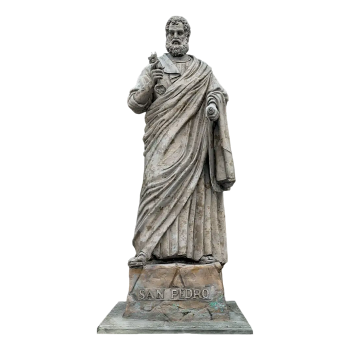
Philippine Heritage St. Paul Statue

Philippine Heritage St. Paul Statue

San Pablo, the first hermit. The prototype of this statue was created in clay by Dr. José Rizal. He gave it to Father Pablo Pastels in Dapidan in 1893. At the time, Rizal was imprisoned for resisting the Spanish government and the Catholic Church. He spent four years in Dapidan before being executed by the Spanish in Luneta. José Protasio Rizal () was a nationalist and erudite in the late Spanish colonial period of the Philippines. He is considered a national hero of the Philippines.
Monument to Pierre de Ronza, French poet of the 16th century

Monument to Pierre de Ronza, French poet of the 16th century

Pierre de Ronsard (11 September 1524-27 December 1585) was a French poet known by the French of his time as the "King of Poets". It is a statue created in 1913 by the sculptor Georges del Péliès (Georges Delperier), built in his honor, in the garden of Prébendes in the city of Toure. Due to the passage of time, most of the details of the statue have been covered with lichen.
Artistic statue of Leonardo da Vinci and the head of Medusa

Artistic statue of Leonardo da Vinci and the head of Medusa

Leonardo da Vinci was portrayed as a classical deity. The sculpture was created by Amleto Cataldi, who died in 1930. In 1935, the Republic of San Marino presented the work to France. Today, the sculpture faces the castle of Ambuis, the royal city where Leonardo da Vinci spent the last years of his life.
Albanian Cultural Heritage Joseph Stalin Statue

Albanian Cultural Heritage Joseph Stalin Statue

The statue, one of the only remaining Stalin statues in Europe, is located in Tirana, the capital of Albania. The name of the statue is "Joseph Stalin" PBR-Albanian Heritage.
France Early 1920 s Statue Joan of Arc-Joan of Arc

France Early 1920 s Statue Joan of Arc-Joan of Arc

The statue was a gift from Sanford Saltus to the French city of Blois and was created by the famous American female sculptor Huntington Anna Hyatt. The name of this statue is Joan of Arc-Joan of Arc.
French Cultural Heritage Jean Fucai Sculpture

French Cultural Heritage Jean Fucai Sculpture

Jean Fouquet (French: Jean (or Jehan)Fouquet, c. 1420-1481) was a French painter and miniature painter. He was a master of panel painting and mud-gold decorative manuscripts, and the inventor of portrait miniatures, and is considered one of the most important painters between the late Gothic art and the early Renaissance. He was the first French artist to travel to Italy and experience the early Italian Renaissance firsthand.
Japanese cultural heritage monks sitting on elephants

Japanese cultural heritage monks sitting on elephants

Albanian Rifleman Albanian Cultural Heritage

Albanian Rifleman Albanian Cultural Heritage

The statue is named "Albanian Rifleman". A statue of an Albanian warrior in Tirana, the capital of Albania. The fighter wore a skull cap unique to northern Albania and traditional northern Albanian trousers and shoes. It is a Soviet work of art in the style of socialist realism.
Monument to Louise Dubin, a figure of the French Enlightenment

Monument to Louise Dubin, a figure of the French Enlightenment

Louise Dubin is one of the important figures of the 18th century French Enlightenment. She is known not only for her literary salons, but also for her concern and advocacy for women's rights. Her book, On the Equality of Men and Women, explored the equal status of men and women in society, and although it was not published during her lifetime, its ideas had a profound impact on future generations. Her residence, the Château de Chenonceau (Château de), is one of the famous buildings in French history and an important place where she held her salon. Her burial ground, located near the castle, became a historic site honoring this remarkable woman.
Rana Dynasty Cultural Heritage Nanda Kumari Bust

Rana Dynasty Cultural Heritage Nanda Kumari Bust

Nanda Kumari is one of the important figures of the Rana dynasty in the history of Nepal. She was the wife of Dir Shumsher Jung Bahadur Rana (Dhir Shumsher Jung Bahadur Rana) and also the mother of many important members of the Rana family. Nanda Kumari's family background and her descendants have occupied an important position in the history of Nepal. The Rana Dynasty had a profound influence on Nepalese society and politics in the 19th and early 20th centuries.
Nepalese cultural heritage meditation wise man

Nepalese cultural heritage meditation wise man

Statue of the wise man in meditation located at Durbar Square in Kathmandu, a statue of cultural heritage from the 18th century history of Nepal.
Richelieu statue in the French city of Amboise

Richelieu statue in the French city of Amboise

Richelieu (1585-1642) was a French clergyman and politician. He was also known as the 'Cardinal, 'a term derived from the honorific title given to the cardinals, 'Your Emine', and the red robes they used to wear. Richelieu was one of the most important political figures in France in the 17th century, when he became chief minister to King Louis XIII of France in 1624. During his tenure, he worked to strengthen France's centralization, weaken the aristocracy, and consolidate France's position through a series of military and foreign policies. It was created by the French artist Henri Alouar 1844-1929.
Latin American Cultural Heritage Military Coat During the War of Independence

Latin American Cultural Heritage Military Coat During the War of Independence

The coat represents part of the historical heritage of the Latin American independence movement between 1815 and 1824. It is a military uniform artifact of historical significance, showing the cultural and military characteristics of that period.
The fez hat of an officer of the regular army unit of the Spanish army dress at the beginning of the twentieth century

The fez hat of an officer of the regular army unit of the Spanish army dress at the beginning of the twentieth century

Twentieth Century Spanish Military Uniform Princess Hussars Regiment Full Dress Top

Twentieth Century Spanish Military Uniform Princess Hussars Regiment Full Dress Top

The short coat of the full dress of the Princess Hussars Corps (1909-1931). The short top is made of blue Christina fabric and has nine gold thread decorations and three rows of nine gold buttons. The buttons have the initials "M.Y.L." (Maria Isabel Luisa) and the prince's crown. The dress edges are decorated with a gold braid, and a coat of arms is formed on the sleeves. Collected in the Spanish National Army Museum (Spanish National Army Museum) in Toledo, Spain.
Nineteenth-century Spanish military uniform Officer's coat of Marshal Joseph Navarro Sangelang

Nineteenth-century Spanish military uniform Officer's coat of Marshal Joseph Navarro Sangelang

Artillery officer's coat of Marshal Joseph Navarro Sangelang (after 1828). The coat is made of turkey blue fabric with an open V-neck straight neckline and red cuffs. The sides of the neckline are embroidered with gold artillery bomb patterns. The middle is closed with a buckle, with two rows of loose green overalls with seven buttons each. There are two separate rings near the left shoulder for wearing ornaments. Collected in the Spanish National Army Museum in Toledo, Spain.
Royal Polish Air Force Pilot Captain Uniform Jacket

Royal Polish Air Force Pilot Captain Uniform Jacket

This captain's uniform jacket belonged to a pilot of the Royal Polish Air Force and is in the collection of the New Songchi District Museum. The steel blue gabardine jacket is lined with a dark lining, with the captain's logo on the sleeves, and consists of two black and blue straps. The front left side of the jacket is sewn with seven medal strips (including the Merit Cross, Air Medal, 1939-1945 Star Medal, Air Service European Star Medal, Defense Medal, War Medal, Unidentified Badge and Royal Air Force Badge-black felt embroidered with yellow eagle and RAF letters on the chest).
Qin Dynasty Cultural Relics Sword-holding Terracotta Warriors and Horses

Qin Dynasty Cultural Relics Sword-holding Terracotta Warriors and Horses

The Terracotta Warriors and Horses sculpture depicts the army of Qin Shihuang, the first emperor of China. It is a martyrdom art, buried with the emperor in 210-209 BC, with the aim of protecting Qin Shi Huang in the afterlife.
Statue of St. Gurdade in the Church of Tynitz Abbey

Statue of St. Gurdade in the Church of Tynitz Abbey

This statue of St. Gectree is one of two statues decorated on the side altar of St. Scolastika in the Church of the Monastery of Tynic, which is currently in the collection of the Benedictine Monastery Museum of Tynic. St. Geradet was a Catholic saint, noted for his religious contributions and a devout lifestyle. This sculpture shows her image, reflecting the artistic style and religious beliefs of the 18th century. The exquisite craftsmanship and meticulous details of the sculpture reflect the craftsman's skills and artistic aesthetics at that time. This sculpture is not only of religious significance, but also represents the cultural and historical background of that period.