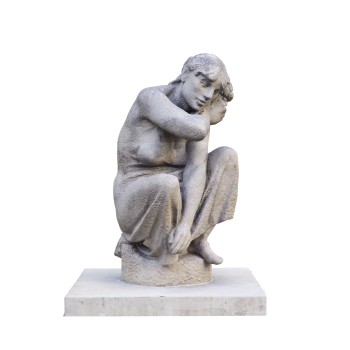
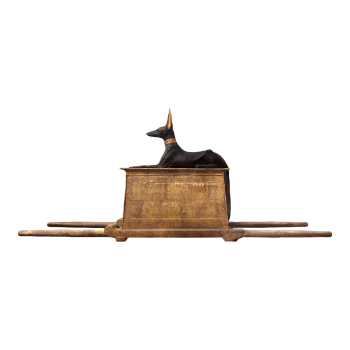
Greek woman and swan alabaster statue

Greek woman and swan alabaster statue
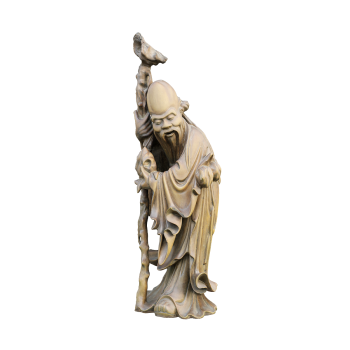
Japanese Old Man Wood Carving
Japanese Old Man Wood Carving

Angel Stone Carving

Angel Stone Carving

It is a mysterious existence derived from many religions and myths and legends. It is usually regarded as the messenger or servant of the gods, with supernatural power and purity. In Christianity, Judaism, and Islam, angels are depicted as messengers of God responsible for communicating God's will and protecting believers. It is often depicted as a human figure with wings, symbolizing purity and divinity. In art and literature, angels are often depicted as symbols of tenderness, compassion and protection, in a variety of images, from classical white robes to modern expressions. It is also often associated with music and is considered a singer of heaven.
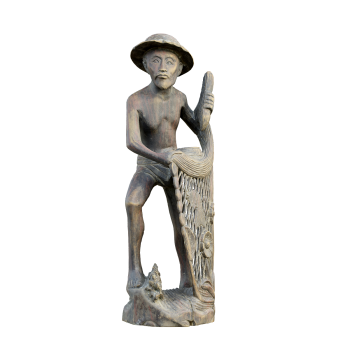
bronze statue of fisherman fishing

bronze statue of fisherman fishing

Metal Statue of Thai Women

Metal Statue of Thai Women

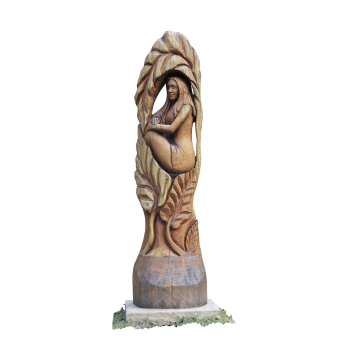
Exquisite female wood carving

Exquisite female wood carving

A bronze statue of a Buddhist monk sitting in meditation

A bronze statue of a Buddhist monk sitting in meditation

GeneraalChass Bronze Bust

GeneraalChass Bronze Bust

GeneraalChass was a Dutch military figure whose career was filled with adventure. Initially, he worked for Dutch patriots, French revolutionaries, and Emperor Napoleon. After 1814, he switched to serving the Netherlands. In 1832, he commanded the city's forts during the French siege of Antwerp, thus gaining the status of national hero, and was subsequently appointed commander of the Breda fortress. He died in 1849 and was buried in the Ginneken cemetery. In 1899, the municipality of Breda offered a bust of this GeneraalChass.
Balinese Women Wood Carvings

Balinese Women Wood Carvings

The Head of Van Gogh-The Creations of Andrea Schaller

The Head of Van Gogh-The Creations of Andrea Schaller

Andre Schaller is a Swiss artist known for his deep understanding of Vincent van Gogh and his unique artistic style. His work "The Head of Van Gogh" is a tribute to Van Gogh's legendary life, showing Van Gogh's complex emotional and spiritual world through sculpture. It is not only a reproduction of Van Gogh's appearance, but also a profound interpretation of his inner world. Through the texture and form of the sculpture, the viewer can feel Van Gogh's pain, passion and endless pursuit of art. This work is often seen as an exploration of Van Gogh's spiritual dimension and a reflection on his dual identity as an artist and an individual.
Bodhidharma (boxwood carving)

Bodhidharma (boxwood carving)

The works of Chinese arts and crafts master Liang Fengzhu, created in 2015, are now collected at the Liang Fengzhu Arts and Crafts Museum in Nanyue, Hengyang, China. The wooden carving is 31 centimeters high and 8 centimeters wide. Bodhidharma was a semi legendary Buddhist monk who lived in the 5th or 6th century. He is traditionally considered the disseminator of Zen Buddhism in China and is regarded as the first Chinese master of Zen Buddhism. According to Chinese legend, he also began physical training for Shaolin monks, thus creating Shaolin Kung Fu. In Japan, he is called Daruma. His name in Sanskrit means' the law of awakening (bodhi) '.
Eastern Han Dynasty pottery figurine for storytelling

Eastern Han Dynasty pottery figurine for storytelling

Eastern Han Dynasty pottery figurine for storytelling. Also known as rap figurines. Excavated in Chengdu, Sichuan Province in 1957. Sitting storytelling figurine: 56 centimeters high, made of clay red pottery, molded. Wearing a scarf and a tassel, with floral decorations in front of the forehead. The belly is bulging, the facial expression is humorous and comical, there are several wrinkles on the forehead, and the mouth is open with teeth exposed. Like a very vivid image of a rap artist.
Terra Cotta Warriors in the Mausoleum of the Qin Emperor

Terra Cotta Warriors in the Mausoleum of the Qin Emperor

The Terra Cotta Warriors, namely the Terra Cotta Warriors in the the Mausoleum of the First Qin Emperor, also referred to as the Terra Cotta Warriors or the Terracotta Warriors, are the first batch of national key cultural relics protection units and the first batch of Chinese world heritage sites. They are located in the Terra Cotta Warriors pit 1.5 kilometers east of the the Mausoleum of the First Qin Emperor in Lintong District, Xi'an, Shaanxi Province. More than 200 foreign heads of state and government have visited and toured, becoming a golden business card of China's ancient glorious civilization and also known as one of the world's top ten rare ancient tombs.
Terra Cotta Warriors

Terra Cotta Warriors

The Terra Cotta Warriors is a category of ancient tomb sculptures. In ancient times, human sacrifice was practiced, and slaves were considered as accessories of the slave owner during their lifetime. After the slave owner's death, the slaves were buried as sacrificial objects with the slave owner. The Terra Cotta Warriors are burial objects in the shape of soldiers and horses (chariots, horses, soldiers). It is an important part of the first batch of national key cultural relics protection units and the world cultural heritage "Mausoleum of Qin Shi Huang and Terracotta Warriors".
Armored warrior figurines from the Sixteen Kingdoms period (collected by Xi'an Museum)

Armored warrior figurines from the Sixteen Kingdoms period (collected by Xi'an Museum)

The Sixteen Kingdoms (304-439 AD) was a period of great division in Chinese history. This period began in 304 when Li Xiong and Liu Yuan respectively established Chengguo (Chenghan) in the Han region of Bashu and Han Zhao (Former Zhao) in the Central Plains, and lasted until 439 when Emperor Taiwu of Northern Wei, Tuoba Tao, conquered Beiliang and unified the north.
Buddha statue

Buddha statue

This statue depicts the Buddha's appearance before his enlightenment under the Bodhi tree. What happened before this moment is often described as a fierce struggle between good and evil, delusion and insight. Moro, the god of illusions, attacks Buddha and challenges the young prince's right to eliminate him. In response, the Buddha extended his right hand and called on the earth to witness his lifelong good deeds. In records from Southeast Asia, the goddess of the earth appeared and submerged the earth, destroying Moro and his army.
Shakyamuni Buddha statue (8th century AD)

Shakyamuni Buddha statue (8th century AD)

The limestone Buddha head of Shakyamuni, dating back to the 8th century AD, is currently housed in the Minneapolis Academy of Arts. The Buddha statue of Shakyamuni is highly compatible with the classical style developed by early sculptors of the Tuora bowl. The face is square, the mouth is wide, the nose is flat, and the hair is curly. Although the artist of the Tara bowl drew inspiration from the idealized sculpture concepts of India, this portrait indicates that the facial features of the local residents quickly integrated into their religious art.
The Giant Feet of Roman Emperor Constantine

The Giant Feet of Roman Emperor Constantine

Constantine's giant foot is 2 meters long and 1.5 meters high, making it one of the largest marble feet still standing in ancient times. It is part of a 12 meter tall seated statue. The original is at the Capitoline Museum in Rome. This scan is from a copy in front of the entrance to the Roman Empire Baths in Trier, Germany. The remaining giant feet, hands with fingertips pointing upwards, and the portrait of the emperor all outline a chilling image of the emperor.
Sculpture: Girl

Sculpture: Girl

Terra Cotta Warriors

Terra Cotta Warriors

On March 29, 1974, farmers dug a well about 1.5 kilometers east of the the Mausoleum of the First Qin Emperor in Lishan Mountain and found the Terra Cotta Warriors. Lishan is an area filled with underground springs and waterways. For centuries, there have been occasional reports of pottery figurines and fragments from Qin tombs - roof tiles, bricks, and large blocks of bricks and stones. This discovery prompted Chinese archaeologists, including Zhao Kangmin, to investigate and reveal the largest group of pottery figurines in history. Afterwards, a museum complex was built in the area, with the largest pit surrounded by a roofed structure.
Christ's Passion Statue

Christ's Passion Statue

The Passion of Christ depicts a scene of Jesus Christ being crucified on the cross and held in the arms of his mother Mary. This is a common Christian art theme aimed at expressing a mother's pain and sorrow towards her son.
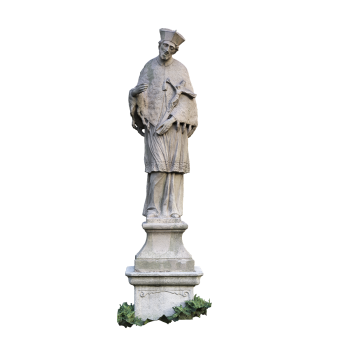
Saint Zachariah

Saint Zachariah

This is a statue of St. Zacharias located on the Baroque style Fourteen Hardroads in Heiligenkreis. St. Zachariah is a priest in the New Testament of the Bible. According to the Gospel of Luke, he lived during the time of King Herod and married Elisabet, who was the father of John the Baptist. St. Zachariah is an important figure in the Christian tradition because he is the father of John the Baptist, who is a cousin and pioneer of Jesus Christ.
Colonel Otmar Moore Memorial

Colonel Otmar Moore Memorial

The Colonel Othmar Muhr Memorial located in Sopron. The monument is a half body statue on a pillar, commemorating the cavalry commander, Colonel Otmar Muir, who was the commander of the 9th Cavalry Regiment of Count Nadasti, a cavalry unit of the Austro Hungarian Empire. Colonel M ü ller led 400 cavalry to confront the Russian army in northern Hungary and achieved victory. But in this process, Colonel Moore sacrificed his own life.
Moses Fountain

Moses Fountain

The Moses Fountain located on Franz Iskane Square in the first district of Vienna. Created by sculptor John Martin Fisher. Johann Martin Fischer was an 18th century Austrian sculptor known for his neoclassical style and significant contributions to urban sculpture in Vienna. The Moses Fountain is a historical landmark in Vienna, whose design and decoration reflect the artistic style and cultural values of the time.
Maria Theresa Statue

Maria Theresa Statue

The statue of Maria Theresa located in the French Garden of Grassakovich Palace in Bratislava. This statue is a reconstruction of a horse sculpture from the second half of the 18th century. Maria Theresa was a famous Grand Duchess and Queen of Hungary in Austrian history, and her reign had a profound impact on the Austrian Empire and later the Austro Hungarian Empire.
Virgin Mary Statue

Virgin Mary Statue

This statue is a colorful Virgin Mary statue from Kittsee, located in the central green space of Kittsee village. The Marian Column is a common religious monument in Central Europe, especially during the Baroque period. They are often used to celebrate the miracles of the Virgin Mary or as a symbol of protection for the village.
Marcus Aurelius Statue

Marcus Aurelius Statue

The statue of Marcus Aurelius located in Bad Deutsch Altenburg. Marcus Aurelius was an important ruler of the Roman Empire and a renowned philosopher. His Meditations had a profound impact on later generations.
Elizabeth Memorial

Elizabeth Memorial

This is a monument located in the People's Park in the first district of Vienna, commemorating Empress Elisabeth. Queen Elizabeth, also known as Sissi, was assassinated in Geneva on September 10, 1898. On June 4, 1907, it was unveiled in the presence of Franz Joseph I. Her family calls her Sisi, and since Ernst Marischka's films, her name "Sisi" has become widely known around the world.
Bust of Joseph II

Bust of Joseph II

The bust of Holy Roman Emperor Joseph II, located next to the Klein Grosnau Baths, was created in 1905. Joseph II was an Austrian emperor in the 18th century, known for his enlightened rule and numerous reforms.
Statue of Julius Caesar

Statue of Julius Caesar

The statue of Julius Caesar located on the slope of the first district council building in Vienna. Julius Caesar was an outstanding politician, military leader, and writer of the late Roman Republic, known for his victories in the Gallic Wars and subsequent civil wars. He is considered by historians to be the uncrowned king of the Roman Empire and had a profound impact on Roman history.
Bust of John Calvin

Bust of John Calvin

A bust of John Calvin in front of the Reformed Church in Sopron. John Calvin (1509-1564) was one of the most influential systematic theologians in the 16th century Reformation movement. John Calvin is not only renowned for his theological works, but also for the theocratic political system he established in Geneva. His teachings emphasize the sovereignty of God, the fall of humanity, and predestination, which form the core of Reformed theology.
Bust of Johann Wolfgang von Goethe

Bust of Johann Wolfgang von Goethe

Portrait bust of Johann Wolfgang von Goethe located next to the Klein und Gro ß au beach. Johann Wolfgang von Goethe is one of the most famous literary figures in German history, and his works include "Faust" and "The Sorrows of Young Werther", which have had a profound impact on world literature. This bust is a tribute to Goethe's cultural heritage.
Stephen Statue

Stephen Statue

Stephen's story is recorded in the Book of Acts, where he faced opposition from Jewish religious leaders for bravely promoting the Christian faith and was ultimately stoned to death. His martyrdom became an important event in Christian history, inspiring later Christians to persevere and sacrifice for their faith. The image of St. Stephen in the sculpture group of the Hardroad at the Heiligenkreis Monastery not only commemorates his historical position as the first martyr, but also reflects the reverence of Christianity for faith and martyrdom spirit. The statue is located on the Hardroad at the Heiligenkreis Monastery.
San Sebastian Monument

San Sebastian Monument

Saint Sebastian was an early Christian saint and martyr, often depicted in art as being pierced by arrows, as he was tied to a tree and shot while being persecuted. In the Christian tradition, he became a symbol of resistance to epidemics and other diseases, and the statue is located on the bitter road of the Heiligenkreis Monastery.
San Sebastian Statue

San Sebastian Statue

Saint Sebastian was an early Christian saint and martyr, often depicted in art as being pierced by arrows, as he was tied to a tree and shot while being persecuted. In the Christian tradition, he became a symbol of resistance to epidemics and other diseases, and the statue is located on the bitter road of the Heiligenkreis Monastery.