Pietro Dabano

Pietro Dabano

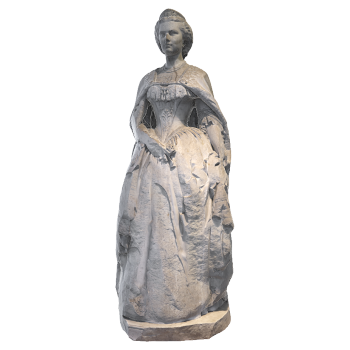
Pietro d'Abano, also known as Petrus de Amono (c. 1250-1315), was an Italian philosopher, astrologer, and medical professor in Padua. He was born in a small town in Italy, and his name came from here. Now he is Abanoterme. In the end, he was accused of heresy and atheism and brought before a religious tribunal. He died in prison before the end of his trial in 1315. The statue is located in the United Arab Emirates and was built in 1723.
Moses

Moses

This is an artwork created by Giovanni Giuliani, which is a clay sculpture model of Jupiter designed for the collection of the Heiligenkreis Monastery. The height of this work is 43.7 centimeters, created in 1720. Moses was a Hebrew teacher and leader, considered the most important prophet in Judaism, and also one of the most important prophets in Christianity, Islam, the Bah á 'í Faith, and other Abrahamic religions. According to the Bible and the Quran, Moses was the leader and legislator of the Israelites, and the prophetic author of the Five Books of Moses belongs to him.
St. Mary Magdalene

St. Mary Magdalene

St. Mary Magdalene is a group of cross sculptures located in Perkhtoltsdorf Hohberg, Austria, which includes a statue of St. Mary Magdalene. This group of cross sculptures can be traced back to the early 18th century. The assistant characters surrounding the 5.25-meter-high cross were replaced with replicas after being repeatedly destroyed. St. Mary Magdalene is an important figure in the New Testament, one of Jesus' loyal followers and the first person to see him after his resurrection. In art, she is often depicted as a repentant sinner who has spent many years in the wilderness.
The Abyss

The Abyss

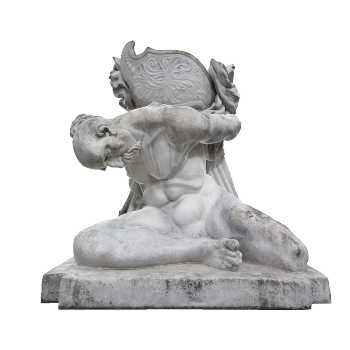
The Abyss "(L'Ab î me) is a marble statue that is 180 centimeters high, 260 centimeters wide, and 120 centimeters deep. This statue was purchased at a salon exhibition in 1901 and is now housed in the Osay Museum. Just Becquet was a French sculptor who was born in Besan ç on, Doubs, France in 1829 and passed away in Paris in 1907. His father was a goldsmith, and Beck initially received a classical education at a school in Besan ç on, earning a Bachelor of Philosophy degree before registering for study at a local art school.
Joseph Ressel Memorial

Joseph Ressel Memorial

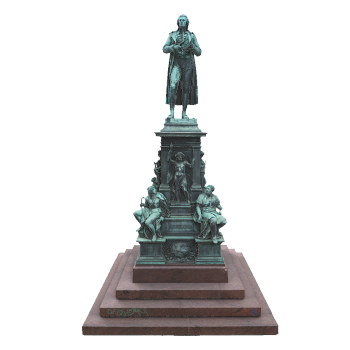
This is the Joseph Reissel Memorial located in the eponymous park in the fourth district of Vienna. This monument displays a bronze statue of Reysol, located on a stepped pedestal. This monument was created by Anton Dominik Fernkorn in 1863 and unveiled on January 18, 1863. Joseph Ressel was one of the inventors of ship propellers, and together with John Erickson, Francis Pettit Smith, Robert Fulton, and David Bushnell, he brought it to a stage of technological maturity.
John the Baptist

John the Baptist

The artwork created by Giovanni Giuliani is a clay sculpture of John the Baptist sitting in the collection of the Heiligenkr ö tz Monastery. The height is 27.5 centimeters, created in 1733. John the Baptist is an important figure in the New Testament, who prophesied the arrival of Jesus and baptized him in the Jordan River. John the Baptist is depicted sitting with a lamb to his left. The lamb usually represents Jesus in Christian symbolism, as Jesus is known as the "Lamb of God" and was sacrificed for the sins of humanity. Giovanni Giuliani is an Italian sculptor active in Heiligenkreis, Austria.
Isaac

Isaac

This is a clay sculpture model with Isaac as the theme designed for the Cross Road Station at Heiligenkreuz Abbey Museum. The height of this artwork is 28.7 centimeters, created between 1740-1745. In this work, Isaac is depicted as completely naked except for a cloth around his waist. He held a bundle of wood in both hands and placed it on a tree stump. Next to it is a burning brazier.
Saint Peter Verona

Saint Peter Verona

St. Peter Verona was a 13th century Italian Catholic priest, a Dominican monk, and a famous preacher. He served as an interrogator in Lombardy, but was later killed by assassins. 11 months after his death, he was canonized as a Catholic saint, the fastest canonization in history. It was created by Gioan Pietro Giuliani. Giovanni Pietro Giuliani was an Italian Austrian plaster sculptor and sculptor.
Saint Neopomouc

Saint Neopomouc

St. Nepomuk is a respected Czech saint and local idol of Prague. He was fatally thrown into the Vltava River by Wenceslaus IV for refusing to disclose Maria von Trak's confession. It is said that when Nepomok fell into the water, five stars appeared in the sky. Therefore, Nepomuk is often depicted as a halo of five stars surrounding his head. Due to his martyrdom, Nebomok is regarded as a guardian saint to prevent drowning and floods.
Saint Neopomouc

Saint Neopomouc

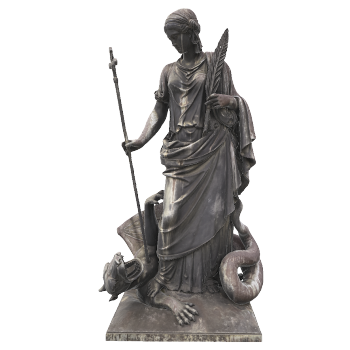
This statue of St. Nepomuk is located in Tribuswinkel, Lower Austria, Austria. This Baroque style statue holds a cross and a palm branch of a martyr, standing on a pedestal with a relief of the coat of arms of the Walsegg family, an imperial count. This statue can be traced back to 1722. Saint Nebomok was a Czech saint who was ordered to drown in the Vltava River by Bohemian King Wenceslas IV in 1393.
The Horse Trainer

The Horse Trainer

This statue is located at the bottom of the ramp of the Vienna Parliament building and is called the 'Horse Trainer'. It was created by sculptor Josef Lax in 1899 and erected in 1901. This statue is located outside the Parliament building in Vienna, Austria, situated on the Ringstrasse. The layout concept of the Vienna Parliament Building was designed by Von Hansen, reflecting the structure of the Imperial Diet (Reichsrat), as stipulated in the 1861 "February Edict" which established the constitutional structure of the empire.
Monument to the Battle of Durnstein

Monument to the Battle of Durnstein

The Battle of Duinstein (also known as the Battle of Krems) occurred on November 11, 1805, as part of the Third Coalition War against France during the Napoleonic Wars. Austria's D ü nsten (modern-day D ü nsten) is located in the Wahau region of the Danube River Valley, approximately 73 kilometers (45 miles) upstream of Vienna, Austria. This battle took place on a flood plain between rivers and mountains.
Saint Leopold

Saint Leopold

The clay sculpture of Saint Leopold depicts him wearing a ducal hat and holding a flag. This clay sculpture model is now housed in the Heiligenkreis Monastery Museum and later became the prototype for the statue carved on stone along the Heiligenkreis Cross Road. It has a height of 32.5 centimeters and was made between 1740-1745.
Saint Leopold

Saint Leopold

The clay sculpture of Saint Leopold depicts him wearing a ducal hat and holding a model of a church. This clay sculpture model is now housed in the Heiligenkreis Monastery Museum and later became the prototype for the statue carved on stone along the Heiligenkreis Cross Road. It has a height of 32.5 centimeters and was made between 1740-1745.
Saint Catherine

Saint Catherine

The Bozzetto of St. Catherine's clay sculpture depicts her wearing a crown and holding a broken wheel. In the past, all wheels had to rest on St. Catherine's Day, including spinning wheels, mill wheels, carriage wheels, and later bicycles. This clay sculpture model is now housed in the Heiligenkreis Monastery Museum and later became the prototype for stone sculptures made along the path of the cross.
Goldhard

Goldhard

Goldhard (960-1038) was a respected German bishop. He played an important role in the development of Hildesheim and played a key role in the imperial movement to reform and restructure the Bavarian Church. His revered place extends from Italy and Croatia all the way to Scandinavia, and the Gotthard Pass in Switzerland is one of the most important cross-border passages in the Alps, named after him.
Saint George and the Dragon Fight

Saint George and the Dragon Fight

This statue depicts the legend of Saint George fighting against a dragon. According to this legend, George was a Roman officer who discovered a town threatened by a dragon. In order to rescue the town, George fought against the dragon and ultimately killed it. In return, the people in the city agreed to undergo baptism. This legend first appeared in the 12th century and was recorded in the medieval text collection "Legenda aurea". This statue is part of the Fountain of St. George, located in the courtyard of the Archbishop's Palace, which was once the residence of the Archbishop.
Francisco Borja

Francisco Borja

Francisco Borja was a Spanish Jesuit priest born in 1510. He was the great grandson of Pope Alexander VI and King Ferdinand II of Aragon, as well as the Duke of Gandia and a prominent figure in Spain. After his wife's death, Borja gave up his title and became a priest of the Jesuit order, later also holding a position in the Jesuit general assembly. The statue of Francisco Borja depicts him sitting next to a skull on his right leg. This saint is dressed in the attire of a Jesuit monk, wearing a hat and cloak. The front of the statue base is engraved with the words: San Francisco Borja, please pray for us.
The Roman Soldiers Fighting the Fire

The Roman Soldiers Fighting the Fire

The Roman soldier fighting the fire depicted a Roman soldier holding a spear, extinguishing a burning house with a bucket of water. This clay sculpture model is now housed in the Heiligenkreis Monastery Museum and later became the prototype for stone sculptures made along the path of the cross. It has a height of 34.5 centimeters and was made between 1740-1745.
The Holy Family Statue

The Holy Family Statue

In the city of Znojmo in the Czech Republic, there is a statue called the "Holy Family Statue". This statue depicts the Holy Family, including Jesus, his mother Mary, and adoptive father Joseph. This is an important theme in the Catholic tradition, showcasing the family relationships of Jesus.
Monument to Baron Friedrich von Schmidt

Monument to Baron Friedrich von Schmidt

The Friedrich von Schmidt Memorial is located in the First District of Vienna. This monument was designed by Edmund Hoffman von Aspenberg and Julius Dininger and unveiled in May 1896 to commemorate the builders of the Vienna City Hall. Originally, this statue stood on a pedestal with railings on both sides. But after multiple movements, only the 3.3-meter-high statue and the upper part of the pedestal remained. Friedrich Wilhelm Schmidt was a German Austrian architect during the era of the Ring Road, who established the Neo Gothic style. Starting from 1886, he was granted baronial status.
Archduke Albrecht

Archduke Albrecht

The Archduke Albrecht is a monument to the Archduke Albrecht located on a slope in front of Vienna's First District. This equestrian statue was built in 1899 to commemorate Archduke Albrecht, who was the Marshal and Inspector General of the Austro Hungarian army. This statue was created by sculptor Caspar von Zubushi and was officially unveiled on May 21, 1899, the 90th anniversary of the Battle of Aspern. In the Battle of Aspern, Albrecht's father gave Napoleon his first defeat. The pedestal of this statue is made of granite near Pozhar, Czech Republic, designed by Carl Konig.
Angel "

Angel "

The Angel statue was designed by Giovanni Giuliani and is located in the Holy Cross Abbey in Lower Austria, Austria. This design is for the podium of the winter restaurant in the monastery. In this design, an angel stands on a pedestal, supporting a cushion that serves as a podium. The statue is currently housed in the monastery museum and is made of clay. It is 36.7 centimeters tall and was created in 1719.
Franz Joseph I

Franz Joseph I

Franz Joseph I (August 18, 1830 – November 21, 1916) was the Emperor of Austria and Austria Hungary (December 2, 1848 – November 21, 1916). The grandson of the last Holy Roman Emperor Franz II, nephew of Ferdinand I, and eldest son of Archduke Franz Karl. On June 28, 1914, the Sarajevo Incident occurred. In July, at the instigation of Foreign Minister Count Bertold, Franz Joseph rashly issued an ultimatum to Serbia, leading to the outbreak of World War I.
Theodor Leschetsky

Theodor Leschetsky

Theodor Leschetizky (1830-1915) was a Polish pianist, composer, and music educator. In his early years, he was brought by his father to Vienna to study piano with Cherni. At the age of 11, he conducted a piano concerto with Mozart's son Franz Krzysztof Wolfgang Mozart, and began teaching piano at the age of 14. Afterwards, he worked at the St. Petersburg Conservatory of Music. He is one of the most famous piano teachers in history, and has also composed some piano pieces and two operas. His famous students include Paderewski and Arthur Schnabel.
Edward Ur

Edward Ur

Edward Ur is a lawyer and the mayor of Vienna. From 1832 to 1840, he was a local judge and then became a private lawyer. In 1848, he served as a captain in the National Guard and became a member of the Vienna City Council in 1861. Edward served as mayor from 1882 to 1889. During his tenure, Edward was particularly dedicated to fire and rescue services as well as the Vienna market.
Carl Miller

Carl Miller

Karl M ü ller (1842-1899) was an Austrian composer and conductor who began learning to play the flute at a very young age. He was a student at the Vienna University of Music and Performing Arts (formerly known as the Vienna Music Friends Association Music Academy), and at the age of 16, he became a flutist at the Joseph City Theatre under the direction of Franz von Supp è. In 1869, he was appointed as the conductor of the Second Orchestra of the Vienna Theatre. Regarded as one of the three great masters of Viennese classical light opera, alongside Johann Strauss II and Franz von Supp é.
Anton Stoch

Anton Stoch

Anton Stoch (1813-1887) was an Austrian composer and choir conductor. He is the choir conductor of the Vienna Men's Singing Association, the Frohsinn Singing Association in Linz, and the Lower Austrian Singing Association, as well as the orchestra conductor of the Vienna Theater and the Joseph City Theater. He passed away in Vienna at the age of 74. His honorary tomb is located at the Vienna Central Cemetery.
Standing Christ

Standing Christ

This model is a standing Christ, with his right hand leaning against a low wall. This individual character was originally part of a group of characters. It may depict the scene of Christ and an adulterous woman, or the scene of Christ and a Samaritan woman by the well. Now collected in the Heiligenkreuz Monastery Museum
Bishop's bust

Bishop's bust

The bishop's bust at the Heiligenkreis Monastery Museum. Giovanni Giuliani's head made of basswood was initially placed on a choir stall in the university church. After renovation work, it entered the museum.
The Austrian Fountain on Freion Square

The Austrian Fountain on Freion Square

The Austrian Fountain on Freion Square in Vienna's First District. This fountain was designed by Ludwig von Schwantaler, and the statue was made by the Royal Bavarian Ore Foundry in Munich under the guidance of Ferdinand Miller. This fountain was unveiled on October 16, 1846, consisting of a four-way basin made of Mathausen granite, a pillar surrounded by oak trees, allegorical figures symbolizing the four main rivers of the monarchy at the time (Danube, Po, Elbe, Vistula), and an Austrian statue draped in a star cloak, wearing a wall crown, holding a spear and shield.
Austria

Austria

This sculpture is a symbol of Austria, located at the end of the Austrian Fountain on Freion Square in Vienna's first district. The sculpture depicts a woman holding a spear and shield, with the emblem of the empire engraved on her shield. This sculpture was designed by Munich sculptor Ludwig Schwantaler in 1844 and cast by Ferdinand von Miller in Munich until it was completed in 1846. During the Habsburg monarchy, Austria's image was seen as a symbol of a multi-ethnic Austrian state. Later, she became a fable of the Austrian nation-state. Her name corresponds to the Latin name of Austria.
Winter Fable

Winter Fable

The Winter Fable "is a sculpture located in the Austerlitz Castle Park. This sculpture depicts a man wearing a fur hat and fur scarf, holding a large tree branch in his hand. This sculpture was created by Ignaz Lenglach. Ignaz Lenglach (July 25, 1698, near Persenberg - around 1780, Baden) was a German born Baroque sculptor who primarily worked in southern Moravia. His works have diverse styles, including bottles and jars, little angels, reliefs, busts, and animal images
Jules Verne Memorial

Jules Verne Memorial

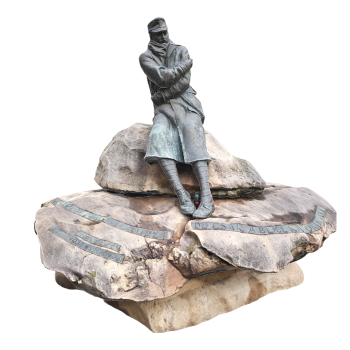
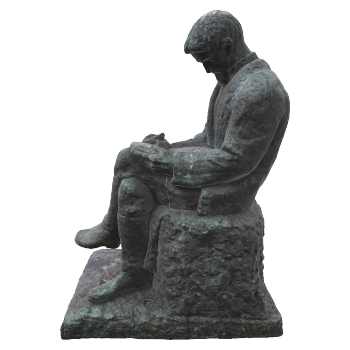
The Jules Verne Memorial is a work located in Vigo Port, Galicia, Spain. This monument was created by Spanish sculptor Jose Morales. He is a famous French writer whose adventure novels are usually set in exotic places. Although Jules Verne had only been to Vigo a few times, Vigo's bay was permanently locked in literary memory in "Twenty Thousand Leagues Under the Sea," even though Captain Nemo's Nautilus was suspended during his oceanic journey. From this place overlooking the bay, Verne sat with a book in his hand, on the tentacles of a giant squid, the enemy of the crew of the Nautilus.
Statue in Seville Garden

Statue in Seville Garden

The statue in Seville Garden was created by artist Artur Coelho and is located in the Jardim Rainha D. Maria Garden in Seville