The statue of St. Nicholas in the St. Nicholas Church in Slovakia

The statue of St. Nicholas in the St. Nicholas Church in Slovakia

Saint Isaac with a wooden and stone sculpture for sacrifice

Saint Isaac with a wooden and stone sculpture for sacrifice

The Guanyin Bodhisattva stone carving gifted by the Qingtian County Government in Zhejiang Province
The Guanyin Bodhisattva stone carving gifted by the Qingtian County Government in Zhejiang Province

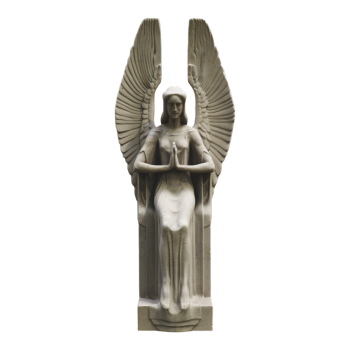
Angel statue with hands clasped together at Vienna Central Cemetery

Angel statue with hands clasped together at Vienna Central Cemetery

Angel stone carving holding wreath at Vienna Central Cemetery

Angel stone carving holding wreath at Vienna Central Cemetery

Qing Dynasty gilded wooden carved Taoist seated statue

Qing Dynasty gilded wooden carved Taoist seated statue

The dove shaped sculpture of the Trinity of God Jesus and the Holy Spirit

The dove shaped sculpture of the Trinity of God Jesus and the Holy Spirit

Roman bust discovered at Licinian tomb in Rome

Roman bust discovered at Licinian tomb in Rome

Statue of Muse Talia

Statue of Muse Talia

The statue of Vesta, the female hearth god in Roman mythology

The statue of Vesta, the female hearth god in Roman mythology

Vesta was the virgin goddess in Roman religion who was in charge of the hearth, home, and household. She is rarely depicted in human form and is often personified by the fire of her temple in the Roman Forum. Only her priestess Vesta was allowed to enter her temple, and they guarded the sacred flame by the fireplace in her temple.
Ancient Egyptian burial statues

Ancient Egyptian burial statues

A small sculpture used in Egypt for funerals, resembling the image of Osiris (whose body is a mummy), usually with the name of the deceased written on it. Many important tombs contain a large number of small sculptures of this kind, with the purpose of allowing them to complete various tasks that the Earth God may require the deceased to accomplish.
The statue of Thutmose III in the Karnak Temple in Egypt

The statue of Thutmose III in the Karnak Temple in Egypt

The statue of Thutmose III in Cairo, Egypt. Thutmose III was the 18th pharaoh of Egypt during the New Kingdom period. Thutmose III was one of the longest reigning kings of Egypt and passed away at the age of 54. He is often referred to as the Napoleon of Egypt, possessing a powerful military force.
Simon O'Rourke's' Our Lady of Perrine '

Simon O'Rourke's' Our Lady of Perrine '

Photogrammetry of the statue of the Virgin Mary

Photogrammetry of the statue of the Virgin Mary

The statue of the goddess of heaven in Roman mythology, Juno

The statue of the goddess of heaven in Roman mythology, Juno

The statue of Hebe, the goddess of youth in ancient Greek mythology

The statue of Hebe, the goddess of youth in ancient Greek mythology

Hebe (Greek: Ἥβ η; English: Hebe) was the goddess of youth in ancient Greek mythology, the daughter of Zeus and Hera. She was known as Juventas in Rome. She is also the sommelier for the gods of Mount Olympus. At every banquet, she pours wine for the gods, and these drinks make them feel happy, energetic, and never tired. Later, she married Hercules, the god of power who ascended to the heavens. And as the sommelier, Zeus brought in the young and handsome Trojan prince Ganymedes from the mortal world to replace her.
Photogrammetric sculpture of Gandhi Monument in the old city of Goa

Photogrammetric sculpture of Gandhi Monument in the old city of Goa

Ancient Egyptian figures, ancient sculptures, Pharaoh Anubis, werewolves, fiberglass

Ancient Egyptian figures, ancient sculptures, Pharaoh Anubis, werewolves, fiberglass

Paris Luxembourg Park "Arion assis sur un Dauphin" Arion sitting on a dolphin

Paris Luxembourg Park "Arion assis sur un Dauphin" Arion sitting on a dolphin

Why was born into slavery, created by Jean Baptiste Calvo

Why was born into slavery, created by Jean Baptiste Calvo

As one of the most powerful expressions of abolitionist sentiment in visual art, "Why Born Enslaved!" depicts an African woman who is bound by ropes and provocatively looks up. The rope painfully pressed against her breasts; Her tattered shirt hinted at the violence that caused her illness. The original colored surface is covered with complex and intricate shadows and subtle shapes. There is evidence to suggest that this masterpiece of 19th-century French sculpture is the primary model for numerous castings in other museum collections. It is currently housed in the Cleveland Museum of Art.
Shang Dynasty Sanxingdui bronze ware "Shang Bronze Man Head"

Shang Dynasty Sanxingdui bronze ware "Shang Bronze Man Head"

This cultural relic is a bronze ware from the Shang Dynasty, with a human head of Fang Yi. It comes in two types: flat topped and round topped, with large or vertical ears and perforated earlobes. Garlic nose, wide mouth, and thick neck. Wrap the hair backwards and add braids or hair accessories to the back of the head. It is currently collected in the Sanxingdui Museum.
Ming Ming Mausoleum and Ming Maoling Statue "Stone Carving of Benevolent Beasts"

Ming Ming Mausoleum and Ming Maoling Statue "Stone Carving of Benevolent Beasts"

Starting from the two hexagonal stone pillars to the north of the Beiting Pavilion and ending at the Dragon and Phoenix Gate, on both sides of the kilometer long divine path, 24 stone beasts and 12 stone figures are neatly arranged, with vivid shapes and exquisite carvings, deeply loved by tourists. The large quantity, large size, exquisite carving, and good preservation of it are rare in ancient Chinese cemeteries. The stone figures are divided into four categories: meritorious officials, civil officials, and military officials, each with four statues. They were close attendants of the emperor during his lifetime, all of whom were standing statues with hands clasped in water, majestic and devout. The installation of such stone statues in imperial tombs dates back over two thousand years to the Qin and Han dynasties.
Dying Gladiator Stone Carving

Dying Gladiator Stone Carving

This sculpture depicts a dying gladiator who displays elegance and dignity in the face of death, gazing at the crown he has earned for his courage. This sculpture was created by French sculptor Pierre Julien (June 20, 1731- December 17, 1804) and was his second entry into the Royal Academy of Painting and Sculpture. It was a crucial work for him. This sculpture is currently on display at the Louvre Museum in Paris, France.
The Spanish Civil War Memorial "Eric Stanford"

The Spanish Civil War Memorial "Eric Stanford"

A fully restored Spanish Civil War memorial has been put back into use in Forbury Gardens. Reading Mayor Tony Jones presided over the event in the monastery district, with representatives from the borough council, unions, and other local groups also attending. The ceremony was held almost 25 years after the statue was first unveiled in May 1990. This monument was created by local sculptor Eric Stanford and, after four years of fundraising, depicts the mothers of those who died in Spain during the 1936-39 Civil War. At least 16 people from or associated with Reading were killed in the battle.
The Piet à da Palestrina marble statue of the Virgin Mary in Palestrina

The Piet à da Palestrina marble statue of the Virgin Mary in Palestrina

Piet à da Palestrina "is a marble sculpture from the Italian Renaissance period, dating back to around 1555 AD. It is currently on display at the Accademia Gallery in Florence. This sculpture depicts three characters, one of which is the body of Jesus Christ. This sculpture was attributed to Michelangelo's work in the first half of the 18th century.
European style blue dress porcelain doll sculpture ornament dress girl

European style blue dress porcelain doll sculpture ornament dress girl

Portrait statue of a Cypriot man

Portrait statue of a Cypriot man

This statue is a portrait of a man from Cyprus, made around 350 to 250 BC. This statue was discovered in the Apollo Temple and has a height of 50.50 centimeters. It is now on display in the British Museum.
Marble statue of the head of a man with long beard

Marble statue of the head of a man with long beard

This marble statue is the head of a bearded man, possibly representing the ancestors of King Mausollos. This work was discovered around 350 BC in the main sculptural sediment north of the North Peripolis Wall, carved from marble. This statue is now on display at the British Museum.
The Madonna and Child painting created by Michelangelo

The Madonna and Child painting created by Michelangelo

Michelangelo Bonaroti's painting of the Virgin Mary, created around 1547-1555. The Cathedral Opera House Museum in Florence, Italy. This painting of the Virgin Mary is Michelangelo's penultimate sculpture. In 1555, the elderly Michelangelo destroyed this sculpture after discovering a defect in the marble. In 1671, Cosimo III de 'Medici purchased the reconstructed sculpture and placed it in the basement of San Lorenzo Cathedral. In 1722, it was transferred to the Florence Cathedral.
Marble bust of Roman Emperor Marcus Aurelius

Marble bust of Roman Emperor Marcus Aurelius

This marble statue is the bust of Roman Emperor Marcus Aurelius, wearing a tassel cloak. The height of this statue is 73.66 centimeters and it comes from Jason Magnus' house. The production date of this statue is approximately between 160 and 170 AD. This statue is now on display at the British Museum.
Lucius relief bust

Lucius relief bust

This Roman stone tomb relief depicts Lucius Antius Philomorsus, his daughter, and his wife. The relief is depicted in the style of the Roman Republic. The production date of this work is from 15 BC to 5 AD, and the dimensions are: height of 61 centimeters, width of 165 centimeters, and depth of 18.5 centimeters. This relief is currently housed in the British Museum.
The bust of Demosthenes, a sculpture from the ancient Greek period in the 3rd century BC

The bust of Demosthenes, a sculpture from the ancient Greek period in the 3rd century BC

Demosthenes studied rhetoric from Isseus in his early years and taught rhetoric to Xuan. Subsequently, he engaged in political activities and strongly opposed Macedonia's invasion of Greece, delivering speeches such as the "Anti Philip Speech" to condemn the expansionist ambitions of Macedonian King Philip II. After the Battle of Catalonia (338 BC), he fled overseas. In 323 BC, Alexander III of Macedonia died and returned to Athens to organize an anti Macedonian movement. After failing, he committed suicide. The statue is currently housed in the Louvre Museum.
Monument to the Republic of Paris, 1879 National Square Monument

Monument to the Republic of Paris, 1879 National Square Monument

Ten years before the 100th anniversary of the French Revolution, the city of Paris launched a competition for the Honor Monument of the New Republic located in the east of Paris. The Morris brothers won the competition, and their Republic Monument is now located on Republic Square. But Jules Darrow's project attracted Paris city councilors, who commissioned him to make bronze for the current Place de la Nation. The victory of the Republic opened in 1899. As a fervent republican, Dalloway chose to provide impetus for his monument, leading humanity towards a new golden age.
The plaster statue of the dancer from the Sevres porcelain factory in France

The plaster statue of the dancer from the Sevres porcelain factory in France

The "Dancer" was made around 1900 at the Sevres Porcelain Factory in France by Agathon Leonard. It is currently housed in the Smithsonian Institution.
Daniel Chester Franky's sculpture 'Soul of Life'

Daniel Chester Franky's sculpture 'Soul of Life'