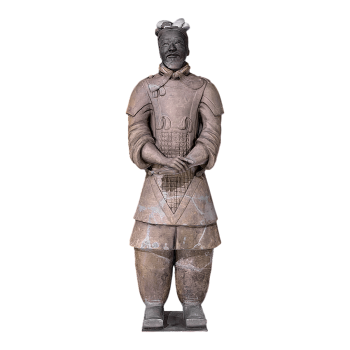
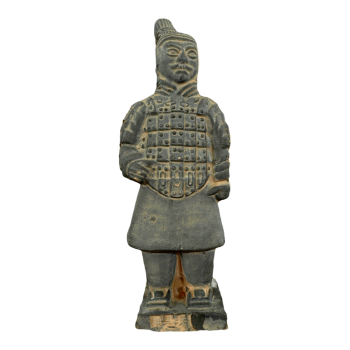
Terra Cotta Warriors in the the Mausoleum of the First Qin Emperor in Xi'an
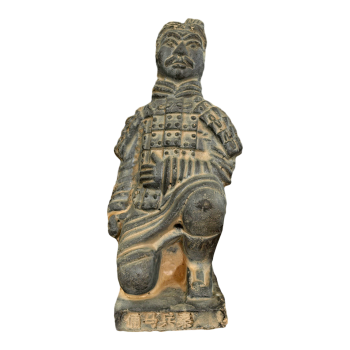
Terra Cotta Warriors in the the Mausoleum of the First Qin Emperor in Xi'an

The Terra Cotta Warriors, namely the Terra Cotta Warriors in the the Mausoleum of the First Qin Emperor, also referred to as the Terra Cotta Warriors or the Terracotta Warriors, are the first batch of national key cultural relics protection units and the first batch of Chinese world heritage sites. They are located in the Terra Cotta Warriors pit 1.5 kilometers east of the the Mausoleum of the First Qin Emperor in Lintong District, Xi'an, Shaanxi Province. Terra Cotta Warriors is a category of ancient tomb sculptures. In ancient times, human sacrifice was practiced, and slaves were considered as accessories of the slave owner during their lifetime. After the slave owner's death, the slaves were buried as sacrificial objects with the slave owner. The Terra Cotta Warriors are burial objects in the shape of soldiers and horses (chariots, horses, soldiers).
Terra Cotta Warriors in the the Mausoleum of the First Qin Emperor in Xi'an - Terra Cotta Warriors kneeling

Terra Cotta Warriors in the the Mausoleum of the First Qin Emperor in Xi'an - Terra Cotta Warriors kneeling

The Terra Cotta Warriors, namely the Terra Cotta Warriors in the the Mausoleum of the First Qin Emperor, also referred to as the Terra Cotta Warriors or the Terracotta Warriors and Horses of the Qin Dynasty, are among the first batch of national key cultural relics protection units, the first batch of Chinese world heritage sites, and are also known as one of the world's top ten rare treasures of ancient tombs. It is located in the Terra Cotta Warriors pit 1.5 kilometers east of the the Mausoleum of the First Qin Emperor in Lintong District, Xi'an, Shaanxi Province. Terra Cotta Warriors is a category of ancient tomb sculptures. In ancient times, human sacrifice was practiced, and slaves were considered as accessories of the slave owner during their lifetime. After the slave owner's death, the slaves were buried as sacrificial objects with the slave owner. The Terra Cotta Warriors are burial objects in the shape of soldiers and horses (chariots, horses, soldiers).
Guan Yu on horseback

Guan Yu on horseback

This is a 16th century artwork, currently housed in the Minneapolis Museum of Art in the United States. The statue is made of gold-plated bronze and measures 51.4 x 41.9 x 18.7 centimeters. Guan Yu (? -220 AD), also known as Yunchang and Changsheng, also known as Meiran Gong, Guan Gong, Wusheng, and Zhuangmu Hou, was born in Jiexian County, Hedong Commandery (now Jiezhou Town, Yanhu District, Yuncheng City, Shanxi Province). A famous general in the late Eastern Han Dynasty.
Terra Cotta Warriors in the the Mausoleum of the First Qin Emperor in Xi'an

Terra Cotta Warriors in the the Mausoleum of the First Qin Emperor in Xi'an

The Terra Cotta Warriors, namely the Terra Cotta Warriors in the the Mausoleum of the First Qin Emperor, also referred to as the Terra Cotta Warriors or the Terracotta Warriors and Horses of the Qin Dynasty, are among the first batch of national key cultural relics protection units, the first batch of Chinese world heritage sites, and are also known as one of the world's top ten rare treasures of ancient tombs. It is located in the Terra Cotta Warriors pit 1.5 kilometers east of the the Mausoleum of the First Qin Emperor in Lintong District, Xi'an, Shaanxi Province. Terra Cotta Warriors is a category of ancient tomb sculptures. In ancient times, human sacrifice was practiced, and slaves were considered as accessories of the slave owner during their lifetime. After the slave owner's death, the slaves were buried as sacrificial objects with the slave owner. The Terra Cotta Warriors are burial objects in the shape of soldiers and horses (chariots, horses, soldiers).
Qing Dynasty boxwood carving "Dao Xian He Xian Gu"

Qing Dynasty boxwood carving "Dao Xian He Xian Gu"

This is a sculpture called 'Taoist Immortal He Xiangu', made in the 1700s during the Qing Dynasty of China (1644-1911). This sculpture is made of boxwood, with a base of colored ivory and an overall height of 13.5 centimeters. He Xiangu is one of the Eight Immortals of Taoism. It is said that she was a real person during the Tang Dynasty, originally named He Qiong. In this exquisite carving, He Xiangu sits calmly on a twisted and multi jointed raft surrounded by green ivory waves. In front of her was a bamboo basket filled with items related to Taoist immortality, while she held a branch of Ganoderma lucidum.
Terra Cotta Warriors in the the Mausoleum of the First Qin Emperor

Terra Cotta Warriors in the the Mausoleum of the First Qin Emperor

The Terra Cotta Warriors, namely the Terra Cotta Warriors in the the Mausoleum of the First Qin Emperor, also referred to as the Terra Cotta Warriors or the Terracotta Warriors, are among the first batch of national key cultural relics protection units, the first batch of Chinese world heritage sites, and are known as one of the world's top ten rare treasures of ancient tombs. It is located in the Terra Cotta Warriors pit 1.5 kilometers east of the the Mausoleum of the First Qin Emperor in Lintong District, Xi'an, Shaanxi Province. Terra Cotta Warriors is a category of ancient tomb sculptures. In ancient times, human sacrifice was practiced, and slaves were considered as accessories of the slave owner during their lifetime. After the slave owner's death, the slaves were buried as sacrificial objects with the slave owner. The Terra Cotta Warriors are burial objects in the shape of soldiers and horses (chariots, horses, soldiers).
Statue of Gandhi and the Goat

Statue of Gandhi and the Goat

This sculpture is an exhibit located at the Gandhi Museum in Delhi, India. This exhibit depicts a scene of Gandhi and a goat. Gandhi once swore not to consume milk and buffalo milk as a protest against animal abuse. But under the persuasion of his wife and doctor, he eventually agreed to drink goat milk.
Spartacus marble sculpture

Spartacus marble sculpture

This is a marble sculpture created by Denis Foyatier, measuring 2.12 meters in height, 0.63 meters in width, and 0.97 meters in length. This work depicts the scene of Spartacus breaking his chains. The work was completed in 1830 and exhibited at a salon exhibition in 1831. From October 1832 to 1877, this work was kept in the Tuileries Garden, and on December 3, 1877, it was moved to the Louvre.
Half body portrait of Mark Twain

Half body portrait of Mark Twain

This bust of Mark Twain is located at the Hermitage Museum and Sculpture Garden in Santa Barbara, California. This is a bronze, life size bust created by artist HermiTed. Mark Twain (November 30, 1835- April 21, 1910), originally named Samuel Langhorne Clemens, was an American humorist, novelist, writer, and renowned orator.
The marble statue of Leonardo da Vinci on Mount Pinzio in Italy

The marble statue of Leonardo da Vinci on Mount Pinzio in Italy

Mount Pianzio is a mountain located in the northeast quadrant of the historical center of Rome. This mountain is located to the north of Quirinal Mountain, overlooking the Place of Matthias. It is located outside the original boundaries of ancient Roman cities and is not one of the seven mountains of Rome, but it is situated within the city walls built by Roman Emperor Aurelian between 270 and 273. Villas and Gardens In the late Roman Republic, several important families owned villas and gardens on the southern slope, including the Lucius Garden created by Lucius, the Saluste Garden created by historian Saluste, the Pompeian Garden, and the Archillion Garden. This mountain was called Garden Mountain during the Roman era.
Gypsum portrait of East German politician Wilhelm Pick

Gypsum portrait of East German politician Wilhelm Pick

William Pick was born in 1876 into a poor working-class family in Guben. Joined the German Social Democratic Party in 1895. Due to disappointment with the cooperation between the party leadership and conservative forces during World War I, he became an early member of the Spartak League and participated in the establishment of the German Communist Party. In 1933, he was forced to flee from Germany under Hitler's rule. In April 1946, the Social Democratic Party of Germany merged with the Communist Party of Germany to form the Socialist Unity Party of Germany, and was elected as one of the two chairpersons of the Socialist Unity Party along with Otto Grotiver. When the German Democratic Republic was established in 1949, he became the only president of East Germany.
The marble statue of Lady Elche from the Iberian Peninsula in medieval Spain

The marble statue of Lady Elche from the Iberian Peninsula in medieval Spain

The Iberian sculpture is located at the National Archaeological Museum in Madrid, Spain. The museum is located on Serrano Street, adjacent to Cologne Square, and shares a building with the National Library of Spain. The museum's collection mainly comes from the Iberian Peninsula, from prehistoric times to early modern times. However, it also has different collections from outside Spain, especially from ancient Greece, whether from Greater Greece or ancient Egypt, and even a small portion from the Near East.
Statue of a Young Man in Limestone from the Classical II Period in Cyprus

Statue of a Young Man in Limestone from the Classical II Period in Cyprus

This youth portrait sculpture was made during the Cyprus Classical II period from 600-475 BC. The statue is made of limestone and was created around 530-520 BC. The hair of the sculpture is divided into large horizontal curls, forming an arched shape at the back. The details are represented by small triangles. The facial features are very delicate, with red marks on the lips. The nose is slightly curved and the eyes are wide open. The eyebrow lines are long and thin, and the ears are depicted very delicately. There is a row of curly hair above the forehead. The statue is currently on display at the Metropolitan Museum of Art in New York, located in Hall 171.
Torso sculpture, created by Czech artist Miloslav Chlup áč

Torso sculpture, created by Czech artist Miloslav Chlup áč

Torso "is an artwork created by Czech artist Miloslav Chlup áč, currently housed in the Kamp Museum in Prague.
The bronze statue of "Bronze Moses" at Augustana University

The bronze statue of "Bronze Moses" at Augustana University

The 'Bronze Moses' at Augustana University is a full-size bronze replica of Michelangelo's' Moses' statue created by Felix de Verden. This work was donated by Fenwick, a Cleveland industrialist and former resident of Sioux Falls, in 1974. It was originally completed around 1964 and was exhibited at the Cleveland Museum in Fenwick. This statue is currently located on the campus of Augustana University.
The marble statue of Alexander the Great from the ancient Greek Empire period

The marble statue of Alexander the Great from the ancient Greek Empire period

The statue was made between the 2nd and 1st centuries BC and came from Alexandria, Egypt. The head of the statue has been cut to accommodate a separately made body. The back of the statue has been processed to receive the remaining parts of hair made from other materials. Alexander the Great was the king of the ancient Greek kingdom of Macedonia, located in present-day northern Greece and neighboring countries. Under his leadership, from 336 BC to 323 BC, Alexander the Great conquered Greek city states, the Persian Empire, and established over 70 cities, creating an empire spanning three continents and covering approximately two million square miles.
The wooden carving "Johannes Sudder" created by Gus

The wooden carving "Johannes Sudder" created by Gus

Johannes Sudel woodcarving was created by an artist named Gus, who was an art sculptor from Dresden, Germany. This wooden carved figure has long flowing hair and beard, giving it an ancient or mythical appearance. His eyes were closed, and his expression was calm and peaceful. The details of the hair and beard are handled very delicately.
Pink granite statue of Ankhkirednefer in ancient Egypt

Pink granite statue of Ankhkirednefer in ancient Egypt

This statue has a beetle on its head, the symbol of Osorkon II engraved on its arm, and the image of Osiris inside the shrine. The edge of the shrine and the back pillar of the spire are both engraved with hieroglyphs. This statue was discovered in Ter Mashuta, Egypt, and is 62 centimeters high, 28 centimeters wide, and 38 centimeters long. It is now housed in the British Museum. Ankhkirednefer served as the Grand Inspector of the Palace and an excellent secretary of the Temple of Artum under the rule of Osorkon II, the fifth king of the 22nd Dynasty of Egypt.
Male statue from Cyprus

Male statue from Cyprus

This statue is the upper half of a huge limestone statue depicting a bearded man, possibly an worshipper or priest. The statue depicts a standing figure wearing a pleated robe, with a cloak draped over his left shoulder and a serrated fold at the edge. This statue can be traced back to 450 BC to 425 BC, with a height of 1.04 meters. The complete statue is at least 2 meters high. The statue comes from Cyprus, possibly from the Temple of Apollo, and is now located in the British Museum.
Medieval Madonna and Child Snowflake Gypsum

Medieval Madonna and Child Snowflake Gypsum

This is a partially painted statue made of plaster from England (possibly the central region) depicting the Virgin Mary and Child, made around 1350-75 AD. The height of this statue is 75 centimeters and it comes from the Redeemer Monastery in Saint Truiden, Limburg Province, Belgium. This statue is currently on display at the Medieval Europe Gallery (G40) of the British Museum. This is the best preserved statue of its kind in the museum.
Statue of Strangford Apollo in ancient Greece

Statue of Strangford Apollo in ancient Greece

Strangford Apollo is an ancient Greek statue depicting a naked boy with missing arms and lower legs. This statue was made around 490 BC and is one of the latest examples of youth sculpture type statues, made of Parian marble. This statue has been in the collection of the British Museum since 1864.
Marble bust of Emperor Grommacus Aurelius

Marble bust of Emperor Grommacus Aurelius

The height of this bust is 73.66 centimeters. Marcus Aurelius (April 26, 121 AD - March 17, 180 AD) was an emperor of the ancient Roman Empire who reigned from 161 AD to 180 AD. He was a philosopher of the Stoic school, known for his philosophical ideas and the book "Reflections". He was also a member of the Nerva Antony dynasty, hailed as the last of the five good emperors and the last emperor of the Roman Empire's peaceful era (27 BC to 180 AD). This statue is currently housed in the British Museum.
Roman Emperor Caracalla marble bust

Roman Emperor Caracalla marble bust

Caracalla was an emperor of the Roman Empire who reigned from 198 to 217 AD. He is known for his strict and cruel way of ruling. This bust has a height of 67.50 centimeters and was discovered at Quattro Fontane on Quirinal Hill in Rome. It is now on display in Gallery 70 of the British Museum.
Ancient Roman Antinos Head Marble Statue

Ancient Roman Antinos Head Marble Statue

The head of this marble statue was taken from a statue of Antinos, who was wearing an ivy wreath. The bust was added later, with the head fixed on top. The head of this statue dates back to the Roman period and was made around 130-140 AD. It was excavated on the Janiculum Mountain in Rome, Lazio, Italy, in Europe. The height of the head of this statue is 81 centimeters and it is currently housed in the British Museum. Antinos was the boyfriend or lover of Roman Emperor Hadrian.
Part of the Head Statue of Pharaoh Amenhotep III in Ancient Egypt

Part of the Head Statue of Pharaoh Amenhotep III in Ancient Egypt

This sculpture is carved from red granite and has a height of 63.50 centimeters. This statue can be traced back to approximately 1370 BC and was discovered within the walls of the Muth Temple in Karnak, ancient Egypt. This huge statue has been broken, and currently known parts include a head and an arm. Both of these parts are now at the British Museum.
Marble statue of the head of King Apion of Selenica in ancient Greece

Marble statue of the head of King Apion of Selenica in ancient Greece

Ptolemy Apion was the last king of Cyrenaica in Greece from 150 BC to 145 BC. He is a member of the Ptolemaic dynasty. This statue was made during the Hellenistic period in the 1st century BC and is 36.83 centimeters tall. The statue was discovered in the Temple of Apollo on Mount Panathos in central Greece and is now located in the British Museum.
Granodiorite statues from the 26th Dynasty of ancient Egypt

Granodiorite statues from the 26th Dynasty of ancient Egypt

This statue is a kneeling statue made of granite from the 26th Dynasty, and it is the image of Mentuemhat. The stone tablet on the statue depicts a scene of worship, with eleven rows of pictographic characters on it and two columns of pictographic characters on the back pillar. Mentuemhat was a wealthy and powerful official during the 25th and 26th dynasties of ancient Egypt. He was the mayor of Thebes and the fourth priest of the god Amun. This statue may have originated from Mentuemhat's tomb in Assassif, Thebes. This statue is currently located in the British Museum.
Armor for Man and Horse with the coat of arms of V ö ls Colonna

Armor for Man and Horse with the coat of arms of V ö ls Colonna

This is a steel work from northern Italy in the 16th century, created around 1575. The decoration of this work is a type popular in late 16th century northern Italy, consisting of etched decorative bands of figures, animals, portrait busts, and armor trophies. The total weight of the man and horse armor in this work is 114 pounds. This artwork has been a well-known centerpiece of the Weapons and Armor Gallery at the Cleveland Museum of Art since 1960. In addition, a part of this artwork, including a matching shield, is currently housed in the Metropolitan Museum of Art.
Head of an Amazon Marble Sculpture

Head of an Amazon Marble Sculpture

This work is a replica of a Greek bronze original from an art competition held in Ephesus between 440-430 BC. This marble replica was discovered in 1874 in the Horti Maecenatiani (garden of Maecenas) in Rome.
Marble statues of the gods Mars and Venus

Marble statues of the gods Mars and Venus

This statue is made of marble, standing 1.73 meters (5 feet 8 inches) tall, and was crafted between 120-140 AD (with repairs made around 170-175 AD). The male figure originally represented the ancient Roman Emperor Hadrian, but his head was later restored to Lucius Verus. The female image represents his wife Sabina. This statue is currently located in the Louvre Museum in Paris, France.
Bronze Statue Garrison - Black Jade Statue of Emperor Guan Gong

Bronze Statue Garrison - Black Jade Statue of Emperor Guan Gong

Guan Yu (160-220 AD), also known as Yunchang and Changsheng, was born in Jiexian County, Hedong Commandery (now Jiezhou Town, Yanhu District, Yuncheng City, Shanxi Province). A famous general in the late Eastern Han Dynasty. Guan Yu treated soldiers well and despised literati, and was known for his loyalty and righteousness in later generations. After his death, he was revered as "Guan Gong" by the people and was often honored by the imperial courts throughout history. During the reign of Emperor Yongzheng of the Qing Dynasty, he was revered as the "Martial Saint" and held the same status as Confucius, the "Literary Saint". In the novel 'Romance of the Three Kingdoms', he is ranked first among the' Five Tiger Generals'. In the regions of Hong Kong, Macau, Taiwan, and some Southeast Asian countries, almost every household worships the statue of Guan Gong, who is worshipped by Confucius in literature and Guan Gong in martial arts.
Marble statue of the dying Gauls in ancient Rome

Marble statue of the dying Gauls in ancient Rome

The 'Dying Gauls', also known as the' Dying Galatians' or 'Dying Gladiators', is an ancient Roman marble half recumbent statue currently housed in the Capitoline Museum in Rome. This statue is a replica of a Greek sculpture, originally made of copper and dating back to the Hellenistic period (323-31 BC, 1633)
Michelangelo's sculpture of David Apollo

Michelangelo's sculpture of David Apollo

This unfinished marble sculpture was created around 1530 and is now located at the Bargello Museum in Florence, Italy. This work was originally commissioned by the head of the Papal army, Baggio Valloli. Later, after Valloli was accused of treason and beheaded on the orders of Cosimo I de 'Medici, the sculpture was acquired by the Duke of Florence. The back of this sculpture is partially completed, with a rough surface that showcases Michelangelo's typical 'unfinished' style.
The Capitoline Amazon statue in the Temple of Jupiter

The Capitoline Amazon statue in the Temple of Jupiter

This statue is a 2-meter-high replica of 2nd century AD marble signed by the Roman sculptor "Sosicles". This statue depicts an Amazonian who is a member of a female warrior race and is injured on the right side. She revealed her chest, raised her right arm, looked at her wound, and grabbed her clothes at the same time. It is a replica of the famous bronze Amazons made by sculptor Kresilas (second half of the 5th century BC), and the original can be traced back to the second half of the 2nd century AD, during the Antonian period (180-190 d. C). This sculpture is currently housed in the Capitoline Museum in Rome, Italy.
Gandhi Statue

Gandhi Statue

Gandhi statue produced by WAGH Studio in Mumbai, India. Mohandas Karamchand Gandhi, also known as the "Great Soul," was an Indian lawyer, politician, social activist, and writer. He successfully led the movement for India's independence from British rule through nonviolent resistance.