Scylla olivacea

Scylla olivacea

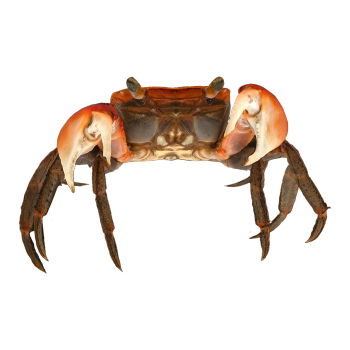
The olive green crab is a species of animal in the family Crabaidae, belonging to the genus Crabapple. It is a commercially important crab species distributed in the Indo Western Pacific region, including Southeast Asia, South Asia, Japan, North Australia, as well as the East and South China Seas of China. Due to its fast growth, large size, and strong adaptability, its meat is delicious and has high nutritional value. It is a traditional precious seafood and artificial breeding object in Southeast Asia, South Asia, and Taiwan. Its claws are orange red in color, and its carapace is horizontally elliptical, with a width of up to 18 centimeters and pointed sides.
Red clawed mantis arm crab male

Red clawed mantis arm crab male

The red clawed mantis arm crab is an arthropod belonging to the family Characidae in the order Decapoda. The width of the head and chest armor is slightly larger than its length, square in shape, and has a smooth surface. Wide forehead, straight leading edge, sharp ridge behind forehead; The outer eye socket is triangular in shape; Sharp and toothless edges. Steps 1-4: The last 3 segments of the foot have black hard bristles; Abdominal triangle, tail segment nearly circular. Male claws are larger than females, with high palmar nodes and granular dorsal edges. The middle of the inner side has granules, while the outer side is smooth and often blood red in color; The gap between the two fingers of the male claw is larger than that of the female claw, and the inner edges of the two fingers are serrated, with one larger tooth at each end. The female abdomen is round and large.
Red clawed mantis arm crab female

Red clawed mantis arm crab female

The red clawed mantis arm crab is an arthropod belonging to the family Characidae in the order Decapoda. The width of the head and chest armor is slightly larger than its length, square in shape, and has a smooth surface. Wide forehead, straight leading edge, sharp ridge behind forehead; The outer eye socket is triangular in shape; Sharp and toothless edges. Steps 1-4: The last 3 segments of the foot have black hard bristles; Abdominal triangle, tail segment nearly circular. Male claws are larger than females, with high palmar nodes and granular dorsal edges. The middle of the inner side has granules, while the outer side is smooth and often blood red in color; The gap between the two fingers of the male claw is larger than that of the female claw, and the inner edges of the two fingers are serrated, with one larger tooth at each end. The female abdomen is round and large.
Medium sized round square crab

Medium sized round square crab

Medium sized round square crab is a species of crab in the family Crabaidae and genus Crabapple. It is distributed in North Korea, the Indian Ocean, and Taiwan Island. This type of crab often inhabits under rocks or between pebbles at the high tide line, and its living environment is seawater. In scientific classification, it belongs to the animal kingdom, arthropod phylum, crustacean subphylum, soft shelled class, Decapoda, Caesarea, short tailed suborder, Crabapple family, and Crabapple genus. The scientific name of this crab was first named by Ortmann in 1894.
Ozawa Crab

Ozawa Crab

Ozawa crab is a freshwater crab belonging to the genus Ozawa. It coexists with Geothelphusa dehaani in river habitats in southern Kyushu, Kagoshima Prefecture, and the Osumi Peninsula in Japan. With G Compared to Dehaani, the maximum body size of the Ozawa crab is smaller and it mainly lives in water (aquatic), while G Dehaani may live both in water and on land (amphibious). The differences in habitat and activity patterns among Geothelphusa species are attributed to their microenvironment and the impact of interspecific competition in symbiosis.
Sesarma bidens

Sesarma bidens

The Sesarma bidens, also known as the Double Toothed Hand Crab, belongs to the family Crabs and the genus Sesarma. The two tooth hand crab is distributed in North Korea, Japan, the Philippines, the Malay Islands, Andaman, Sri Lanka, India, Taiwan Island, as well as Guangxi, Guangdong, Hong Kong, Fujian and other places in the Chinese Mainland. Its living environment is seawater, which is mostly found on mudflats near estuaries and far away from water.
Metopograpsus quadridentatus

Metopograpsus quadridentatus

The Four Toothed Large Crab (scientific name: Metopograpsus quadridentatus) is an animal belonging to the genus Large Crab in the family Crabs. It is distributed in Malacca, Java, Balibaban, Kalimantan, New Guinea, the Indian Ocean, and Guangdong, Fujian, Zhejiang, Shandong and other places in Chinese Mainland. Its living environment is sea water, which is mostly found in rock cracks or under rocks at the low tide line.
Chasmagnathus convexus

Chasmagnathus convexus

Chasmaganathus converxus, also known as the long backed open mouth crab, belongs to the family of square crabs. Some individuals have a bright purple color all over their body and red joints, which are easily recognizable, but some individuals have a yellowish color that is very similar to Taiwan thick crabs. Cave dwellings are found around grassy marshes near river mouths, between field ridges, mangrove swamps, and along earthen embankments. There are collection records in both the Jianxing ephedra forest and the Wenliao mangrove forest.
Dehani Sawa Crab

Dehani Sawa Crab

The Geothelphusa dehaani crab (scientific name: Geothelphusa dehaani) is a type of crab classified in the order Shrimp (Decapoda), suborder Crabs, and family Characidae. It is a unique species in Japan, a pure freshwater crab that spends its entire life in freshwater areas. The specific name dehaani in the scientific name is named in honor of the Dutch zoologist Wilhelm de Haan, who made contributions to the classification of crustaceans in Japan.
Chiromantes dehaani

Chiromantes dehaani

Chiromantes dehaani, formerly known as Chiromantes dehaani, originally belonged to the family Characidae and genus Chiromantes. After separating from the family Characidae, Chiromantes dehaani was reclassified as Chiromantes and genus Chiromantes dehaani. It is distributed in Korea, Japan, Taiwan Island, Hainan Island, Guangdong, Fujian, Zhejiang, Jiangsu, Liaodong Peninsula and other places in Chinese Mainland, and generally lives on the muddy banks of offshore freshwater rivers or in offshore marshes. It is the second intermediate host of mouse lung flukes.
Sea squirt shrimp

Sea squirt shrimp

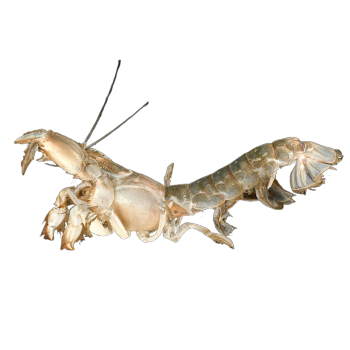
Thalassina anomala (scientific name: Thalassina anomala) is an animal belonging to the family Thalassidae in the order Decapoda of the phylum Arthropoda in the animal kingdom. The head and chest armor of the sea squirt shrimp genus is slightly flattened and swollen on the side, slightly elliptical in shape, calcified and thick, with two longitudinal sutures (sea squirt shrimp sutures), small frontal horns, and pointed spines. Abdominal degeneration, slender and flat, without obvious lateral armor. The first and second steps are characterized by sub chelation of the feet, with the first pair being thick and asymmetrical, with the knuckles greatly extending beyond the end of the immobile fingers.
Anthropomorphic face crab

Anthropomorphic face crab

The anthropomorphic crab is a species of crab in the anthropomorphic crab family, also known as the carrier crab. It occurs in the eastern Atlantic and Mediterranean, from Angola to Norway, the Northern Islands, and Iceland. It is benthic and occurs at depths of 10-1212 meters, but is mainly found at depths exceeding 80 meters. It prefers areas with soil and emerging rocks, and has been observed in deep-water coral gardens and sponge gathering areas.
Red eyed Snow Crab

Red eyed Snow Crab

Red eyed snow crab, also known as Bai's snow crab or long footed crab, is a type of snow crab. It is very similar to the gray eyed snow crab and is both found in the Bering Sea. The difference is that it is only found in the northern Pacific Ocean and is commonly referred to as the "snow crab" when sold. In the United States, it is also known as the cobbler crab, and in Japan, it is also known as the Great Chu crab or the big headed dwarf crab. Due to overfishing, the population of red eyed snow crabs has significantly decreased.
Platycodon grandiflorus crab

Platycodon grandiflorus crab

Platycodon grandiflorus, commonly known as orange mud crab, is a species of important commercial value in the mangrove crab genus. It is one of several crabs known as mud crabs, distributed in mangrove areas from Southeast Asia to Pakistan, from Japan to northern Australia. Like other species in the Scylla genus, it is widely cultivated using wild caught populations in aquaculture.
sesarma haematocheir

sesarma haematocheir

The red clawed hand crab is an arthropod belonging to the family Tetraodontidae in the order Decapoda. The width of the head and chest armor is slightly larger than its length, square in shape, and has a smooth surface. Wide forehead, straight leading edge, sharp ridge behind forehead; The outer eye socket is triangular in shape; Sharp and toothless edges. Steps 1-4: The last 3 segments of the foot have black hard bristles; Abdominal triangle, tail segment nearly circular. Male claws are larger than females, with high palmar nodes and granular dorsal edges. The middle of the inner side has granules, while the outer side is smooth and often blood red in color; The gap between the two fingers of the male claw is larger than that of the female claw, and the inner edges of the two fingers are serrated, with one larger tooth at each end. The female abdomen is round and large.
Mytilus galloprovincialis

Mytilus galloprovincialis

The Mediterranean mussel (scientific name: Mytilus galloprovincialis) is a species of shellfish in the genus Mytilus. It is an invasive species in many parts of the world, but is also a common species in aquaculture. The Invasive Species Expert Group (ISSG) of the International Union for Conservation of Nature's Species Survival Committee is listed as one of the world's top 100 invasive alien species.
Noble scallop specimens

Noble scallop specimens

The shell of the luxurious scallop is large and larger, with a shell length exceeding 100mm. The shell is tough and round in shape. The shell length is slightly equal to the shell height, the two shells are equal, the left shell is slightly more convex than the right shell, and the sides of the shell are slightly equal. The dorsal edge of the shell is straight, and the ventral edge is circular. The top of the shell is located in the middle of the back edge, small and not convex, with shell ears in front and behind the top of the shell. The two ears are unequal, with the left anterior ear slightly larger and both ears forming triangles, with 7-8 thin ribs on the ribs; There is a significant difference between the front and back ears of the right shell; The front ear is large, nearly triangular, with about 4 thick ribs on the surface, and there are several small comb teeth in the foot silk holes below; Rear ear triangle with several thin ribs.
Two color river clam specimen

Two color river clam specimen

The external characteristics of the shell range from medium to large. The shell beak is located at the front end. Thin shell. The true bead layer did not extend to the end. Lack of twisted teeth. The scar on the anterior adductor muscle is small and located at the front end, while the scar on the posterior adductor muscle is large and located in the center. There are no water pipes. Attach the front foot fibers to the substrate and bury them in the substrate with the back edge facing upwards.
Overturned pufferfish

Overturned pufferfish

The overturned pufferfish is a fish species belonging to the family Tetraodontidae in the order Tetraodontiformes, also known as the overturned pufferfish, stingray, or stingray. Short and extremely flattened, oval in shape; The body height is about 2/3 of the body length; The head is slightly short, extremely flattened, and nearly semi-circular; Blunt and round snout, slightly protruding snout tip; Eyes are small and slightly tall; The tail is very short and has no tail handle; Small mouth, front position; Body without scales; No lateral lines; The dorsal fin is short and extremely high; Mid position pectoral fin, very small, nearly circular; The anal fin is similar to the dorsal fin and is symmetrically positioned; The caudal fin is wide and short, with wavy grooves, and the posterior edge is connected to the dorsal and anal fins. The back of the body is gray brown, with silver gray on both sides, white on the belly, and most of the fins are gray brown.
Stingray fish

Stingray fish

Ray fish, a general term for cartilaginous fish in the order Rayiformes. The body shape is flat, slightly circular or diamond shaped, resembling a thin disk; The surface of the fish has various patterns, which are brown or black in color; The abdomen is white; The tail is slender, with spines on the caudal peduncle, and the tip of the spines is hooked. The stingray is also known as the "devil fish".
Killer whale

Killer whale

Orcas are mammals belonging to the family of dolphins in the order of Whale Artiodactyla. Adult weight 6600 kilograms, average body length 6-9 meters; The head is slightly round, with an indistinct beak or no beak; The body is black and white in color; There are oval shaped white eye spots above and behind the eyes; There are 10-12 conical teeth on each side of the upper and lower jaws; Males are longer than females and weigh about twice as much as adult females. The killer whale has a large head, black and white colors, and looks like a tiger, hence its name.
Manta ray

Manta ray

Manta ray is a collective term for several marine fish species in the family Mantidae of the order Rayiformes. There are currently 13 species of manta rays. Manta rays are most closely related to sharks. Manta rays have a flat body; The kiss end is wide and flat horizontally; There are two protruding head fins differentiated from pectoral fins in front of the head; The tail is slender like a whip; The gill pores are wide. Manta rays are named after their swimming posture that resembles bats flying at night.
humpback

humpback

The humpback whale is a mammal belonging to the family Cetidae in the order Cetacean. Enlarged body, broad upper jaw, with tumor like protrusions along the central line from the breathing hole to the snout and on both sides of the upper and lower jaws; The dorsal fin is relatively small, located at 2/3 of the posterior body length; The fin limbs are very large, about one-third of the body length, with irregular serrated protrusions on the leading edge; The caudal fin is wide and the outer edge is also irregularly serrated; There are fewer folds and grooves on the ventral surface, ranging from 14 to 35, extending from the lower jaw to the front of the navel. The back is black with black stripes, the abdomen is black or white, and the body color varies greatly among individuals; There are more white parts above the fins than black parts, and white parts below; The ventral surface of the caudal fin is white, with black edges.
Devouring shark

Devouring shark

The great white shark, also known as the man eating shark, is a fish species in the family Muridae of the order Muriformes. The body is spindle shaped; The tail handle is flat and has a protrusion on one side; Each of the upper and lower parts of the tail base has a depression; Blunt and pointed kisses, relatively short; No blinking membrane in the eyes; The nostrils are close to the mouth; The mouth is longer than the kiss in front of the mouth; Short lip folds; Teeth large, triangular, with fine serrations on the edges; 5 gill pores; The first dorsal fin is tall and triangular in shape; The second dorsal fin is very small; The caudal fin is forked, wide and short; The anal fin is the same shape and size as the second dorsal fin, located below and behind the second dorsal fin; The pelvic fins are located approximately below the center of the gap between the two dorsal fins; The pectoral fins are sickle shaped. The dorsal side is greenish brown or dark brown, while the lower and ventral sides are light gray to white.
Blue Whale

Blue Whale

Blue whale is a marine mammal belonging to the family of baleen whales and the genus of baleen whales. There are four subspecies in total. The blue whale is considered the largest animal known to have lived on Earth, measuring up to 33 meters in length and weighing 181 tons. The body of a blue whale is slender and long, with a bluish gray back, but sometimes it appears lighter in water. The fin limbs of blue whales are 3-4 meters long. Above is gray with narrow white edges. Below is completely white. The head and tail fins are generally gray. But the back and sometimes the fins are usually mottled.
The sperm whale

The sperm whale

Sperm whales are marine mammals belonging to the order Cetiformes and family Spermatidae. With a body length of up to 18 meters and a weight of over 50 tons, it is the largest toothed whale, with its head occupying one-third of its body. The head is huge, the lower jaw is small, and only the lower jaw has teeth. No dorsal fin; Highly capable of diving, it is the mammal with the deepest and longest diving time. Like a fish in size, it breathes through its lungs. Short neck, the head seems to be connected to the torso; Cervical spine healing; The nostrils are spray holes located at the snout end, the forelimbs become fins, the forearms degenerate, the palms become longer, and the number of toes increases, but the toes and claws cannot be seen from the outside; Hind limb degeneration; The tail is like a fish, with horizontal tail fins, and it swings by the tail when swimming.
Mosasaurus

Mosasaurus

Mosasaurus is a marine reptile belonging to the family Mosasaurus in the order Scales. Its largest individual can reach about 20 meters, with a long barrel shaped body, a strong tail, and a snake like appearance. It has high fluid dynamics; Teeth are curved, sharp, and conical in shape; The forelimbs of Canglong have five toes, while the hind limbs have four toes. The limbs have evolved into fin like limbs, with the forelimbs being larger than the hind limbs. Most of the time, they swim slowly in the waters near the coast, with a fierce temperament that preys on fish, ammonites, turtles, and possibly other small sauropods. He is a ferocious ocean hunter.
Killer whale

Killer whale

Orcas are mammals belonging to the family of dolphins in the order of Whale Artiodactyla. Adult weight 6600 kilograms, average body length 6-9 meters; The head is slightly round, with an indistinct beak or no beak; The body is black and white in color; There are oval shaped white eye spots above and behind the eyes; There are 10-12 conical teeth on each side of the upper and lower jaws; Males are longer than females and weigh about twice as much as adult females. The killer whale has a large head, black and white colors, and looks like a tiger, hence its name.
Killer whale

Killer whale

It is a mammal belonging to the family of dolphins in the order of Artiodactyla and the genus of killer whales. The adult weight is 6600 kilograms, with an average body length of 6-9 meters. The head is large, black and white, and looks like a tiger, hence the name. Distributed in the waters near Liaoning, Shandong, Zhejiang, and Taiwan in China, and also in various oceans around the world, it is common in high latitude areas and nearshore waters. There is no fixed habitat, mainly chasing the fish or other sea animals it likes to eat, usually gathering into groups of 5-20 people, and there are also groups of up to 100 people or more. It is a highly socialized animal that forms families and is the most stable family in the animal world, with complex social behaviors.
Crab

Crab

octopus

octopus

A green turtle without a forelimb

A green turtle without a forelimb

Green sea turtles are reptiles of the family Turtles in the order Turtles, also known as sea turtles. The lifespan can reach over 100 years. Green sea turtles are distributed in warm waters of the Atlantic, Pacific, and Indian Oceans, and are found along the coasts of Shandong, Zhejiang, Fujian, Guangdong, Taiwan, and other regions in China. Food sources include fish, crustaceans, mollusks, and seaweed. According to the survey, green sea turtles are the most frequently occurring and widely distributed sea turtles in China, but their numbers have significantly decreased. The main reasons for the decline in its population are human predation, destruction of spawning grounds, death from fishing nets, and seawater pollution. Listed as a first-class protected animal in China.
Flat backed turtle

Flat backed turtle

The flat backed turtle is a species of sea turtle unique to Australia. Among sea turtles, only the hatchlings of flat backed turtles live in coastal waters and do not swim into the ocean, which is why they are unique to Australia. The flat backed turtle shell can grow up to 1 meter long and weigh up to 80 kilograms. The back shell is flat and circular, with a gray olive color and a brownish yellow edge. The edge shield has a thin layer of wax. Flat backed turtles are omnivorous turtles with a preference for meat, mainly feeding on mollusks. The flatback turtle is a CITES Class I protected animal under the Washington Convention.
Right Whale

Right Whale

Right whales are also known as humpback whales, black humpback whales, straight backed whales, Biscay whales, and beaked whales. It is a rare cold temperate baleen whale belonging to the family of right whales in the order of cetaceans. The body length is about 17 meters and the weight is 47-69 tons. The body color is blue black or black, the head length is about 1/4 of the body length, and it has a unique shaped keratin tumor, hence the name "beaked whale". Right whales are distributed in the South China Sea, East China Sea, Yellow Sea, Taiwan Sea, Pacific Ocean and other waters in China. They feed on planktonic crustaceans. Due to overfishing, the number of right whales is on the brink of extinction, estimated to be only 1000 in the North Pacific and around 1000 in the North Atlantic. They are now protected through international agreements
Heptranchias perlo

Heptranchias perlo

A species of shark belonging to the family Hexabranchidae and the genus Hexabranchia. The body is elongated, with a sub cylindrical shape in the front and slightly flattened in the back. Slightly flattened head; There are no depressions above or below the tail base. Large deep-sea sharks that inhabit the outer slopes of continental or island shelves, generally inhabiting depths of 100-400 meters, but can reach depths of up to 1000 meters. They are occasionally captured on the surface of water. Mainly feeds on other small sharks, small bony fish, crustaceans, and squid. Ovulation can give birth to 9-20 young sharks per litter. Widely distributed in tropical and temperate coastal waters of the Atlantic, Indian Ocean, and Pacific Ocean. Distributed in the East China Sea, the waters near Taiwan, and the South China Sea in China.