Gandhi Statue

Gandhi Statue

Gandhi statue produced by WAGH Studio in Mumbai, India. Mohandas Karamchand Gandhi, also known as the "Great Soul," was an Indian lawyer, politician, social activist, and writer. He successfully led the movement for India's independence from British rule through nonviolent resistance.
The Michael H ö rlich Medal, a commemorative medal from the Austrian Empire in the 16th century

The Michael H ö rlich Medal, a commemorative medal from the Austrian Empire in the 16th century

This commemorative medal was made in honor of Michael Hurlich, the abbot of the Getweg Monastery. The front of the commemorative medal features a half profile portrait of Herlich, with the words' MICH Æ L HERRLICH A [B] BAS GOTVICENSIS Æ T LI 'written on it. On the back of the commemorative medal is the city emblem of Getweg Monastery, which reads "DEVS REFVGIVM MEXM A ᴼ 1590". The commemorative medal is made of silver with a diameter of 3.5 centimeters. It was made in 1590 and is exhibited at the State Museum of Lower Austria in Austria.
Injured Amazon Head Statue

Injured Amazon Head Statue

This is a replica. The statue of the injured Amazon's head is derived from the marble statue of the original work "The Injured Amazon" by Greek sculptor Phidias in the 5th century BC. The original work is currently housed in the Capitoline Museum in Rome.
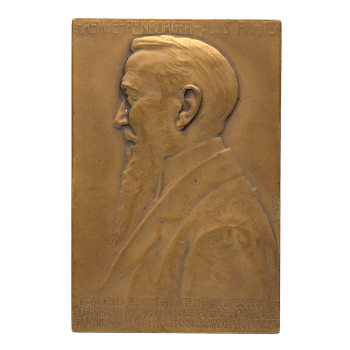
The Michael Haydn Medal, a commemorative medal from the Austrian Republic in the 20th century

The Michael Haydn Medal, a commemorative medal from the Austrian Republic in the 20th century

Michael Haydn was an Austrian composer of the modern era, and this commemorative medal was made in honor of Michael Haydn. The front of the commemorative medal features a half profile portrait of Haydn, with the words' MiCHAEL HAYDN: 1737-1806 'written on it. On the back of the commemorative medal is a scene of Hohenzollerbach, with two little angels on the left holding violins and a sheet music on the right. The commemorative medal is made of bronze with a diameter of 7.6 centimeters. It was made in 1927 and is exhibited at the State Museum of Lower Austria in Austria.
Statue of Duke de Richelieu of France

Statue of Duke de Richelieu of France

Duke de Richelieu was a French nobleman, soldier, and politician. He served as the Prime Minister of France from 1815 to 1818 and from 1820 to 1821, successfully causing the Allied occupation forces to withdraw from France. Prior to this, he served as the governor of Odessa and was renowned for his progressive administrative management. This monument was built in memory of him in 1828 after his death. This statue is one of the most famous statues in Odessa and ranks 10th among the 294 attractions in Odessa. This monument is currently located at the top of the Potemkin Steps in Odessa, Ukraine.
Commemorative medal of the Austrian Republic period in the 20th century, "Outstanding Medal of the Lower Austrian Agricultural Chamber of Commerce"

Commemorative medal of the Austrian Republic period in the 20th century, "Outstanding Medal of the Lower Austrian Agricultural Chamber of Commerce"

This commemorative medal is made to celebrate the outstanding performance of the Austrian Agricultural Chamber of Commerce. The front of the commemorative medal features a farmer and his cattle in front of an apple tree, with a harvest scene in the background. The back of the commemorative medal features the emblem of Lower Austria and five castles, while the front displays laurel leaves. It says' Progress. Lower Austrian Agricultural Chamber of Commerce. '. The commemorative medal is made of bronze, with a silver plated surface and a diameter of 5.5 centimeters. It was made in 1928. This commemorative medal is on display at the State Museum of Lower Austria in Austria.
Commemorative Medal of the Austrian Republic in the 20th Century, "Turn Meritorious Medal"

Commemorative Medal of the Austrian Republic in the 20th Century, "Turn Meritorious Medal"

This commemorative medal was made to celebrate the Lower Austria Provincial Exhibition held in Thurn. The front of the commemorative medal features farmers and craftsmen facing each other, each holding a central flag with their right hand. The farmer's left hand is also on the flagpole, while the craftsman's left hand lifts a laurel branch. Under their feet are symbols of agriculture, trade, and engineering, and the background is a scene from Turen. The back of the commemorative medal features the city emblem of Turen and laurel leaves. This commemorative medal is on display at the State Museum of Lower Austria in Austria.
The commemorative medal of the Austrian Empire period in the 19th century, titled "Rudolf Crown Prince Tasting Reiz Gold Wine Commemorative Medal"

The commemorative medal of the Austrian Empire period in the 19th century, titled "Rudolf Crown Prince Tasting Reiz Gold Wine Commemorative Medal"

The front of the commemorative medal features a quarter profile portrait of Rudolf, with the words' ARCHDUKE RUDOLF CROWN PRINCE OF AUSTRA 'written on it. The back of the commemorative medal features a view of a tall cup with a lid and the city emblem of Leitz. The creator of the commemorative medal is Kristelbauer. The medal is made of bronze with a diameter of 5.4 centimeters and was made in 1888. It is collected in the State Museum of Lower Austria, Austria.
20th Century Austrian Empire Period Commemorative Medal "Kaiser Franz Joseph District Orphanage Commemorative Medal"

20th Century Austrian Empire Period Commemorative Medal "Kaiser Franz Joseph District Orphanage Commemorative Medal"

This commemorative medal was made to celebrate the establishment of the orphanage in Leitz. The obverse of the commemorative medal features a quarter profile portrait of Franz Joseph I, with the words "FRANC. IOS. I. Monogram RN. The back of the commemorative medal features the architectural view of the orphanage and the city emblem of Leitz. The commemorative medal is made of silver, with a diameter of 3.7 centimeters, and was made in 1905. Franz Joseph I, Emperor of Austria and Austria Hungary, was a ruler of central and southern Europe in the 19th and 20th centuries. This commemorative medal is on display at the State Museum of Lower Austria in Austria.
The Joseph Hesse 60th Anniversary Medal, a commemorative plaque for British entrepreneurs

The Joseph Hesse 60th Anniversary Medal, a commemorative plaque for British entrepreneurs

This commemorative medal was made to celebrate Joseph Heyser's 60th anniversary. The front of the commemorative medal features a half profile portrait of Heather, with the words' JOSEF HEISER. BORN. SEPTEMBER 3, 1809 'written on it. The back of the commemorative medal features Heather's patented shaft and laurel leaves, with the words' AUGUST 1828 AUGUST 1888 'written on it. The creator of the commemorative medal is Heinrich Yanauer. The medal is made of British metal, with a diameter of 5.2 centimeters, and was made in 1888.
17th Century Polish Commemorative Medal "Sobieski Commemorative Medal"

17th Century Polish Commemorative Medal "Sobieski Commemorative Medal"

This commemorative medal is in honor of King John III Sobieski of Poland. The front of the commemorative medal features a side portrait of Sobieski, with the words' IOAN: III D. G. REX POLONIARUM 'written on it, meaning' John III, God's Grace, King of Poland '. On the back of the commemorative medal are two eagles, with the left eagle wearing a Rudolf crown and the right eagle wearing a Polish crown. This commemorative medal can be visited at the Uppsala University Commemorative Coin Museum in Sweden.
Bronze Commemorative Medal of the Habsburg Dynasty: Commemorative Medal for 600 Years of Habsburg Family Rule

Bronze Commemorative Medal of the Habsburg Dynasty: Commemorative Medal for 600 Years of Habsburg Family Rule

This commemorative medal is to celebrate the 600 year reign of the Habsburg family. The front of the commemorative medal features Rudolf I sitting, holding a scepter and the flag of the Austrian Duchy with five eagles. After the Habsburg family entered Austria in the late 13th century, their power gradually increased and they established a wide empire based in Austria. Rudolf I was the lord of southern Alsace and northern Switzerland. With the help of secular and ecclesiastical princes, Rudolf I successfully launched several campaigns against his main competitor, the most powerful German vassal, King Ottokar II of Bohemia, and ultimately achieved his goal in one battle.
Austrian Entrepreneur Commemorative Medal "Faber's New Year Commemorative Medal"

Austrian Entrepreneur Commemorative Medal "Faber's New Year Commemorative Medal"

This commemorative medal was made to celebrate the New Year of 1907 by the brewery owner Moritz Faber, his son Carl, and grandson Theodore. The front bust of the commemorative medal features Moritz, Carl, and Theodore, as well as the coat of arms of the Fir Branch and the Brewers Guild. Moritz Faber was born on March 14, 1837, Karl Faber was born on August 30, 1866, and Theodore Faber was born on February 1, 1897. The commemorative medal is made of copper, measuring 9.9 x 6 cm, and was made in 1906. The commemorative medal is now located at the State Museum in Lower Austria, Austria.
Albanian Lek Currency - Lek Commemorative Coin for the 25th Anniversary of World War II Liberation

Albanian Lek Currency - Lek Commemorative Coin for the 25th Anniversary of World War II Liberation

The original currency used in Albania was the franc. In July 1947, currency reform was implemented, replacing the franc with the current circulating new currency, the lek, with 1 lek=100 kunta. The lek replaced the old currency franc, with an exchange rate of 9 leks to 1 franc, and an exchange rate of 50 leks to 1 dollar against the US dollar. One lek commemorative coin, commemorating the 25th anniversary of the liberation from World War II.
Albanian Lek Currency Fifty Kunta Commemorative Coin for the 25th Anniversary of World War II Liberation

Albanian Lek Currency Fifty Kunta Commemorative Coin for the 25th Anniversary of World War II Liberation

The original currency used in Albania was the franc. In July 1947, currency reform was implemented, replacing the franc with the current circulating new currency, the lek, with 1 lek=100 kunta. The lek replaced the old currency franc, with an exchange rate of 9 leks to 1 franc, and an exchange rate of 50 leks to 1 dollar against the US dollar. 50 Kunta commemorative coin, commemorating the 25th anniversary of the liberation from World War II.
Albanian Lek Currency Two Lek Commemorative Coin for the 45th Anniversary of World War II Liberation

Albanian Lek Currency Two Lek Commemorative Coin for the 45th Anniversary of World War II Liberation

The original currency used in Albania was the franc. In July 1947, currency reform was implemented, replacing the franc with the current circulating new currency, the lek, with 1 lek=100 kunta. The lek replaced the old currency franc, with an exchange rate of 9 leks to 1 franc, and an exchange rate of 50 leks to 1 dollar against the US dollar. Erlek commemorative coin, commemorating the 45th anniversary of the liberation from World War II.
Albanian Lek Currency Five Kunta Coin

Albanian Lek Currency Five Kunta Coin

The original currency used in Albania was the franc. In July 1947, currency reform was implemented, replacing the franc with the current circulating new currency, the lek, with 1 lek=100 kunta. The Lek replaced the old currency franc, with an exchange rate of 9 Lek to 1 franc, and an exchange rate of 50 Lek to 1 dollar against the US dollar
Albanian Lek Currency Ten Kunta Coin

Albanian Lek Currency Ten Kunta Coin

The original currency used in Albania was the franc. In July 1947, currency reform was implemented, replacing the franc with the current circulating new currency, the lek, with 1 lek=100 kunta. The Lek replaced the old currency franc, with an exchange rate of 9 Lek to 1 franc, and an exchange rate of 50 Lek to 1 dollar against the US dollar
Albanian Lek Currency Twenty Kunta Coin

Albanian Lek Currency Twenty Kunta Coin

The original currency used in Albania was the franc. In July 1947, currency reform was implemented, replacing the franc with the current circulating new currency, the lek, with 1 lek=100 kunta. The Lek replaced the old currency franc, with an exchange rate of 9 Lek to 1 franc, and an exchange rate of 50 Lek to 1 dollar against the US dollar
Albanian Lek Currency Fifty Kunta Coin

Albanian Lek Currency Fifty Kunta Coin

The original currency used in Albania was the franc. In July 1947, currency reform was implemented, replacing the franc with the current circulating new currency, the lek, with 1 lek=100 kunta. The Lek replaced the old currency franc, with an exchange rate of 9 Lek to 1 franc, and an exchange rate of 50 Lek to 1 dollar against the US dollar
Albanian Lek currency 100 Lek coin

Albanian Lek currency 100 Lek coin

The original currency used in Albania was the franc. In July 1947, currency reform was implemented, replacing the old currency with the new currency, the franc, which was now in circulation. The exchange rate was 9 leks to 1 franc, and the exchange rate against the US dollar was 50 leks to 1 dollar.
Albanian Lek Currency Fifty Lek Coin

Albanian Lek Currency Fifty Lek Coin

Albanian Lek Currency Twenty Lek Coin

Albanian Lek Currency Twenty Lek Coin

The original currency used in Albania was the franc. In July 1947, currency reform was implemented, replacing the old currency with the new currency, the franc, which was now in circulation. The exchange rate was 9 leks to 1 franc, and the exchange rate against the US dollar was 50 leks to 1 dollar.
Albanian Lek Currency Ten Lek Coin

Albanian Lek Currency Ten Lek Coin

The original currency used in Albania was the franc. In July 1947, currency reform was implemented, replacing the old currency with the new currency, the franc, which was now in circulation. The exchange rate was 9 leks to 1 franc, and the exchange rate against the US dollar was 50 leks to 1 dollar.
Albanian Lek Currency Five Lek Coin

Albanian Lek Currency Five Lek Coin

The original currency used in Albania was the franc. In July 1947, currency reform was implemented, replacing the old currency with the new currency, the franc, which was now in circulation. The exchange rate was 9 leks to 1 franc, and the exchange rate against the US dollar was 50 leks to 1 dollar.
Albanian Lek currency - one Lek coin

Albanian Lek currency - one Lek coin

The original currency used in Albania was the franc. In July 1947, currency reform was implemented, replacing the old currency with the new currency, the franc, which was now in circulation. The exchange rate was 9 leks to 1 franc, and the exchange rate against the US dollar was 50 leks to 1 dollar.
Albanian Lek Currency Two Lek Coins

Albanian Lek Currency Two Lek Coins

The original currency used in Albania was the franc. In July 1947, currency reform was implemented, replacing the old currency with the new currency, the franc, which was now in circulation. The exchange rate was 9 leks to 1 franc, and the exchange rate against the US dollar was 50 leks to 1 dollar.
Albanian Lek Currency Half Lek Coin

Albanian Lek Currency Half Lek Coin

The original currency used in Albania was the franc. In July 1947, currency reform was implemented, replacing the old currency with the new currency, the franc, which was now in circulation. The exchange rate was 9 leks to 1 franc, and the exchange rate against the US dollar was 50 leks to 1 dollar.
The commemorative medal of the Holy Roman Empire period, the "George Gynge Medal"

The commemorative medal of the Holy Roman Empire period, the "George Gynge Medal"

The obverse of the medal features a middle-aged bearded bust of George Gynge. In 1538, he was appointed as the newly established Deputy Prime Minister of the Holy Roman Empire. Jean Baptiste was a supporter of church reform in the Catholic sense and repeatedly provided advice to King Ferdinand I on religious affairs. Since 1563, he has served as the Chief Marshal of the Court.
The commemorative medal of the Prussian Austrian struggle period, the Ernst Gideon von Laudong Memorial Medal

The commemorative medal of the Prussian Austrian struggle period, the Ernst Gideon von Laudong Memorial Medal

Ernst Gideon von Laudon was a Marshal of Austria, and this commemorative medal was issued after his death. On the back is the Honorary Cemetery of Lauden located in Hardsdorf, next to a knight in armor leaning against his sword, with a helmet, shield, and a broken spear on the ground. Ernst Gideon von Laudong, as a military commander in Austria, was the most successful commander of the Habsburg family during the Seven Years' War and the Austro Turkish War. He defeated King Frederick II of Prussia in the battles of Kunesdorf in 1759 and Landhut in 1760.
The commemorative medal of the Austrian Empire, "Franz Joseph I Commemorative Medal at the Age of 80"

The commemorative medal of the Austrian Empire, "Franz Joseph I Commemorative Medal at the Age of 80"

The Emperor Franz Joseph I 80th Birthday Commemorative Medal was issued by Emperor Franz Joseph I of Austria in 1910. The obverse of this medal depicts a side portrait of the emperor, while the reverse displays the architecture of the Franz Joseph I Emperor Museum located in Baden near Vienna. Franz Joseph I was the Emperor of Austria, who ascended to the throne on December 2, 1848 and remained there until his death in 1916. During his reign, his territories and territories were known as the Austrian Empire, but were reorganized as the Austro Hungarian Empire in 1867. The British Museum, currently located in London.
The sculpture of the Pacific god A'a, carved on the island of Lulutu in the Australian archipelago in the 16th century

The sculpture of the Pacific god A'a, carved on the island of Lulutu in the Australian archipelago in the 16th century

The A'a statue on Lulutu Island is a wooden sculpture of the A'a god, made on the Pacific island of Lulutu in the Australian archipelago. The production period may have been between 1591 and 1647. In the early 19th century, this sculpture was given to the London Missionary Society by islanders to commemorate their conversion to Christianity. Afterwards, it was brought back to the UK and exhibited at the British Museum. The image of A'a is one of the best surviving works of Polynesian sculpture, and according to Julie Adams, director of the Oceanian Collection at the British Museum, in the 21st century, the sculpture is considered an "international celebrity".
The oval bronze plaque of the Governor General of the Netherlands in 1557

The oval bronze plaque of the Governor General of the Netherlands in 1557

This plaque is in honor of Fernando Á lvarez de Toledo (1507-1582), Duke of Alvar III, who was a Spanish nobleman, general, and politician. In the Netherlands, he was known for suppressing uprisings against Spanish rule, especially during the Eighty Years' War. He served as the Governor General of Spain and the Netherlands from 1567 to 1573. In Spain, he is regarded by some as a great and successful military leader. However, outside of Spain, he is usually considered the 'executioner of the Netherlands'.
Seal of Austrian diplomat Heinrich von Gudenhof

Seal of Austrian diplomat Heinrich von Gudenhof

This is a seal with a wooden handle and a circular brass sealing plate. The seal board is engraved with the coat of arms of the Count's family, carried by two griffins. Above the coat of arms is the Count's crown, below is a knight's helmet, and at the top is a left facing wolf head. The diameter of the seal is 38.5 centimeters and the height is 11.8 centimeters. Heinrich von Kudenhof (1859-1906) was an Austrian diplomat who was proficient in 18 languages and held diplomatic positions in Athens, Rio de Janeiro, Constantinople, and Buenos Aires.
The Silver Medal of Ferdinand I of Rome

The Silver Medal of Ferdinand I of Rome

The Silver Medal of Ferdinand I in 1555. On the front is an armored bust, and on the left is a folded Golden Fleece Medal. On the back is a single headed eagle, adorned with the coat of arms of Bohemia/Hungary, and on the chest is the central coat of arms of Austria/Castile.