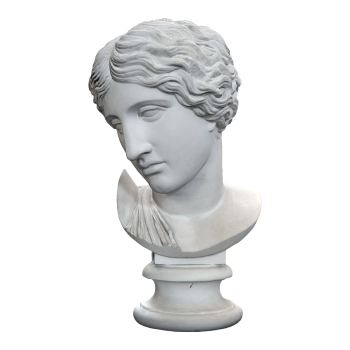
The marble statue "Half body Statue of a Lady" created by Karl Schl ü tte

The marble statue "Half body Statue of a Lady" created by Karl Schl ü tte

Carl Schl ü ter (1846-1884) was a German sculptor of the 19th century. His works are mainly concrete, and he excels in portrait sculpture, especially on female themes. This is a classical bust depicting a young woman. The head of this statue tilts slightly to the right. The base of the bust is a contoured base. The back of the bust bears the author's signature and the year of creation of the work: "C. Schl ü ter. 1880". This statue is now on display at the Czernov Museum in Poland.
Jennings Dog Marble Statue

Jennings Dog Marble Statue

This statue is called Jennings Dog, also known as Duncombe Dog or Alcibiad's Dog. It is a marble statue of a Molossican dog with a trimmed tail, a Roman replica of a copper original from the Hellenistic period. This statue is 1.05 meters high and was discovered in Monte Cagnouolo, Rome. This statue became very famous after arriving in England and was praised as one of the masterpieces of Roman animal sculpture. It was acquired by the British Museum in 2001 and is now exhibited in the G22 exhibition hall.
Gold round brooch, first half of the 7th century AD

Gold round brooch, first half of the 7th century AD

This gold brooch, decorated with Nile, has a diameter of 8.4 centimeters and a height of 2.7 centimeters, dating back to the first half of the 7th century AD. Excavated in K ö lked Feketekapu, Hungary, this place was inhabited from the mid-6th century AD to the Avar period. This cultural relic is now housed in the Hungarian National Museum.
Belt buckle, first half of the 7th century AD

Belt buckle, first half of the 7th century AD

This belt buckle can be traced back to the first half of the 7th century AD, measuring 8.4 centimeters in length, 6.8 centimeters in width, and 1.5 centimeters in height. Excavated in K ö lked Feketekapu, Hungary, this place was inhabited from the mid-6th century AD to the Avar period. This cultural relic is now housed in the Hungarian National Museum.
Half body portrait of Nikus

Half body portrait of Nikus

This statue is made of green basalt and is dressed in military uniform. The nose was destroyed, possibly by Christians carving a cross on their forehead during the late Christian period. There are other damaged areas around the chest and nose. This statue is 47 centimeters high, 30 centimeters wide, and 24 centimeters deep. It is carved of Nikus, who was the nephew of Roman Emperor Augustus and the fifth emperor of the Roman Empire. This statue may have been made around 19 AD and is now on display in the G70 exhibition hall of the British Museum.
Fossil specimen of saber toothed tiger skeleton at Vienna Natural History Museum

Fossil specimen of saber toothed tiger skeleton at Vienna Natural History Museum

The saber toothed tiger is a carnivorous mammal belonging to the genus saber toothed tiger in the order Felidae. The saber toothed tiger was once widely distributed on the continents of Asia, Europe, and America. It appeared in the Oligocene 35 million years ago and became extinct in the Pleistocene one million years ago. Their living period was during the Quaternary glacial period, when herbivores were slow-moving and easily hunted. But the ice age has ended, and cold resistant large herbivores cannot adapt to climate change and migrate northward, dying due to insufficient food. The saber toothed tiger lost its food source, did not have an advantage in hunting, and even became a prey for humans. In the end, it could only go extinct with the extinction of large thick skinned animals.
Goldfish shaped root

Goldfish shaped root

Genfu is a type of miniature sculpture art from the Edo period in Japan (1615-1868), commonly used for decorating and securing small items hanging on kimono belts. This goldfish shaped rootstock is made of boxwood by rootstock sculptor Masanao Ise, and the eyes are set with light and dark keratin. This root has a width of 5.5 centimeters and is located in the British Museum. Masanao Masanao (Ise) was a famous root carving artist during the Edo period in the 19th century. His works usually depict animals, and he is considered one of the greatest artists in the art form of Genfu.
The marble statue of Roman women from the ancient Roman Empire period, known as the "Roman Female Bust"

The marble statue of Roman women from the ancient Roman Empire period, known as the "Roman Female Bust"

This statue is currently housed in the National Archaeological Museum of Umbria, located in San Domenico, Italy.
Sir Hans Sloane clay bust

Sir Hans Sloane clay bust

This bust was made of clay by British sculptor Michael Risbrak, depicting the image of Sir Hans Sloane. His head is slightly turned to the right, with a mole on his left cheek, wearing a delicate wig, and a jacket with a lace collar. The size of this bust is 68.50 centimeters high and the maximum width is 60 centimeters. Sir Hans Sloan was a British doctor, naturalist, and collector born in Ireland, known for bequeathing his collection to the country, which laid the foundation for the establishment of British museums. This bust is now housed in the British Museum
Ancient Egyptian Lion Sculpture

Ancient Egyptian Lion Sculpture

This is one of a pair of lions. The sculpture is carved from red granite, with each lion measuring approximately 1.20 meters in height and 2.20 meters in length. The sculpture is from the Sulib Temple in Nubia, which was built by King Amenhotep III of the 18th Dynasty. Later in the third century AD, it was transferred to Gebel Barkal in Sudan by King Amanislo of the Meroe Kingdom. In the early 19th century, Lord Prudhoe took the lions from Gebel Barkal and handed them over to the British Museum in 1835.
The basalt statue "Olmec Giant Stone Head" from the heyday of the Olmec civilization

The basalt statue "Olmec Giant Stone Head" from the heyday of the Olmec civilization

This is a basalt human head sculpture from the Olmec civilization, carved from large basalt boulders and currently housed in the National Museum of Anthropology in Mexico. The height of these avatars ranges from 1.17 meters to 3.4 meters, dating back to at least 900 BC, and is a prominent feature of the ancient Mesoamerican Olmec civilization. These huge sculptures only depict the head, possibly because it is widely believed in Central American culture that the head contains an individual's emotions, experiences, and soul. Each avatar has unique facial features and may therefore be seen as a portrait of the actual ruler.
Amitabha Buddha statue

Amitabha Buddha statue

This statue was originally located in Hancui Village, Hebei Province, northern China. According to the inscription on the pedestal of the statue, it was enshrined for Chongguang Temple in 585 AD. This statue was created by art merchant C T. Loo donated it to the Chinese government, and in 1938, the Chinese government gave it as a gift to the British Museum to commemorate the Chinese art exhibition held in London from 1935 to 1936 This Amitabha Buddha statue is about 6 meters high and is the largest ancient Chinese statue in the West
Paradosis trilobite, a fossil specimen of the Bournemouth Society for Natural Sciences

Paradosis trilobite, a fossil specimen of the Bournemouth Society for Natural Sciences

The fossil specimen of the Paladocxis genus trilobite from the Bournemouth Natural Science Society. Trilobites are extinct arthropods, hard shelled organisms with segmented bodies and articulated legs. They lived from 521 million years ago in the early Cambrian to 252 million years ago in the Permian, when they became extinct during the Permian Triassic mass extinction. Marine organisms are usually small, but species of the Paradosis genus can grow up to 45 centimeters in length.
Syrian limestone relief from the 3rd century AD, depicting Tem é and his wife Hadila

Syrian limestone relief from the 3rd century AD, depicting Tem é and his wife Hadila

Taimei and his wife Hadila "is a cultural relic located in the Louvre, originating from ancient Palmyra. This cultural relic is a tombstone relief depicting Taimei and his wife Hadila. The discovery site of this artifact is Palmyra, an ancient prosperous city located in present-day Syria, at the intersection of several desert trade routes. This city reached its peak between the 2nd century BC and the 3rd century AD. The relief is the tombstone of Taimei and his wife Hadila, used to mourn their lives and deaths. The relief depicts their images and some scenes of their lives
Statue of Guan Yu

Statue of Guan Yu

Guan Yu (160-220 AD) was a famous general during the Han Dynasty (206 BC-220 AD) and one of the most famous historical figures in ancient Chinese history. Guan Yu is also revered as the "Martial Saint", commonly known as "Lord Guan", "Second Lord Guan" or "Guan Gong". Later generations deified him and respectfully referred to him as' Emperor Guan '.
Ivory artifact "Louise Chess Queen" discovered on the island of Lewis in Scotland

Ivory artifact "Louise Chess Queen" discovered on the island of Lewis in Scotland

Ancient Mayan limestone lintel

Ancient Mayan limestone lintel

This limestone lintel is a very important ancient Maya artifact, showcasing the hallucination stage of Ms. K'ab'al Xook during the blood sacrifice ceremony. The dimensions of this lintel are 121 centimeters high, 85.50 centimeters wide, and 13.50 centimeters deep. This lintel was originally stored in the Victoria and Albert Museum in 1885 (until 1899 it was called the South Kensington Museum). This lintel was transferred to the British Museum in 1923.
The ceramic bottle "Pelik" from the classical period of ancient Greece

The ceramic bottle "Pelik" from the classical period of ancient Greece

Pelik is a Greek container made of ceramic double ear bottles used for storing liquids. The cultural relic collected by the Krakow National Museum is made in the Kerch style, which is characterized by items produced in Athens in the 4th century BC and exported to cities in the northern Black Sea. The popular decorative theme of the Kerch style vessels comes from the cycle of Dionysius: on the belly of Pelik, depicting Dionysius' attendants. From the left dance pose, Dionysius' half man, half beast, Menard playing drums, and another half man, half beast. Menard tilted slightly backwards, attracting the attention of other participants amidst religious fervor.
Ancient Egyptian Scarab Sculpture

Ancient Egyptian Scarab Sculpture

The Scarabeus sacer is a lasting symbol of ancient Egypt, representing rebirth and associated with the rising sun. This beetle lays eggs by rolling dung balls, a behavior believed by ancient Egyptians to be similar to the process of the sun rolling from the east across the sky to the west. This sculpture is carved from green diorite and measures approximately 1.5 meters in length, making it one of the largest known beetle figures.
Alfred the Great's Silver Coins

Alfred the Great's Silver Coins

Alfred the Great (849-899 October 26, 1999) was the king of the Kingdom of Wessex during the Anglo Saxon period of England, and the first person in British history to call himself the "King of the Anglo Saxons" and truly live up to his name. In 886 AD, Alfred recaptured London from Danilao and began issuing silver pence featuring his portrait. This is considered the beginning of the continuous development history of the Royal Mint. To celebrate the 1150th anniversary of one of the most influential monarchs in British history becoming king, the Royal Mint announced today the launch of a commemorative coin collection in honor of Alfred the Great.
Nereid Monument

Nereid Monument

In Greek mythology, Nereid is the daughter of the sea gods Neris and Doris, who help sailors in the face of fierce storms. This monument comes from Kesantos in Lysia (now near Fetshiya, Türkiye), and was built about 390-380 BC. It is believed to have been built in memory of Arbinas, a member of the Cthulhu dynasty that ruled Silesia under the Achaemenid Empire. The form of this monument is a Greek temple located on a pedestal decorated with carved reliefs.
Bronze elephant statue, a folk handicraft in Uttar Pradesh, India

Bronze elephant statue, a folk handicraft in Uttar Pradesh, India

In India, elephants play an important role in both art and religion. In traditional Indian art, elephants are often used as themes and carved into various forms of statues, including deities, decorations, and memorabilia. In Hinduism, elephants are regarded as auspicious symbols, and the elephant headed god Ganesh is one of the important deities in Hinduism. In the northern region of India, folk people are skilled in using various materials such as wood, stone, metal, etc. to create animal statues, especially elephant statues.
Lion Fountain Statue at the Entrance of the British Museum

Lion Fountain Statue at the Entrance of the British Museum

This sculpture is one of many lion statues decorated at the north entrance of the British Museum. Legend has it that these lions will come to life at midnight, stretch lazily, yawn, and drink water.
The marble statue of the 18th century French castle of Marley, titled 'The Horse Trapped by the Horseman'

The marble statue of the 18th century French castle of Marley, titled 'The Horse Trapped by the Horseman'

The Horse Trapped by the Horseman, also known as the Malima, depicts a galloping horse and a horseman pulling the horse. These sculptures are made of Carrara marble and were created by sculptor Guillaume Cousteau between 1743 and 1745. The sculpture was originally ordered by King Louis XV to be made to decorate the entrance of the Mari Castle and replace the removed sculpture. Due to the damage caused by the armored vehicle parade on July 14th, they were replaced with reconstructed marble replicas made by Michel Bourbon in his studio in Bouyg. The original document is now preserved in an old building in the Louvre that has been transformed into a courtyard, known as the Marley Courtyard.
The Nereid Monument, British Museum

The Nereid Monument, British Museum

Nereid Monument, a sculpture tomb from Lysia, is located in Santos, near Fetshiya, Türkiye today. It takes the form of a Greek temple, decorated with carved reliefs on its pedestal, and is believed to have been built in the early 4th century BC (around 390 BC) for Arbinas (Erbbina or Erbinna in Lysian), the ruler of the Shantos dynasty that ruled Silesia under the Achaemenid Empire. This sculpture is currently housed in the British Museum.
Xipe T ó tec Mexican Cultural Sculpture

Xipe T ó tec Mexican Cultural Sculpture

This ceramic sculpture represents the god Xipe T ó tec ("Our Master, the Skinned Man"). It was discovered by Swedish archaeologists in 1932. This sculpture is currently housed in the Teotihuacan exhibition hall of the National Museum of Anthropology (MNA) in Mexico. Xipe T ó tec is a god of life, death, and resurrection in Mexican culture, as well as a god of agriculture, plants, the East, disease, and goldsmiths. This sculpture has two different human bodies: a complete human body below, and on top of it is the skin and some tissues of a victim.
The clay sculpture "Dog ū (Mia)" from the prehistoric Jomon period in Japan

The clay sculpture "Dog ū (Mia)" from the prehistoric Jomon period in Japan

Over the years, archaeologists have discovered many different types of clay sculptures - dog ū - dating back to the prehistoric Jomon period in Japan (1400-800 BC). Various forms have been unearthed in northeastern Japan, some sitting, some standing, some with almost no surface decoration, while others, like this example, are known as the "goggles" type, with unique large eyes adorned with colors and complex carved decorations. The popular theory suggests that they are talismans related to health and childbirth, and after use, they are intentionally destroyed and disposed of. They are now collected at the Minneapolis Institute of the Arts.
Colorful ceremonial tray from the lobby of Tomb No. 2 in the state of Oaxaca, southern Mexico

Colorful ceremonial tray from the lobby of Tomb No. 2 in the state of Oaxaca, southern Mexico

This is a cultural relic located at the National Museum of Anthropology in Mexico. This artwork is a colorful ceremonial plate from the front chamber of the second tomb in Zaachila, Oaxaca state. This type of ceremonial plate is usually used in special ceremonies or celebrations, and may be used to worship deities or ancestors, or as a symbolic gift.
Fossils of terror beasts, fossil specimens from the Vienna Museum of Natural History

Fossils of terror beasts, fossil specimens from the Vienna Museum of Natural History

The scientific name of the terror beast is Deinoterium, which means "terrifying beast". The terror beast belongs to the mammalian phylum, long nosed order, and terror beast family. The terror beast is a huge proboscid animal, with some individuals reaching a height of up to 5 meters, making it the third largest known terrestrial mammal to have existed. The lower jaw of the terror beast has a pair of long fangs that curve downwards and backwards, without the upper fangs found in other long nosed animals. The terror beasts appeared in the Miocene and lived until the early Pleistocene. Fossils of terror beasts have been found in all major excavation sites in East Africa, including Hadar, Letoli, Olduvai Gorge, and Lake Turkana.
Ś iva Temple Indian Sandstone Model

Ś iva Temple Indian Sandstone Model

This is a red sandstone model of the Temple of Shiva, hidden in the British Museum, with Linga inside. There is a short elephant headed statue on the lintel above the door. This model was made between the 18th and 19th centuries. Ś iva is one of the main deities in Hinduism, primarily worshipped by followers of the Indian Shiva religion.
Statue of Neptune

Statue of Neptune

This is a work by French sculptor Antoine Coysevox, named 'Neptune'. This artwork is a marble sculpture, measuring 1.85 meters in height, 1.77 meters in length, and 1.11 meters in width. This work is one of the "River" sculpture groups in Mally Park, opposite the Aphrodite sculpture at the bottom of the waterfall, now located in the Louvre Museum in France.
North Atlantic right whale skeleton, skeleton specimen from the Danish Museum of Natural History

North Atlantic right whale skeleton, skeleton specimen from the Danish Museum of Natural History

The North Atlantic right whale (scientific name: Eubalaena glacialis) is a species of whale belonging to the true right whale genus. Currently, there are approximately 400 North Atlantic right whales living in the waters of the North Atlantic. Without dorsal fins, the head has many warts, the largest of which is located on the back and is called a cap, which can reach up to 30 centimeters in height. Two jet holes, long and narrow. The whole body is black, the abdominal color is light, and there are irregular white spots. Due to overfishing around the world, it is on the brink of extinction and has been listed as one of the six endangered whale species in the world. In the 1940s, hunting was completely banned and it was listed as a second-class protected wild animal by the state.
The wooden sculpture "Drinking Water Horn" from the heyday of medieval Sweden

The wooden sculpture "Drinking Water Horn" from the heyday of medieval Sweden

The name of the cultural relic is the drinking water horn, which is currently housed in the Swedish History Museum. A birch wooden drinking water horn from the medieval peak of 1250-1299, with two dragon and griffin shaped figures carved on it. The end of the horn is shaped like a dragon's head, turn the head towards the edge. The grappling bucket bites the edge with its beak, while the kite bites the wings of the grappling bucket, connecting the end to the edge. There are three copper strips around the horn and two simple mortise and tenon legs for support.
Statue of En é e et Anchise

Statue of En é e et Anchise

The works of French sculptor Antoine Coysevox are currently housed in the Louvre Museum. The height of this artwork is 2.64 meters, the width is 1.14 meters, and the depth is 1.10 meters. The hero Aeneas and his father Anchises in ancient Roman mythology. This work is currently housed in the Louvre Museum, with a height of 2.64 meters, a width of 1.14 meters, and a depth of 1.10 meters.
Fossil specimen "Robust Southern Ape Skull" from the National Museum of Anthropology in Mexico

Fossil specimen "Robust Southern Ape Skull" from the National Museum of Anthropology in Mexico

The robust Southern Ape, referred to by some researchers as the hominid genus, lived on the newly formed African savannah 1.5 million years ago. Unlike the more elegant southern apes, the skull features of this species are related to a diet primarily based on hard fruits, bark, and some roots. We can notice that it has a thick and protruding zygomatic arch, with a very large muscle passing through it and ending at the sagittal crest located in the upper part of the skull. Its dental arch is very sturdy and can be seen in very wide and pointed molars. This specimen was discovered by scientist Robert Bloom in 1938 in the Stekefontein Cave near Johannesburg, South Africa.