
Sanxingdui Bronze Human Head

Sanxingdui Bronze Human Head

Sanxingdui is an ancient site, about 4,800 to 3,800 years ago, and is considered to be one of the important centers of prehistoric culture. This bronze statue was unearthed in the Sanxingdui No. 2 Sacrifice Pit. It has a history of more than 3000 years. It is the oldest and tallest bronze figure discovered in China. It is now in the Sanxingdui Museum in Sichuan Province. The total height of this bronze statue is 115cm. The lower part is a bronze man kneeling down. His hands are held in front of him. His head is topped with a square plate. The square plate is connected with the bronze big mouth statue. The shoulder of the statue is decorated with exquisite dragon shape.
Plaster statue of sculptor Jill Lambert Goldshire "Andre Bust"

Plaster statue of sculptor Jill Lambert Goldshire "Andre Bust"

Andre Bust is a work of art created by Belgian sculptor Gil Lambert Goldshire, now in the Royal Gallery in Brussels, Belgium.
Korean Koryo period bronze clock "Buddhist temple bronze inscription ceremony clock"

Korean Koryo period bronze clock "Buddhist temple bronze inscription ceremony clock"

This bronze ceremonial bell is a Korean artifact from the Koryo period (918-1392). Its name is "Buddhist temple bronze inscription ritual bell". The decoration of this bell is very fine, made of cast bronze with engraved inscriptions, the bell was made in the 1200 AD generation. Once used as part of a Buddhist indoor ritual, the bell hangs in a Buddhist temple with a cast dragon on top and a vertical tube to amplify the sound. The inscription indicates that it was cast in the Year of the Dragon, took three years to make, and is now in the collection of the Cleveland Museum of Art.
The statue of kaolin during the reign of Ramapala, India "Skywalker Bodhisattva of Mercy"

The statue of kaolin during the reign of Ramapala, India "Skywalker Bodhisattva of Mercy"

The sculpture is an artifact from the reign of Bihar, Para Dynasty, Ramapala (1078 AD/79 to at least 1130 AD) in eastern India. The name is "Skywalker Mercy Bodhisattva. The sculpture is very finely decorated, made of kaolin with traces of pigment. This sculpture is the image of Avalokitesvara, a powerful and compassionate bodhisattva, sitting in an elegant posture with the image of Amitabha above his head. This image is a compassionate bodhisattva that brings liberation to evil spirits. To the right of Avallokitsvara is the Green Mother, holding a lotus flower in his hand, and to his left is the four-armed goddess, holding a rosary and a water bottle in his hand.
Joseon Dynasty Scroll Box "Painted Wood Dragon and Phoenix Scroll Box"

Joseon Dynasty Scroll Box "Painted Wood Dragon and Phoenix Scroll Box"

This set of scroll boxes is a Korean cultural relic from the Joseon Dynasty (1392-1910), and its name is "Painted Wood Dragon and Phoenix Scroll Box". The scroll box is very finely decorated. The scroll is printed with gorgeous dragon and phoenix patterns, mother-of-pearl inlaid on lacquered wood and twisted brass and copper wires. This scroll box is used by the royal family to keep scrolls or important documents. It measures 11.5 x 11.6 x 87cm (the scroll box was made from the 1700 s to the 1800 s) and is in the collection of the Cleveland Museum of Art.
Tibetan silver vase during the Tang Dynasty "Tibetan gold-plated silver vase"

Tibetan silver vase during the Tang Dynasty "Tibetan gold-plated silver vase"

This vase is a cultural relic of the early 8th century AD from Tibet. Its name is "gold-plated silver vase". The decoration of this vase is very fine, mainly with Central Asian elements, including grape vines, bead edges and heart patterns. Sogite craftsmen are known to be adept at using gilded foil to set off silver relief designs. The form of the animal head-shaped drinking utensils and the use of silver are derived from Persian origins, while the rich, luxurious texture of the design and the form of the lion and the curly dragon on the side of the vase show an understanding of the Chinese form, which is proved in the early stage of political unity and integration in Tibet. This vase is now in the collection of the Cleveland Museum of Art.
Riding statue of Louis XIV

Riding statue of Louis XIV

Louis XIV, whose full name is Louis de Bourbon, is known as the Sun King. He was the king of the French Bourbon dynasty and reigned from 1643 to 1715.. He was the longest-serving monarch in French history and one of the most powerful in European history. The statue is located in Piazza Belle Cure in the center of Lyon, France. The first statue, built in 1713, was destroyed during the French Revolution in 1793 to make cannons. In 1825, the statue was placed in the square.
Korean Dynasty blue and white porcelain "dragon blue and white porcelain jar"

Korean Dynasty blue and white porcelain "dragon blue and white porcelain jar"

This porcelain is a Korean artifact from the Joseon Dynasty (1392-1910). Its name is "dragon pattern blue and white porcelain jar". The decoration of this jar is very fine, including the underglaze blue dragon design. This jar was probably used as a vase in an official courtyard ceremony. It has an overall height of 39.5cm and a bottom diameter of 14.7cm. This jar was made in the 1700 s and is now in the collection of the Cleveland Museum of Art.
South Korea crane cloud plum bottle

South Korea crane cloud plum bottle

This is a South Korea plum bottle decorated with cranes and clouds (a popular pattern on Korean celadon) made in the second half of the 12th century. South Korea plum bottle (Korean Meiping) is a traditional South Korea ceramic. It is a unique bottle, usually with a tall and thin cylindrical body, a slender neck and a closed mouth. The design of the plum bottle was influenced by the plum bottle of the Song Dynasty in China, but South Korea plum bottle has its own unique style and characteristics.
Korean Koryo period bronze basin "pilgrimage inscription bronze binaural basin"

Korean Koryo period bronze basin "pilgrimage inscription bronze binaural basin"

The charm of this relic lies in the fine decoration of its silver inlay: the five-character and four-line poem is intertwined with the image of the child. These poems, which evoke the concepts of no attachment and no duality, were written by Buddhist monks. One of the main decorative elements of this basin is that a child, probably a young Buddhist pilgrim named Sultanna, goes on a long spiritual journey in search of enlightenment. This bronze basin was made during the Koryo period (918-1392) between 1100 and 1200 AD. The basin was sold by London Gallery Limited to the Cleveland Museum of Art.
Statue of Our Lady of Monte Graba

Statue of Our Lady of Monte Graba

The Statue of Our Lady of Monte Grappa is a statue on the top of the mountain (Monte Grappa) in northeastern Italy. It is a symbolic religious monument to the Italian soldiers who fought and died in the area during World War I. The statue is about 4.15 meters (13.6 feet) high and made of bronze, depicting the Virgin Mary. The statue was originally unveiled in 1925, but was later destroyed by German forces during World War II. After the war, however, it was rebuilt and re-unveiled in 1958.
Pottery Figurines of the Zodiac in the Northern Wei Dynasty: Pottery Figurines Dog

Pottery Figurines of the Zodiac in the Northern Wei Dynasty: Pottery Figurines Dog

The Terracotta Warriors of the Twelve Palaces is a work of the Northern Wei Dynasty in China, made in the 500 AD era. This terracotta figure is made of gray terracotta, and there are traces on the surface that show that it was coated with slippery soil. This pottery figurine is part of the Zodiac series, and the animals represent the traditional concept of time in ancient China. This group of pottery figurines is currently in the collection of the Cleveland Museum of Art. The pottery figurines of the Northern Wei Dynasty showed the great confluence of the farming culture of the Han nationality in the Central Plains and the nomadic culture of the northern grassland at that time, as well as the new look of ancient pottery under the influence of the flourishing Buddhist statues and sculptures.
Pottery Figurines of the Zodiac in the Northern Wei Dynasty: Pottery Figurines Dragon

Pottery Figurines of the Zodiac in the Northern Wei Dynasty: Pottery Figurines Dragon

The Terracotta Warriors of the Twelve Palaces is a work of the Northern Wei Dynasty in China, made in the 500 AD era. This terracotta figure is made of gray terracotta, and there are traces on the surface that show that it was coated with slippery soil. This pottery figurine is part of the Zodiac series, and the animals represent the traditional concept of time in ancient China. This group of pottery figurines is currently in the collection of the Cleveland Museum of Art. The pottery figurines of the Northern Wei Dynasty showed the great confluence of the farming culture of the Han nationality in the Central Plains and the nomadic culture of the northern grassland at that time, as well as the new look of ancient pottery under the influence of the flourishing Buddhist statues and sculptures.
Pottery Figurines of the Zodiac in the Northern Wei Dynasty: Pottery Figurines Rat

Pottery Figurines of the Zodiac in the Northern Wei Dynasty: Pottery Figurines Rat

The Terracotta Warriors of the Twelve Palaces is a work of the Northern Wei Dynasty in China, made in the 500 AD era. This terracotta figure is made of gray terracotta, and there are traces on the surface that show that it was coated with slippery soil. This pottery figurine is part of the Zodiac series, and the animals represent the traditional concept of time in ancient China. This group of pottery figurines is currently in the collection of the Cleveland Museum of Art. The pottery figurines of the Northern Wei Dynasty showed the great confluence of the farming culture of the Han nationality in the Central Plains and the nomadic culture of the northern grassland at that time, as well as the new look of ancient pottery under the influence of the flourishing Buddhist statues and sculptures.
The porcelain of the Joseon Dynasty "Carved Pollen Celadon"

The porcelain of the Joseon Dynasty "Carved Pollen Celadon"

This vase was classified as pink celadon, which flourished during the 1400s-1500s. Pink celadon is pottery decorated with iron-containing clay and white slippery clay. The fish pattern on this vase was made using the technique of engraving and scratching, which was very common in ceramic making during the Joseon Dynasty (1392-1910). The bottle is now in the collection of the Cleveland Museum of Art.
The coffin of Akhenaten in Tomb KV55, Valley of Egypt

The coffin of Akhenaten in Tomb KV55, Valley of Egypt

Akhenaten, also known as Inu or Amenlu Ahtnu, was an 18th dynasty pharaoh of ancient Egypt, reigning from about 1353 BC to about 1336 BC. He was the son of Egyptian pharaoh Amenlu Ahtep III (Amenhotep III) and Queen Tiye, father of Tutankhamun. In 1907, the tomb was discovered. Today, Akhenaten's coffin is hidden in the Egyptian Museum.
Ink Cake "Panlong Ink Cake" during Jiaqing Period of Qing Dynasty

Ink Cake "Panlong Ink Cake" during Jiaqing Period of Qing Dynasty

This piece of ink cake is from China during the Jiaqing period (1795-1820) of the Qing Dynasty. The ink cake was green and shaped like a spiralling dragon. Ink cake (also called ink block) is dissolved in water and then ground into liquid ink on the surface of a square stone, which is used in painting and calligraphy. However, this precious piece of ink cake has never been used. the inscription on the side of the blue ink cake says that this set of ink cake was commissioned by governor chen huai of jiangxi province. This inset box is now in the collection of the Cleveland Museum of Art.
Ancient Egyptian Statue of Goddess Mendes

Ancient Egyptian Statue of Goddess Mendes

The ancient Egyptian goddess Mendes is often depicted as a winged human-headed snake goddess, whose image combines elements of humans, snakes and birds, symbolizing different attributes and powers. The statue is now on display at the National Museum of Egyptian Civilization.
Bronze statue of the Chola period in Tamil Nadu, South India Shiva, King of Dance

Bronze statue of the Chola period in Tamil Nadu, South India Shiva, King of Dance

The statue is a work from the Chola period (900-1200 AD) in Tamil Nadu, South India, depicting Shiva, the king of dance. The statue measures: 113 x 102 x 30 cm overall and is currently in the collection of the Cleveland Museum of Art. In this statue, Shiva is depicted as the source of all movement in the universe. His dance of destruction is accompanied by the arc of flame, symbolizing the demise of the universe at the end of an era. Four hands hold different objects, including flame and drum, representing destruction and creation respectively. The right foot steps on a dwarf demon, symbolizing the smashing of ignorance.
Sandstone statue of Hapi the Scribe of the Temple of Karnak

Sandstone statue of Hapi the Scribe of the Temple of Karnak

This sandstone statue is located in the courtyard of the Karnak temple and is commonly known as the "statue of Hapi" or "Hapi of Karnak", which served as the caretaker of the Karnak temple during the 19th dynasty. It is now on display at the National Museum of Egyptian Civilization (NMEC) in Cairo, Egypt.
Bronze statue of the Joseon Dynasty "Three Amitabha"

Bronze statue of the Joseon Dynasty "Three Amitabha"

This relic is a bronze statue named Amitabha Three, made in 1400 AD. This statue is from the South Korea of the Joseon Dynasty (AD 1392-1910). This statue is made of bronze material with traces of gilding. The overall dimensions of this statue are 40.6 x 16.5 x 54.6cm. Among them, Amitabha Buddha sits in the center of the lotus seat. On his left and right sides are two waiters: Ksitigarbha Bodhisattva and Guanyin Bodhisattva. The combination of these three was popular in the early Korean period. This statue is now in the collection of the Cleveland Museum of Art.
Ancient Egyptian god Kunsu granite statue

Ancient Egyptian god Kunsu granite statue

The Egyptian god Kunsu is the god of the moon, the god of travel and the god of medicine. He is believed to be the son of the gods Amun and Mut, and the youngest of the three sons of their family. The Egyptian god Kunsu granite statue has the characteristics of the Pharaoh Tutankhamun of the 18th Dynasty of ancient Egypt. It is 2.52 meters high. It was originally discovered in the Kunsu Temple in Karnak. It is a building of the New Kingdom of Egypt and belongs to Ramses III. The statue during the reign of (Ramses III) has been exhibited in the Egyptian Museum in Cairo for many years.
Korean Koryo period inlaid porcelain "chrysanthemum and peony inlaid hip flask"

Korean Koryo period inlaid porcelain "chrysanthemum and peony inlaid hip flask"

This relic is inlaid porcelain decorated with chrysanthemum and peony patterns, made in the 1100 AD generation. Porcelain from the Koryo period (AD 918-1392) South Korea. This piece of porcelain is made of celadon and is decorated with white and black slip glaze. This piece of porcelain has an outer diameter of 15cm and a height of 18.8cm. The shape of this porcelain resembles a melon, inlaid with delicate chrysanthemum and peony patterns. In South Korea the flowers and leaves of chrysanthemum are used to make chrysanthemum wine. Chrysanthemum wine is enjoyed by people on the Double Ninth Festival (the ninth day of the ninth lunar month). This piece of porcelain is now in the collection of the Cleveland Museum of Art.
Ancient Egyptian Queen Hitfirus II Sphinx

Ancient Egyptian Queen Hitfirus II Sphinx

Hitfirus II was a queen of the Fourth Dynasty of the Old Kingdom of Egypt, wife of Pharaoh Khufu and daughter of Pharaoh Sneferu. on display at the National Museum of Egyptian Civilization.
Ancient Greek Macedonian Period Currency Macedonian Shield Silver Coin (Four Drachmas)

Ancient Greek Macedonian Period Currency Macedonian Shield Silver Coin (Four Drachmas)

It is a silver Macedonian shield with the head of Artemis (obverse) and a stick (reverse), minted around 158-150 BC. This silver coin was minted in the city of Amphipolis in Macedonia under Roman control. The silver coin has a diameter of 3.3cm. Artemis is a hunting goddess in Greek mythology, and her image is embedded in a delicate Macedonian shield. On the reverse side is a stick, surrounded by a wreath and surrounded by a line of inscriptions attributing this coin to the first area of the Roman vassal state. This Macedonian shield silver coin is in the collection of the Minneapolis Museum of Art.
Ancient Egyptian Ramses III with Statue of Horus and Seth

Ancient Egyptian Ramses III with Statue of Horus and Seth

The statue of Messi III and Horus and Seth depicts the Egyptian pharaoh Ramses III with the two gods Horus and Seth, with Horus on his right and Seth on his left. The statue is now in the Egyptian Museum in Cairo. Ramesses III was a pharaoh of the 20th dynasty of ancient Egypt, reigning from 1186 BC to 1155 BC. He was a powerful pharaoh who worked to restore stability and prosperity to his country. His reign is considered one of the peaks of the New Kingdom period.
50 euro cent coin

50 euro cent coin

The 50 euro cent coin, which is a denomination in the euro monetary system. The 50-cent coin is usually made of brass alloy and has a diameter of 24.25mm. A map of Europe is printed on the front, and denomination numbers and euro symbols are printed on the back.
Ancient Cave Bear Skull

Ancient Cave Bear Skull

The cave bear (scientific name: Ursus spelaeus) is a prehistoric bear that lived in Europe and Asia, living in the Pleistocene period about 300000 to 15000 years ago. They are much larger than modern bears, with male cave bears weighing up to 1,000 kilograms. The skull of the cave bear is an important and interesting specimen for paleontologists and researchers studying prehistoric mammals. The characteristics of the cave bear's skull include its enormous size and strong structure, reflecting the bear's enormous size.
Ancient Egyptian pharaoh Ramses II megalithic statue

Ancient Egyptian pharaoh Ramses II megalithic statue

This stone sculpture is one of a pair of statues in front of the Ramses Museum. Ramses II (Ramses II), also known as Ramses the Great, was a pharaoh of the 19th dynasty of ancient Egypt and one of the most famous pharaohs of ancient Egypt. He ruled Egypt for about 66 years, from about 1279 BC to 1213 BC.
ammonite fossil

ammonite fossil

The ammonite is an extinct marine mollusk belonging to the cephalopod family. They lived on Earth during the Mesozoic period, about 0.25 billion to 65 million years ago, and were mainly distributed in the oceans. The shape of the ammonite resembles a spiral flat disc, consisting of a series of spiral chambers. Their shells are usually made of calcareous matter and can be preserved as fossils. The size range of ammonites is large, from tiny species with only a few millimeters to giant species with a diameter of more than 2 meters.
Ancient Egyptian statue of a jackal in the Seth period

Ancient Egyptian statue of a jackal in the Seth period

The Seth period was the 26th dynasty in the history of ancient Egypt (664-525 BC), also known as the Seth dynasty. This period lasted from approximately 664 BC to 525 BC. Egypt was ruled by foreign invaders, including Assyrians and Persians. Saite or Saite gods usually appear in the image of jackals. Saite is regarded as the god of war, chaos and the desert, and his image is often associated with the jackal or jackal head. This copper alloy statue is now located at the Art Institute of Chicago.
Ancient Egyptian Sphinx on Basalt Column Foundation

Ancient Egyptian Sphinx on Basalt Column Foundation

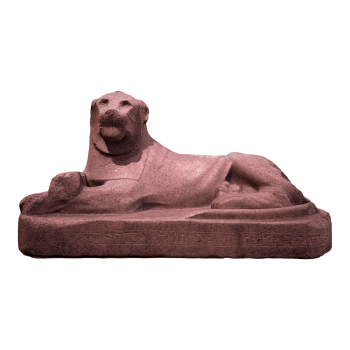
The statue belongs to the period of the 18th or 19th dynasty of ancient Egypt and depicts a Sphinx with the body of a lion and the head of a human being. The Sphinx has important symbolic significance in ancient Egyptian culture, and is considered a symbol of power, wisdom and protection. The statue is generally considered to be a product belonging to the period of Pharaoh Amenhotep III (Amenhotep III). However, the exact time of creation and the producer are still controversial. The statue is currently in the ancient Egyptian collection of the Pergamon Museum in Berlin
Colossus of Pharaoh Amenhotep III of Ancient Egypt

Colossus of Pharaoh Amenhotep III of Ancient Egypt

Amenhotep III (Amenhotep III) was a pharaoh of the 18th dynasty of ancient Egypt who ruled from about 1390 BC to 1352 BC. He was one of the richest and most powerful pharaohs of the dynasty and one of the oldest in Egyptian history. The reign of Amenhotep III is considered a golden age in Egyptian history. This stone statue is part of the Karnak temple. They were originally the statue of the patron saint of the entrance to the temple of Amenhotep III and, at a height of about 18 meters (60 feet), were one of the largest column statues in the ancient world.
Electric gold three drachma (tridrachm) coin of ancient Roman Carthage (Carthage)

Electric gold three drachma (tridrachm) coin of ancient Roman Carthage (Carthage)

Carthage was an ancient Phoenician city-state on the Mediterranean coast of present-day Tunisia. Electric gold is an alloy composed of gold and silver, while the tridrachma is a unit of coin from the ancient Greek and Roman periods. Such coins are usually issued by governments or city-states for commercial transactions and currency circulation.
University of Applied Arts Vienna Holy Cross Courtyard Marble Portal

University of Applied Arts Vienna Holy Cross Courtyard Marble Portal

The entrance to the University of Applied Arts in Vienna, Austria, is part of the Holy Cross Courtyard, a courtyard complex in the center of Vienna. It is located between the streets of the beautiful Lantern and Grashov, and is today surrounded by a complex of monastery courtyards, abbeys, houses of worship and apartment buildings. The courtyard of the Holy Cross is often called the oldest apartment building in Vienna. It was built in the 13th century and has since then belonged to the Sist Monastery of the Holy Cross. Most of the chapel of the courtyard and the courtyard of the abbot were demolished during the Baroque period and rebuilt by order of the abbot of the Abbey of the Holy Cross between 1659 and 1676.