The marble bow statue of the British fifth class frigate 'The Old Father Thames'

The marble bow statue of the British fifth class frigate 'The Old Father Thames'

The statue is a cultural relic dating back to 1823, which was a five class frigate with 46 guns built at Chatham Shipbuilding. The statue is a carefully carved marble male half body, depicting an angry river god and undoubtedly representing the spirit of the Thames River. The statue is known as the 'Old Father Thames' and was taken from the fifth class frigate HMS Thames (1823). The Thames River is an important river that serves as the main trade route to the busiest port in London. It is an important shipbuilding center with royal docks and numerous private companies, and the statue is now housed in the National Maritime Museum in London.
The marble statue of the Nine Muses - Erato during the reign of Emperor Hadrian in ancient Greece

The marble statue of the Nine Muses - Erato during the reign of Emperor Hadrian in ancient Greece

Erato is one of the nine Muses in Greek mythology, and she is the goddess of inspiration for literature, science, and art. Erato is the muse of lyrical poetry, especially erotic poetry. In Orphic hymns, Erato is known for her visual charm. Since the Renaissance, she has been often depicted wearing a wreath of myrtle and roses, holding a harp or small harp, which is an instrument often associated with Apollo. This statue is made of marble and comes from Mount Calvo in the 2nd century AD. It is now collected at the Carlsberg Art Museum in Copenhagen, Denmark.
The marble statue "Aphrodite Bathing" from the classical period of ancient Greece

The marble statue "Aphrodite Bathing" from the classical period of ancient Greece

Aphrodite is the goddess of love and beauty in ancient Greek mythology, often depicted in scenes related to water, such as bathing or drying oneself after bathing. This is one of the most famous sculptures of Aphrodite, created by the Greek sculptor Praxiteles in the 4th century BC. The statue is a typical feature of ancient Greek sculpture, depicting the scene of a goddess suddenly startled while bathing. The statue is now housed in the British Museum. Many versions of the statue depict Aphrodite attempting to cover her body with her hands or a falling curtain. In this statue, Aphrodite crouches naked and turns her head to the right, as if startled.
Artist James Tissot Gypsum Bust

Artist James Tissot Gypsum Bust

James (Jacques Joseph) Tissot (October 15, 1836, Nantes - August 8, 1902, Abbey of Besan ç on, France) - French painter and illustrator. The bust is currently housed in the Copenhagen Museum in Denmark. This painter is famous for his illustrations "The Life of Christ and the Old Testament" and for depicting fashionable beauties in Paris and London. The pioneer of Belgian realism, an artist, had a significant impact on its technology.
Hans Christian Andersen Statue

Hans Christian Andersen Statue

Hans Christian Andersen (1805-1875) was a famous Danish fairy tale writer and poet, known in Denmark as H C. His works include classic fairy tales such as "The Ugly Duckling," "The Little Match Girl," and "The Daughter of the Sea. This statue was built in memory of Hans Christian Andersen, a Danish literary giant, and was created by Danish sculptor Henry Luckow Nielsen.
Queen Nefertiti of Ancient Egypt's 18th Dynasty Funeral Mask

Queen Nefertiti of Ancient Egypt's 18th Dynasty Funeral Mask

Philopoemen Statue

Philopoemen Statue

The Philopoman statue is a marble sculpture, measuring 2.29 meters in height, 0.91 meters in width, and 0.98 meters in depth. The statue was created by French sculptor David d'Angers and is currently housed in the Louvre Museum.
Indian Shiva Nataraja Igneous Rock Statue from the Chola Period

Indian Shiva Nataraja Igneous Rock Statue from the Chola Period

Shiva is one of the three main gods of Hinduism. Its predecessor was the god of reproduction, "Beast Lord," and the god of Vedic storms, Tatra, during the Indus Civilization era. It had a dual personality of reproduction and destruction, creation and destruction, presenting various bizarre and bizarre appearances, mainly including the Linga, Gentle, Superhuman, Dance King, Rika, and Half Girl. Linga is the most basic symbol of Shiva. Like many gods in mythology, due to Shiva's omniscient and omnipotent nature, her gender is not fixed, but changes at any time according to her different appearances. In Buddhist literature, Shiva is referred to as the Great Self in Heaven, residing at the top of the realm of colors, and is the ruler of the three thousand realms.
The brass statue of Shiva Temple during the reign of King Mahler in India, titled 'Palace Brass Lion'

The brass statue of Shiva Temple during the reign of King Mahler in India, titled 'Palace Brass Lion'

The brass lion, at the Shiva Temple in Barktapur Durbar Square. This temple is built directly in front of the palace. This metal lion was built in the 18th century and is made of brass with a thin layer of other metal coating on top. Nepal's metal products were later introduced. The oldest sculptures are usually built from stone. It is believed that the first batch of metal statue workers in the early days were Buddhist monks working for their Vihara religious school. In the past two or three centuries, metal works have flourished during the reign of King Mahler, when metal sculptures were coated with additional metal as a protective layer and decoration to eliminate degradation and corrosion.
Marble statue of ancient Greek philosopher 'Half body of Gorgias'

Marble statue of ancient Greek philosopher 'Half body of Gorgias'

Ancient Greek philosopher and rhetorician of the 5th century BC, renowned for his wisdom. He was born in the city of Lyon, Sicily, around 490 BC or later. In his early years, he studied rhetoric, argumentation, natural philosophy, and medicine with Empedocles. His ideas were influenced by Zeno, but mainly originated from Protagoras. In 427 BC, he sent an envoy to Athens to request a united opposition against Syracuse, and in his later years lived in Larisa in Thessalya.
The Angel Tomb with Lost Hands in Vienna Central Cemetery

The Angel Tomb with Lost Hands in Vienna Central Cemetery

The Zentralfriedhof is a famous cemetery in Vienna, Austria, and is one of the largest cemeteries in the world. The cemetery was built in 1874 and covers an area of over 2.5 square kilometers. It houses many well-known figures, including composer Beethoven and writer Stefan Zweig. In the Vienna Central Cemetery, there are many angel tombs with unique shapes. These angel shaped tombs are often regarded as works of art because they showcase exquisite sculptures and architectural craftsmanship.
The porcelain "Dionysus Ceramic Double Eared Vase" from the University Town of Paris in the 1922

The porcelain "Dionysus Ceramic Double Eared Vase" from the University Town of Paris in the 1922

Dionysus, also known as the Greek god of wine, is one of the twelve main gods of Olympus in ancient Greek mythology. Dionysus was the god of wine believed in by ancient Greeks and Thracians. Not only did he possess the intoxicating power of wine, but he also became a highly charismatic god at the time for his generosity, joy, and love. He promoted the civilization of ancient society, established laws, and maintained world peace.
Beijing Temple of Heaven Circular Hill Drainage Head Stone Carving

Beijing Temple of Heaven Circular Hill Drainage Head Stone Carving

Buddha Head Statue

Buddha Head Statue

This Buddha head is a work from the 2nd to 3rd century AD, originating from the ancient Indian state of Dhara (now Pakistan), made of gray gneiss, with dimensions of 27.8 × 16.4 × 19.6 centimeters. It is currently preserved at the Art Institute of Chicago.
Night Queen Bernie Relief

Night Queen Bernie Relief

Bernie, also known as the 'Queen of the Night', is a Mesopotamian clay relief that may represent Ereshkigal or Ishtar. This relief was created during the Isin Larsa or Old Babylonian period, measuring 49.5 centimeters in height and 37 centimeters in width. It depicts a naked, winged goddess with bird claws and owls on both sides, standing on two lions. This relief is now on display at the British Museum in London, which dates its creation between 1800 BC and 1750 BC.
The wooden carving of the Haida totem pole from the indigenous Haida civilization in Canada

The wooden carving of the Haida totem pole from the indigenous Haida civilization in Canada

The wooden carving depicts a beaver holding a chewing stick with crossed shadows on its tail. Beavers symbolize creativity, artistry, and determination, and were made around 1860. It is now a collection of the Cambridge Museum of Archaeology and Anthropology. The homeland of the Haida people is located in the Queen Charlotte Islands off the Pacific coast of Canada, separated from the Black Carter Strait and the North American continent, and facing the Alexander Islands of Alaska across the Dixon Strait. It stretches nearly 300 kilometers along the province of Alberta in northwestern Canada. The Haida people did not have writing before, they recorded the stories and legends of their ancestors through carving totem poles.
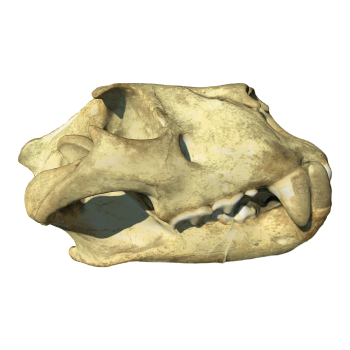
Fossil skull of iguana dinosaur from the early Cretaceous period

Fossil skull of iguana dinosaur from the early Cretaceous period

Iguanosaurus is a dinosaur genus that lived in the early Cretaceous period. The name means "iguana teeth" and is the first recognized dinosaur, the second officially named dinosaur type, and one of the original three dinosaur species used to define dinosaur classification.
The King in Lewis Chess

The King in Lewis Chess

Lewis chess pieces, also known as Uig chess pieces, are a unique set of 12th century chess pieces, as well as other game chess pieces, mostly carved from walrus teeth. These chess pieces were discovered in 1831 in the Outer Hebrides of Lewis, Scotland. When discovered, this collection contained 93 items: 78 chess pieces, 14 tables, and a belt buckle. Now, 82 chess pieces are owned and usually exhibited by the British Museum in London, and the remaining 11 are at the National Museum of Scotland in Edinburgh. This chess piece is now on display at the British Museum.
Roman Empire period marble statue "dance muse"

Roman Empire period marble statue "dance muse"

This marble statue is the work of ancient Rome in the 2nd century AD and is now in the museum in Copenhagen, Denmark. The rotation movement emphasized by the right hand holding the cloak indicates that the woman is dancing. She's the muse, the muse of dance. The muse in Greek mythology is the muse of sacred poetry, sacred hymns, dance and eloquence, and agriculture and pantomime. She is depicted as very serious, contemplative and meditative, often putting her fingers to her mouth, wearing a long cloak and veil, and resting her elbows on a post. It is also sometimes considered the muse of geometry and meditation. Museum in Copenhagen, Denmark
Pericles marble bust

Pericles marble bust

The statue is a Roman period marble statue from Tivoli, Italy, in the 2nd century AD, modeled on a bronze statue of the Greek sculptor Kresilas. Pericles of this statue, which wears a helmet that pushes to the top of his head, is also a parody of an early Greek original. The height of the statue is 58.42cm and is now on display in the British Museum.
Statue of Sekemet (Sekhmet) in ancient Egypt

Statue of Sekemet (Sekhmet) in ancient Egypt

The statue of Sekemet (Sekhmet) is an isometric statue of one of the oldest known gods in ancient Egypt, about 6 feet (184cm) high. Her name is derived from the Egyptian word "sekhem" (meaning "power" or "might"), which is often translated as "the mighty". Sekemet is often depicted as a female with a lioness head, sometimes with the addition of a sun disc and uraos serpent. She was the goddess of war in ancient Egypt and was considered the protector of the Maat (balance or justice) and the Egyptian people. This statue of Sekemet is now on display in the Ancient Egypt Gallery at the Royal Ontario Museum.
World War II steel helmets for American soldiers

World War II steel helmets for American soldiers

Statue of the High Priest Roy of Amun in Ancient Egypt

Statue of the High Priest Roy of Amun in Ancient Egypt

The statue of Roy, the high priest of Amon, is a very important artifact. This statue is made of granodiorite and has a height of 113cm. It was made in 1220 BC. Roy was the high priest of Amun during the reign of Ramses II, Merumpta and Seti II during the 19th dynasty of ancient Egypt. He commissioned several statues of himself, four of which were found at Karnak. The statue is now in the collection of the British Museum.
Italian aluminum-magnesium alloy 1 lira

Italian aluminum-magnesium alloy 1 lira

The lira (L.1) is a minted coin that represents the basic unit of the Italian lira. The 1-lire coin and the 50-cent, 2-lire and 5-lire coins have been minted since 1861 and were originally made of 900 ‰ silver. After the First World War, 1 lira coins were minted in nickel from 1921 to 1938; from 1939 it was minted in Italian coin steel with a diameter of 26.7mm. After the fall of the monarchy, one lire coins were cast in 17.2mm and 0.625g (1951-1959) of Italian aluminum-magnesium alloy.
Modern Imitation Granite Mayan Statue

Modern Imitation Granite Mayan Statue

Statues of the Acolytes in the Temple of Nabu

Statues of the Acolytes in the Temple of Nabu

This limestone statue is a statue of the chamberlain dedicated to Nabu by the Assyrian kings of the Neo-Assyrian period, Adadnilari III and Sammuramat. The statue was found in the temple of Nabu (located in Nimrud). The height of the statue is 182.88cm.. There is cuneiform writing around the skirt, and the translation of the inscription reads: "Future man, wait for Nabu. Don't trust other gods. The statue is now on display at the British Museum.
The Golden Wood Carving of Compassionate Avalokitesvara from the Jin Dynasty

The Golden Wood Carving of Compassionate Avalokitesvara from the Jin Dynasty

This Bodhisattva statue is a cultural relic in Shanxi Province, China, from the Jin Dynasty, around 1200 AD. Its name is "Avalokitesvara of Mercy". The decoration of the statue is very fine, made of wood, with traces of gold and multi-color on it. The statue is the image of the Bodhisattva of Guan Shi Yin, who is the Bodhisattva of compassion. Bodhisattvas are the central element of Mahayana Buddhism. They are people who have reached a high degree of enlightenment. They help others to reach enlightenment and postpone their own enlightenment on the road to Buddhism. This work shows two intertwined dragons and a remarkable necklace. This statue is now in the Museum of Art History in Brussels, Belgium.
Bogaiese Gladiator Statue

Bogaiese Gladiator Statue

The statue was created by the ancient Greek sculptor Agacias, the son of Dosisius. The statue was created around 100 BC and was discovered in 1611 near Anzio, south of Rome. Since then, it has been included in the collection of Borghese, hence the name Borghese Gladiator. In 1807, Napoleon Bonaparte purchased the statue and brought it to the Louvre.
The Fall of Babylon, carved by a Belgian artist

The Fall of Babylon, carved by a Belgian artist

The Babylon Fall of Babylon, also known as La Chute de Babylone, was created in 1884 by Belgian artist Joseph Ducaju (1823-1891). This work is now in the collection of the Royal Gallery of Belgium.
Gryphon statue in the Golden Temple of Patan, Nepal (Hiranya Varna Mahavihar)

Gryphon statue in the Golden Temple of Patan, Nepal (Hiranya Varna Mahavihar)

Griffin (ancient Greek: γρ≠ φων), also known as "Griffin", "Gryphon", "Sphinx Eagle", "Sphinx Eagle Beast", "Fawl Head Flying Lion" or "Lion Bird" is a legendary creature popular in West Asia to the Mediterranean. Hiranya Varna Mahavihar, is a Buddhist temple located in Patan, Nepal. Dating back to the 12th century, the temple was built by King Bhaskar Verma in the 12th century, and all the statues and structures inside the temple were painted in gold, making it popularly known as the "Golden Temple".
Gryphon statue in the Golden Temple of Patan, Nepal (Hiranya Varna Mahavihar)

Gryphon statue in the Golden Temple of Patan, Nepal (Hiranya Varna Mahavihar)

Griffin (ancient Greek: γρ≠ φων), also known as "Griffin", "Gryphon", "Sphinx Eagle", "Sphinx Eagle Beast", "Fawl Head Flying Lion" or "Lion Bird" is a legendary creature popular in West Asia to the Mediterranean. Hiranya Varna Mahavihar, is a Buddhist temple located in Patan, Nepal. Dating back to the 12th century, the temple was built by King Bhaskar Verma in the 12th century, and all the statues and structures inside the temple were painted in gold, making it popularly known as the "Golden Temple".
Plaster statue of the sculptor Joseph Ducacu, The Fall of Babylon

Plaster statue of the sculptor Joseph Ducacu, The Fall of Babylon

The Fall of Babylon is a work of art created in 1884 by Joseph Dukaju (1823-1891), now in the collection of the Royal Gallery in Brussels, Belgium. Babylon was an important city in the ancient Middle East, famous for its majestic walls and hanging gardens. However, the glory of Babylon did not last long. In 539 B. C., the Persian king, Serus II, captured Babylon, marking the end of the Neo-Babylonian Empire.
Sitting Statues of Sakyamuni Buddha in the Period of the Imperial Empire of Gui Shuang

Sitting Statues of Sakyamuni Buddha in the Period of the Imperial Empire of Gui Shuang

The statue depicts the image of Buddha Sakyamuni in a state of enlightenment, sitting in a meditative posture. This statue is probably an early Buddha found by the site of Jamal Garry in the ancient Gandhara region of modern Pakistan during the Kisam Empire, during the 2-3rd century AD.
Late Roman period plaster replica statue "Bringing Hope-Athena of Farnese"

Late Roman period plaster replica statue "Bringing Hope-Athena of Farnese"

Bringing Hope-Farnese's Athena is a statue of Asina, a Roman plaster replica of a late 5th century BC Greek original. The design of the statue's intricate helmet was inspired by Asina Parthenon of the Parthenon. The repaired parts include the arms, the animal and cheek pieces on the helmet, and some amulet snakes. The statue has a height of 224cm and is now preserved in the National Museum of Naples.
Bronze censer in the Western Han Dynasty

Bronze censer in the Western Han Dynasty

This artifact is an incense burner with geometric decoration and narrative scenes. It is made of bronze and inlaid with gold, silver, turquoise and onyx. The dimensions are 17.9cm high and 10cm wide. The artwork may have originated in Henan or Hebei province. The date of production is about the 2nd century BC and belongs to the early Western Han Dynasty. The work is now in the collections of the Freer Gallery and the Arthur M. Sackler Gallery.