Sculpture/Artifacts
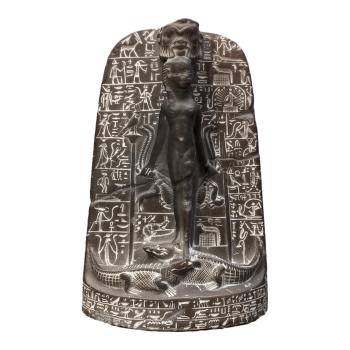
Ancient Egyptian cylinder of black soft stone in the British Museum
It is a small stone artwork, usually cylindrical or nearly cylindrical. Its surface is smooth and its color is black. This stony material is called soft stone because it is relatively easy to carve and process. These columns are often used as monuments, altars, or as carriers of spells. They played an important role in ancient Egyptian religion and religious rituals. They are often placed in temples, cemeteries or other important religious sites.
Cambay Carved Tombstone British Museum Collection
A relief marble tombstone made in Kambe (found/acquired in Aden, Yemen), Gujarat, India, now at the British Museum, London.
"The inscription includes blessings and Quranic verses in Arabic... the name of the deceased (Abu Hassan Ali ibn Osman) appears on the side of the panel......"
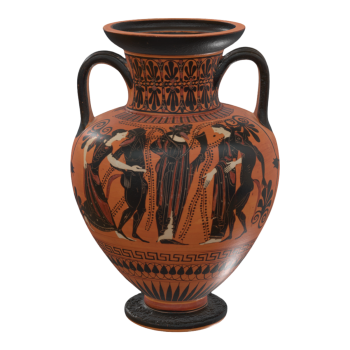
Cleveland Museum of Art Collection Black Pottery Neck Jars: Hercules and Nemeia Lions, Dionysus, Goat Gods and Fanatical Goddess
This Greek Athens pottery has a total height of 39.8cm and a diameter of 29cm. It was purchased by the Andrew R. and Martha Holden Jennings Foundation in 1970. On the front of the wine jar, Hercules, one of Greece's greatest heroes, is shown wrestling with a lion of Nemeia, who wears a lion's skin as a trophy for protection. Athena, the patron goddess of Hercules, stands with her nephew Iolaus (armed with the Hero's Stick). On the other side, a scene unrelated to the former is shown, depicting Dionysus, the god of wine, with the dancing fanatical goddess and the goat god.
Yuan Dynasty Seal
The jade seal, which refers specifically to the emperor's jade seal, is a symbol of supreme power. The ancient seal, the general term, to gold or jade. It is said to begin with Qin Shihuang. The seal came from Zhou Dynasty, and it was not until the Qin Dynasty that there was a seal and a seal. The seal used by the emperor was called the seal, while the seal used by his subjects could only be called the seal.
acupuncture point model of chinese medicine
Chinese human acupoint model in the 1950 s, meridian acupoint model.
A sign of the Castle Tavern in London
A well-preserved signboard from the now-demolished Castle Inn in Lawrence Lane, near Gresham Street, London. UNDATED: 17th century.
A wood carving of the Qing Dynasty
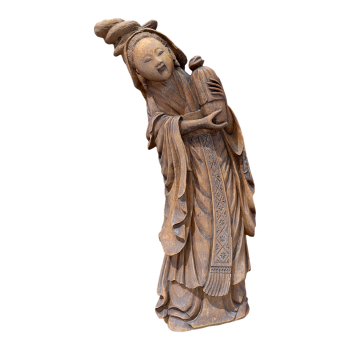
A wooden sculpture from the Qing Dynasty (1644-1912). She wore a long coat with lotus leaves on the back and framed her face with a high bow. Her earlobes look misshapen, with dangling earrings. The carvings are currently in the collection of the Spanish National Army Museum.
[3D Printing] Decorative Art Table Lamp "Woman Carrying Lamp"
Inspired by Pierre Le Faguays's sculpture "The Woman Carrying the Lamp." Fegary's early works are inspired by the ancient Greek terracotta statues unearthed in Tanagra (Tanagra) in the north of Athens, and are famous for their small dancer statues; at the peak of his career, he is famous for his works from literature and Greek mythology, as well as dancing figure sculptures, making good use of human body lines and dancing postures to achieve a combination of movement and movement. Female characters are sexy and elegant, while male characters have strong and masculine temperament, make his works very visual and expressive.
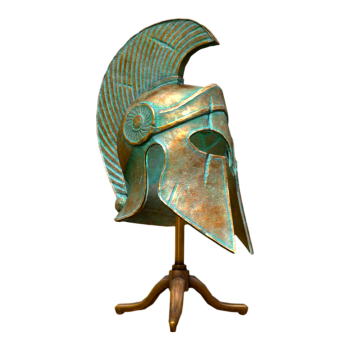
Collins Helmet 3D Model
The thickness of the Corinthian helmet varies depending on the location. The thickness of the skull part is about 0.25cm, and the facial part such as the nose is extremely thick, some even reaching 0.6cm. The helmet is decorated with a horsehair pattern and a horsetail trailing behind it. A soldier wearing this helmet means he is as energetic as a horse. The splicing method of this horsehair decoration also varies from place to place. Generally, a small groove or angle hook is made on the top of the helmet, so that it is convenient to install or remove decorations at will. The "horsehair" is generally vertical, but Sparta, which likes to be on its own, is horizontal.
Japanese Black Glazed Crane Pattern Seven Treasure Burned 3D Model
Qibao burn is a Japanese term for metal enamels. Because of its firing process from China's cloisonne, it is also known as "Japan's cloisonne. At the end of the 16th century (that is, during the long period of Japan's celebration), Japanese arts and crafts artists and their craftsmen, in imitating and learning to make Chinese "cloisonne" (enamel) handicrafts (created during the Wanli period of the Ming Dynasty), inadvertently produced works of art with their own national style and named "Qibao Burn.
Kangxi Blue and White Porcelain
Kangxi blue and white porcelain is famous for its fine fetal glaze, bright blue and white, simple and diverse shapes and beautiful decorations. In the Kangxi Dynasty of the Qing Dynasty (1662-1722 AD, the emperor of the Qing Dynasty Aixinjueluo Xuanye), the economy and trade were developed. In the 19th year of Kangxi, Jingdezhen restored the imperial kiln factory, and blue and white porcelain made outstanding achievements. Kangxi blue and white is divided into three periods: early, middle and late: the early period is from the first year of Kangxi to the 19th year of Kangxi; The middle period is from the 20th year of Kangxi to the 40th year of Kangxi. The late period is from the 40th year of Kangxi to the end of the Kangxi dynasty, of which the blue and white porcelain is the most prominent in the middle of Kangxi.
NBA championship trophy
The Larry O'Brien NBA Championship Trophy is a trophy presented annually by the National Basketball League (NBA) to the winning teams in the NBA Finals Series. The trophy has been in use since 1977, replacing the previous Walter A. Brown Trophy. The trophy remained in the old name of the "Walter A. Brown Trophy" until after the 1984 NBA Finals, the trophy was named the "Larry O'Brien Championship Trophy" in honor of former NBA President (later known as NBA Commissioner) Larry.
FIFA World Cup Trophy
The FIFA World Cup (FIFA World Cup), referred to as the "World Cup", is a football match that is participated by national-level teams from all over the world, symbolizing the highest honor in the football world, and has the greatest popularity and influence. The World Cup was televised to more than 3.5 billion viewers worldwide. The World Cup is held every four years, and any FIFA member country (region) can send a team to sign up for the event.
Oscar trophy
The main body of the Oscar trophy is a 13.5-inch 3.9-kilogram gilded male statue designed by the famous American sculptor George Stanley. According to the selection rules related to the Oscars, the winner of an award can only receive one golden statue award seat. If two people win an award together, each of them should be awarded a golden statue award seat.
British Museum, London A boulder with petroglyphs
A boulder with a picture of a man on it. Found in the fourth waterfall of Sudan. It is now in the British Museum in London.
A group of stone sculptures
This is a set of brown stonework: a bear biting the neck of a standing man, and on a bent man. Originated from British Columbia, manufactured in the 19th century.
Random Model
Chinese ancient smelting plant
1057 View
Austrian Mausoleum
950 View
Hairdressing tool storage cart
860 View
Durasta Fire Engine
957 View
Willow
1459 View
Vienna Belvedere Palace Stone Vase
726 View
Statue of Judah
1106 View
3D model of koala with animation
940 View