Fifth Century BC Cultural Relics Wine Glass-shaped Klatt Wine Vapor

Fifth Century BC Cultural Relics Wine Glass-shaped Klatt Wine Vapor

Glass-shaped Kratt wine ware decorated with red figures, Sicily La Gusa. Front: The warrior bids farewell to his family (wife and son in the arms of a nanny); Back: The man, armed with a stick and Himatian, stands between two women. From the site of Kamarina, Lagusa Province, Sicily, Italy. Classical period, 5th century BC. Collected in the Parco Archeologico di Kamarina e Cava d'Ispica Archaeological Park.
Tenth Century Cultural Relics Bifurcation Spiral Figure Porcelain Bowl

Tenth Century Cultural Relics Bifurcation Spiral Figure Porcelain Bowl

Bowl decorated with geometric patterns (swastika and double-forked spiral pattern "yc"). From the site of Elcano, Corclé, Panama, 900-1020 AD. In the collection of the Fundaci Foundation (El Caño). Centre for Archaeological Studies of the Isthmus (Centro de Investigaciones Arqueol ógicas del Istmo).
Wauchelvik Cup

Wauchelvik Cup

Wauchervik Cup, in the collection of the National Museum in Krakow. The Wauchervik Cup is a ceramic work of art with rich decoration and craftsmanship.
Eighteenth Century Artifacts Meissen Botegau Flute Vase

Eighteenth Century Artifacts Meissen Botegau Flute Vase

This is a vase for Botegtau flute, made in Meissen, Germany, from about 1710 to 1719. The material is a bortegtao (Bö ttgersteinzeug) with relief decoration (the so-called "Irminger relief decoration"). The flute vase used a special porcelain material known for its hardness and durability.
18th Century Artifacts Meissen Porcelain Flute Vase

18th Century Artifacts Meissen Porcelain Flute Vase

This is a flute vase, decorated with the figure part designed by Johann Gregorius Höroldt and the flower part designed by Johann Ehrenfried Stadler, made in Meissen, Germany, on August 17, 1726. The material is porcelain, and the decoration uses sprayed underglaze blue background (gespritzter Fond), overglaze color and gold.
Eighteenth Century Cultural Relics German Meissen Chinese Lantern

Eighteenth Century Cultural Relics German Meissen Chinese Lantern

This is a lantern, decorated by Johann Ehrenfried Stadler (Johann Ehrenfried Stadler), produced in Meissen, Germany, about 1726/1727. This lantern is decorated with Chinese style pattern (Chinoiseriedekor). Meissen porcelain is famous for its exquisite craftsmanship and exquisite decoration. The lantern was decorated with overglazed colors, demonstrating the European passion and imitation of the Chinese artistic style of the time.
Seventeenth-century relics have field underglaze blue and blue flower vase

Seventeenth-century relics have field underglaze blue and blue flower vase

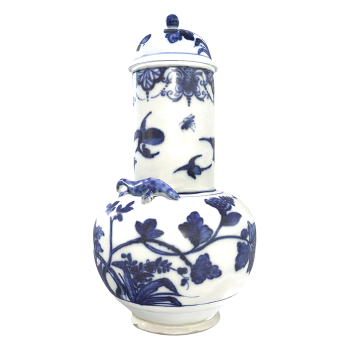
This Japanese vase, which was produced in Yoda, was from about 1670 to 1690. The material is porcelain, and the decoration uses underglaze blue and white blue. This covered vase uses the decoration process of underglaze blue and white blue, which means that before firing, a pattern is drawn with blue and white blue on the surface of the porcelain, and then fired at a high temperature to allow the color to penetrate under the glaze.
Eighteenth-century relics have field underglaze color vase

Eighteenth-century relics have field underglaze color vase

This Japanese vase, produced in Yoda, was from 1700 to 1720. The material is porcelain, and the decoration uses underglaze blue and white blue, overglaze color and gold. This covered vase is in the Imari Style.
Bessamin Box

Bessamin Box

The Besamin box [Hebrew: bassamim,psumin-byksy] is a container for spices. It is used at the end of the Sabbath and is usually tower-shaped. Interestingly, the Bessamin box from Novi Songe is fish-shaped. The fish head is connected to the fish body by a hinge and can be opened and tilted to one side. The body of the fish consists of five overlapping segments, each tapering towards the caudal fin, each segment ending in semicircular scales, each with a network of textures and grooves. The various segments of the fish body are connected to each other so that the fish's body can be slightly curved.
Japanese Edo Period Pictographic Porcelain

Japanese Edo Period Pictographic Porcelain

This pictographic porcelain was made during the Edo period of Japan (1680-1700) in the Yoda area. It uses the glaze painting technique of Shijiuweimen style, showing the superb craftsmanship of Japanese porcelain making at that time. The Shikakuweimen style is known for its bright colors and fine paintings, usually decorated in red, blue, green, yellow and other colors.
19th century Qing Dynasty cultural relic porcelain gold-plated vase
19th century Qing Dynasty cultural relic porcelain gold-plated vase

This vase dates back to the 19th century. It is embedded in a gold-plated metal frame with dragon-shaped handles and feet with ear-shaped decorations.
18th century Qianlong period palace carved lacquer box
18th century Qianlong period palace carved lacquer box

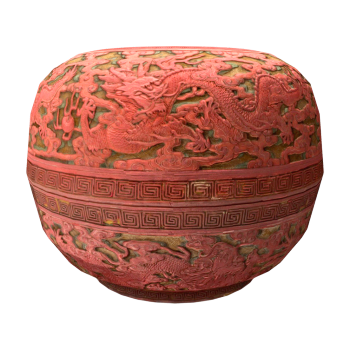
The carved lacquer box was created by the Qing court workshop during the period of Emperor Qianlong. Carving lacquer is a fine traditional process, made by multi-layer lacquer coating and complex engraving technology. These crafts usually display superb skills and exquisite design, symbolizing imperial power and nobility. This carved lacquer box is currently in the collection of the Jaguelon University Museum in Poland.
Protection of the Virgin Mary

Protection of the Virgin Mary

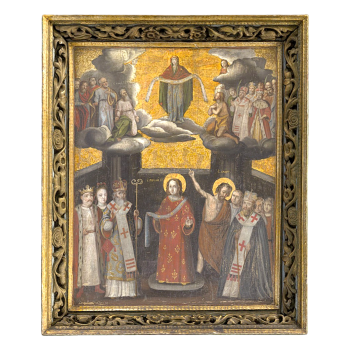
"The Protection of the Virgin Mary" is a religious painting, which was created in 1703 and is displayed in the Museum of Novi Sunch. The artwork shows superb craftsmanship and profound religious and cultural background, and is one of the precious collections in the museum collection. The depiction of the Virgin Mary protecting her followers is an important theme in Christian art. In paintings, the Virgin Mary is often depicted as a symbol of love and protection, surrounded by a halo.
17th-century Polish restored clockwork table clock
17th-century Polish restored clockwork table clock

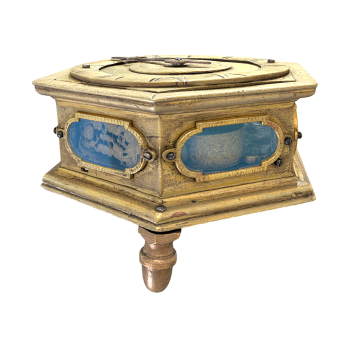
The clockwork table clock (17th-18th century) was made by George Merkel, and this horizontal tile-shaped table clock is called "kaflak" in Polish ". Its movement is incomplete, and it was rebuilt in the 19th century. The movement has two clockwork drums (one of which is not original and belongs to the 19th century), a reduction screw with a chain, a vintage movement gear, a crown wheel escapement protected by a decorative bow (the bow is missing). The chiming mechanism is incomplete. The clock originally marked the hour and half hour. It has a ring dial and single needle mechanism (secondary needle for the 21st century). It is now in the Museum of the University of Jaguaronia.
The Holy Grail of the 17th century Benedictine monastery

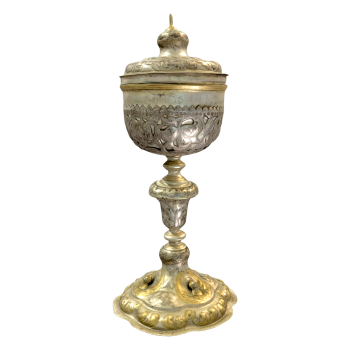
The Holy Grail of the 17th century Benedictine monastery

This chalice is in the collection of the Benedictine monastery in Tyniec and was founded in 1691 by Benedictine Mierkowski Rupert Milkowski. The vessel may not have been originally designed for the Tyniec Abbey Church. The founder of the Eucharist Vessel was also the parish priest of Tyniec, who presented it to the parish church of Tyniec. After the church was demolished in 1825, the item was transferred to the monastery. It is one of the few gold vessels left after the Dissolution of the Tyniec Monastery.
Jade of the Zhou Dynasty, 1100-771 BC
Jade of the Zhou Dynasty, 1100-771 BC

Jade is a kind of ancient Chinese jade, usually round, with a round hole in the middle. The history of the jade can be traced back to the Neolithic period, especially the Liangzhu culture (3400-2250 BC). In the later Shang, Zhou and Han dynasties, the craftsmanship and decoration of jade became more complex and exquisite.
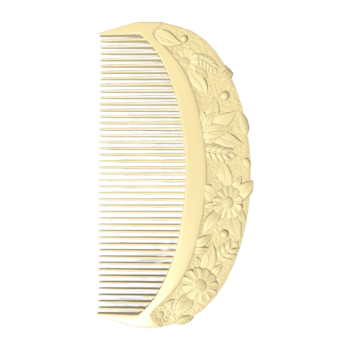
Antique ivory hair comb

Antique ivory hair comb

Guofeng handmade paper plum blossom fan

Guofeng handmade paper plum blossom fan

During the Qing Dynasty, Fang Ding-style copper incense burner

During the Qing Dynasty, Fang Ding-style copper incense burner

Cast copper antique national style incense burner

Cast copper antique national style incense burner

Chinese copper official kiln pottery cock
Chinese copper official kiln pottery cock

Tongguan Kiln, located in Changsha City, Hunan Province, is one of the famous ceramic kiln sites in ancient China and is famous for its exquisite ceramic products. The pottery cock is one of the typical works. This pottery cock is made with exquisite craftsmanship and vivid shape, and is often used as an ornament or gift. The image of the rooster has a rich symbolic meaning in Chinese culture, usually representing auspiciousness, bravery and hard work. This pottery cock is currently in the collection of Changsha Tongguan Kiln Ceramic Research Institute.
Crane and Snake

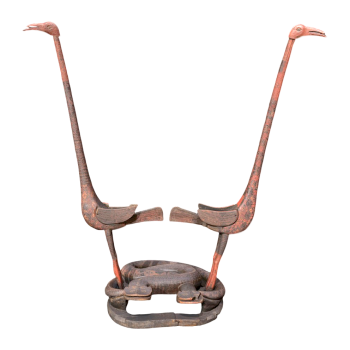
Crane and Snake

The artwork, titled "Crane and Snake", is from Changsha, Hunan Province, China, and belongs to the Warring States Period (475-221 BC) and the State of Chu (about 1046-223 BC). It is made of painted wood and has overall dimensions of 132.1 x 124.5cm (52 x 49 in). The artwork is currently in the collection of the Cleveland Museum of Art.
Stone Bergamot

Stone Bergamot

Stone Vase Decoration

Stone Vase Decoration

Vase at the entrance of Brno Central Park

Vase at the entrance of Brno Central Park

is a striking art installation designed to add life and beauty to the park. Inspired by nature, the design uses modern materials and craftsmanship, showing an elegant shape and rich colors. It is not only a decoration, but also an interactive space. Visitors can walk around the vase and feel the fusion of art and nature. This installation attracts many photography enthusiasts and tourists. The presence of the vase not only enhances the overall landscape of the park, but also provides a place for citizens to relax and enjoy nature. The design of the vase also reflects Brno's emphasis on art and landscaping as part of the city's culture.
Iron cock ornaments

Iron cock ornaments

Antique dragon incense burner

Antique dragon incense burner

With its exquisite carvings and unique dragon patterns, it has become a treasure in traditional Chinese art. It is not only a work of art, but also an important manifestation of dragon totem worship in Chinese culture. The history can be traced back to the Han Dynasty. As a symbol of the Chinese nation, the dragon pattern has profound cultural significance. Features include the unique dragon pattern decoration, the image of the dragon is usually presented as a cloud of fog, posture, carving lifelike, meticulous. The production process is complex and requires multiple processes to show a high artistic level. In history, the dragon incense burner is not only a practical instrument, but also an important tool for etiquette and sacrifice.
Woman and dragon exquisite wood carving

Woman and dragon exquisite wood carving

Fortune, Fortune, Longevity, and Three Stars (Yellow Peach Woodcarving)

Fortune, Fortune, Longevity, and Three Stars (Yellow Peach Woodcarving)

The Three Stars of Fortune, Fortune, and Longevity originated from people's natural worship of ancient stars. In the beginning of spring, in the south, there are three stars that are closely spaced and connected in a straight line. Chinese people call these three stars "Lu, Fu, and Shou", and regard them as three auspicious stars that respectively govern the blessings, longevity, and other aspects of the world, known as the "Three Stars of Fu, Lu, and Shou". As the saying goes, "Three stars shine high, and the New Year is coming!" When three stars hang high in the southern sky at night, it is the time of Chinese Spring Festival. This is a belief belonging to the Chinese people. They have a great influence in the Han people. The three immortals of happiness, wealth and longevity have become a true portrayal of the Han people's secular life ideal.
Elephant wood carving

Elephant wood carving

Antique wooden globe

Antique wooden globe

The first globe, the Beheim globe

The first globe, the Beheim globe

The diameter of the Beiheim globe is 51 centimeters, and the decoration is luxurious. In records from 1494, the production of this ball was particularly time-consuming and laborious. In 1992, Nuremberg conducted a detailed study on the material of this ball, and its report stated that the production process was indeed quite complex. This is a mixture of old and new geographical knowledge, with ancient Greek speculations about the world, medieval geographical ideas, and new results of maritime exploration all visible. It became a model for drawing world images in central Europe at that time, and one of the few remaining map works in the world that collected different mapping methods and schools.
Antique astronomical theodolite

Antique astronomical theodolite

Theodolites are measuring instruments designed based on the principle of angle measurement to measure horizontal and vertical angles. They are divided into two types: optical theodolites and electronic theodolites, with the most commonly used being electronic theodolites. The theodolite is the mechanical part of a telescope that allows it to point in different directions. The theodolite has two mutually perpendicular axes to adjust the azimuth and horizontal height of the telescope. A theodolite is a type of angle measuring instrument equipped with a sighting section, a horizontal dial and reading indicators, and a vertical dial and reading indicators.
Celestial globe

Celestial globe

The celestial globe is a general term for the celestial globe and the celestial globe. The armillary sphere is an instrument used to measure the spherical coordinates of celestial bodies, while the celestial globe was an instrument used in ancient times to demonstrate celestial phenomena. The armillary sphere and the celestial globe are instruments that reflect the theory of the celestial sphere. The inventor of the armillary sphere is said to be Luo Xiahong from the Western Han Dynasty, who was improved by scientist Zhang Heng during the Eastern Han Dynasty. The earliest existing armillary sphere in China was manufactured during the Ming Dynasty and is displayed at the Purple Mountain Observatory in Nanjing.
Centuripe pottery

Centuripe pottery

It is a product of the Hellenistic period (3rd century BC to 2nd century BC), known for its exquisite decoration and colorful glaze. This type of pottery is commonly used in tombs and has important cultural and symbolic significance. The characteristics of Centuripe pottery are its complex decorative applications and exquisite post firing painting. Usually depicting wedding scenes, such as the bride being surrounded by bridesmaids, reflecting the social customs and religious beliefs of the time. These funeral pottery pieces are not only works of art, but also important materials for studying ancient Sicilian culture and religion. It demonstrates the profound influence of ancient Greek culture on Sicily.