The ceramic bottle "Pelik" from the classical period of ancient Greece

The ceramic bottle "Pelik" from the classical period of ancient Greece

Pelik is a Greek container made of ceramic double ear bottles used for storing liquids. The cultural relic collected by the Krakow National Museum is made in the Kerch style, which is characterized by items produced in Athens in the 4th century BC and exported to cities in the northern Black Sea. The popular decorative theme of the Kerch style vessels comes from the cycle of Dionysius: on the belly of Pelik, depicting Dionysius' attendants. From the left dance pose, Dionysius' half man, half beast, Menard playing drums, and another half man, half beast. Menard tilted slightly backwards, attracting the attention of other participants amidst religious fervor.
The clay sculpture "Dog ū (Mia)" from the prehistoric Jomon period in Japan

The clay sculpture "Dog ū (Mia)" from the prehistoric Jomon period in Japan

Over the years, archaeologists have discovered many different types of clay sculptures - dog ū - dating back to the prehistoric Jomon period in Japan (1400-800 BC). Various forms have been unearthed in northeastern Japan, some sitting, some standing, some with almost no surface decoration, while others, like this example, are known as the "goggles" type, with unique large eyes adorned with colors and complex carved decorations. The popular theory suggests that they are talismans related to health and childbirth, and after use, they are intentionally destroyed and disposed of. They are now collected at the Minneapolis Institute of the Arts.
A horse catapult carved in 15000 BC

A horse catapult carved in 15000 BC

This artwork is a three-dimensional sculpture carved on reindeer bones, depicting a jumping horse. This work is believed to date back to around 15000 BC and is a representative work of the Palaiologist period and the Magdalen culture. This sculpture is considered to be a Baroque mobile art piece. This work was discovered at the Brunikel site and is currently located at the National Museum of Archaeology in France.
Ivory artifact "Louis Chess King" discovered on the island of Lewis in Scotland

Ivory artifact "Louis Chess King" discovered on the island of Lewis in Scotland
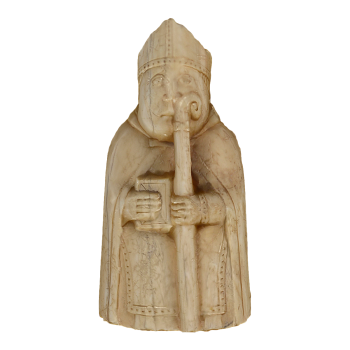
The chess pieces are now collected in the British Museum and have been exhibited in multiple exhibitions. This chess piece is part of the Louis Chess, a medieval chess set made of ivory, including pieces for kings, queens, bishops, knights, castles, and soldiers. This is a bishop chess piece made of ivory, standing with a damaged sword on the knee, wearing a crown with crossed stripes on the head, and decorated with three vertical panels on the back of the throne, including clover, geometric interweaving, and wave scroll design.
Ivory artifact "Louis Chess Bishop" discovered on the island of Lewis in Scotland

Ivory artifact "Louis Chess Bishop" discovered on the island of Lewis in Scotland

The chess pieces are now collected in the British Museum and have been exhibited in multiple exhibitions. This chess piece is part of the Louis Chess, a medieval chess set made of ivory, including pieces for kings, queens, bishops, knights, castles, and soldiers. This is a bishop chess piece made of ivory, which is standing, wearing a vestment and shawl, wearing a bishop's crown with tassels on the head, holding a scepter and a book. The chess piece was made around 1150-1200 AD.
The magnificent marble double ear vase in Hyde Park, Italy

The magnificent marble double ear vase in Hyde Park, Italy

Coffin of Pharaoh Ramses II of ancient Egypt

Coffin of Pharaoh Ramses II of ancient Egypt

Ramses II was a pharaoh of the 19th Dynasty of ancient Egypt, who ruled from 1279 BC to 1213 BC. This coffin was found in Tomb DB320 of the Royal Mummy Library, where the remains of Ramses II's mummy were discovered. Now this coffin is hidden in the Egyptian Museum.
The porcelain "Dionysus Ceramic Double Eared Vase" from the University Town of Paris in the 1922

The porcelain "Dionysus Ceramic Double Eared Vase" from the University Town of Paris in the 1922

Dionysus, also known as the Greek god of wine, is one of the twelve main gods of Olympus in ancient Greek mythology. Dionysus was the god of wine believed in by ancient Greeks and Thracians. Not only did he possess the intoxicating power of wine, but he also became a highly charismatic god at the time for his generosity, joy, and love. He promoted the civilization of ancient society, established laws, and maintained world peace.
The wooden carving of the Haida totem pole from the indigenous Haida civilization in Canada

The wooden carving of the Haida totem pole from the indigenous Haida civilization in Canada

The wooden carving depicts a beaver holding a chewing stick with crossed shadows on its tail. Beavers symbolize creativity, artistry, and determination, and were made around 1860. It is now a collection of the Cambridge Museum of Archaeology and Anthropology. The homeland of the Haida people is located in the Queen Charlotte Islands off the Pacific coast of Canada, separated from the Black Carter Strait and the North American continent, and facing the Alexander Islands of Alaska across the Dixon Strait. It stretches nearly 300 kilometers along the province of Alberta in northwestern Canada. The Haida people did not have writing before, they recorded the stories and legends of their ancestors through carving totem poles.
The King in Lewis Chess

The King in Lewis Chess

Lewis chess pieces, also known as Uig chess pieces, are a unique set of 12th century chess pieces, as well as other game chess pieces, mostly carved from walrus teeth. These chess pieces were discovered in 1831 in the Outer Hebrides of Lewis, Scotland. When discovered, this collection contained 93 items: 78 chess pieces, 14 tables, and a belt buckle. Now, 82 chess pieces are owned and usually exhibited by the British Museum in London, and the remaining 11 are at the National Museum of Scotland in Edinburgh. This chess piece is now on display at the British Museum.
Korean Koryo period bronze clock "Buddhist temple bronze inscription ceremony clock"

Korean Koryo period bronze clock "Buddhist temple bronze inscription ceremony clock"

This bronze ceremonial bell is a Korean artifact from the Koryo period (918-1392). Its name is "Buddhist temple bronze inscription ritual bell". The decoration of this bell is very fine, made of cast bronze with engraved inscriptions, the bell was made in the 1200 AD generation. Once used as part of a Buddhist indoor ritual, the bell hangs in a Buddhist temple with a cast dragon on top and a vertical tube to amplify the sound. The inscription indicates that it was cast in the Year of the Dragon, took three years to make, and is now in the collection of the Cleveland Museum of Art.
Joseon Dynasty Scroll Box "Painted Wood Dragon and Phoenix Scroll Box"
Joseon Dynasty Scroll Box "Painted Wood Dragon and Phoenix Scroll Box"

This set of scroll boxes is a Korean cultural relic from the Joseon Dynasty (1392-1910), and its name is "Painted Wood Dragon and Phoenix Scroll Box". The scroll box is very finely decorated. The scroll is printed with gorgeous dragon and phoenix patterns, mother-of-pearl inlaid on lacquered wood and twisted brass and copper wires. This scroll box is used by the royal family to keep scrolls or important documents. It measures 11.5 x 11.6 x 87cm (the scroll box was made from the 1700 s to the 1800 s) and is in the collection of the Cleveland Museum of Art.
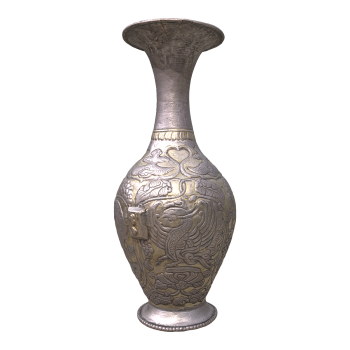
Tibetan silver vase during the Tang Dynasty "Tibetan gold-plated silver vase"

Tibetan silver vase during the Tang Dynasty "Tibetan gold-plated silver vase"

This vase is a cultural relic of the early 8th century AD from Tibet. Its name is "gold-plated silver vase". The decoration of this vase is very fine, mainly with Central Asian elements, including grape vines, bead edges and heart patterns. Sogite craftsmen are known to be adept at using gilded foil to set off silver relief designs. The form of the animal head-shaped drinking utensils and the use of silver are derived from Persian origins, while the rich, luxurious texture of the design and the form of the lion and the curly dragon on the side of the vase show an understanding of the Chinese form, which is proved in the early stage of political unity and integration in Tibet. This vase is now in the collection of the Cleveland Museum of Art.
Korean Dynasty blue and white porcelain "dragon blue and white porcelain jar"

Korean Dynasty blue and white porcelain "dragon blue and white porcelain jar"

This porcelain is a Korean artifact from the Joseon Dynasty (1392-1910). Its name is "dragon pattern blue and white porcelain jar". The decoration of this jar is very fine, including the underglaze blue dragon design. This jar was probably used as a vase in an official courtyard ceremony. It has an overall height of 39.5cm and a bottom diameter of 14.7cm. This jar was made in the 1700 s and is now in the collection of the Cleveland Museum of Art.
The porcelain of the Joseon Dynasty "Carved Pollen Celadon"

The porcelain of the Joseon Dynasty "Carved Pollen Celadon"

This vase was classified as pink celadon, which flourished during the 1400s-1500s. Pink celadon is pottery decorated with iron-containing clay and white slippery clay. The fish pattern on this vase was made using the technique of engraving and scratching, which was very common in ceramic making during the Joseon Dynasty (1392-1910). The bottle is now in the collection of the Cleveland Museum of Art.
Ink Cake "Panlong Ink Cake" during Jiaqing Period of Qing Dynasty

Ink Cake "Panlong Ink Cake" during Jiaqing Period of Qing Dynasty

This piece of ink cake is from China during the Jiaqing period (1795-1820) of the Qing Dynasty. The ink cake was green and shaped like a spiralling dragon. Ink cake (also called ink block) is dissolved in water and then ground into liquid ink on the surface of a square stone, which is used in painting and calligraphy. However, this precious piece of ink cake has never been used. the inscription on the side of the blue ink cake says that this set of ink cake was commissioned by governor chen huai of jiangxi province. This inset box is now in the collection of the Cleveland Museum of Art.
Qing Dynasty Ivory Sitting Pier "Small Ivory Characters Embroidered Pier"

Qing Dynasty Ivory Sitting Pier "Small Ivory Characters Embroidered Pier"

The work is from the Qianlong period (1736-95) of the Qing Dynasty (1644-1911). At the age of the Qing dynasty, luxury goods became more popular and affordable, including merchants and literati in unofficial positions. The growing urban population has encouraged the consumption of luxury goods and local crafts. This piece of ivory carved and painted to imitate a small garden chair shows the exquisite skills of the talented craftsmen of the Qing Dynasty, the craft of embroidering figure patterns, which combines embroidery and furniture making, showing the unique charm of traditional Chinese handicrafts. This sill is currently in the collection of the Cleveland Museum of Art.
Oscar Statue

Oscar Statue

The Academy Awards look like a naked man, his hands crossed on his chest, holding a long sword, standing on a five-ring film plate, each ring representing an important work department of the Academy of Film Arts: production, director, Screenwriter, actor, technician. The original trophy was made by Mayer and given 500 US dollars to George Stanley. The trophy was 13 and a half inches high and weighed 6 and 3/4 pounds. It was made of alloy inside and a layer of gold flakes on the outside. It looked sparkling, so it was called the Academy Award.
Nepal Blue Handmade Clay Sculpture Tribal Mask

Nepal Blue Handmade Clay Sculpture Tribal Mask

Kyoto National Museum Wooden Mask Red Ghost Mask

Kyoto National Museum Wooden Mask Red Ghost Mask

The red ghost mask is a mask used to perform ghost dances, usually held in shrines, temples and other religious places. Ghost dance is a ritual that can dispel evil spirits and bless peace. It is usually composed of ghost masks, ghost costumes, ghost props, etc. There are many styles of red ghost masks, some are human, some are animal-shaped, and some are weird. This mask is in the collection of the Kyoto National Museum. It is an animal-shaped red ghost mask with sharp teeth and fangs, as well as a long nose and eyebrows. The mask is carved out of wood.
Ancient Greek Antique Bronze Art Binaural Vase

Ancient Greek Antique Bronze Art Binaural Vase

19th Century British Antique Ceramic Vase

19th Century British Antique Ceramic Vase

Ancient Egyptian cylinder of black soft stone in the British Museum

Ancient Egyptian cylinder of black soft stone in the British Museum

It is a small stone artwork, usually cylindrical or nearly cylindrical. Its surface is smooth and its color is black. This stony material is called soft stone because it is relatively easy to carve and process. These columns are often used as monuments, altars, or as carriers of spells. They played an important role in ancient Egyptian religion and religious rituals. They are often placed in temples, cemeteries or other important religious sites.
Cambay Carved Tombstone British Museum Collection

Cambay Carved Tombstone British Museum Collection

A relief marble tombstone made in Kambe (found/acquired in Aden, Yemen), Gujarat, India, now at the British Museum, London. "The inscription includes blessings and Quranic verses in Arabic... the name of the deceased (Abu Hassan Ali ibn Osman) appears on the side of the panel......"
Do the old copper wealth ingot Maitreya Buddha ornaments

Do the old copper wealth ingot Maitreya Buddha ornaments

Antique Dragon Tuzhu Jade Relief Sculpture Crafts Ornaments

Antique Dragon Tuzhu Jade Relief Sculpture Crafts Ornaments

Cleveland Museum of Art Collection Black Pottery Neck Jars: Hercules and Nemeia Lions, Dionysus, Goat Gods and Fanatical Goddess

Cleveland Museum of Art Collection Black Pottery Neck Jars: Hercules and Nemeia Lions, Dionysus, Goat Gods and Fanatical Goddess

This Greek Athens pottery has a total height of 39.8cm and a diameter of 29cm. It was purchased by the Andrew R. and Martha Holden Jennings Foundation in 1970. On the front of the wine jar, Hercules, one of Greece's greatest heroes, is shown wrestling with a lion of Nemeia, who wears a lion's skin as a trophy for protection. Athena, the patron goddess of Hercules, stands with her nephew Iolaus (armed with the Hero's Stick). On the other side, a scene unrelated to the former is shown, depicting Dionysus, the god of wine, with the dancing fanatical goddess and the goat god.
Japanese vase with lid

Japanese vase with lid

It is now in the National Gallery in Dresden, Germany.
Pottery Santa Claus Christmas Decorations

Pottery Santa Claus Christmas Decorations

Garden stone seed pot

Garden stone seed pot

Monument Rune Stone

Monument Rune Stone

Yuan Dynasty Seal

Yuan Dynasty Seal

The jade seal, which refers specifically to the emperor's jade seal, is a symbol of supreme power. The ancient seal, the general term, to gold or jade. It is said to begin with Qin Shihuang. The seal came from Zhou Dynasty, and it was not until the Qin Dynasty that there was a seal and a seal. The seal used by the emperor was called the seal, while the seal used by his subjects could only be called the seal.
acupuncture point model of chinese medicine

acupuncture point model of chinese medicine

Chinese human acupoint model in the 1950 s, meridian acupoint model.
A sign of the Castle Tavern in London

A sign of the Castle Tavern in London

A well-preserved signboard from the now-demolished Castle Inn in Lawrence Lane, near Gresham Street, London. UNDATED: 17th century.
A wood carving of the Qing Dynasty

A wood carving of the Qing Dynasty

A wooden sculpture from the Qing Dynasty (1644-1912). She wore a long coat with lotus leaves on the back and framed her face with a high bow. Her earlobes look misshapen, with dangling earrings. The carvings are currently in the collection of the Spanish National Army Museum.