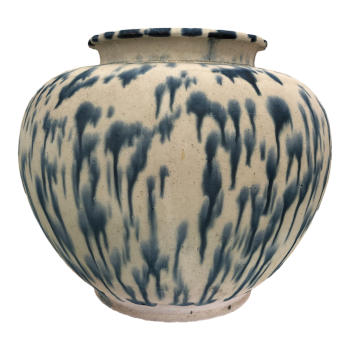

During the Kaiyuan period of the Tang Dynasty, the ceramic "Tang Dynasty Cobalt Pottery Jar"

During the Kaiyuan period of the Tang Dynasty, the ceramic "Tang Dynasty Cobalt Pottery Jar"

Tang Dynasty cobalt pottery jars are a very rare type of pottery, characterized by the use of cobalt blue glaze. In the Tang Dynasty, cobalt blue glaze was very popular, but due to the high price of high-quality cobalt ore, it was usually only used sparingly. Chinese cobalt ore contains manganese, so its color tends to be darker. The glaze of the jar flows during the firing process, so it stops before the feet, which is a characteristic of Tang Dynasty lead glazed pottery. It is currently housed in the China Ceramic Museum.
Jingdezhen Blue and White Porcelain Vase "from the Kangxi period of the Qing Dynasty

Jingdezhen Blue and White Porcelain Vase "from the Kangxi period of the Qing Dynasty

This Chinese cultural relic is a porcelain vase from the Kangxi period of the Qing Dynasty (1662-1722). The vase is made of transparent and colorless underglaze blue and white porcelain with cobalt pigment, fired in Jingdezhen, and is now collected in the Smithsonian Museum.
Simulated Crown Prop by Jan Matejko Academy of Fine Arts in Krakow

Simulated Crown Prop by Jan Matejko Academy of Fine Arts in Krakow

This crown is a prop from the Jan Matejko Academy of Fine Arts Museum in Krakow, Poland. The Jan Matejko Academy of Fine Arts is the oldest art academy in Poland, founded in 1818 and granted full autonomy in 1873. This college is located on Matejko Square in the center of Krakow city.
Cultural relic from the Qianlong period of the Qing Dynasty: "Recommended Boxes from the Qianlong Period"

Cultural relic from the Qianlong period of the Qing Dynasty: "Recommended Boxes from the Qianlong Period"

In traditional religious beliefs, offering sacrifices or sacrifices is the most common religious behavior. In order to express respect and reverence for gods or ancestors, or to achieve the purpose of communication between humans and gods, people will prepare various foods as sacrificial offerings and offer various types of gold paper as offerings. They will also use various sacrificial and offering utensils to express respect and prayers to the gods, such as shrines, sedan chairs, and other utensils that can be directly used for offerings to the gods; Cups, chopsticks, and poems are used as tools for seeking divine approval; Incense burners, recommendation boxes, and other utensils are used to hold offerings. The utensils used to hold various types of offerings are diverse and complex in variety, and their production techniques and styles are tailored to meet the various forms and purposes of offerings.
The cultural relic of the Shang Dynasty, "Bone shaped Artifacts"

The cultural relic of the Shang Dynasty, "Bone shaped Artifacts"

It is a bone artifact unearthed from the Tomb of Shang Wang No. 1001, possibly made of elephant leg bones, with a complete lower end and a damaged upper end, and a rounded triangular cross-section of the body. On one of the corners of the body, there are two vertically arranged perforations at the lower position of the middle decorative band, which may be used to install handles. The decoration can be roughly divided into three parts. The upper and lower ends of the object are decorated with animal face patterns, the middle part is decorated with the main decoration of Taotie, and the two sides of the triangular pattern below are decorated with inverted dragons. Going further will be the Shen character decorative strip. These patterns are surrounded by dense cloud and thunder patterns, and the carvings are very exquisite. First stored at the Central Institute of Historical Research.
Cultural relic from the late Shang Dynasty, titled 'Turtle Belly Armor with Inscriptions on Zhu Bu'

Cultural relic from the late Shang Dynasty, titled 'Turtle Belly Armor with Inscriptions on Zhu Bu'

This oracle bone belongs to the first Wu Ding divination of the Late Shang Dynasty, which records the divination results of the virtuous man "Wei" on the day of "Bingzi". He used the direct question 'I will receive a good harvest (I will have a good harvest)' and the reverse question 'I will not receive a good harvest (I will not have a good harvest)' to predict whether the crops will have a good harvest this year. The divination inscriptions are usually engraved next to the divination signs, and they usually avoid the divination signs, which is called "avoiding signs"; This edition is inscribed with divination or engraved on divination signs, known as "criminal signs", and currently exists at the Central Institute of Historical Research.
Copper pendant from the Russian Empire period titled 'Old Believers and Tsar Peter I'

Copper pendant from the Russian Empire period titled 'Old Believers and Tsar Peter I'

They are part of the ancient tradition of making metal castings, especially in the circles of old believers (old ritualists) in modern Russia. This type of metal product is often seen as a manifestation of the differences between the old believers and the laws of Tsar Peter I in 1722 and 1723. It is currently housed in the Krakow National Museum in Poland.
Porcelain "Sacrificial Blue Sky Ball Vase" from the Qianlong period of the Qing Dynasty

Porcelain "Sacrificial Blue Sky Ball Vase" from the Qianlong period of the Qing Dynasty

This vessel shape appeared during the Ming Xuande period, with a large and upright body, a majestic aura, and a sturdy and antique shape. It is named after its round and bulging belly resembling a spherical shape. The sacrificial blue glaze is often used during sacrificial ceremonies, hence it is called sacrificial blue glaze. It is also known as Jilan or Gemstone Blue.
The Double Phoenix Jade Pendant from the Zhou Dynasty
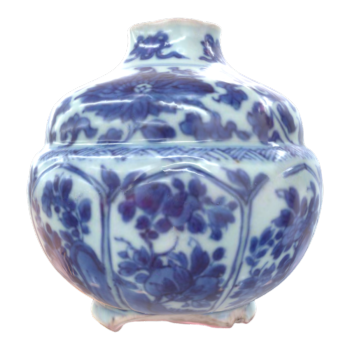
The Double Phoenix Jade Pendant from the Zhou Dynasty

This jade pendant is from Tomb 60 of Liuli Ri in Hui County, Henan Province, and was buried together with the deceased. This light green jade piece is in the shape of two phoenixes, with a circular overall shape. The hollow carving imitates the shape and decoration of the work. The two sides of the pendant rotate upwards to form the head of a phoenix, while their circular bodies are connected to each other. A carved line surrounds the edge of the decoration, outlining the shape of a phoenix, while the entire piece is filled with curled cloud patterns. The pattern on the back of the pendant does not match its shape, indicating that the pendant was remade from an old piece of jade and is now housed in the National Museum of China.
Jingde Blue and White Porcelain Vase from the Kangxi period of the Qing Dynasty
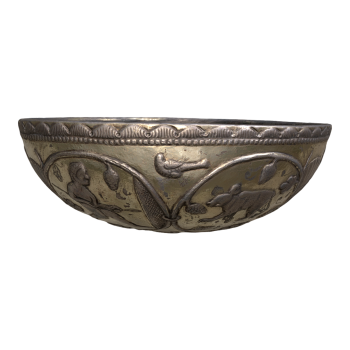
Jingde Blue and White Porcelain Vase from the Kangxi period of the Qing Dynasty

This Chinese cultural relic is a blue and white porcelain trumpet shaped vase fired in Jingdezhen during the Kangxi reign of the Qing Dynasty. The vase is decorated with fresh flowers and leaves, measuring 11cm in height, 11cm in width, and 11cm in length. It is currently housed in the Hunt Museum in the United Kingdom.
Silver Bowl from the Sassanid Dynasty

Silver Bowl from the Sassanid Dynasty

This bowl is a cultural relic from the Sassanid Dynasty (224-651 AD), originating from Iran. It is made of silver and has an overall size of 5 x 13.4 centimeters. The people of the Sassanid dynasty attached great importance to the enjoyment of life. It is said that a good Zoroastrian should divide his day into three parts: farming, philosophical thinking, and eating, resting, and enjoying. The abundance of luxury goods in the Sassanid dynasty proves their emphasis on the last part of life. This bowl is currently housed in the Cleveland Museum of Art in the United States.
Cape of Saint Blaise

Cape of Saint Blaise

This ivory carved Cape of Saint Blaise was discovered in the 12th century in southern Italy or Sicily. Ivory as a whole: 12 centimeters. It is currently housed at the Cleveland Museum of Art. Its shape is exquisite, with a series of six carved bands, and the outer ring depicts a hunting scene. The earliest existing inventory of St. Blaise Church from 1482-85 lists an olivine decorated with silver rings and gemstones, known as the 'Cape of St. Blaise'. By the 17th century, it was said that Saint Bryce used this horn to summon believers to worship.
18th century Qing Dynasty copper doll "Qing Dynasty Mechanical Doll"

18th century Qing Dynasty copper doll "Qing Dynasty Mechanical Doll"

This cultural relic is an 18th century Chinese mechanical doll from the Qing Dynasty, depicting a man sitting on a lion. This man holds a spear and sits on a mythical lion (also known as the guardian lion of China). The exquisite craftsmanship of this doll is astonishing, and it is a testament to the professional skills and artistic talent of its creator or creator. The uniqueness of this doll lies in its spring driven mechanism, which allows you to appreciate the mobility of these small statues and marvel at the exquisite craftsmanship of past craftsmen even after being restored by the managers of the Krakow National Museum.
The "Cloisonn é Incense Burner" produced during the Kangxi period of the Qing Dynasty
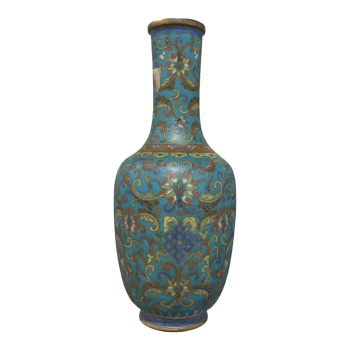
The "Cloisonn é Incense Burner" produced during the Kangxi period of the Qing Dynasty

This Chinese cultural relic is a type of incense burner, belonging to the category of metal handicrafts. It was made by craftsmen in Jingdezhen and is part of a set of altar equipment, using cloisonn é craftsmanship. This artifact is currently located on the staircase of Gallery 17 at the Fitzwilliam Museum, University of Cambridge. This artifact was donated by John McClane. It was made around the 18th century, specifically during the Kangxi period.
Porcelain from the Yongzheng period of the Qing Dynasty, titled 'Flat bottomed Oval Vase from the Yongzheng Period'

Porcelain from the Yongzheng period of the Qing Dynasty, titled 'Flat bottomed Oval Vase from the Yongzheng Period'

The vase is exquisitely painted, with a flat bottom, an oval shaped body, a cylindrical neck, and a flat, trumpet shaped mouth. The Qing Dynasty of China (1644-1912). Collected by the National Military Museum of Spain (Toledo, Spain).
Painted ivory sculptures from the Qing Dynasty

Painted ivory sculptures from the Qing Dynasty

The Buddha Stele from the Eastern Wei Dynasty

The Buddha Stele from the Eastern Wei Dynasty

This stone monument is a cultural relic from the Eastern Wei Dynasty in China (534-550 AD) and is currently housed in the Cleveland Museum of Art in the United States. According to the inscription, this stone tablet was commissioned by King Yuanning of Gaoping in 537 AD to commemorate his deceased concubine, hoping that it could take her to the Western Paradise. Here, the Buddha's robe displays carefully arranged decorative patterns (large U-shaped folds and scallop shaped folds at the hem), combining linear rhythm and ordered symmetry. The mandala (almond shaped halo) on the edge of the flame echoes the linear eloquence of Chinese painting.
Bronze pole top decoration from 12th to 11th century BC

Bronze pole top decoration from 12th to 11th century BC

This bronze ware is an ancient Chinese pole top decoration, featuring a combination of four masks on its pointed tip. It was originally decorated at the end of a pole. A powerful taotie (composite animal) mask appears on one side of the top, with a downward facing C-shaped angle. The monster's face formed a mask on the human head; It has a wide nose typical of early masks. On the other side, a ram's head, with its horns pointing downwards, was biting a head resembling a taupe. This artifact can be traced back to the 12th to 11th centuries BC and is now housed in the Minneapolis Museum of Art in the United States.
The stone lion statue in front of Datsan Gunzechounei in St. Petersburg, Russia

The stone lion statue in front of Datsan Gunzechounei in St. Petersburg, Russia

Datsan Gunzechounei is a large Buddhist temple in St. Petersburg, Russia, and also the northernmost Buddhist temple in Russia. The Chinese guardian lion in front of this temple is an important decorative and symbolic element. In Chinese culture, these stone lions are usually placed in front of important buildings such as palaces, official residences, temples, and cemeteries to symbolize power and status, and to protect buildings from evil and negative energy.
Folding Fan of Bull Bone Paper during the Qing Dynasty

Folding Fan of Bull Bone Paper during the Qing Dynasty

Bronze artifact from Sanxingdui during the ancient Shu Kingdom period, titled 'Bronze Beast Head Crown Portrait'

Bronze artifact from Sanxingdui during the ancient Shu Kingdom period, titled 'Bronze Beast Head Crown Portrait'

The cultural relic is a bronze artifact from Sanxingdui, measuring 40.2 centimeters in height, 23.3 centimeters in width, and weighing 3 kilograms. It was produced in Sanxingdui between 1250-1100 BC. This cultural relic was excavated in the second pit of Sanxingdui and is now collected in the Sanxingdui Museum with the collection number 0028. The Sanxingdui Museum is located in Guanghan City, Sichuan Province and is a public heritage museum. The museum is located at the northeast corner of the Sanxingdui site, near the Duck River in the western part of Guanghan City. The museum is 38 kilometers away from Chengdu. The infrastructure of the museum began construction in August 1992 and was officially opened to the public in October 1997.
The 18th century cultural relic seal "The Annunciation Seal of the Virgin Mary" in Bratislava

The 18th century cultural relic seal "The Annunciation Seal of the Virgin Mary" in Bratislava

This artifact is an 18th century seal of the Annunciation of the Virgin Mary from the Bratislava Monastery. This seal is made of silver and is installed on an iron device for a sealing machine. The height of the seal is 5.1 centimeters. Visit this cultural relic at the Franciscan Church of the Annunciation in Bratislava. The church is the oldest religious building in Bratislava, originally Gothic in style, but after multiple damages and reconstructions, the current nave arch is Renaissance style. Inside the church, you can see the Baroque style main altar with a glass painting of the Virgin Mary on it. I hope this information is helpful to you!
Granite altar of the 26th Dynasty of Egypt "Ancient Egyptian hieroglyphic altar"

Granite altar of the 26th Dynasty of Egypt "Ancient Egyptian hieroglyphic altar"

Human Anatomy Statues

Human Anatomy Statues

This small statue was carved by Pierre Franqueville (also known as Pietro Francavilla or Petrus a Francvilla) and was one of the three models recorded in the Jagiellonian Library collection as early as 1783. Pietro Francavilla (1547-1615) was a Flemish French sculptor working in Italy. The statue is currently located in the Jagiellonian University Museum in Poland.
Exquisite bronze carved lion statue sculpture in front of the Chinese style door

Exquisite bronze carved lion statue sculpture in front of the Chinese style door

Porcelain from the Han Dynasty and Eastern Han Dynasty: "Han Dynasty Ceramic Fish Pond"

Porcelain from the Han Dynasty and Eastern Han Dynasty: "Han Dynasty Ceramic Fish Pond"

This cultural relic called "Han Dynasty Fish Pond Porcelain" is a ceramic product belonging to the cultural heritage of the Han Dynasty in China. It was made around the period from the 1st century BC to the 2nd century AD. The diameter of this cultural relic is 39.40 centimeters and the height is 35.50 centimeters. This artifact is collected by the British Museum.
Athena's Shield in the Parthenon during the Roman Empire

Athena's Shield in the Parthenon during the Roman Empire

This is a small marble statue from the Roman period, which is the Athena shield in the Parthenon temple. This artwork is currently housed in the British Museum in London. The statue was made between 100-150 AD. This shield showcases Athena's shield, which was originally part of the Parthenon temple.
Inscribed clay tablets from the Third Dynasty of Ur

Inscribed clay tablets from the Third Dynasty of Ur

The length of this mud board is 14.10 centimeters and the width is 2.80 centimeters. There are four columns of inscriptions on this clay tablet, which come from the Third Dynasty of Ur. The Third Dynasty of Ur, also known as the Neo Ur Empire, was established by the Sumerian city-state of Ur and ruled over the entire Mesopotamia from 2112-2004 BC. The two corners and left side of the mud board have been broken. This mudboard may have been found in the Umma area of Ur city. The inscription on this clay tablet may be related to the Shulgi of the Drehem calendar.
20th century wooden carvings used for sacrificial purposes in Moba villages in Africa

20th century wooden carvings used for sacrificial purposes in Moba villages in Africa

This eroded statue has been preserved outdoors for decades to protect a village in Moba. It represents a female ancestor of the Moba tribe, who was once the focus of worship by villagers to ensure successful hunting and a bountiful harvest. When the owner converted to Christianity or Islam, it was abandoned, which regarded most traditional beliefs and practices as heretics, and is now housed at the Minneapolis Institute of the Arts.
The Roman Limestone Coffin from the Ancient Roman Empire Period

The Roman Limestone Coffin from the Ancient Roman Empire Period

This Roman limestone sarcophagus was discovered in Hayden Square, London. It was made in the 4th century AD, during the period of the Roman Empire. This sarcophagus is now preserved in the British Museum in London.
Limestone reliefs from the ancient Etruscan civilization, titled 'Relief Tomb Inscription Base'

Limestone reliefs from the ancient Etruscan civilization, titled 'Relief Tomb Inscription Base'

This artifact is a tombstone pedestal, discovered in Chios, Italy, and currently housed in the British Museum in London. It was made between 490 BC and 470 BC. The base is made of limestone, with a height of 44.45 centimeters, a length of 58.42 centimeters, and a width of 58.42 centimeters. The tombstone pedestal is a product of the Etruscan culture period, which was an important culture in ancient Italy and existed from the 8th century BC to the 3rd century BC. The art and architectural style of the Etruscans had a profound impact on later Roman culture.
The Limestone Coffin of Ancient Etruscan Civilization "Painted Etruscan Coffin"

The Limestone Coffin of Ancient Etruscan Civilization "Painted Etruscan Coffin"

This artifact is a stone Etruscan limestone coffin discovered in a painted cave in Italy, and is now housed in the British Museum in London. The production date of this coffin is between 325 BC and 250 BC. This coffin was once covered with white plaster and painted. The lid of the coffin was carved into the roof of a temple or house and decorated with curled patterns, lion and human faced beasts, snakes, female heads, and rows of tiles.
The Bronze Bell "Niu Zhong" from the Eastern Zhou Dynasty in China

The Bronze Bell "Niu Zhong" from the Eastern Zhou Dynasty in China

This bronze bell is a cultural relic from the Eastern Zhou Dynasty in China, made in the 5th century BC. The name of this clock is "Niu Zhong", which was discovered in Henan Province, China. This clock is housed in the British Museum. During the Eastern Zhou Dynasty, bronze bells were a very important part. Clocks did not have bell tongues and needed to be struck with wooden hammers to produce sound. This type of clock has excellent quality in music, such as clear sound, fast attenuation, clear and focused tones. The height of the clock is 38.3 centimeters and the width is 24.4 centimeters. There are three rows of snake shaped decorations on each side, further divided by trapezoidal panels with faint dragon patterns.
Clay slabs from the Assyrian period in Babylon, titled 'Intentions of the Babylonian World'

Clay slabs from the Assyrian period in Babylon, titled 'Intentions of the Babylonian World'

This is a Babylonian clay tablet written in Akkadian. It was created no earlier than the 9th century BC (more likely in the 8th or late 7th century BC). This map is centered around the Euphrates River, flowing from the north to the south. The map is marked with "Babylon" and is located in the northern half of the map. The outlet of the Euphrates River is marked with "swamp" and "outflow outlet". Susa, the capital of Elam, is located in the south, with Urartu in the northeast,. Mesopotamia is surrounded by a circular "river" called the "Bitter River" or the ocean, with seven or eight "regions" depicted as triangular areas outside the ocean.
Ivory artifact "Louise Chess Queen" discovered on the island of Lewis in Scotland

Ivory artifact "Louise Chess Queen" discovered on the island of Lewis in Scotland