Minneapolis Museum of Art Double Eagle Wine Jar

Minneapolis Museum of Art Double Eagle Wine Jar

It is an ancient artifact from the 12th to 11th centuries BC, shaped like two eagle heads facing each other. This artifact may have been used in religious ceremonies or as a symbol of power, as eagles symbolize strength and freedom in many cultures. They may be used as containers, and sometimes as decorations or gifts. The design of the Double Eagle not only showcases the superb craftsmanship of the craftsmen at that time, but also reflects the artistic style and social beliefs of that era. These types of artifacts were discovered during archaeological excavations, providing valuable physical evidence for our understanding of ancient civilizations. Now collected at the Minneapolis Museum of Art.
Western Zhou Yu

Western Zhou Yu

Yu "is an ancient Chinese vessel used to hold wine. Its exact appearance time is unknown, but it was popular during the Shang and Western Zhou dynasties. At that time, it was used to hold wine, so most of its appearance was round or oval, with feet or foot rings at the bottom, and exquisite craftsmanship patterns carved around it.
Medieval Double Cup Maazel

Medieval Double Cup Maazel

It is a medieval double cup Mazzel, belonging to the collection of the Cleveland Museum of Art. A type of medieval drinking utensil typically made of tightly textured wood (such as maple) and developed a unique form in Germany in the early 14th century. Composed of two cups, with a smaller cup inverted on top of a larger cup, this design allows both cups to be used for drinking. Not only practical, but also has display value due to its exquisite craftsmanship and decoration. In the Middle Ages, the Maazel cup was often used as a symbol to display wealth and status, and sometimes even engraved with religious or secular inscriptions.
New Ireland Malagan Totem Bird

New Ireland Malagan Totem Bird

The Malagan totem from late 19th century New Ireland is decorated with various pigments, including lime, in the form of carved wood. Adopting a wooden board form, the bird is facing forward. Malagan is a collective term in Northern New Ireland, primarily used for ceremonies commemorating the deceased, as well as for masks and carvings associated with them. This Malagan totem is now housed in the Metropolitan Museum of Art.
New Ireland Malagan Totem Rhinoceros Bird

New Ireland Malagan Totem Rhinoceros Bird

The Malagan totem from late 19th century New Ireland is decorated with various pigments, including lime, in the form of carved wood. The eyes are made of tiger snail shells and are carved wooden hornbill heads colored with various pigments. Malagan is a collective term in Northern New Ireland, primarily used for ceremonies commemorating the deceased, as well as for masks and carvings associated with them. This Malagan totem is now housed in the Metropolitan Museum of Art.
Hercules and His Seventh Mission: Ceramic Plate

Hercules and His Seventh Mission: Ceramic Plate

It is a Majorica ceramic plate depicting the Greek mythological hero Hercules completing his seventh labor. Majorica is a ceramic art form originating from the Italian Renaissance period, known for its exquisite decoration and glaze colors. The central scene is presented in colorful tones, with Hercules' image located in the center of the disc, completing his seventh task of taming the raging bull on Crete. It showcases the power and courage of Hercules, as well as the exquisite craftsmanship of Majorica art. It is a representative of Italian Renaissance ceramic craftsmanship, with rich colors and vivid narrative scenes.
Statues of buried figures, dancers

Statues of buried figures, dancers

This cultural relic is a painted pottery piece called "Statue of a buried figure, depicting a dancer performing", created between 618-906 AD. This statue is currently housed in the Minneapolis Museum of Art in the United States. The height of this statue is about 20 centimeters. Painted pottery and white talc were used as materials. This statue was bequeathed to the Minneapolis Museum of Art by Alfred F. Piersbury. This statue represents the top ceramic technology of China from the 7th to the 10th century.
Qing Dynasty Jade Carving Autumn Mountain Traveler

Qing Dynasty Jade Carving Autumn Mountain Traveler

In this mountain view, an official riding a donkey is followed by his attendant, holding an umbrella; They crossed a simple bridge over the waterfall. Above them, a smaller similar group seemed to be crossing another bridge in a distant place. This type of Yushan originated in the late Ming Dynasty. The characters, trees, bridges, and animals in the background represent the traditional translation of jade carving in orthodox landscape painting. In the paintings of this period, many similar depictions of scholars traveling or contemplating mountain scenery can be found. The theme of harmonious coexistence between humans and nature is favored by Taoists and literati. The sculpture is currently collected in
JeanCoulon vase from the Saint Th é es Museum of Decorative Arts in France

JeanCoulon vase from the Saint Th é es Museum of Decorative Arts in France

A ceramic vase created in 1902 for the S è vres National Ceramic Factory in France, measuring 27 centimeters in height and 15.8 centimeters in diameter. This vase, named 'Water Fairy', is renowned for its unique artistic style and exquisite craftsmanship. The painting depicts a water fairy holding a fish with an open mouth in her arms, decorated with yellow, brown, and green brown marble textures. This showcases the artist's bold interpretation of female images, with the water fairy surrounding marine creatures in a twisted, nude posture, giving a strong visual impact. The Decorative Arts Museum in Saintes, France is one of its precious collections
Burial figure statue pipa

Burial figure statue pipa

This cultural relic is a painted pottery piece called "Statue of a Buried Figure, depicting a musician playing", created between 618-906 AD. This statue is currently housed in the Minneapolis Museum of Art in the United States. The height of this statue is about 20 centimeters. Painted pottery and white talc were used as materials. This statue was bequeathed to the Minneapolis Museum of Art by Alfred F. Piersbury. This statue represents the top ceramic technology of China from the 7th to the 10th century.
Burial figures statue bamboo flute

Burial figures statue bamboo flute

This cultural relic is a painted pottery piece called "Statue of a Burial Figure, depicting a musician playing a bamboo flute", created between 618-906 AD. This statue is currently housed in the Minneapolis Museum of Art in the United States. The height of this statue is about 20 centimeters. Painted pottery and white talc were used as materials. This statue was bequeathed to the Minneapolis Museum of Art by Alfred F. Piersbury. This statue represents the top ceramic technology of China from the 7th to the 10th century.
Tibetan auspicious beast Mani Wheel

Tibetan auspicious beast Mani Wheel

The "Mani Wheel" is a scripture turner in Xizang, a cylindrical device for Buddhist practice, used to spread spiritual blessings and evoke good karma. The prayer wheel is composed of cylindrical wheels mounted on a shaft made of metal, wood, stone, leather, or coarse cotton. Sutra turning tubes are common in Xizang and Xizang culture dominated areas.
Ulciorul Byzantine period relics

Ulciorul Byzantine period relics

It is a relic from the Byzantine period, with a history dating back to the 11th century. Discovered in 1981 at the Nufarur site located in Turcha County. Collected in the collections of the Turcha Ecological Museum Research Institute. The discovery of this relic is of great significance for studying the culture and history of the Byzantine period. The Byzantine Empire was a continuation of the Eastern Roman Empire, whose cultural influence spanned multiple centuries and had a profound impact on the later Renaissance. Enriched our understanding of Byzantine art and craftsmanship, and provided valuable physical evidence for understanding social life and religious beliefs at that time.
Copper Chinese dragon vase

Copper Chinese dragon vase

The bronze Chinese dragon vase in the late 19th century was a model of the combination of craft and art in that era. Usually made of copper, the surface is finely carved or cast with the image of a dragon, which symbolizes authority and auspiciousness in Chinese culture and is a symbol of imperial power. Due to its sturdy and durable material, as well as the unique patina formed over time, it is highly favored by collectors. Design often combines tradition and innovation, with both classical elegance and popular decorative art styles of the time. Diverse shapes and exquisite decorative techniques, such as using reliefs, hollowing out, or inlaying, make the image of the dragon vivid and lifelike.
Double cup maze cup

Double cup maze cup

The Double Cup (Mazer) is a beautifully crafted 16th century German artifact collected by the Cleveland Museum of Art, dating back to approximately 1530. This piece is made of maple wood material and is decorated with gold and silver plated ornaments on the surface, with the second part measuring 17.4 centimeters in height. It consists of two spherical cups made of mazer wood (a multi jointed wood believed by ancient people to neutralize poison poured into it). The Cleveland Museum of Art, through J H. Wade Fund purchased and collected this artwork with the serial number 1950.83. a.
German stone pottery beer glass Bartmann Kruik

German stone pottery beer glass Bartmann Kruik

Batman Kruik is a stone pottery product from Freising, Germany, exquisitely decorated and possessing significant Renaissance characteristics. Featuring a relief style beard head, surrounded by six medals, four buttercup leaves, and a horizontal ribbon engraved with a repeated motto, meaning 'Do not forget, I am God'. Originating from the NR4 shipwreck site near Luttelgeest, Nord Ostpold province, Netherlands. It can be traced back to 1590 to 1600 and is a valuable witness to Dutch maritime history and ceramic craftsmanship. It is currently housed in the Batavialand Museum.
Bronze Lion Incense Burner in Qing Dynasty Temples

Bronze Lion Incense Burner in Qing Dynasty Temples

The "Bronze Lion Incense Burner in Qing Dynasty Temple" is a pair of 17th century Chinese cultural relics, currently collected at the Minneapolis Museum of Art in the United States. This lion shaped incense burner is a guard lion, and each of these auspicious beasts (Lin) has a unicorn. They are mythical animals endowed with the ability to distinguish between good and evil. These legendary animals appear in pairs and are used to stand on both sides of the imperial throne in the Forbidden City, representing the dignity, virtues, and wisdom of the royal family.
Maitreya Bodhisattva Stele

Maitreya Bodhisattva Stele

The Maitreya Bodhisattva Stele is a Chinese cultural relic dating back to 563 AD, currently housed in the Minneapolis Museum of Art in the United States. This cultural relic is made of black limestone and has traces of paint. This exquisitely carved stone tablet, although small in scale, displays a complete image of the same theme as a large Buddha statue. In addition to the Maitreya Buddha statue in the center, the engraved halo, and the bodhisattvas on both sides, there are also flying celestial beings and dragons on the flame shaped backs at the top and bottom. The back of the stone tablet is engraved with a 69 character inscription, listing the names of the donors who commissioned the production of this work and dedicated it in 563.
Western Zhou bronze lamp holder

Western Zhou bronze lamp holder

The "Western Zhou Bronze Man Lamp Holder" is a Chinese cultural relic from the 5th to 4th centuries BC, currently housed in the Minneapolis Museum of Art in the United States. This cultural relic is made of bronze and embedded with metal. This small and exquisite figure statue has outstretched hands, and its curled fingers form a socket that was originally used to insert the pole of an oil lamp. During the Shang and Western Zhou dynasties (1600-771 BC), bronze figures were very rare, but now several bronze figures have been excavated from Zhou tombs in the late Warring States period as lamp sockets.
Bamboo spring dressing box

Bamboo spring dressing box

Bamboo spring dressing box, also known as dressing case, is a traditional handicraft that not only has practicality but also high artistic value. Although modern dressing boxes may differ in functionality from ancient times, they are still an important part of women's daily lives, and their exquisite craftsmanship and design make them objects of collection and appreciation. The bamboo spring dressing box is a work of art that combines traditional craftsmanship with modern aesthetics. It not only carries rich cultural significance, but also showcases the exquisite skills of craftsmen.
Qing Dynasty cinnabar lacquer snuff pottery pot

Qing Dynasty cinnabar lacquer snuff pottery pot

The "Qing Dynasty cinnabar lacquered snuff pottery pot" is a Chinese cultural relic from 1780-1850 AD, currently housed in the Minneapolis Museum of Art in the United States. This cultural relic is made of ceramics and decorated with cinnabar paint on the outside.
Ceramic artifacts with lion headed handles at the Cleveland Museum of Art in the United States

Ceramic artifacts with lion headed handles at the Cleveland Museum of Art in the United States

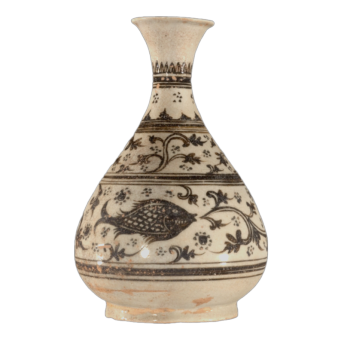
It is a porcelain fired in Jingdezhen, Jiangxi Province during the Yuan Dynasty (1271-1368) in the 13th century. Adopting underglaze painting decoration techniques. The sides of the jar are decorated with lion shaped handles, which is one of its most prominent features. It only showcased the highly developed ceramic craftsmanship at that time, and also reflected the aesthetic characteristics of Chinese ceramic art. The design of the lion's head handle adds a decorative effect to the jar, making it not only a practical vessel, but also of high artistic value. Currently housed in the Cleveland Museum of Art in the United States.
Father Gonzalo de Sousa's Tomb

Father Gonzalo de Sousa's Tomb

An important historical site located in Brazil, commemorating Portuguese missionary and explorer Gonzalo de Sousa. He had a significant impact on Brazil's early colonial and missionary activities and was one of the key figures in Portugal's spread of Catholicism in South America. As a commemorative building, it not only marks his personal life and achievements, but also reflects Portugal's religious and cultural influence in Brazilian history. The design and architectural style of tombs may have integrated the artistic characteristics of that time, becoming tangible materials for studying the architecture and sculpture art of that era.
Plum Blossom and Bamboo Charm "Bamboo Root Carving

Plum Blossom and Bamboo Charm "Bamboo Root Carving

Mei Xiu Zhu Yun "is a bamboo root carving work, which was completed by Zhang Zongfan, the inheritor of Baoqing bamboo carving intangible cultural heritage, and his students. The dimensions of this work are 18 centimeters wide and 25 centimeters high. Bamboo root carving is a traditional carving art that utilizes the natural shape of bamboo roots. Bamboo root carving art has a long history in China, and it is not only a handicraft, but also a cultural heritage. From the search results, it can be seen that bamboo root carving art is still highly valued by many artists and inheritors in modern times, and is constantly innovating and developing. Through the artist's clever conception and exquisite skills, create art with unique beauty and cultural connotations
Longevity Star Woodcarving

Longevity Star Woodcarving

Taoist longevity star wood carving. In Chinese, his name means' Star of Longevity '. The elderly figure leaned against a cane, holding a peach in his left hand and a crane beside him. In this situation, the crane would land on the cane.
Bronze wine vessels for sacrificial offerings in the Shang Dynasty

Bronze wine vessels for sacrificial offerings in the Shang Dynasty

The "Shang Dynasty Sacrificial Wine Vessel" is a Chinese cultural relic dating back to the 12th to 11th centuries BC, currently housed in the Minneapolis Museum of Art in the United States. This cultural relic is made of bronze. Its dimensions are 27.62 × 12.7 × 11.75 centimeters and it weighs 1.3 kilograms.
Harrogate Museum Roman period bizarre faces oil lamp

Harrogate Museum Roman period bizarre faces oil lamp

Named after its bizarre face design, it features a handle with a loop at the top and a small ring below. The central opening is semi-circular, resembling a face shaped mouth, surrounded by decorations representing beards, and each endpoint has a ring. It has three nozzles and a seal with a Greek inscription on the base. It can be traced back to the Greco Roman period. It was once part of the Kent Collection and was bequeathed to the Harrogate Museum in 1968. Items from Gaza. Not only did it meet the practical needs of ancient people, but it also demonstrated the cultural characteristics of the time in terms of artistry and decoration.
Eastern Zhou copper bronze bell

Eastern Zhou copper bronze bell

This cultural relic is a copper musical instrument called the "Chinese Bronze Bell", made from the late 6th century BC to the early 5th century BC, and is now collected at the Minneapolis Museum of Art in the United States. The shape of this bell is called "xi", which is one of the two common bell shapes found in tombs of the Eastern Zhou Dynasty. The "Liu" clock has a flat bottom, slightly convex sides, and a decorative hanging device at the top, usually featuring stylized animal images that can emit a single tone. The decoration of this clock is very rich. There are 36 evenly distributed protrusions on the clock body, shaped like coiled snakes. The suspension device is a pair of tigers wrapped around a snake.
Valdivian style pottery jar

Valdivian style pottery jar

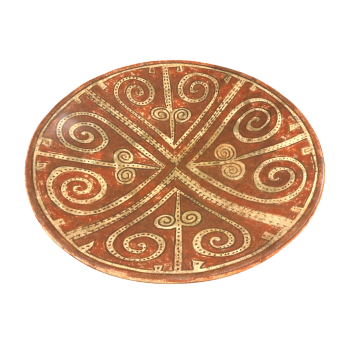
A modern ceramic container that imitates the pottery style of the Valdivian culture period in Colombia, South America. It existed approximately between 3500 BC and 1800 BC and is known for its unique pottery making techniques, typically featuring intricate hand carvings and complex patterns. Not only does it have significant value in archaeological and anthropological research, but it is also appreciated in contemporary times for its unique aesthetic and cultural significance. Design often reflects the artistic aesthetics and social life of ancient Valdivians. The modern production of Valdivian style pottery jars is not only a continuation of ancient craftsmanship, but also a tribute to this cultural heritage.
The relief bamboo tube of "Wen Cai Feng Liu"

The relief bamboo tube of "Wen Cai Feng Liu"

The relief bamboo tube of "Wen Cai Feng Liu" is an artwork with profound cultural heritage. This work may have used traditional relief techniques, combining literature and art, and showcasing the charm of Chinese traditional culture through the bamboo tube as a carrier. Relief is an art form that involves carving patterns or images on the surface of materials to create protrusions on the background, often used for decoration and commemorative buildings. The relief bamboo tube in "Wencai Fengliu" is not only a reflection of traditional Chinese handicrafts, but also an important carrier of cultural inheritance. It combines literature, art, and natural materials, showcasing the profound heritage and unique charm of traditional Chinese culture.
Cambridge Fitzwilliam Museum Ancient Egyptian "Frog" Pottery Oil Lamp

Cambridge Fitzwilliam Museum Ancient Egyptian "Frog" Pottery Oil Lamp

The pottery oil lamp is a molded product of the ancient Egyptian "frog" type, with a circular oil storage tank, a hole in the center of the top, and concentric ring decorations around it. The top of the oil storage tank is decorated with a concave "frog and corn" pattern, and the base has a concave ring around the raised pottery mark. The nozzle extends from the main body of the oil lamp and also has a concave decoration. Burning spots with traces of use left on them. The oil lamp is made of brown Nile silt with a gray core inside. It can be traced back to the 2nd to 4th centuries AD. From the Fayum region. Now part of the collection of the Fitzwilliam Museum in Cambridge
Ancient Rhyme "Brass Round Vase

Ancient Rhyme "Brass Round Vase

The "Ancient Rhyme" brass round vase is a decoration that combines traditional craftsmanship with modern design elements. Brass vases are commonly used to make various handicrafts and decorations due to their corrosion resistance and beautiful color. In Chinese culture, brass crafts are often combined with "ancient charm" to showcase the beauty of blending classical and modern elements. The design of the brass round vase in "Ancient Rhyme" may have incorporated traditional elements, presented in the form of 3D models. This not only reflects the combination of traditional craftsmanship and modern technology, but also enables the digital preservation and dissemination of this traditional artwork.
During the Qianlong period, a copper gilded incense burner with inlaid gemstones and auspicious beasts was used

During the Qianlong period, a copper gilded incense burner with inlaid gemstones and auspicious beasts was used

This incense burner is made using copper gilding technology and is shaped like a mythical beast. The incense burner has an open mouth, with the neck and back of the beast integrated into one. The animal body is the main body of the incense burner, with the tail curled up and the head looking up. The mouth is open and the teeth are exposed. The details are carved using intaglio and relief techniques, decorated with red, white, green and other colored gemstones. The beast is magnificent and colorful, with a majestic expression. The carving is exquisite, the image is realistic, and it exudes a sense of elegance and wealth. The history of incense burning has a long history in China, and the famous Boshan furnace in the Han Dynasty was designed by people for incense burning. Produced between 1736-1795, it is now housed in the Minneapolis Museum of Art in the United States.
Harrogate Museum Ancient Egyptian Ceramic Oil Lamp

Harrogate Museum Ancient Egyptian Ceramic Oil Lamp

A molded Egyptian pottery oil lamp with a goat pattern painted on its decorative plate. The shoulder of the oil lamp is decorated with a row of embossed oval patterns and marked with a vent hole. There are two circular dot patterns on both sides of the nozzle, with a protruding point at the chamfer. There is a circular handle at the back. There is also a circular dot pattern in the center of the raised base. The surface is covered with a coating ranging from yellow to reddish brown, with a white coating underneath. The side of the oil lamp is damaged. It was once part of the Kent Collection and was bequeathed to the Harrogate Museum in 1968. It was produced in Ephesus, Türkiye, between AD 98 and 192.
Shabuti Coffin (First Half)

Shabuti Coffin (First Half)

It is a container used for funerals in ancient Egypt, specifically designed to hold Shabuti figurines, which are small wooden or ceramic figurines representing the servants of the deceased in the afterlife. The design inspiration comes from Osiris, the god of resurrection and afterlife in ancient Egypt, usually presented in the form of a mummy. The surface usually features exquisite paintings and pictographic inscriptions, taken from the Book of the Dead, to protect and guide the souls of the deceased. The shape and decoration vary by period and region, but they are usually humanoid or rectangular, sometimes with arched lids. Not only is it a part of funeral customs, but it is also a concrete manifestation of ancient Egyptians' concept of the afterlife.