Dinosaur skull fossil

Dinosaur skull fossil

Jilong is a medium-sized spinosaurus, whose fossils were discovered in Brazil during the Early Cretaceous period. At present, there is only one species under the genus Jilong, which is the type species Chalinjie Jilong. Fossil materials of Jilong are also very rare, but what is slightly better than other similar specimens is that the holotype specimen of Jilong is a well preserved skull. Although the snout is missing, the latter half of the mouth and skull are preserved, which can provide more information for phylogenetic analysis and other research.
Snake Hair Monster Dragon Skull Fossil - Closed Mouth

Snake Hair Monster Dragon Skull Fossil - Closed Mouth

The snake haired female monster dragon is a large tyrannosaur belonging to the Albertosaurinae subfamily of the Tyrannosauridae superfamily. At present, there is only one effective species under this command, the balanced snake hair female monster dragon. Compared to the robust tyrannosauridae subfamily, the Albertosaurinae subfamily is more slender. Adult snake haired female monster dragons can grow up to 9 meters long and weigh about 2 tons. Like the Tyrannosaurus rex, Albertosaurus, and Tyrannosaurus rex, the snake haired female monster dragon also has a large collection of specimens, making it one of the most carefully studied large tyrannosaurs. Many works involving the macroevolution of tyrannosaurs compare these four.
Snake Hair Monster Dragon Skull Fossil - Mouth Opening

Snake Hair Monster Dragon Skull Fossil - Mouth Opening

The snake haired female monster dragon is a large tyrannosaur belonging to the Albertosaurinae subfamily of the Tyrannosauridae superfamily. At present, there is only one effective species under this command, the balanced snake hair female monster dragon. Compared to the robust tyrannosauridae subfamily, the Albertosaurinae subfamily is more slender. Adult snake haired female monster dragons can grow up to 9 meters long and weigh about 2 tons. Like the Tyrannosaurus rex, Albertosaurus, and Tyrannosaurus rex, the snake haired female monster dragon also has a large collection of specimens, making it one of the most carefully studied large tyrannosaurs. Many works involving the macroevolution of tyrannosaurs compare these four.
Deng's fish skull fossil

Deng's fish skull fossil

Deng's fish is a genus of fish in the family Scaridae, also known as the shell fish. It is the largest known shield skin fish, with a body length of up to 11 meters. The body shape is spindle shaped, similar to that of a shark; The head and neck are covered with thick and hard shells; The skin on the back is dark in color; The abdomen is silver in color. Living in Devonian ancient organisms, inhabiting shallower waters. Being able to prey on any creature in the ocean at that time, he was likely the first king of beasts on Earth, more than 100 million years before the birth of the first dinosaur on land. The largest predator in the Devonian ocean and the largest carnivorous fish that has ever appeared on Earth is known as the Tyrannosaurus rex in the ocean.
Fossil skull of Archaeopteryx

Fossil skull of Archaeopteryx

Archaeopteryx is a dinosaur belonging to the family Archaeopteryx in the order Saurischia. The size is similar to that of medium-sized birds today. Flexible head, slender neck, short body, long and stiff tail; The arms, forelimbs, and long tail are covered with feathers, while the thumb faces backwards; It has sharp teeth, claws on its wings, sharp and curved claws at the end of its hind toe, and a bony coccyx. Living in the late Jurassic period, mostly distributed in southern Germany. Carnivorous animals feed on insects and fish. Not strong in flying ability, only suitable for short distance flight; Unable to live in trees for a long time, but skilled at running on the ground. Scientists believe that it may be the first terrestrial organism to transform into a bird.
Giraffe upper skull

Giraffe upper skull

Giraffes are ruminant cloven hoofed animals that grow in Africa. They are the tallest living terrestrial animals in the world. When standing, it can reach 6-8 meters from head to feet, weigh about 700 kilograms, and the newborn baby is 1.5 meters tall. It is the most unique type in the order Artiodactyla, with primitive low crown teeth that cannot feed on grass, but only on leaves. The tongue is long and can be used for feeding, with short horns on the head covered by hairy skin. It inhabits tropical and subtropical savannas, shrubs, open acacia forests, arid and open savanna areas, and semi desert areas with sparse trees in Africa.
Parsons Chameleon skull

Parsons Chameleon skull

Parson's chameleon is a relatively large chameleon species that is endemic to the remote moist virgin forests of eastern and northern Madagascar. It is a near threatened species and therefore subject to restrictions on international trade. In terms of size, it is second only to the Madagascar giant chameleon. The Parson chameleon can exceed 2 feet in length and comes in two main colors. Yellow and green. According to gender, the color may vary, so the color of a chameleon may be red, brown, or even blue-green. Some types of these reptiles may have unique orange eyes. It is omnivorous, eating most plants or small animals.
Dinosaur skull fossil of Euphorbia

Dinosaur skull fossil of Euphorbia

Halbersaurus, also known as Spiny Shield Ceratopsian, lived in the late Cretaceous period and is a type of herbivorous ceratopsian dinosaur. The neck shield halbersaurus had a large head and beautiful shield shaped circular decorations on its neck. Around the shield shaped ornament, there are six long horns of different sizes, which form the terrifying neck shield of the halberd dragon. This neck shield can not only scare the enemy. This neck shield usually looks spectacular and beautiful on strong and powerful males, but is not well-developed on females, so experts speculate that its main function is to showcase and attract the attention of the opposite sex. Because this neck shield looks very similar to a halberd in ancient Chinese weapons, it was named Jilong figuratively.
Triceratops fossil

Triceratops fossil

Triceratops is a herbivorous dinosaur belonging to the family Ceratopsidae in the order Ornithischia. It is a dinosaur resembling a rhinoceros, with a bulky appearance, thick legs, three horns on the head, and a large bone plate extending backwards at the back of the skull to form a neck shield. There is a short horn above the beak and two long horns above the eye sockets. The horns of Triceratops are defensive weapons that can scare off predators. The tail is short and pointed, and the feet are like hooves. Distributed in North America, it lived in the late Cretaceous period, approximately 68 to 65 million years ago. Triceratops often take advantage of their clustered lifestyle to protect their young; When facing enemies, often bow down and use horns to resist predators.
Crow skull

Crow skull

Crow is the common name for several species of black birds in the family Crowidae and genus Crow. Also known as Lao Lu, his mouth is filled with joyful cries. It is the largest bird in the Passeriformes order, with a body length of about 50 centimeters. The whole body or most of the feathers are blackish black, hence the name. Feathers are mostly black or black and white, with long beaks, some with distinct white collars, and black feathers with a purple blue metallic luster; Wings are much longer than tails; The mouth, legs, and feet are pure black. The distance between the nostrils and the forehead is about one-third of the length of the mouth, and the nose must be hard and straight, reaching the middle of the mouth.
Oyster shell

Oyster shell

Clams, also known as round clams, hard shell clams, or quails, are edible marine bivalve mollusks native to the east coasts of North and Central America, from Prince Edward Island to the Yucatan Peninsula. It is one of many unrelated edible bivalves, commonly referred to as clams in the United States. Hard clams are common throughout New England, northern Canada, and the East Coast of the United States to Florida; But they are particularly abundant between Cape Cod and New Jersey, where sowing and harvesting them is an important form of aquaculture business. For example, this species is an important member of the benthic community of suspended feeding animals in the lower Chesapeake Bay.
Headless Spiny Guinea Pig Skull

Headless Spiny Guinea Pig Skull

The tailless spiny guinea pig is a type of terrestrial medium to large herbivorous rodent, and is a member of the only genus in the tailless spiny porpoise family, the tailless spiny porpoise genus. Tailless spiny guinea pigs are distributed in Central and South America, resembling spiny porpoises in appearance, but with a larger snout and light colored spots and horizontal lines on the body. The tailless spiny guinea pig has a length of 50-77 centimeters, excluding a short tail of 13-23 centimeters. It weighs 6-14 kilograms and is the sixth largest rodent in the world. Similar to guinea pigs, they have square heads, small ears, sides with spotted and striped patterns, and almost invisible tails.
Large navel parrot shell

Large navel parrot shell

Nautilus is a general term for marine mollusks in the family Nautidae, belonging to the order Cephalopoda. There are 2 genera and 6 species, with curled pearl like shells that can grow up to 26 centimeters in size, but adult parrots generally do not exceed 20 centimeters. Usually only 16 centimeters. The shell is composed of many chambers, and the outer shell is located inside the shell. There is a diaphragm separating each chamber; Two pairs of gills; 63-94 wrists, but without suction cups. The shell is thin and light, coiled in a spiral shape, with a white or milky white surface. The growth lines radiate from the navel of the shell, smooth and fine, mostly reddish brown in color. The entire spiral shell is smooth like a disc, resembling a parrot's beak, hence the name "Nautilus".
Yi Beike

Yi Beike

Mussels are marine organisms in the family Mytilidae of the phylum Mollusca. The shell is wedge-shaped, with a black brown surface, smooth and glossy; The growth pattern is fine and dense, and the inner surface of the shell is gray blue in color. The shell edge has a narrow edge where the outer skin is rolled in, and there are obvious scars on the adductor muscle and outer shell. The hinge has 2-5 granular small teeth; The ligament is slender and located at the dorsal edge of the shell, and is brown in color. Thin jacket, thick jacket edge. Mussels are widely distributed along the coast of China. Growing on coastal rocks, it mostly inhabits areas with rapid seawater currents and clear water quality, and has strong resistance to adverse environments such as red tide and sewage. Food is mainly composed of organic debris and diatoms.
Bishop's pen snail shell

Bishop's pen snail shell

The mitre shell of the pen snail is a marine snail belonging to the family Callichthyidae in the subclass Gastropoda. The shell is thick, typically in the shape of a bullet, and slightly resembles a bishop's crown, hence the English name bishop's crown snail. Pen snails are common in the Indo Pacific region, inhabiting shallow sandy bottoms. The largest type of bishop's pen snail is 10 centimeters long, with a white shell surface and red yellow patches. Shell white, spiral tower round, shallow stitching; There are red spots on the surface of the shell, with a brilliant color.
Big bamboo snail shell

Big bamboo snail shell

The large bamboo snail is a member of the bamboo snail family, with slender shells, a snail tower shape, and multiple layers of snails. The shell is large and sturdy, with a light flesh color and luster. Each layer of the snail usually has black markings, and the lower half of the body has lighter markings. The shell can reach a length of up to 27 centimeters. The shell is heavy, glossy, with a wide body layer and a long shell mouth. The later spiral layer is slightly convex and smooth. Early snail layers had weak longitudinal ridges, a milky white shell surface, and fractured snail bands composed of brown patterns. The shell opening is small, the suture band is obvious, and there is no umbilical hole. The outer lip is not thickened, and the interior is smooth. Twist of the shaft lip. The mouth cap is oval in shape, with the nucleus located below. Lack or only marginal teeth on the tongue. It inhabits shallow sandy bottoms in tropical Indo Pacific waters and is carnivorous.
Marble taro shell

Marble taro shell

The outline of the marble taro snail shell is generally straight, with a slight protrusion near the upper part. The shoulders are angular in shape, with strong nodules to almost smooth. The spiral tower is low to quite high, with contours ranging from slightly concave to slightly concave. The secondary snail layer has nodules ranging from strong to weak. The slope under the last layer of suture line of the adult shell is concave, with 2-4 weak spiral grooves and lines, and the spiral carving is often worn out. The snail layer near the bottom quarter to half usually has weak equidistant spiral ribs. The toxicity of the marble cone snail belongs to protein toxicity, similar to that of venomous snakes, but significantly stronger than that of venomous snakes by several times.
Yellow eyed penguin skull

Yellow eyed penguin skull

The yellow eyed penguin is a penguin belonging to the bird class, penguin family, and yellow eyed penguin genus. Height is 56-78 centimeters, weight is about 5-8 kilograms. This species exhibits sexual dimorphism, with male birds possessing decorations derived from carotenoids. The difference between males and females can be seen from the pigment deposition on their feathers, with males having a brighter yellow head. The pupils of yellow eyed penguins are light yellow, which is their main characteristic. The body is black, and the jaw and throat are black brown. There is a yellow band connecting the eyes at the back of the head. Residing along the coastline of New Zealand's islands. Most of the coast is covered by coastal forests.
Western roe deer skull

Western roe deer skull

The Western roe deer, belonging to the family Deer and genus Deer, is a small deer with a body length of only 95-135 centimeters, a shoulder height of 65 centimeters, and a weight of 15-30 kilograms. Cheeks gray, body color reddish, golden red in summer, deepening to brown or even black in winter. The color of the abdomen is light, and there is a tuft of white hair near the tail. The tail fur of female roe deer is heart-shaped, while that of male roe deer is kidney shaped. The tail is extremely short, only 2-3 centimeters, almost invisible. When frightened, they will shout loudly and raise their white tail hair. Only male roe deer have horns, are short and straight, and are 5-12 centimeters long. Unlike other deer, roe deer immediately begin to regrow after losing their horns.
Garden snail shell

Garden snail shell

The garden snail belongs to the "Halix" snail genus, which is native to central western Europe such as France and England. It usually inhabits gardens or shrubs, hence it is called the "garden snail" or the scattered snail. There are dense and delicate engraved patterns, with multiple dark brown spiral shaped bands that block the yellow spots or stripes that intersect with them., Shells have 4.5 to 5 snail layers, with a shell height of 29 to 33 millimeters and a shell width of 32 to 38 millimeters. The shell surface has obvious threads and growth lines, and the spiral part is short. The embryonic snail layer is smooth, and the body snail layer is particularly enlarged, with extreme inclination in the forward direction.
European bison skull

European bison skull

The European bison is a member of the family Oxidae in the order Artiodactyla. The body length is 220-300 centimeters, the tail length is 40-60 centimeters, and the weight is 450-1000 kilograms. Both female and male animals have horns, which are slender and elongated. The horns first turn inward, then turn upward, and then bend forward. The tips of the horns then bend inward. Female animals have shorter and thinner horns. Small head, exposed snout, small eyes, and short ears. The neck is relatively short, with obvious hanging hair from the lower cheeks to the chest. European bison breed offspring in spring, and typically cows can produce a calf weighing over 20 kilograms. The lifespan of European bison is quite long, about 40 years in suitable environments.
Reindeer skull

Reindeer skull

Reindeer, belonging to the family Reindeer in the order Artiodactyla, are animals of the genus Reindeer. Reindeer have a large body shape, with thick and dense coarse fur all over their body. Their head is long and straight, their mouth is thick, their eyes are large, their neck is thick and short, their nostrils are large, they do not have a nose mirror, their nostrils have short fur, their tail is short, and their hooves are wide. Females have smaller horns than males. Reindeer have features such as horse heads, antlers, donkey bodies, and cow hooves, and are commonly known as "four unlike". Reindeer are widely distributed in the cold regions of northern Eurasia, North America, and southern Siberia, generally inhabiting coniferous forests in cold temperate zones. Every year, reindeer undergo a large-scale migration of several hundred kilometers, with female deer leading the entire migration team and male deer following closely behind.
Sperm whale skull

Sperm whale skull

Sperm whales are marine mammals belonging to the order Cetiformes and family Spermatidae. With a body length of up to 18 meters and a weight of over 50 tons, it is the largest toothed whale, with its head occupying one-third of its body. The head is huge, the lower jaw is small, and only the lower jaw has teeth. No dorsal fin; Highly capable of diving, it is the mammal with the deepest and longest diving time. Like a fish in size, it breathes through its lungs. Short neck, the head seems to be connected to the torso; Cervical spine healing; The nostrils are spray holes located at the snout end, the forelimbs become fins, the forearms degenerate, the palms become longer, and the number of toes increases, but the toes and claws cannot be seen from the outside; Hind limb degeneration; The tail is like a fish, with horizontal tail fins, and it swings by the tail when swimming.
The skull of a cow

The skull of a cow

A group of animals belonging to the order Artiodactyla, family Oxidae, and subfamily Oxinae, commonly known as "cattle", with a total of 5 genera. Most of them are large to extremely large herbivorous animals. This includes African buffalo and American bison, as well as yellow cattle, water buffalo, and yaks that are very important to humans. Habitats vary greatly among different species. It can survive in grasslands, savannas, wetlands, tropical rainforests, and temperate forests. Bison are highly social animals. Cattle are herbivorous animals that feed on open grassland habitats. As herbivores, they consume high fiber vegetation, which contains more cellulose and lignin than forest animals.
White tailed deer skull

White tailed deer skull

White tailed deer is an animal belonging to the subfamily of hollow toothed deer and the genus of hollow toothed deer. The white tailed deer has a wide white tail, with a slightly reddish brown fur in summer and a slightly gray brown fur in winter. White tailed deer have strong adaptability and are distributed in most parts of North America, northern South America, and Africa. They mainly live in forests, swamps, tundra, and even deserts. White tailed deer are also common in the United States, usually living alone or in groups of one male deer and two or three female deer.
White tailed deer skull

White tailed deer skull

White tailed deer is an animal belonging to the subfamily of hollow toothed deer and the genus of hollow toothed deer. The white tailed deer has a wide white tail, with a slightly reddish brown fur in summer and a slightly gray brown fur in winter. An adult white tailed deer has antlers, which extend forward on the main trunk and grow upward on the forked branch. The horns of the white tailed deer do not split, and its broad brown tail is covered with a patch of white fur. When the white tailed deer encounters a danger warning and rushes forward, its tail lifts upward, revealing its white color. It is said to have the effect of confusing pursuers, and the name of the white tailed deer comes from this.
Spoonbill skull

Spoonbill skull

Spoonbill, a collective term for six species of long legged wading birds, is the national bird of the Netherlands. Mainly feeds on small vertebrates and invertebrates such as shrimp, crabs, aquatic insects, insect larvae, worms, crustaceans, mollusks, frogs, tadpoles, lizards, and small fish, occasionally also consuming small amounts of plant-based food. Spoonbills often move in groups, and occasionally there may be individuals moving alone. Resting often spreads out in a straight line by the water's edge. Stand still for a long time, then fly to another place after being startled. Sexual alertness and fear of people, with both wings flapping rapidly during flight, averaging around 186 movements per minute. Flying often takes place in sparse single rows or in wavy diagonal lines.
Sheep skull

Sheep skull

Sheep are mammals of the family Auchenipteridae in the order Artiodactyla. Full body and dense fur; Short head; Rams often have spiral shaped large horns, while ewes have no horns or small horns; There are tear troughs on the skull, and the nasal bone is relatively raised; Four hooves have toe glands; Sharp mouth, thin and flexible lips; The weight ranges from tens of kilograms to hundreds of kilograms, and the natural lifespan is about 15 years. Sheep originated in Central Asia and gradually expanded to various parts of the world. Gentle temperament, strong imitative and sociable, with a habit of following the leader sheep to gather in groups. Eating short grass, as well as coarse and hard straw and branches. Artificially raised animals can be fed with feed.
Skull of the Red tailed Owl

Skull of the Red tailed Owl

The red tailed hawk is a bird of the family Falconidae in the order Falconiformes. Its body is robust, with wide and round wings, and a red and broad tail. The red tailed pheasant is one of the largest members of birds, with a body length of 45-56 centimeters and a weight of 690-1300 grams. The red tailed pheasant has a very obvious male female dimorphism in terms of body size, with females being 25% larger than males. The upper beak of the red tailed pheasant has an arc-shaped protrusion at the edge, which is suitable for tearing prey and swallowing; The base has wax film or whisker like feathers; Strong wings, wide, round and dull wings, fan-shaped and soaring flight, fan-shaped rhythm slower than falcons; The tarsal region is relatively long, approximately equal to the length of the tibia. The iris of young birds is light yellow, and as adults, the color gradually darkens to bird reddish brown.
Porcupine skull

Porcupine skull

Porcupines are mammals of the family Porcupidae in the order Rodentia, belonging to the genus Porcupines. Extremely large in size. Eyes and ears are very small; The skull is thick and robust, the occipital spine is well-developed, and the nasal bone is long and wide, longer than half the length of the skull; A cavity with expansion and inflation; The nasal snout is concave and the nasal cavity is large; My whole body is covered in thorns, and the spines on my buttocks are particularly long. My tail is hidden inside the spines. The base of the spines on the forehead and front back is light brown in color, while the upper part is white; The body is dark brown with a white stripe on the neck. Porcupines mostly inhabit mountainous environments, making large-scale prevention and control difficult. They are often captured using physical equipment. Due to the increasing depletion and extinction of wild porcupines, the Chinese forestry department has listed them as a protected species and banned hunting.
Musk rat skull

Musk rat skull

Muskrat, belonging to the rodent order Cricetidae, genus Muskrat, also known as muskrat. The muskrat has a body shape similar to a large mouse, with dense fur around its body, a brown black or chestnut yellow back, and a brown gray belly. The tail is brownish black in length, slightly flattened, with scaly skin on top and sparse brownish black mixed hair. Because it lives in water and is good at swimming, it is known as a water mouse or water rat.
Yellow throated mink skull

Yellow throated mink skull

The yellow throated ferret is a terrestrial carnivorous animal in the family Italidae of the order Carnivora, also known as the green ferret, the snub nosed dog, or the yellow weasel. Small and lightweight body length; Kiss tip, big ears; Short limbs; Well-developed claws; Tail cylindrical shape; In winter, the fur coat is brightly colored, with a black brown color from the tip to the neck and back, a white chin that extends backward to the ears, and a white or light yellow throat; The back of the body is orange yellow or yellow brown; Gradually transitioning to black brown in the middle of the body, and orange yellow or yellow brown in the chest; Abdominal pale yellow brown or light yellow white; The head, hind limbs, and tail are black brown in color.
Seagull skull

Seagull skull

Seagulls are a group of seabirds belonging to the gull family in the order Characiformes. Seagull head and neck are white, back and shoulders are slate gray; The waist, tail feathers, and tail feathers are all pure white. The base is gray white or forms larger gray spots on the inner lining. The lower body is pure white. Humans believe that the call of seagulls sounds like "Europe, Europe", and "gull" is a onomatopoeic word that imitates this bird's call, hence the name. Seagulls are mainly distributed in northeastern, southern, and southwestern China, as well as in Europe, the Mediterranean coast, the Black Sea, Caspian Sea, western North America, including Alaska and the eastern Pacific coast, and even near the Tropic of Cancer.
Spotted head wagtail skull

Spotted head wagtail skull

The spotted headed wagtail is an animal belonging to the family Scombridae in the order Scombriformes. The body length of the spotted headed wagtail is about 24 centimeters, belonging to the earless feather tribe. Its body color is brown with light horizontal stripes; The chin is white with one white diagonal line on the shoulder, and the abdomen is white with brown vertical lines; Yellow brown iris; Yellow green mouth, yellow end; The feet are yellow green, and the soles are covered in feathers. The spotted wagtail is distributed in northeastern India and various Southeast Asian countries, while it is found in southern, central, southwestern, and southeastern China. It inhabits forested and agricultural areas in mountainous, hilly, and plain regions. The spotted headed wagtail is nocturnal and usually moves alone or in pairs. It is more active during the day, particularly in the early morning and evening, and can also hunt at night.
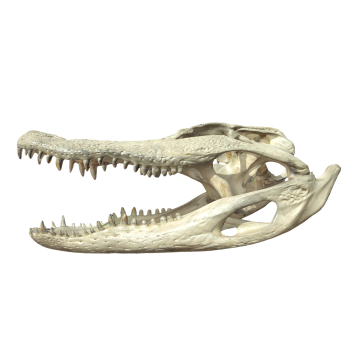
Nile crocodile skull

Nile crocodile skull

Nile crocodile is a large crocodile belonging to the family Crocodylidae in the order Crocodiles. Nile crocodiles have a large body size, ranging from olive green to coffee colored, with black spots and a mesh pattern; The fourth tooth of the lower jaw protrudes outward from the depression of the upper jaw; There are 5 anterior teeth, 13-14 maxillary teeth, and 14-5 mandibular teeth, for a total of 64-68 teeth; The tail is strong and powerful. The adult Nile crocodile weighs up to one ton. The juvenile Nile crocodile is dark yellow brown in color, with obvious horizontal stripes on its body and tail. As an adult, the color of the horizontal stripes becomes lighter.