Eagle owl skull

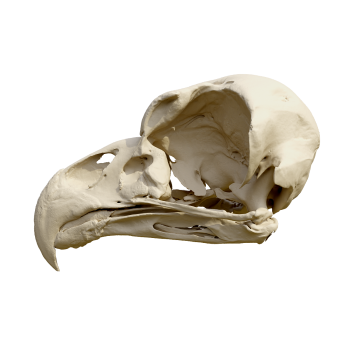
Eagle owl skull

The eagle owl is a bird species belonging to the family Scombridae in the order Scombriformes. No significant facial features; The upper body is dark brown in color, with black transverse spots on the tail feathers; The throat and forehead are light gray white, and the feather edges are light brown yellow; The remaining part of the lower body is white, with brown longitudinal stripes on the chest and wide reddish brown patches on the abdomen, forming incomplete horizontal spots; Iris bright golden yellow; Mouth peak angle gray or blue black, with a shallow tip; Wax film dark green or green brown; The tarsus is dark yellow or yellow green. Distributed in eastern to southern Asia, and in northeastern, northern, and eastern China. Nocturnal, active at dusk or night. The food is mainly insects, but also includes frogs, lizards, birds, rodents, etc.
Pigeon skull

Pigeon skull

Pigeons are animals of the pigeon genus in the pigeon family of the pigeon shaped order. The body length is 295-360 millimeters. The head, neck, chest, and upper back are slate gray, with metallic green and purple flashes on the upper back and front chest. The rest of the back is light gray, with a black horizontal spot on each wing. The tail feathers are slate gray, with a wide black horizontal spot at the end, similar to males and females. Widely distributed, except for Antarctica, high latitude regions in the Northern Hemisphere, and extremely arid areas in deserts. Most of them inhabit forests or forests, while some inhabit open areas or near cliffs. Active during the day and returning to their nest at night, but trained pigeons can fly at night if they do not return to their habitat before evening.
Huangxiangliu Monkey Skull

Huangxiangliu Monkey Skull

The Saguinusimperator, a species of marmoset in the family Tamarix, is a type of marmoset monkey. He has two long white beards and is accustomed to sitting quietly together to eat and rest. Another way of saying it is called "Emperor" is because it resembles Wilhelm II of Germany. The fur is mainly gray with yellow spots on the chest. Living in the dense Amazon rainforest. Residing in the upper canopy of tropical rainforests or tropical forest grasslands, rarely active on the ground. Eat fruits, nuts, and other plant-based foods, as well as insects, spiders, frogs, small lizards, and bird eggs.
Trilobite Fossil

Trilobite Fossil

Trilobites are arthropods belonging to the order Tetraodontiformes in the phylum Arthropoda. The body is divided into three parts: head, chest, and abdomen; There is a carapace on the back, which is longitudinally divided into three pieces. The head is covered with a hard shell, called a cephalothorax; The central raised part of the head armor is called the head saddle, and the shape and size of the head saddle vary greatly depending on the type; The anterior part of the head saddle is the skull, on which there are eyes; There are also shells wrapped around the abdomen and tail. Named after the longitudinal division of the carapace on the back into three pieces. Widely distributed in ancient oceans, fossils are found on all continents today. I like to live in warm shallow sea areas and feed on algae, protozoa, and other organisms.
Upper half skull of ferret

Upper half skull of ferret

The ferret (Mustelapulourius furo) is a mammal belonging to the family Mustelidae in the order Carnivora. The body of a ferret is slightly slender, streamlined, with a round body and no sharp corners or flat areas. Distributed in southern Canada and Oklahoma and Kansas in the United States. Ferrets love to play and live in groups. They mostly sleep throughout the day and prefer quiet environments. They are highly alert to external stimuli. Ferrets lack sweat glands and are not suitable for high temperature environments. When frightened, they will empty their anal glands and secrete musk. Ferrets are carnivorous animals that mainly feed on small vertebrates such as mice and rabbits.
Velociraptor skeleton fossil

Velociraptor skeleton fossil

Velociraptor, also known as Velociraptor, is a dinosaur belonging to the family Velociraptor in the order Saurischia, also known as Velociraptor. Covered in feathers all over the body; Not big in size, similar in size to a turkey. China and Mongolia lived in Asia during the late Cretaceous period. Enjoy living in groups. Carnivorous animals mainly hunt small dinosaurs, dinosaur eggs, dinosaur juveniles, and small mammals. Due to their agile actions, they are known as the 'fast robbers'. It is the first discovered theropod dinosaur in Asia. In 1971, the fossil specimen "Dinosaur in a Battle" was discovered by a Polish exploration team, and as a result, this fossil specimen is considered a national treasure by Mongolia.
White Rhinoceros Skull

White Rhinoceros Skull

The white rhinoceros is a mammal belonging to the family Rhinocerotidae in the order Neodactyla. The body is round and robust, the skin is thick and smooth, and the surface of the body is approximately gray; The head has special features, but the incisors and canines have degenerated. The developed 7 pairs of cheek teeth have a very thick layer of limestone; There are two horns, one large and one small, one in front and one behind. The horns are not made of bone, but are derivatives of epithelial tissue, formed by the accumulation of keratin fibers. Distributed in southern and northeastern Africa, mainly active in the morning and evening, and rolling or resting in muddy water at other times; When the weather is cool, they lie under the shade of trees and take a nap, living alone or forming small groups. They are distributed in southern and northeastern Africa and feed on grass.
Otter skull

Otter skull

The marmot is a mammal belonging to the family Muridae in the order Rodentia of the class Mammalia; Also known as groundhog. The largest terrestrial and burrowing herbivorous and hibernating wild animal in the squirrel family. There are 14 subspecies worldwide, with 4 species in China. Distributed in Siberia and Mongolia of Russia, and also in Inner Mongolia of China. Resting in plateaus, meadows, foothills, and other areas, the lower edge of sunny slopes in plains and mountains is its high-density aggregation zone. Active during the day, with a large appetite, gnawing on a large amount of grass every day, enduring hunger and satiety, and preferring juicy feed with high water content, post rain grass, and dew grass. Likes to live in groups, easy to drive, does not harm people, is not heat-resistant, afraid of direct sunlight, and has strong disease resistance.
Soft shell glans bone

Soft shell glans bone

Soft shelled turtles, also known as soft shelled turtles, refer to aquatic turtles belonging to the order Turtles and family Turtles. Soft shelled turtles are distributed in freshwater streams and lakes in Asia, Africa, and North America. The characteristics of soft shelled turtles are a round, soft crust like pancake, webbed legs, a long head and neck, and nostrils located at the front of the fleshy long nose (female turtles are noticeably larger than male turtles). There are two main species of soft shelled turtles in the New World, the prickly soft shelled turtle and the smooth soft shelled turtle, whose dorsal shells are gray or brown. The smooth shell turtle has a shell length of about 35 centimeters, while the soft shell turtle has a shell length of about 45 centimeters, mainly distributed in the United States. There are two species of soft shelled turtles in the Old World: African turtles and Malay turtles.
South American Half Skull Fossil

South American Half Skull Fossil

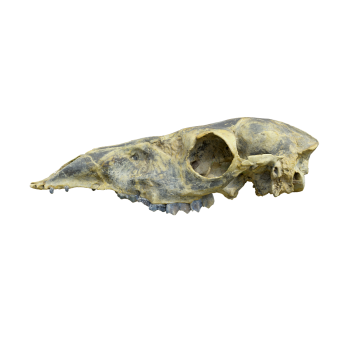
Hippidion, also known as South American horse, is a member of the horse family in the order of odd hooves. In the mid-19th century, some horse fossils were discovered on the grasslands of South America and handed over to British paleontologist Richard Owen. After restoration, Owen found that they were similar to modern horses, but smaller in size and were ponies, commonly translated as South American horses in China. The body size is not as big as a donkey, with a shoulder height of less than 1.4 meters and a weight of over 200 kilograms. The body shape of a South American horse is similar to that of a pony, with a short and sturdy body, short limbs, and a large head, making it look uncoordinated. Like modern horses, it is suitable for gnawing on hard grass rich in silicon.
Hamster skull

Hamster skull

The Cricetinae subfamily is the smallest subfamily of the Cricetidae family, including only the Palearctic (Eastern Hemisphere) hamsters, which are small rodents. There are about 60 genera, with 3 genera and 9 species in China. Short and thick body shape; Short tail; Cheek pouch; Most types of skulls have no obvious ridges; The skull does not significantly enlarge; Listening to bubbles; Molar chewing mask with conical tooth tips. It inhabits a wide range of environments, including grasslands, deserts, semi deserts, farmland, and alpine grasslands. No hibernation habit; All of them are terrestrial species, mainly engaged in cave living, living by digging caves, with complex cave systems and specialized warehouses for storing food; Strong adaptability. Mainly feeds on plants, but also on animal carcasses.
Green iguana skull

Green iguana skull

The green iguana is an animal belonging to the genus of American green iguanas in the family Hymenonidae of the order Perciformes. Young green iguanas typically have a green body and use it to evade attacks from predators; As one grows older, green will gradually fade away and be replaced by colors such as light yellow, light blue, or brown; The main features of green iguanas include comb like scales on the back, black circular stripes on the tail, and large, drooping throat fans in adult males. Also known as: American Green Iguana. Distributed in tropical rainforest areas from Mexico to Paraguay in Central and South America. Omnivorous animals primarily consume small insects, eggs, and other animal based foods during their infancy, and eventually transition to plant-based diets in adulthood
Fossil skull of giant ape

Fossil skull of giant ape

The giant ape is an extinct genus of ape that lived in China, India, and Vietnam about 1 to 3 million years ago, and shares the same time frame and geographical location as several hominids. It is a type of ape that lives on the ground, similar to chimpanzees. It is likely the largest ape in the world, standing up to 3 meters tall and weighing 500 kilograms. The morphological characteristics of giant apes are between those of apes and humans. Giant apes have strong canine teeth and huge molars, with teeth about five times larger than modern human teeth. It is as easy as breaking a toothpick to bite through bamboo that is as thick as a bowl mouth. My favorite food is bamboo, and occasionally I also eat leaves and fruits.
Frog skull

Frog skull

Frogs (a species of amphibian in the family Ranidae) have a slightly triangular head that grows wider; large and protruding eyes; short forelimbs, blunt toes, short and thick hind limbs, and almost full webbed toes; and a rough back. They are most common and abundant in plains and hilly areas from North China to South China, suitable for living in amphibious environments. They often inhabit low-lying and humid places such as rivers, ponds, streams, ditches, lakes, and shallow waters with dense aquatic vegetation. They are active during the day and night, searching for food at night. They are carnivorous and usually prey on small insects, but can also swallow fish meat and the organs of chickens, ducks, and fish.
Pseudo killer whale skull

Pseudo killer whale skull

Pseudo killer whales are mammals belonging to the dolphin family and the genus Pseudo killer whales. Living in tropical or temperate seas. The whole body is black or dark gray, with a slender body and a blunt and round head. Visiting coastal waters, but preferring to stay in deeper waters. Their diving depth can reach 2000 meters. Regularly organize large group activities. They feed on squid, but also catch hairtail, small sharks, as well as mackerel, black snapper, sea bass, and mackerel. Widely distributed in major oceans around the world except for the Arctic Ocean. Living in warm temperate to tropical waters around the world, it is found in the Bohai Sea, Yellow Sea, East China Sea, South China Sea, and Taiwan waters in China.
Elephant skeleton

Elephant skeleton

Elephantidae is a mammal belonging to the family Elephantidae in the order Longnose, consisting of two genera, and is the largest terrestrial animal in the world. Its pillar like limbs and wide feet can stably support its massive body. A huge head with fan-shaped large ears and a long and elastic nose. Elephant ears have abundant blood vessels that can effectively dissipate heat. The elephant trunk, which combines the nose and upper lip, is coordinated by over 15000 muscles. Distributed in sub Saharan Africa and southeastern Asia, it inhabits various living environments, especially forests, grasslands, and river valleys. Living in groups, male beasts occasionally live alone. Eating plants, with a large appetite.
Worm lizard skull

Worm lizard skull

The Rhineura floridana, also known as the worm lizard, belongs to the suborder Lizards, family Loricariidae, and is a reptile., Produced in North America; Cave in the soil, sand, and soil layers mainly composed of decaying plant matter (such as fallen leaves) on the Florida Peninsula. Body length 18-35 centimeters (7-12 inches), peach colored. Looks like a snake. Immediately return to the cave when startled, and enter the cave first at the tail. No limbs, or no external eyes or ears. I spend most of my life underground, feeding on worms, spiders, and termites.
Armadillo skull

Armadillo skull

Armadillo is a mammal of the family Armadillidae in the order Heterodontoides. The bone armor covers the head, body, tail, and outer legs. The bone armor in the head, front half, and back half is separated, and the bone armor in the body forms a band shape, allowing for flexible movement; Having sparse hair in areas of the body without bone armor; There are strong claws on the front foot. The armadillo is named after the nine layered ribbon on its body. Distributed in the southern tip of South America, the Caribbean coast, and the Central American continent, it often inhabits dense shrubs, grasslands, wilderness, and has strong adaptability. It is a burrowing animal that lives underground, crouching during the day and emerging at night. Its vision is poor, but its sense of smell is excellent.
Turtle skull

Turtle skull

Pelodiscusssine is a reptile belonging to the family Turtles in the order Turtles, commonly known as turtle, grouper, water fish, turtle, and foot fish. It has an elliptical shape and is flatter than a turtle. They live in rivers, lakes, ponds, reservoirs and mountain streams, and hibernate at the bottom of the pool in winter. Xiyang is afraid of wind, Xijing is afraid of shock, Xijie is afraid of dirt, and Xidong and climbing are preferred. They move more frequently along the quiet, clean, and sunny waterfront. Soft shelled turtles have a wide and diverse diet, mainly consisting of animal based foods, as well as decaying plants and tender aquatic plants. They have strong hunger tolerance and are classified as ectothermic animals. Their feeding and growth vary with changes in water temperature.
Giant Salamander Skull

Giant Salamander Skull

The giant salamander (Andrias davidianus), also known as the fire lizard, has a total length of 12-15 centimeters, obvious grooves between its ribs, no lung structure, and relies entirely on its skin for gas exchange. It inhabits karst geological caves and lives in water, with high requirements for water quality. Feed on benthic cephalopods, annelids, and aquatic invertebrates. There are about 400 species of the largest amphibians in the world. They mostly inhabit freshwater and swamp areas, mainly in temperate regions of the Northern Hemisphere. It is a first-class protected animal in China. Salamanders mainly feed on insects, worms, snails, and some small animals.
Fossil skeleton of Dodo bird

Fossil skeleton of Dodo bird

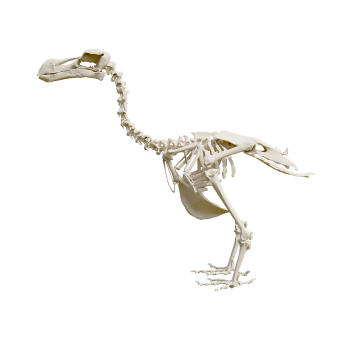
Raphuscucullatus: an extinct bird species in the pigeon family of the pigeon shaped order. The body shape is comparable to that of a swan, and there are also obvious sexual dimorphism. It is a large bird with a body length of 70-90 centimeters and a weight of 17-28 kilograms. There is a white feather on the tail. Their wings are too small to lift the Dodo off the ground. Eating fruits and seeds. This species is a non flying bird found only on the island of Mauritius in the Indian Ocean. Within just 200 years of its discovery by humans, this bird was completely extinct due to hunting and human activities.
Upper skull of camel

Upper skull of camel

Camel genus, belonging to the family Camelidae in the order Artiodactyla, is divided into two types based on morphology: Bactrian camels and Bactrian camels. Also known as "Tuotuo". Its head is small, the neck is thick and long, curved like a goose's neck, with double eyelids and thick long eyelashes, and the nose can be freely closed. It can reproduce and thrive on barren desert grasslands, and can still work without drinking water or eating forage for 5-7 days. Camels enjoy eating hard branches, tall shrubs, foul smelling grasses, and thorny plants. Has high economic value. Camel milk can be processed into dairy products such as yogurt, butter, white oil, cheese, dairy beverages, etc; Camel manure is one of the fuels used by herdsmen for heating. It is known as the 'ship of the desert'.
Snapper skull

Snapper skull

The Sparidae family refers to the phylum Chordata, suborder Vertebrates, order Perciformes, suborder Percoidei, and order Perciformes. The appearance of undergraduate fish is similar to that of the family Cichlidae or the family Percoidei, but the body size of the snapper is higher and more flattened; The incisors, canine teeth, and molars on both sides of the upper and lower jaws are relatively developed. The body is elliptical or oval in shape, with a large head and a higher front half. The back edge is curved, and the abdominal edge is relatively flat. As an important economic fish species along the coast of our country, it belongs to advanced edible fish. Likes to forage in small groups. Omnivorous, mainly feeding on benthic crustaceans, mollusks, echinoderms, or seaweed, occasionally preying on small fish. Androgynous and capable of sexual transformation.
Tyrannosaurus rex skull fossil

Tyrannosaurus rex skull fossil

Tyrannosaurus belongs to the Tyrannosaurus genus of the Tyrannosauridae superfamily and is the only species in this genus. It was named in 1905 by American paleontologist and member of the American Academy of Arts and Sciences, Henry Osborne. If we refer to the translation format of other dinosaur species, it would be more appropriate to translate its species name as' King Tyrannosaurus'. Adult Tyrannosaurus rex is about 12 meters long and weighs around 7 tons, making it one of the largest land predators in Earth's history. Although the current size of Tyrannosaurus rex has been challenged by large Allosaurus and Spinosaurus, considering the depth of research and cultural influence, it is still truly the king of dinosaurs.
African Warthog Skull

African Warthog Skull

African wart pig (Phacochoerus africanus): also known as a common wart pig, weighing between 50-75 kilograms, named after the warts under its eyes, which may help protect its eyes when digging for food. The head is relatively large, accounting for one-third of the body length. Having a mane on the back. Four fangs, long and sharp. Living alone or in groups, skilled at digging caves. They feed on green grass, moss, and tubers, and occasionally consume carrion. Enjoy mud baths. Has strong survival ability, is very adaptable to high temperatures and dry environments, and can go without drinking water for several months in a row. Be aggressive and have a developed sense of smell.
Armored Dragon Skull Fossil

Armored Dragon Skull Fossil

Hoplitosaurus, also known as Armored Dragon, is a genus of ankylosauria and a close relative of the spiny ankylosaurus. Living in the late Cretaceous period, which is 65 to 70 million years ago. The armored dragon is 7-10 meters long and weighs 7 tons. The appearance is very scary, it looks like a breathing armored vehicle. The head of the armored dragon is almost completely covered by the bone armor wrapped outside, and the back is also covered with large and small bone armor. These bone plates are very heavy, with each plate forming a pentagon and covering the entire body, playing an important protective role. Tetrapod dinosaurs mainly ate plants that were relatively short in stature.
Fossil skull of Brachiosaurus

Fossil skull of Brachiosaurus

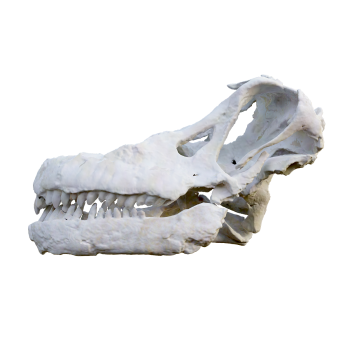
Brachiosaurus is a general term for the "Brachiosaurus genus" dinosaurs of the Jurassic period. The body length is 25 meters, the height is 15 meters, the weight is 30 tons, the tail is thick and short, the head is small, the neck is long, and the appearance is similar to that of a giraffe; There are large claws on the inner side of the forefoot; The jaw is well-developed, with 52 teeth covering the upper and lower parts, and the edges of the teeth are sharp; Strong limbs; The nostrils grow on the top of the head. Named after its long forelimbs. The head is very small and it is a dinosaur with low intelligence. Living in North America during the late Jurassic period and North Africa during the early Cretaceous period. It inhabits grasslands filled with ferns, cycads, and wood thieves. Mild temperament, enjoys living in groups. Feed on leaves and tender branches. Often foraging together.
Camel skull

Camel skull

Camel deer is a mammal of the camel genus in the family Camelidae of the order Artiodactyla. Camel deer have a larger body size, generally ranging from 2-2.6 meters in length. The body resembles a camel, with four long legs similar to a camel. The shoulders are high, the head is large, the eyes are small, the face is long, the neck is short, the nose is enlarged and slightly drooping, and the upper lip is 5-6 centimeters longer than the lower lip. The hair color of the whole body is brown, the nose is thickened, and there is a chin pouch under the throat. Named after the hump shaped back hump and the horn shaped lower jaw. Typical subarctic coniferous forest animals, wandering in groups in the forest clearing, like to eat tender branches of plants, move quickly and agilely, and can run quickly. Long legs, able to walk freely even in thick snow
Fossil of upper half skull of upper dog

Fossil of upper half skull of upper dog

The largest species in the genus Canis, the Hydni, has a shoulder height of 1.2 meters and an estimated weight of 95-120 kilograms, which is twice the size of the North American gray wolf. The sturdy physique and tenacious collective strength made these terrifying animals a nightmare for many vegetarians in North America at that time. The emergence of the upper dog was due to the decline of the canine bear family, which allowed them to turn passive into active and deliver fatal blows to their opponents, thus replacing half of the dominance of canine bears. The Terridae subfamily not only suppressed the development of the Canidae family in North America, but also eliminated its own ancestral group, led by the Osborn dog, which can weigh up to 50 kilograms.
Fossil skull of woolly rhinoceros

Fossil skull of woolly rhinoceros

The woolly rhinoceros is a mammal belonging to the family Rhinocerotidae in the order Neodactyla. The woolly rhinoceros is an extinct species of rhinoceros, named after its thick and dense fur covering its entire body. The woolly rhinoceros has strong bones, a long and large skull, and a head and neck that droops downwards; There is a rhinoceros horn on both the forehead and nose bones. The woolly rhinoceros has a body length of about 4 meters and a shoulder height of about 2 meters. It is covered with warm long hair and thick fur, and has a thick layer of fat under its skin. Like mammoths, they are all ice age animals that adapted to the cold climate and have traveled throughout the northern part of the Eurasian continent. They mainly inhabit the Eurasian grasslands and feed on shrubs and grasses grown in cold climates.
Fossil skull of wolf lizard beast

Fossil skull of wolf lizard beast

The wolf lizard (genus name: Inostrancevia), also known as the Inostrancevia, is a genus of theropod animals in the order Theropoda. It is a quadrupedal animal with four limbs standing upright below its body. The skull is 45 centimeters long and approximately 1 to 4.3 meters in length, with strong muscle attachments on the bones. Compared to other more primitive theropod animals such as the Bamo crocodile, the wolf lizard has smaller eye sockets and larger temporal fenestrae. Fossils were discovered in Sokolki, North Dvina River basin, Arkhangelsk Oblast, Russia. Wolf lizards lived in the Late Permian period 251 million years ago. South Africa has also discovered wolf lizards, which have been named African wolf lizards.
Beaver skull

Beaver skull

The beaver (scientific name: Castorfiber) is an animal of the beaver family and genus. The body of a beaver is enlarged, with no significant difference between males and females. The head is short and dull, the eyes are small, the neck is short, the limbs are short and wide, the forelimbs are short, the feet are small and have strong claws, the hind limbs are thick and strong, and the tail is large and flat. Nighttime activity, rarely going out of caves during the day, good at swimming and diving, not hibernating, weak self-defense ability, timid, fond of eating tender branches, bark, and roots of various plants. The skull is related to biting trees, exceptionally solid, with well-developed bone ridges and prominent sagittal and herringbone ridges. The nasal bone is wide in front and narrow in the back. The cheekbones are particularly thick. The incisors are chiseled in shape and suitable for biting through branches and trunks.
High crowned chameleon skull

High crowned chameleon skull

Chamaeleocalyptoratus is a type of chameleon named after the towering flesh crown on its head. It is one of the few species found in Asia, while the rest are mostly found in Africa, especially on the island of Madagascar. The high crowned chameleon is named after the towering, hat like crown composed of bone plates on their heads, and is a arboreal diurnal chameleon. The high crown chameleon adapts to a wide temperature range, making them the easiest chameleon species to breed. The main food of omnivorous species is insects, and most chameleons will develop anorexia towards a single food, sometimes refusing to eat until death.
North American opossum skull

North American opossum skull

Didelphis virginiana, a North American opossum, is a mammal belonging to the suborder Theropoda, order Notothenioidei, family Notothenioidei, and genus Notothenioidei. The only marsupial that inhabits north of the Rio Grande in North America. It is a solitary and nocturnal animal, about the size of a domestic cat. Their ancestors began to evolve in South America and entered North America 3 million years ago through the Great Migration of North and South American organisms. They usually appear in nearby cities. It is the largest member of the opossum genus and the largest member of the opossum order. They are generally 38-51 centimeters long and weigh 4-6 kilograms. Omnivorous, eating different types of plants and animals.
Argentine dragon head bone fossil

Argentine dragon head bone fossil

Argentinosaurus belongs to the Titanosaur class of sauropod dinosaurs, and its name is very simple, meaning a dinosaur discovered in Argentina. Survival period: 100 million years ago, mid Cretaceous Albian stage -93 million years ago, late Cretaceous Senonian stage. It is one of the largest land dinosaurs discovered. It is one of the largest animals that once roamed the earth, with a height of 12 meters and a length of 42 meters. Among all modern organisms, only the fragile double chambered dinosaur is longer than it. There are some other dinosaurs that are as long as the Argentinosaurus, and some that are taller than it. However, Argentinosaurus is still much heavier than other dinosaurs, possibly weighing up to 94 tons.