
Monkey Skull 3D Model Animation

Monkey Skull 3D Model Animation

Belonging to the primate order, it is a mammal closely related to humans. Medium in size, with equal limbs or slightly longer hind limbs, varying tail lengths, cheek pouches and arm calluses, suitable for arboreal or terrestrial life. The skull is larger and the cranial cavity is spherical, which is due to the shortening of the jaw and flattening of the face. Smell is usually secondary to vision and touch, and certain species have highly developed olfactory centers in the brain. The social behavior of monkeys is complex, usually living in groups and forming a hierarchical social structure. There is a variety of food, including fruits, leaves, insects, small animals, etc. In culture, monkeys are often seen as symbols of wit and flexibility.
Jersey tiger moth specimen

Jersey tiger moth specimen

It is a medium-sized moth species distributed in the southern region of England, known for its striking black and white striped forewings and bright orange red hind wings, with black spots on the hind wings. Adults are active during both day and night, visiting various flowers in warm weather and being attracted by light sources at night. Larvae feed on various herbaceous plants and maintain a small body size in winter, until they start feeding and undergo their last molting in spring, followed by pupation. It is a native moth species in the UK, but it is also possible to migrate from the European continent during the summer. They were once only found along the southern coast of England, but in recent years their distribution has expanded.
Hippocampus specimen

Hippocampus specimen

It is a unique marine organism belonging to fish, but its morphology and living habits differ greatly from common fish. They have a horse like head, a curved neck, and a long tail, and the most prominent feature is that their males have a brood sac where they can hatch eggs. The fins are very unique, including a dorsal fin, a pectoral fin, and a small pelvic fin, which enable them to stand upright and move slowly in water. The skin is covered with bony rings, which are composed of hard bone plates and provide protection. Mainly distributed in tropical and subtropical waters around the world, it usually inhabits seaweed beds, mangroves, and coral reefs.
3D model of sperm whale teeth

3D model of sperm whale teeth

It is the largest surviving toothed whale, known for its huge head and unique teeth. There are significant differences in the number and size of teeth between genders and individuals, with males typically having more teeth than females. Having larger teeth that can grow up to 20 centimeters long, conical in shape, mainly located in the lower jaw. Teeth may serve a display function during mating and competition for mates, but are not used for predation. The teeth of female sperm whales are usually smaller and sometimes even underdeveloped, with almost no gum exposed. Sperm whale teeth are composed of dentin, a hard tissue that can resist the immense pressure of deep-sea predation.
3D model of sperm whale ear bone

3D model of sperm whale ear bone

It is the largest surviving toothed whale, known for its massive head and complex sonar system. The head accounts for one-third of its body length and contains special ear structures that are crucial for their navigation and communication in deep-sea environments. The ears of sperm whales do not have obvious external ear structures like terrestrial mammals, but are hidden in complex structures on the head. Characterized by high adaptability to deep-sea environments, including an inner ear structure capable of withstanding extreme water pressure. The hearing is very sensitive and can detect very low frequency sounds that travel far underwater, helping to locate prey, navigate, and communicate with companions.
Yi Beike

Yi Beike

It is a common marine shellfish that is loved by people for its delicious meat and rich nutritional value. Shells are wedge-shaped, with a black brown surface and a gray blue interior, giving them a pearl like luster. Usually inhabiting coastal rocks, especially in areas with rapid seawater currents and clear water quality. It has strong resistance to adverse environments such as red tide and sewage, and mainly feeds on organic debris and diatoms. The reproductive ability is strong, and female clams can lay up to 25 million eggs. Strong vitality and easy to cultivate artificially. In terms of consumption, the meat is delicious, rich in protein, essential amino acids, vitamins, and minerals, and is known as the egg of the sea.
3D model of conch shell

3D model of conch shell

Usually refers to the shells of marine snails, which are loved by people for their unique shape and beautiful texture. The size, shape, and color vary, with some shells having smooth surfaces and others having rough textures or nodules. It also holds a unique position in culture and history. In ancient times, snail shells were used as horns or musical instruments in some cultures, while in other cultures they were used as decorative or ceremonial objects. In modern times, conch shells are often used to make various handicrafts such as jewelry, wind chimes, and other decorations. It also has ecological functions in nature. Some marine creatures, such as hermit crabs, use empty snail shells as a home to protect themselves
Leopard skull

Leopard skull

It is a large feline with an elegant body shape and both strength and speed. Known for its unique spotted fur, these spots are called "rose spots" and help camouflage in forest and grassland environments. Widely distributed in various habitats in Africa and Asia, from tropical rainforests to arid desert regions. He is a lonely hunter, skilled in climbing and swimming, often resting and storing prey in trees. The body size of felines is considered moderate, with strong muscles, sharp claws, and strong jaw power, capable of hunting and killing various prey. They usually avoid contact with humans and exhibit strong defensive measures when threatened.
Fossil teeth of megalodon shark

Fossil teeth of megalodon shark

It is an extinct giant shark, considered the largest shark in history and possibly the largest fish. Living during the Early Miocene to Pliocene period, approximately 23 to 2.6 million years ago. Fossil teeth are the main evidence for the existence of this ancient predator, and these teeth can grow up to 18 centimeters long, more than three times the size of modern great white shark teeth. It has a huge body size and a very strong biting force, making it the strongest known animal. The teeth are similar to modern great white sharks, with triangular, serrated edges and symmetry, but larger, thicker, more evenly spaced serrations, and a darker, V-shaped area near the root of the teeth.
3D model of dolphin skull

3D model of dolphin skull

It is a highly intelligent marine mammal belonging to the dolphin family of the cetacean order. Known for its streamlined body, agile swimming ability, and friendly nature. Widely distributed in oceans and certain rivers worldwide, it adapts to various environments ranging from cold polar waters to warm tropical seas. Having a developed sonar system that can detect the surrounding environment by emitting sound waves and receiving echoes, this ability makes underwater navigation and hunting very efficient. It is a social animal that often lives in groups, with complex communication and collaborative behaviors among group members. They feed on fish, squid, and other marine organisms.
Ke Guo

Ke Guo

Lithocarpus glaber (Thunb.) Nakai is a tree in the family Fabaceae. The plant reaches a height of 15 meters; Leaves are leathery or hard papery in texture, oblong or oblong in shape, with 2-4 shallow teeth on the entire margin or near the tip. The lower part of the old leaves is hairless or almost hairless and covered with a waxy scale layer; Flowers have small branches, young petioles, and the underside of leaves and inflorescence axis are densely covered with grayish yellow short hairs; The fruit is disc-shaped or shallow bowl shaped, with triangular scales, and is covered with gray soft hairs. The fruit is elliptical in shape; The flowering period is from September to October; The fruiting period is from September to October of the following year.
Tyrannosaurus skull fossil

Tyrannosaurus skull fossil

Tyrannosaurus (Tyrannosaurus) is a genus under Tyrannosauridae. The only effective species is the model species Tyrannosaurus rex or Rexosaurus rex. It is a large carnivorous dinosaur with a length of about 15 meters, a hip height of about 5 meters, and a weight of about 8 metric tons to 13 tons. The Maastricht order, which lived at the end of the Cretaceous, was about 67 million to 66 million years ago. It was one of the last dinosaur populations before the Cretaceous-Tertiary extinction event. Fossils are distributed in the United States and western Canada in North America, and the distribution range is wider than that of other Tyrannosauridae. Western North America in the late Cretaceous period is an independent continent of Larramidia.
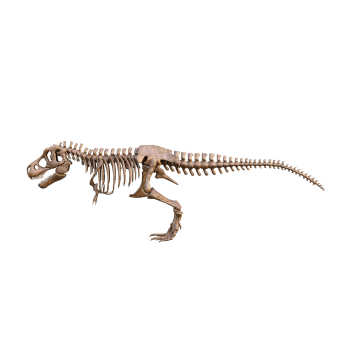
Tyrannosaurus rex skeleton fossil

Tyrannosaurus rex skeleton fossil

Tyrannosaurus belongs to the Tyrannosaurus genus of the Tyrannosauridae superfamily and is the only species in this genus. It was named in 1905 by American paleontologist and member of the American Academy of Arts and Sciences, Henry Osborne. If we refer to the translation format of other dinosaur species, it would be more appropriate to translate its species name as' King Tyrannosaurus'. Adult Tyrannosaurus rex is about 12 meters long and weighs around 7 tons, making it one of the largest land predators in Earth's history. Although the current size of Tyrannosaurus rex has been challenged by large Allosaurus and Spinosaurus, considering the depth of research and cultural influence, it is still truly the king of dinosaurs.
Fossil of triangular keel frame

Fossil of triangular keel frame

Triceratops is a herbivorous dinosaur belonging to the family Ceratopsidae in the order Ornithischia. It is a dinosaur resembling a rhinoceros, with a bulky appearance, thick legs, three horns on the head, and a large bone plate extending backwards at the back of the skull to form a neck shield. There is a short horn above the beak and two long horns above the eye sockets. The horns of Triceratops are defensive weapons that can scare off predators. The tail is short and pointed, and the feet are like hooves. Distributed in North America, it lived in the late Cretaceous period, approximately 68 to 65 million years ago. Triceratops often take advantage of their clustered lifestyle to protect their young; When facing enemies, often bow down and use horns to resist predators.
Stegosaur skeleton fossil

Stegosaur skeleton fossil

The stegosaur is an animal belonging to the family Stegosauridae in the suborder Stegosauria of the order Ornithischia, also known as the Bone Plate Dragon. The head is small, and the tip of the mouth has a bird like pointed beak without teeth. The teeth are distributed on both sides of the mouth and are very small. Strong and robust in appearance, weighing up to 4 tons, with 5 toes on the front legs and 3 toes on the back legs; The front legs of the stegosaur are slightly shorter, while the hind legs are longer and more robust. Jianlong is named after its large sword board and sharp tail spikes on its tail. Living in the late Jurassic to early Cretaceous period. The diet is herbivorous. Due to their small teeth, they cannot grind plants and can only eat some low moss or fern plants.
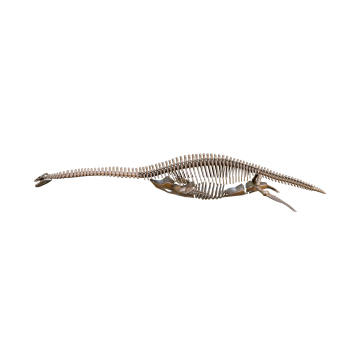
Fossil skeleton of plesiosaur

Fossil skeleton of plesiosaur

Plesiosaur is a collective term for the extinct marine reptiles of the genus Plesiosaur, belonging to the suborder Diptera and the order Pterosauriformes. It is a group adapted to living in shallow water environments, with large individuals and long necks, hence its name. It began to appear in the late Triassic period and spread all over the world by the Jurassic period, and became extinct by the end of the Cretaceous period. The plesiosaur were incredibly large in size and ruled the oceans of the Mesozoic era alongside ichthyosaurs. Its living habits are similar to modern sea lions, mainly living in the ocean and feeding on fish. It can be divided into long necked plesiosaurs and short necked plesiosaurs. Survived from Jurassic to Cretaceous.
Lianglong skull fossil

Lianglong skull fossil

Lianglong is a dinosaur belonging to the family Lianglong in the order Saurischia. The neck is long, the head is small, and the position of the nostrils is higher than the eyes; The front of the mouth has flat teeth, while the sides and back have no teeth; Strong limbs, short forelimbs, long hind limbs; The buttocks are higher than the front shoulders; Each palm has 5 fingers (toes); The tail is longer than the neck and gradually narrows towards the end, forming a whip like shape, with over 10 human bones in the middle. The name Shuanglianglong comes from two protrusions that protrude from the top of the human character bone, resembling double beams, and is commonly referred to as Lianglong. Living in western North America during the late Jurassic period. Living in groups, when there is a shortage of local food, they collectively migrate to distant places. Plant eating, feeding on leaves and ferns.
Skull fossil of helmet dragon

Skull fossil of helmet dragon

Corythosaurus, also known as Guanlong, Cockscomb Dragon, Helmet Headed Dragon or Helmet Headed Dragon, meaning "helmet lizard", is a genus of hadrosaurids in the subfamily Leucisaurinae. It lived in North America during the Upper Cretaceous period, about 75 million years ago. It has a duck like face and a high helmet like protrusion on top of its head, hence its name. Helmeted dragons have a gentle temperament and lack defensive equipment such as spines and claws, which means they can only rely on their sharp and developed visual and auditory organs to prevent predator attacks. It is a herbivorous dinosaur that mainly feeds on pine leaves, fruits, tender branches, and magnolia leaves.
Amorosaurus skull fossil

Amorosaurus skull fossil

Amurasaurus is a genus belonging to the subfamily Leucisaurinae in the family Hadrosauridae, and lived in East Asia during the Upper Cretaceous period. It has a platypus like nose and an empty crown on its head, but no fossil of the crown has been found yet. The fossil of an adult Amurlong is rare, but it is estimated to be at least 6 meters long. Like other members of the Lycosauridae subfamily, it is primarily a bipedal herbivorous dinosaur. Living in the Late Cretaceous period 74 to 65 million years ago, it was discovered in Russia, China Heilongjiang, Europe, and Asia.
Blue Phoenix Butterfly Specimen

Blue Phoenix Butterfly Specimen

Blue swallowtail butterfly is an insect of the genus Papilionidae in the family Papilionidae. The wingspan is 95-120mm. The wings are black with an indigo velvet sheen. The male butterfly has yellow white markings on the front edge of its hind wings and black spots on the outer red ring of its buttocks; There are several arc-shaped red spots on the outer edge of the dorsal side of the hind wing, and three red spots on the buttock angle. There are three subspecies in China.
Bush's snail shell

Bush's snail shell

The snail is a shellfish, belonging to the family Protogastropoda. The shell is in the shape of a gyroscope, with an enlarged snail layer. The height and width of the shell are not significantly different, and the surface of the shell is smooth or has spiral ribs, spines, or protrusions. The spiral tower is high, the shell top is blunt, and the suture line is shallow. All screw layers are convex, but the body layer is slightly concave near the suture line. The shell is round, and the edge of the outer lip is sharp. The shell surface has rich colors and complex patterns, with many variations.
White tea plum specimen

White tea plum specimen

Camellia is a small tree in the Camellia genus of the Theaceae family. Branches sparse, tender branches hairy; Leaves leathery, elliptical in shape, dark green and shiny when dried on top, brownish green below, hairless; The flowers vary in size, with soft hairs on the flower buds and sepals, and wide, inverted petals that are red in color; Capsule spherical, seed brown, hairless; The flowering period is from November to March of the following year. Because its flower shape combines the characteristics of plum blossom and camellia, it is named Camellia. Camellia prefers warmth and moisture, prefers light but is slightly tolerant to shade, and avoids strong light. It is a semi negative plant and is suitable for growing in well drained, humus rich, and moist slightly acidic soil. The main propagation method of Camellia sinensis is through cutting propagation.
Black striped dragonfly specimen

Black striped dragonfly specimen

The Black striped Velociraptor is an insect in the family Scolopoda and genus Velociraptor. Males have a belly length of 56-59 millimeters and hind wings of 46-48 millimeters. Male upper and lower lips are yellow, and the anterior edge of the upper lip is black. The base of the front and back lips is green yellow. Green with one black "T" - shaped stripe. The top of the head, antennae, and back of the head are black. The front of the chest and back is green with no markings, while the chest and spine are yellow; Yellow green color on the side of the chest. There is a small black dot above and in front of the stomata. The wings are transparent, the anterior veins are yellow, the wing veins are black, and the wing moles are yellow brown. The abdomen is black with blue spots. The first and second abdominal segments are enlarged, with the base of the first and second segments being green. The lateral sides of the third to seventh segments each have three blue spots and one longitudinal spot of the same color.
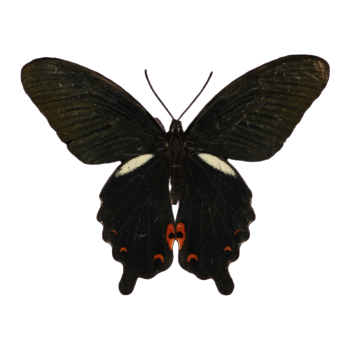
Viewing the specimen of the Twilight eyed Butterfly
Viewing the specimen of the Twilight eyed Butterfly

The forest night eyed butterfly, also known as the black tree shade butterfly, belongs to the order Lepidoptera, family Nymphalidae, and genus Nymphalidae. It is mainly distributed in Guizhou, Yunnan, Zhejiang, Jiangxi, Fujian, Guangdong, Guangxi, Hainan, Chongqing, Sichuan, Xizang, Taiwan and other places. Its characteristics are brown, dark brown, or yellow brown on the back and abdomen of the body, and the shape of the forewings is similar to a right angled triangle, while the hindwings are nearly oval shaped. In Taiwan, adult butterflies can be seen year-round and belong to multiple generations. Its main activity time is when the sky is close to dusk, hence it is named "Twilight Eye Butterfly". The larvae of the night eyed butterfly are hosted by the brown leaved dogweed of the Poaceae family.
Black Phoenix Butterfly Specimen

Black Phoenix Butterfly Specimen

The black swallowtail butterfly is a species of the swallowtail genus in the family Papilionidae. Spread the wings 80-90mm wide. The main feature is that the surface of the wings is almost entirely black. The difference between males and females lies in the presence of white strip-shaped transverse spots on the leading edge of the lower wing surface of male butterflies; Female butterflies do not have it, and their wings are lighter in color. Male butterflies have orange red crescent shaped markings on the underside of their lower wings, while female butterflies have more developed markings than male butterflies.
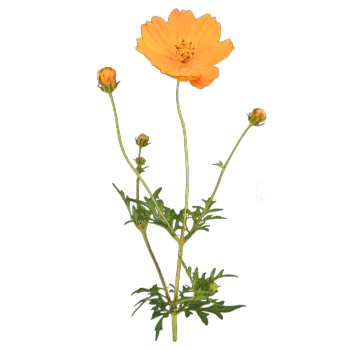
Huang Qiuying specimen

Huang Qiuying specimen

Huang Qiuying is an annual herbaceous plant of the Asteraceae family. The branches and leaves are paired bipinnate compound leaves with lanceolate lobes; The flowers are tongue shaped, with two types: single and double. The colors are mostly yellow, golden, orange, and red; Skinny fruit brown in color; The flowering period for spring sowing is from June to August, and for summer sowing it is from September to October; Also known as "sulfur chrysanthemum", it is named after its golden color, resembling a mineral called sulfur. Native to Mexico, it can naturally grow in alkaline soil areas below 1600 meters above sea level. Prefer warmth, not cold resistant, avoid extreme heat. Likes light, drought resistant and thin, prefers sandy soil with good drainage. Avoid strong winds and plant in a leeward location.
Sea curled specimen

Sea curled specimen

Haijuan, a type of shell, is medium to large in size, slender, and has many layers of snails. The shell surface usually has many spiral ribs and significant thick longitudinal ribs. Discovered on the west coast and Penghu Islands. From the Yellow Sea to the South China Sea, Indonesia, Malaysia, and Singapore. Keelung, in the western waters of Taiwan, Mosquito Pit in Gongliao Township, Taipei County, Lukang in Changhua County, Kaohsiung County, Penghu, Penghu Inland Sea, Danshui in Taipei County, Baishawan Coast in Taipei County, Hualien Coast, Anping in Tainan City, Donggang in Pingtung County, Jinning in Kinmen, Jincheng, Jinsha, Jinhu, and Lieyu. Mature individuals have a well-developed and broad outer lip on their shell; The water pipe trench is also very deep, and the leading edge of the outer lip usually extends beyond the water pipe trench.
Golden Phoenix Butterfly Specimen

Golden Phoenix Butterfly Specimen

The golden phoenix butterfly is an animal belonging to the family Papilionidae in the order Lepidoptera. The golden butterfly is a medium-sized butterfly with a wingspan of 70-84 millimeters. The underside of the wings is black brown with black veins, and the wing chambers have yellow spots; The base of the dorsal surface of the forewings is dark yellow, with a black sub outer edge and a row of small yellow spots inside; The posterior wing has a black broad border in the sub outer edge area, gray blue stripes on the inner side, yellow stripes on the outer side, and an orange red circular spot in the buttock area. The posterior wing has a pair of slender caudal processes. The golden phoenix butterfly is also known as the yellow phoenix butterfly, fennel phoenix butterfly, or carrot phoenix butterfly.
Turtle foot specimen

Turtle foot specimen

Common names for turtle feet: Buddha's Hand Shell, Stone Snail, Dog Claw Snail, Turtle Feet, Chicken Crown Shell, Chicken Feet, Chicken Feet, Guanyin Palm. The body is divided into a head and a handle, generally 2-3 centimeters wide and 3-5 centimeters high. The head is light yellow and green in color. The handle is soft and brown or yellow brown in color, with small calcareous scales arranged tightly on the surface. The largest individual has a head width of up to 44 millimeters, a height of 27 millimeters, a handle width of 25 millimeters, and a length of 15 millimeters. The head is flattened on the side, and the shell chamber is formed by 8 shell plates including the rib plate, back plate, upper side plate, peak plate, and kiss plate. The base has a row (21-31) of small side plates that rotate.
Turtle foot specimen

Turtle foot specimen

Common names for turtle feet: Buddha's Hand Shell, Stone Snail, Dog Claw Snail, Turtle Feet, Chicken Crown Shell, Chicken Feet, Chicken Feet, Guanyin Palm. The body is divided into a head and a handle, generally 2-3 centimeters wide and 3-5 centimeters high. The head is light yellow and green in color. The handle is soft and brown or yellow brown in color, with small calcareous scales arranged tightly on the surface. The largest individual has a head width of up to 44 millimeters, a height of 27 millimeters, a handle width of 25 millimeters, and a length of 15 millimeters. The head is flattened on the side, and the shell chamber is formed by 8 shell plates including the rib plate, back plate, upper side plate, peak plate, and kiss plate. The base has a row (21-31) of small side plates that rotate.
Garden snail specimen

Garden snail specimen

The garden snail belongs to the "Halix" snail genus, which is native to central western Europe such as France and England. It usually inhabits gardens or shrubs, hence it is called the "garden snail" or the scattered snail. There are dense and delicate engraved patterns, with multiple dark brown spiral shaped bands that block the yellow spots or stripes that intersect with them., Shells have 4.5 to 5 snail layers, with a shell height of 29 to 33 millimeters and a shell width of 32 to 38 millimeters. The shell surface has obvious threads and growth lines, and the spiral part is short. The embryonic snail layer is smooth, and the body snail layer is particularly enlarged, with extreme inclination in the forward direction.
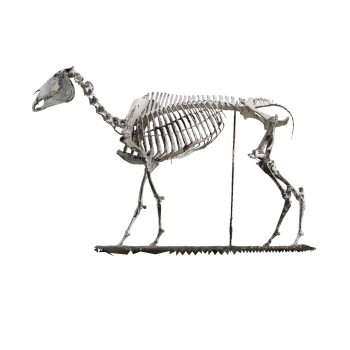
Horse skeleton

Horse skeleton

Horses are herbivorous animals belonging to the genus Malcoma in the order Quetziformes, and currently exist as two subspecies: domesticated horses and wild horses. Wild horses have upright and non drooping mane on their necks, extremely short forehead hair, long tail hair, and no distance hair on their limbs. In summer, the upper body is light brown, red brown, and reddish brown, while in winter, the back of the skin is light brown; Family horses are divided into heavy, small, and miniature horses according to their breeds; Jiama has long limbs, solid bones, well-developed tendons and ligaments, hard hooves, diverse fur colors, mostly chestnut, green, and black, well-developed sweat glands, and strong chewing power. With a developed system, it has a keen sense of hearing and smell, strong sensitivity to light, and can also see surrounding objects at night.
Terror bird skull

Terror bird skull

Dinornitidae is a bird species in the ostrich order of the terror bird family. The abdominal feathers are yellow, and the other parts are yellow and black in color. Enlarged body, degeneration of upper limbs, and short and thick lower limbs; The neck is covered with feathers and is relatively short; There are three toes. In 1843, it was named the terror bird by Owen, meaning a large bird that can scare people. Resting in the primitive lowlands and coastal forest grasslands of the southern islands of New Zealand. Living as a couple, each pair has their own territory. Cannot fly, runs slower than ostriches. They feed on berries, grass seeds, and roots, and sometimes also collect some insects. It is one of the largest birds on Earth.
Rhinoceros skeleton

Rhinoceros skeleton

Rhinoceros is a large mammal in the family Rhinocerotidae of the order Rhinoceros. Fat and clumsy, with thick and rough skin arranged in folds; The fur is sparse and hard; The ears are oval in shape; Big and long head; Short and thick neck; No canine teeth; The tail is thin and short, and the body is yellow brown, brown, black or gray; Solid single or double horns on the head and nose; Both males and females have double horns, with females having longer horns than males. Rhinos are distributed in Asia, such as India in South Asia; It inhabits sparse grasslands and dense forests in tropical and subtropical regions. They often come out to forage in the early morning, evening, or night, with poor vision and sensitive sense of smell and hearing; Living alone often with little contact between individuals.
Amazon parrot skull

Amazon parrot skull

The Amazon parrot is a bird species of the Amazon parrot genus in the parrot family of the parrot order, also known as the orange winged Amazon parrot. The body is strong and sturdy, with a square shaped tail that is relatively short; The face is covered in hard hair; The mouth is thick and strong, with a hooked shape. Most of the feathers are green, with yellow green edges; Orange iris of the eyes; Yellow between the crown, eyes, and thighs; The main flight feathers are purple blue, and the secondary flight feathers are purple blue and distributed in the feather petals and wing tips; There is a slight red color at the turning point of the wings.. Has migratory habits. They feed on figs, nuts, flowers, seeds, and fruits, and sometimes forage in crops such as banana groves or corn fields.