Niu Tenghua specimen

Niu Tenghua specimen

For the stems and roots of the woody plant Naiteng or Tailleaf Naiteng. Harvesting in summer and autumn, vine stems, removing branches and leaves; Root, remove the roots. Wash thoroughly, let it moisten thoroughly, cut into sections or slices, and dry in the sun. That vine grows on the edge of valley forests or in shrubs at the foot of mountains, and is also cultivated in courtyards. Tailleaf vine is mostly found along mountain slopes or in shrubs at the edge of valley forests. That vine is distributed in Taiwan, Guangdong, Guangxi and other places. Tailleaf Vine is distributed in Zhejiang, Jiangxi, Fujian, Hunan, Guangdong, and Guangxi. Bitter taste, cool nature. Returning to the liver and bladder meridians. It has the effects of dispelling wind, dispersing blood stasis, relieving pain, diuresis, and reducing swelling. It is mainly used for treating rheumatism, rheumatism, pain caused by falls, various neuropathic pains, difficulty urinating, edema and other diseases.
Specimen of deep mountain crayfish

Specimen of deep mountain crayfish

Deep mountain crayfish is a high mountain form of crayfish, native to Korea and Russia. Its leaves and flowers are smaller than those of Pu Ran. The leaves of the crayfish are circular, with a slightly thin tip and shallow triangular serrations on the edges. The fruit is larger than the crabapple, with a spherical shape and beautiful autumn leaves. In addition, the fruit of the crayfish is upward, and in deep mountain crayfish, the tips of the leaves become narrow and sharp, with shallow triangular serrated edges. It is a cold resistant evergreen shrub native to Japan, the Korean Peninsula, and China. The oval shaped fruit ripens into a deep purple color from October to November, coinciding with the flowering period. The fruit ripens from October to November, overlapping with flowering.
Barracuda skull

Barracuda skull

The barracuda is a fish species belonging to the family Scorpaenidae in the order Perciformes, suborder Scombroidei. Also known as Barracuda or Sparrow Brocade, it is a species of ray finned fish in the family of Barracuda, belonging to the genus Gobiidae. The body is elongated, with a pointed front end and a slightly flattened rear end. Belonging to a global fish species, it is distributed in various sea areas around the world. So far, 20 species of barracuda have been discovered, and barracuda in different seas have completely different behavior patterns. However, their "solitary" behavior is a common feature, and adult barracuda have almost no natural enemies. Juvenile fish feed on planktonic animals, while adult fish feed on diatoms and small organisms. Usually inhabits the sea
Fu Shu Hua specimen

Fu Shu Hua specimen

Fushu is a deciduous shrub belonging to the genus Fushu in the family Saxifragaceae. Up to 3 meters in height; The small branches are hollow, reddish brown in color, with star shaped hairs when young, and smooth or flaky when old; Leaves opposite, with short stalks, leaves ovate to ovate lanceolate; The inflorescence is upright, with star shaped hairs, and is oblong or oblong ovate in shape; The cute fruit is nearly spherical, with a flat tip and many small seeds; The flowering period is from May to June, and the fruiting period is from July to October. Native to various provinces in the Yangtze River Basin, distributed in Shandong, Jiangsu, Zhejiang and other places. Likes light, slightly shade tolerant, prefers warm and humid climates, is cold and drought resistant, and does not have strict requirements for soil. Mostly grows in valleys, fields, and other areas.
Upper skull of desert cotton tailed rabbit

Upper skull of desert cotton tailed rabbit

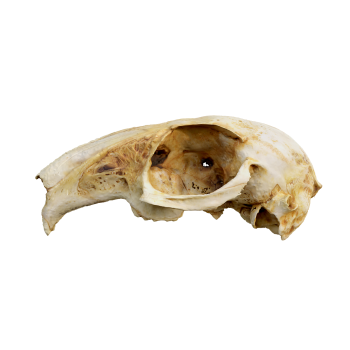
Sylvilagusauduboni: a mammal belonging to the genus Sylvilagusauduboni in the family Actinidae. Body length 30-38 centimeters, ear length 7 centimeters, weight 0.85-1 kilograms. Females are slightly larger than males. The fur is generally light brown, brown or gray; The lower abdomen of the body turns white; The throat often has an orange brown stripe; The tail wraps around and looks like a cotton ball. The habitat is dry grasslands, shrubs, coastal areas, and juniper forests. Usually inactive at noon, foraging in the early morning and evening. It is a herbivore that feeds on various plants, including grass, shrubs, leaves, and cacti.
Multi flowered wisteria specimen

Multi flowered wisteria specimen

Duohua Wisteria is a deciduous woody vine of the legume family Wisteria, with alternating leaves, odd feather compound leaves, opposite growth, long elliptical or lanceolate, round base, pointed tip; Racemes, terminal or axillary, corolla butterfly shaped, purple or blue purple flowers, cultivated in pink, white, and double petaled varieties; The flowering period is in spring. Purple wisteria, originally from Japan, is cultivated in various parts of North China and south of the Yangtze River. It prefers warm and sunny environments, but has slightly poor cold and heat resistance; The suitable temperature for growth is 16-26 ℃, and it prefers loose loam soil with good drainage. The multi flowered wisteria is propagated through sowing, cutting, and grafting, with spring being the suitable season.
Rhododendron specimen

Rhododendron specimen

Rhododendron is a deciduous shrub of the Rhododendron genus in the Ericaceae family, standing 2-5 meters tall with numerous and slender branches. The leaves are leathery and often gather at the ends of branches, forming an oval, elliptical, or inverted shape. The front end is short and gradually becomes pointed, and the edges of the leaves are slightly curled and have fine teeth. The upper part is dark green, and the lower part is light white; The corolla is broad funnel-shaped and inverted, usually 2-6 clusters growing at the top of the branch, with rose, bright red or dark red colors. The flowering period is from April to May, and the fruiting period is from June to August. Enduring shade and preferring warmth, evergreen rhododendrons can only grow well in humid and cool mountain air. Rhododendron is one of the three famous wild flowers in China and also one of the four major alpine flowers in the world.
Fossil skull of canine toothed beast

Fossil skull of canine toothed beast

Cynodont, the ancestor of mammals. More like mammals than reptiles. Some live in pairs in caves. Ancient creatures, only two large canine molars have been found in the petrified forest of Arizona. Most canines are carnivorous animals, with very few exceeding 90 centimeters in length. They have many similarities with mammals. Both canines and mammals can breathe while chewing food. They all have several different types of teeth. Like mammals, canines have whiskers and perhaps body hair. Dogtooth beasts have their limbs located beneath their bodies and can run quickly.
Black footed Albatross Skull

Black footed Albatross Skull

Phoebastrianigrills is a large seabird belonging to the family Albatrosidae in the order Siluriformes. It is a monotypic species with no subspecies differentiation. The body length is 79-83 centimeters. The mouth is black, the base of the mouth and the area under the eyes are gray white, and the rest of the body is black brown. Some individuals have white tail feathers and black feet, which can distinguish them from short tailed albatrosses. Breeding in groups, enjoying following boats to forage, often inhabiting the sea. Distributed in the North Pacific. China is commonly found in the Taiwan Strait, and in the South China Sea during spring and winter, with very few populations. Mainly foraging for marine invertebrates and fish such as cephalopods and mollusks.
Black Tree Lizard Skull

Black Tree Lizard Skull

The Varanus beccarii, also known as the Black Pearl Lizard, is a medium-sized giant lizard. The body length is about 90-100 centimeters, and its characteristic color is completely black. The juvenile's chest is light green, and its tail is quite slender. The scales on the tail are arranged in a circular pattern. This species is a close relative of the emerald green giant lizard. A species that is completely arboreal, although its distribution area has little rainfall, the black tree monitor lizard needs to live in a high humidity environment, is timid and somewhat neurotic, and feeds on insects, reptiles, birds, and small mammals. Distributed in the Aru Islands west of Papua New Guinea. Residing in mangrove forests.
Milk thistle flower specimen

Milk thistle flower specimen

Milk thistle is a one-year or biennial herbaceous plant in the family Asteraceae, belonging to the dicotyledonous plant class. Also known as Western white thistle, milk thistle, and North American milk thistle, it has antioxidant properties and can protect liver cells from free radical damage. Milk thistle has been used in Europe to treat liver disease. Annual or biennial herb, 1.2 meters tall. The stem is upright, branched, with edges, and rarely unbranched. All stem branches have white powdery coating, sparsely covered with spider silk or hair. The lotus shaped basal leaves and lower stem leaves have petioles, which are fully elliptical or lanceolate in shape, measuring up to 50 cm in length and 30 cm in width, with feather like shallow to fully lobed.
Sea Fairy Flower Specimen

Sea Fairy Flower Specimen

Haixianhua is a perennial herbaceous plant in the Primulaceae family, belonging to the Haixianhua genus. Sea Fairy Flower reaches a height of 5 meters; Small branches thick, hairless or nearly hairy; Leaves opposite, broadly elliptical to ovate, with fine blunt serrations; The inflorescence grows in the axils or tips of lateral branches; Bract linear; The corolla is bell shaped and funnel-shaped, with light red or yellowish white flowers that later turn dark red or purple; Capsule cylindrical shape; The flowering period is from May to June; The fruiting period is from September to October. Haixianhua is produced in East China and is cultivated in Qingdao, Shandong, Nanjing, Shanghai, Zhejiang, Shaanxi, and Guangzhou, Guangdong; Likes light, slightly shade tolerant, relatively cold resistant, prefers thick and moist soil.
Mink skull

Mink skull

Neovisonvison is a mammalian species belonging to the genus Neovisonvison in the family Italidae, order Carnivora. The tail is less than half the length of the head, and the ears are short and round. The body is slender and the limbs are short. The head is narrow and elongated, with a sensitive sense of smell and hearing. Residing in areas near freshwater. The lifestyle is semi aquatic. Carnivorous, mainly feeding on rodents, bird eggs and chicks, fish, insects, and plant fruits. Distributed in the United States and Canada. Usually active at night, occasionally appearing during the day. He is a great swimmer who can dive to a depth of 5 to 6 meters and won't chase prey for long distances in open waters. Still a skilled tree climber.
Specimen of prickly fruit buttercup flower

Specimen of prickly fruit buttercup flower

The prickly fruit buttercup is a species of the genus Ranunculus in the Ranunculaceae family. Distributed in Jiangsu, Zhejiang, and Guangxi in China. Born in the weeds of the roadside fields. Annual herb, nearly hairless. Single leaf, with 3 shallow to 3 deep fissures, and lobes with reticular teeth. The achene is flat with wide edges and spines about 2mm long on both sides. The flowering and fruiting period is from March to May. Distributed in Jiangsu, Zhejiang, and Guangxi in China. Born in the weeds of the roadside fields. Distributed in North America, Oceania, Europe, and Asia.
Melia azedarach petal specimen

Melia azedarach petal specimen

The Chinese toon tree, also known as the Chinese toon, is a deciduous tree in the Chinese toon family. It can grow up to 30 meters tall, with a diameter of 1 meter at breast height. It has two to three odd lobed compound leaves and is 20-40 centimeters long. The flowers are fragrant, and the sepals are deeply lobed with five lobes. The lobes are oval or elongated oval in shape, and the petals are light purple and spoon shaped. The filaments are tube purple and 7-8 millimeters long. The anthers are 10 and grow on the inner side of the lobes. The drupe is spherical or oval in shape and 1-2 centimeters long. It is produced in various provinces and regions south of the Yellow River in China, widely distributed in tropical and subtropical Asia abroad, and also cultivated in temperate regions. It grows in low altitude open fields, roadsides, or sparse forests. The flowering period is from April to May, and the fruiting.
Fossil skull of saber toothed tiger

Fossil skull of saber toothed tiger

Thylacosmilus is an extinct marsupial mammal that lived in prehistoric South America. It was a large terrestrial carnivore that once lived and competed with the saber toothed tiger. But the saber toothed tiger is actually a marsupial mammal, not belonging to the feline family, and even not to the carnivorous order. It only resembles the saber toothed tiger in appearance due to convergent evolution. Living in the Quaternary period of the Tertiary period. The body size is not very large, the largest of which is equivalent to the size of a jaguar and four times that of a pack wolf. He was one of the larger meat beasts in the southern cuisine at that time, with developed sword teeth and a strong body.
Rhododendron specimen

Rhododendron specimen

Rhododendron is a deciduous shrub of the Rhododendron genus in the Ericaceae family, standing 2-5 meters tall with numerous and slender branches. The leaves are leathery and often gather at the ends of branches, forming an oval, elliptical, or inverted shape. The front end is short and gradually becomes pointed, and the edges of the leaves are slightly curled and have fine teeth. The upper part is dark green, and the lower part is light white; The corolla is broad funnel-shaped and inverted, usually 2-6 clusters growing at the top of the branch, with rose, bright red or dark red colors. The flowering period is from April to May, and the fruiting period is from June to August. It is concentrated in the southwestern and southern regions of China. Rhododendrons prefer acidic and fertile soil. Enduring shade and preferring warmth, evergreen rhododendrons can only grow well in humid and cool mountain air.
Dinosaur skull fossil

Dinosaur skull fossil

Plateosaurus is an ancient dinosaur from the Triassic period, which lived between 222 million and 200 million years ago. It was the first giant dinosaur to appear on Earth. Before the appearance of the Banosaurus, the largest herbivore had a body size as big as a pig, while the Banosaurus was much larger, with a body the size of a bus. It is an ancient dinosaur that lived 210 million years ago during the Late Triassic period. It has a body length of 6-8 meters, a height of 3.6 meters, and a weight of about 5 tons. According to archaeological research, it was the first giant dinosaur that lived on Earth and ate plants.
Grey whale skull

Grey whale skull

The gray whale (scientific name: Eschrichtiusrobustus) belongs to the family of gray whales in the suborder of baleen whales of the order Artiodactyla. It has a larger body circumference than species in the family of baleen whales, but smaller than the humpback whale; Its adult length is 10 to 15 meters (female whales are slightly larger than male whales), and its maximum weight exceeds 35 tons. The body is spindle shaped, with a thick and chubby trunk, thickest near the fins, and gradually narrows towards the tail. Without dorsal fins, there are 8-15 low peaks along the posterior one-third of the spine, with the first peak being the largest and decreasing towards the tail. Mainly feeds on planktonic small crustaceans, herring eggs, and other group fish. But they do not feed during their southward migration.
Scutellaria baicalensis flower specimen

Scutellaria baicalensis flower specimen

Scutellaria baicalensis is a perennial herbaceous plant belonging to the family Lamiaceae and the genus Scutellaria; Stem branching, nearly hairless, or covered with slightly soft hairs that extend upwards; Root and stem fleshy, branched; Leaves lanceolate or linear lanceolate, blunt apex, rounded base, both surfaces hairless or sparsely covered with soft hairs; The flower stem is covered with soft hairs; Calyx densely covered with soft hairs, with edge hairs; The corolla is purple red or blue, densely covered with glandular soft hairs, and the lower lip has triangular ovate lobes; The small nut is black brown, ovoid in shape, with a navel like protrusion near the base of the ventral surface; Flowering period from July to August; The fruiting period is from August to September. According to the Compendium of Materia Medica, "Ling Shuowen is known for its yellow color." Huangqin, also known as "qin" in ancient times, is named after the yellowish color of Ling grass.
White egret skull

White egret skull

Egret is a medium-sized wading bird belonging to the family Egret in the order Characiformes. There are 13 species of birds in the genus Egret, among which the Big, Medium, Small Egret, and Snow Egret are all white in body feathers, commonly known as Egrets, and have a medium body size. Distributed in the Yangtze River Basin and other areas of China, as well as in Africa, central and southern Europe, West Asia, Central Asia, East Asia, Southeast Asia, Oceania and other regions. They inhabit lakes, ponds, estuaries, and other water bodies in low altitude areas, often gathering in small groups and active in shallow waters or riverbanks. They often forage in the water during the day and fly back to the forest to rest at night. White egrets prey on small fish, shrimp, frogs, mollusks, insects, and also peck at small amounts of plant seeds.
Hydrangea flower specimen

Hydrangea flower specimen

Hydrangea is a woody plant belonging to the Hydrangea genus in the Hydrangeaceae family. The tree crown is spherical; Small branches thick, hairless; Leaves are oblong or broadly elliptical in shape, with thick and hairless petioles; The inflorescence is spherical or head shaped, with thick branches and attached soft hairs. The flowers are dense and pink, light blue, or white in color; The fruit is in the shape of a spinning top. The flowering period is from June to August. The original name of the hydrangea was "Eight Immortal Flowers". People saw that this flower looked like a hydrangea, so it was also called "hydrangea flower". Hydrangea originated in China and is now distributed in Fujian, Jiangxi, Guangdong, Hong Kong, and Yunnan Guizhou provinces. It is also found in Japan and Korea. It often grows in valleys below 1700 meters above sea level, in dense forests by streams, or under sparse forests on mountaintops, and is often cultivated near houses, temples, or courtyards.
Negative rat skull

Negative rat skull

Didelphinae is a general term for mammals in the family Didelphinae, belonging to the marsupial order, and is a small to medium-sized mammal. Due to the fact that female opossums can carry their young around and run around, they are named "opossums". Has the largest number of teeth among living land mammals. Nocturnal, gentle temperament, often goes out at night, preys on small invertebrates such as insects and snails, and also eats some plant-based food. When threatened or injured, opossums will roar (especially males), pretend to be dead, and mimic the appearance and scent of sick or dead animals. He is known as the "brake man" because he suddenly stands still while running, confusing predators, and then suddenly jumps up to escape
Yellow Acorus calamus specimen

Yellow Acorus calamus specimen

Yellow iris is also known as water candle, yellow iris, aquatic iris, yellow iris, etc. Iris family, Iris genus is a perennial wet or emergent perennial herbaceous plant. The rhizomes of Acorus calamus are thick and robust, with a diameter of up to 2.5 centimeters. The basal leaves are gray green, broad sword shaped, and have distinct midrib. They are 40-60 centimeters long and 1.5-3 centimeters wide; The flower stem is thick and robust, with a height of 60-70 centimeters; Bracts 3-4, membranous, green, lanceolate with prominent ribs and transverse reticular veins. The stem is slightly higher than the leaves, with long elliptical petals and nearly equal width at the base. It has brown markings or no markings, and the flag petals are light yellow. The flower diameter is 8 centimeters. The capsule is elongated and contains many seeds, which are brown in color.
Galapagos land iguana skull

Galapagos land iguana skull

The Galapagos land iguana (scientific name: Conolophussubicritatus) weighs up to 13 kilograms and measures 1 meter in length. The lower half is orange yellow, and the upper half is reddish brown. Due to the low corners, their appearance looks particularly foolish. The land iguana is distributed on six islands in the Galapagos Islands and is a unique species that evolved on the islands. The earthy yellow skin is designed to adapt to the color of sand and rocks. They mainly feed on cacti, which is related to the relatively dry climate of the Galapagos Islands. They choose to eat cacti because they can obtain the water their bodies need.
Larch pine cone specimen

Larch pine cone specimen

Larch is a tree in the pine family, belonging to the genus Larch. Its bark is dark brown, and it splits vertically into scaly pieces that fall off; The young branches are covered in brown soft fur and gradually shed; The leaves are needle shaped and narrow in shape, with a slightly pointed or blunt tip and a slightly flat upper surface; The cone is broadly ovate or cylindrical ovate in shape, yellow brown when ripe, with scales in the middle that are ovate rectangular or ovate square in shape. The upper edge is wavy and significantly curved outward, with a flat and slightly concave tip. The back surface is covered with brown wart like protrusions or short coarse hairs; The scales of the bract are not exposed; Seeds are inverted oval in shape; The flowering period is from April to May, and the cones mature in October.
Chinese mitten crab specimen

Chinese mitten crab specimen

The Chinese mitten crab is an arthropod belonging to the family Eriocheir in the order Decapoda of the phylum Arthropoda. Its head and chest armor are round and square, with the back half wider than the front half; The back is raised, the forehead and liver area are depressed, and there are six symmetrical protrusions in front of the stomach area, each with particles; The boundary between the gastric and cardiac regions is significant, with concave points around the former; Forehead width, divided into four teeth; The upper edge of the eye socket protrudes near the middle, forming a triangle; The anterior margin has four sharp teeth and runs diagonally on the outer side of the gill area; The inner and outer surfaces of the base of the palmar and phalanges are densely covered with fuzz. The inner corner of the wrist has a sharp spike, and the dorsal edge of the long segment has a sharp spike similar to the long segment of the foot. The Chinese mitten crab is also known as the river crab or hairy crab.
Spotted shovel armor specimen

Spotted shovel armor specimen

The spotted shovel beetle, a member of the Coleoptera family, is distributed in regions such as Heilongjiang, Shaanxi, Shanxi, Gansu, Henan, Zhejiang, Yunnan, Guizhou, Sichuan, Fujian, Taiwan, and Beijing. The upper palate of male insects is well-developed, resembling the horns of a stag. Many types of horns have finer branches and teeth, and the length of the horns is equivalent to the length of the body, which can cause bleeding on the hands. But some palates are too large, which can become a burden on action. Thick and robust, black or brown in color. However, there are few bright colors.
Spade armor specimen

Spade armor specimen

Spades are a collective term for insects in the order Coleoptera, family Spades, of the phylum Arthropods. The adult body of the shovel beetle is elliptical in shape, black or brown in color, mostly glossy, and has a solid surface; The upper forehead of male insects is mostly large and protruding like deer antlers. Some species have teeth on the upper jaw, while others have forked horns at the end of the upper jaw; The elytra cover the entire abdomen. The spade beetle is named because its shape resembles that of a shovel when its elfin is closed. Spade armor, also known as shovel shaped armor, shovel shaped insect, or deer antler insect.
Spotted shovel armor specimen

Spotted shovel armor specimen

The spotted shovel beetle, a member of the Coleoptera family, is distributed in regions such as Heilongjiang, Shaanxi, Shanxi, Gansu, Henan, Zhejiang, Yunnan, Guizhou, Sichuan, Fujian, Taiwan, and Beijing. The upper palate of male insects is well-developed, resembling the horns of a stag. Many types of horns have finer branches and teeth, and the length of the horns is equivalent to the length of the body, which can cause bleeding on the hands. But some palates are too large, which can become a burden on action. Thick and robust, black or brown in color. However, there are few bright colors.
Lishan Tianniu specimen

Lishan Tianniu specimen

The longhorn beetle is a general term for insects in the polyphagous suborder of the longhorn family, with a body length of 40-80 millimeters. Gray brown or gray black, with short brownish yellow hairs covering the elytra and entire body. There is a deep groove in the center between the antennae and the two compound eyes, which extends all the way to the top of the head and is deeper at the top of the head. The antennae are almost black. About one and a half times the size of the body, with a notch in the first section; The first section is thick and cylindrical, with a slightly outward protruding rear edge; The third section is relatively long, approximately equal to the sum of the fourth and fifth sections; Sections 7-10 are rod-shaped, with no flat edges, protrusions, or sharp edges on the outer side. The back of the anterior thoracic joint has irregular horizontal wrinkles, with round wrinkles on both sides but no lateral spikes.
Pen Dragon Gallbladder Specimen

Pen Dragon Gallbladder Specimen

Pen gentian is an annual herbaceous plant of the Gentianaceae family and Gentiana genus. The stem is upright, purple red, branched from the base, sparsely unbranched; Leaves oval or oval spoon shaped, margin cartilaginous, smooth or with indistinct fine papillae; Most flowers, solitary at the top of small branches, densely arranged in umbrella shaped branches, sparsely solitary at the top of flowers; The capsule is exposed or hidden, inverted oval shaped and rectangular in shape, with wide wings; The seeds are brown, oval in shape, with a fine mesh on the surface; The flowering and fruiting period is from April to June. Because its flowers resemble a pen tip when closed, it is named "Pen Dragon Gallbladder".
Chinese Spade Armor Specimen

Chinese Spade Armor Specimen

The Chinese shovel beetle, also known as the deer beetle, is a member of the family Scaridae in the order Coleoptera. Significant changes in body length, presenting a male female dimorphism; There are three types of males: large, medium, and small; The male insect's body color is dark black except for the reddish brown outer edge of the elytra. Belonging to the order Coleoptera and family Scaridae, it is a completely metamorphosed insect that undergoes four stages in its life: egg, larva, pupae, and adult. The larvae overwinter in decaying wood and reproduce once a year.
Shan Ci Mei specimen

Shan Ci Mei specimen

Shan Ci Mei is a plant of the Rosaceae family and the Rosaceae genus. Upright shrub, about 1.5 meters high; Branchlets are cylindrical, purple brown or gray brown in color. Small leaves 7-9, small leaf segments long circular or broadly lanceolate, flowers solitary in leaf axils, or 2-3 clustered; Bracts ovate, petals pink, ovate, fruit subglobose or ovoid, red, sepals persistent, erect. The flowering period is from June to July, and the fruiting period is from August to September. Distributed in provinces and regions such as Heilongjiang, Jilin, Liaoning, Inner Mongolia, Hebei, and Shanxi in China. It is also distributed in North Korea, eastern Siberia of Russia, and southern Mongolia.
Macaque skull

Macaque skull

Macaca (scientific name: Macaca) is a mammal belonging to the genus Macaca in the primate family. The body is thick and robust, with a smaller body size compared to other members of the same genus; Both hands and feet have 5 fingers and toes, with flat nails; The limbs are basically of equal length, and the thumb can be relative to the other four fingers; The distance between the eyes is narrow, and stereoscopic vision is developed, which can distinguish colors. It inhabits broad-leaved forests in tropical, subtropical, and warm temperate regions, living in clusters of 30-50 individuals. Omnivorous, feeding on wild fruits, leaves, insects, and also stealing crops such as corn and sugarcane. It is a relatively ancient primate and a rare animal in the Mulao ethnic region.