Heavenly King of the Four Heavenly Kings
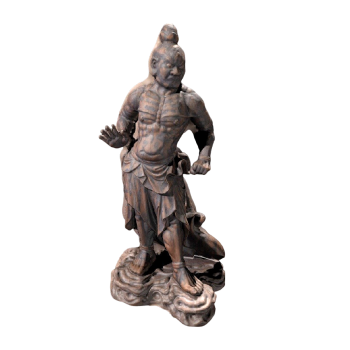
Heavenly King of the Four Heavenly Kings

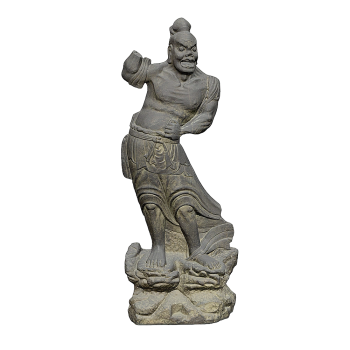
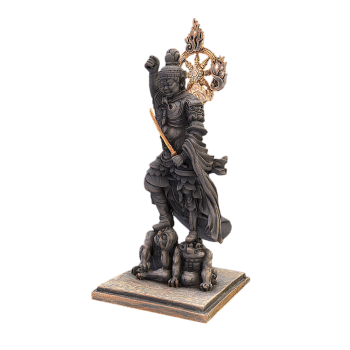
The King of Heaven is an important dharma protector in Buddhism and belongs to one of the four heavenly kings. The heavenly king of the country guards the east of the Buddhist world. His name means "land holder" and his duty is to protect the land and safeguard the Dharma. He is often portrayed as a samurai in armor and with an angry expression to deter evil forces. In East Asian Buddhist art, the standard image of a heavenly king holding a kingdom is a lute or sword. The musical instrument pipa (or other stringed instrument) held by the heavenly king of the country symbolizes the need to manage the world with both hardness and softness, neither too relaxed nor too nervous.
King Kong Hercules Wood Carving

King Kong Hercules Wood Carving

Konglius (King Ren), who are the Buddhist protectors of anger, usually appear in pairs and guard the entrance to many Buddhist temples in Japan and East Asia on both sides of the mountain gate. The statue is known for its exaggerated muscles, ferocious expressions and power-filled postures, designed to drive away evil spirits and deter enemies. This statue is made of wood, and many of the ancient Ren Wang statues are carved from wood such as Japanese cypress.
Ksitigarbha King Bodhisattva Statues

Ksitigarbha King Bodhisattva Statues

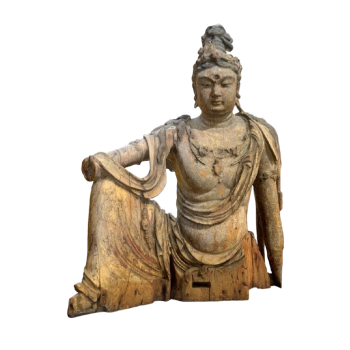
The King Bodhisattva (Kṣitigarbha Bodhisattva) is one of the four major Bodhisattvas of Chinese Buddhism. It is famous for its "great wish" ("hell is not empty, vows not to become a Buddha"), and is mainly responsible for saving all living beings in hell.
a statue of a god

a statue of a god

This statue holds the obvious instrument of "axe", and its appearance is powerful, which is more inclined to be some kind of Buddhist dharma protector, or a martial god with axe as weapon in folk belief.
Stone carving brave (HD 3D scanning)

Stone carving brave (HD 3D scanning)

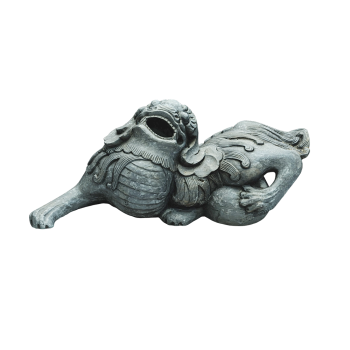
A combination of animal features, often described as having a dragon head, a horse body, unicorn feet, and sometimes wings. The neck and body have carved details of curly or flowing mane and hair. With a big mouth and a strong expression, this gesture symbolizes fortune, evil spirits and deterrence in traditional Chinese mythical beast sculptures.
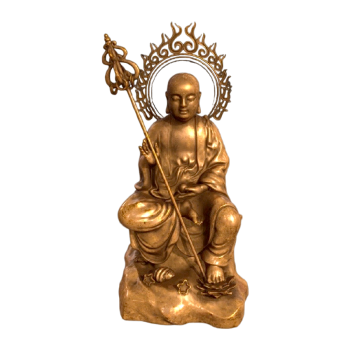
Ksitigarbha Bodhisattva

Ksitigarbha Bodhisattva

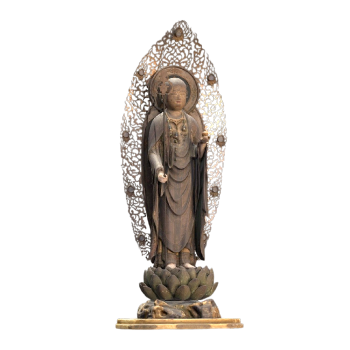
Ksitigarbha Bodhisattva is one of the four Bodhisattvas in Mahayana Buddhism. He is famous for his "great wish". His famous oath is "hell is not empty, and he will not become a Buddha". He is mainly responsible for saving six sentient beings, especially those suffering in hell, in the Buddha-free world after the Nirvana of Shakyamuni Buddha and before the birth of Maitreya Buddha. Ksitigarbha Bodhisattva usually appears in the image of a monk. This is the difference between him and other major Bodhisattvas (such as Guanyin, Manjusri, and Samurian) in the appearance of heaven and man (wearing wreaths and crowns).
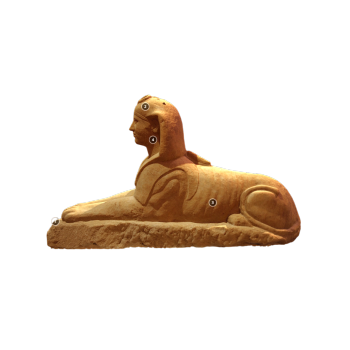
Egyptian Style Sphinx Statue

Egyptian Style Sphinx Statue

Strictly follow the Egyptian style Sphinx modeling specifications-the head is an idealized pharaoh's face (smooth eyebrow arch, deep eye sockets, apricot-shaped eyes, high nose bridge, full lips, tough jaw lines, with false beard symbolizing divinity); The head wears ancient Egyptian iconic headdresses (such as the Niemes scarf, with blue and yellow vertical stripes and holy snake decoration, symbolizing kingship and protection of gods); the body, the muscle lines are full and strong (broad chest, slightly bulging back and tight abdomen), with stout limbs, front paws stretched together, claws with clear details (clear toenails) and tail naturally curled on the side of the body.
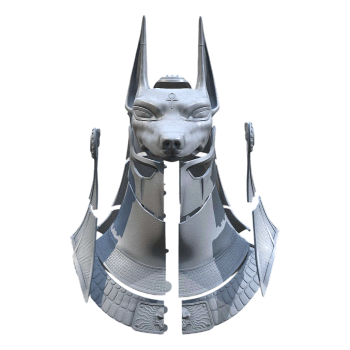
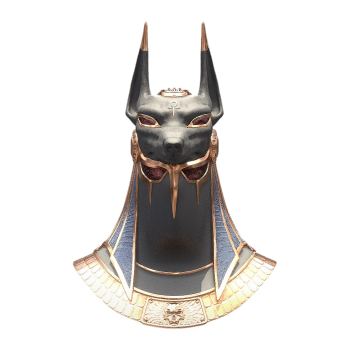
Anubis bust (support 3D printing, can be assembled model)
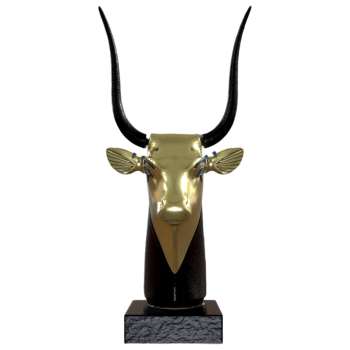
Anubis bust (support 3D printing, can be assembled model)

Hassol cow statue (3D printable)
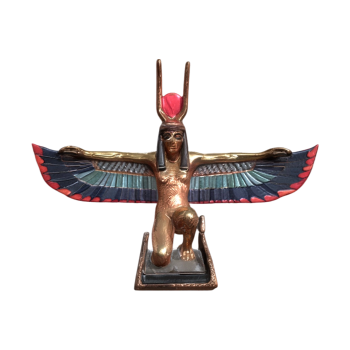
Hassol cow statue (3D printable)

"Hathor bull head image" is a typical artistic image of Hathor (Hathor), the god of love, music and joy in ancient Egyptian mythology. It is marked by "cow head" or "female face with bull ears". It is widely used in ancient Egyptian temples, burial chamber reliefs, statues and decorative arts. This image is not only the core symbol of the Hassolge, but also bears the deep belief in "fertility", "sacred protection" and "joy of life" in ancient Egypt, and is an important physical carrier for the study of religion, art and social culture in ancient Egypt.
Ancient Egyptian sky statue (3D printable)
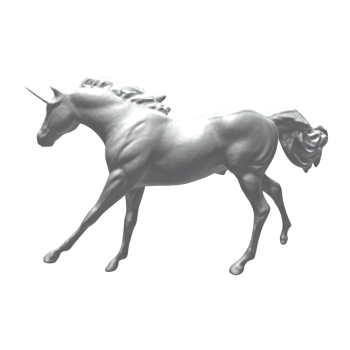
Ancient Egyptian sky statue (3D printable)

Unicorn Plaster Sculpture (supports 3D printing)
Unicorn Plaster Sculpture (supports 3D printing)

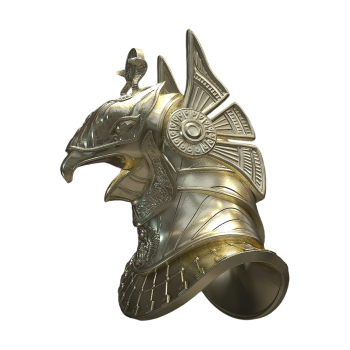
Horus bust (supports 3D printing)
Horus bust (supports 3D printing)

Horus (Horus), is the patron saint of the pharaoh in ancient Egyptian mythology, the symbol of kingship, but also the god of vengeance. He is the son of Osiris and Isis, the image of a hawk (falcon) head, wearing an Egyptian crown, a linen skirt around the waist, and a god holding a Voss (energy) cane and an Anka (life) symbol.
Anubis bust (supports 3D printing)

Anubis bust (supports 3D printing)
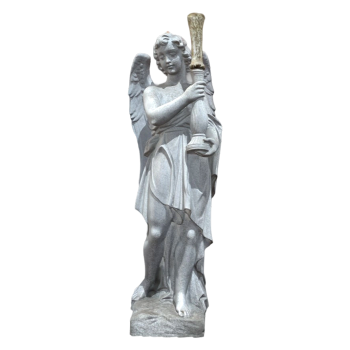
Angel Candlestick (support 3D printing)
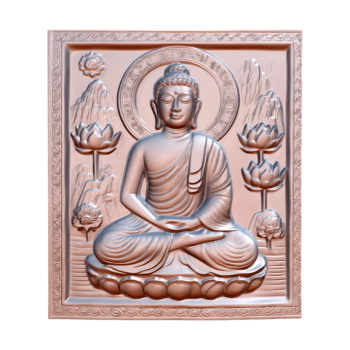
Angel Candlestick (support 3D printing)

Metal relief Sakyamuni lotus statue
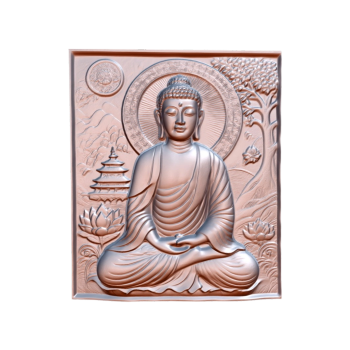
Metal relief Sakyamuni lotus statue

Sitting Statues of Sakyamuni in Metal Relief
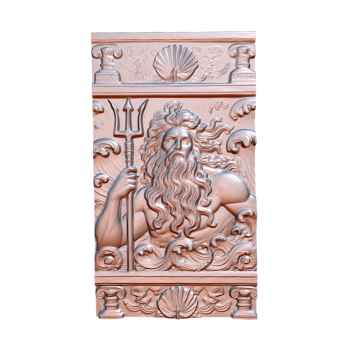
Sitting Statues of Sakyamuni in Metal Relief

Metal embossed Poseidon
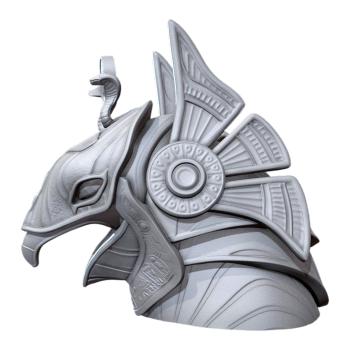
Metal embossed Poseidon

Horus sculpture (support 3D printing)
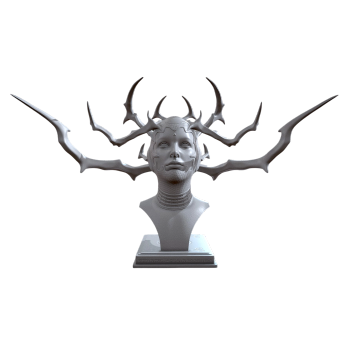
Horus sculpture (support 3D printing)

Horus (Horus), is the patron saint of the pharaoh in ancient Egyptian mythology, the symbol of kingship, but also the god of vengeance. He is the son of Osiris and Isis, the image of a hawk (falcon) head, wearing an Egyptian crown, a linen skirt around the waist, and a god holding a Voss (energy) cane and an Anka (life) symbol.
Marvel character head carving Hella (normal 3D printing)
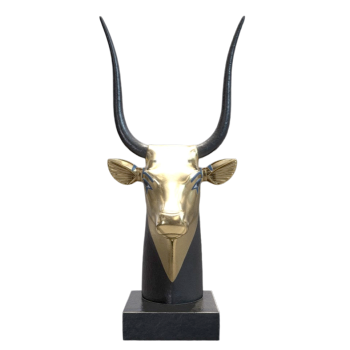
Marvel character head carving Hella (normal 3D printing)

Hella (Old Norse: Hel, English: Hela, also translated as Hull), the giant race, is the goddess of death and the queen of the underworld in ancient Norse mythology. At the same time, she is the daughter of Loki, the god of fire, and Angelburda, the sister of the giant wolf Fenrir and the giant Yermungard. Hella inherited the appearance of her parents, half of the body inherited the divine, beautiful, lovely and energetic female image of his father Loki, while the other half inherited the ugly, deformed, rotten and decaying body of the giantess mother, presenting a glacier-like cyan.
Hathor's head image (3D printable)

Hathor's head image (3D printable)

"Hathor bull head image" is a typical artistic image of Hathor (Hathor), the god of love, music and joy in ancient Egyptian mythology. It is marked by "cow head" or "female face with bull ears". It is widely used in ancient Egyptian temples, burial chamber reliefs, statues and decorative arts. This image is not only the core symbol of the Hassolge, but also carries the deep belief in "fertility", "sacred protection" and "joy of life" in ancient Egypt, and is an important physical carrier for the study of religion, art and social culture in ancient Egypt.
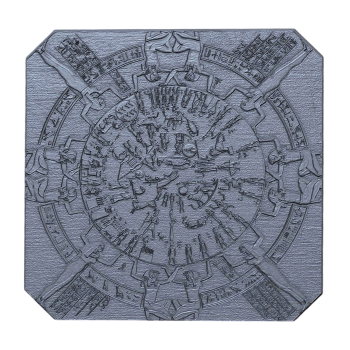
Dendra Zodiac relief (3D printable)

Dendra Zodiac relief (3D printable)

The "relief of the Zodiac in the Louvre" is an important relic of astronomical art in the late ancient Egypt (Ptolemaic period, about the 1st century BC-the 1st century AD). It was originally an "astronomical ceiling" decoration of the Temple of Dendra (Temple of Dendera) in Egypt. This group of reliefs is famous for accurate astronomical observation and mysterious religious symbols. It is a typical representative of the fusion of "astronomical calendar-theocracy" in ancient Egypt. It is now hidden in the "Egyptian Art Department" of the Louvre (Musée du Louvre) in Paris, France ".
Zhihua Temple Stone Carving Buddhist Sutra Library

Zhihua Temple Stone Carving Buddhist Sutra Library

Zhihua Temple, located at No. 5 Lumicang Hutong, Dongcheng District, Beijing, was built under the regulations of the temple "Jialan Seven Hall". It can be called the largest Ming Dynasty wooden structure complex in Beijing. Zhihua Temple was built in the eighth year of orthodoxy in the Ming Dynasty (1443). It was originally the home temple of Wang Zhen, the eunuch of Si Li Jian. During the period of Emperor Yingzong of Ming Dynasty, Wang Zhen, as the emperor's minister, monopolized the power of the court. Although he was a eunuch, his family was quite rich, so the family temple he built was extremely poor and magnificent. Because he was a favorite of the emperor, and Wang Zhenguan built a temple in the name of remembering the emperor's kindness, so Yingzong named it "Zhihua Zen Temple".
Statue of Bodhisattva in the Northern Song Dynasty

Statue of Bodhisattva in the Northern Song Dynasty

This painted stone statue of Bodhisattva during the Northern Qi Dynasty (550-577) is one of the important collections of the Asian Art Department of the Metropolitan Museum of Art (The Metropolitan Museum of Art) in New York, USA. This statue is famous for its style of "showing bones and clearing images", which perfectly combines the influence of the "Central Plains" of Buddhist art in the Northern Qi Dynasty and the "Matura style of the Gupta Dynasty in India". The Bodhisattva is "upright", with its feet slightly separated, its center of gravity falling on its right foot, its left foot naturally extending forward, and its body slightly lateral, forming a dynamic balance.
Holy Bone Box of Qingshan Temple in Jining City

Holy Bone Box of Qingshan Temple in Jining City

Qingshan Temple is Huiji Gong Temple, also known as Jiao Wang Temple. It is located in Qingshan Village, Zhifang Town, Jiaxiang County, Jining City, Shandong Province. It is an ancestral temple dedicated to the king of Jiao State in the Western Zhou Dynasty. It was later expanded into a temple integrating Buddhism and Taoism. It was built at the end of the Eastern Han Dynasty. It was rebuilt and expanded many times in the Song, Yuan, Ming, and Qing dynasties. The existing buildings were basically built in the Qing Dynasty and the Republic of China. Because the temple is located on the side of the green hills, the locals call it Qingshan Temple.
Chongqing Beishan Dazu Stone Carved Statue

Chongqing Beishan Dazu Stone Carved Statue

Dazu Rock (Dazu Rock Carvings), located in Dazu District, Chongqing, is the general name of 141 cliff statues in Dazu District. Among them, there are Baoding Mountain, Beishan (including Duo Pagoda), Nanshan, Shimen Mountain, Shizhuan Mountain, Miao Gaoshan and Shu Chengyan at the national level. The municipal level includes Jianshanzi, Qianfoyan, Fengshan Temple, Shengshui Temple, Chenjiayan and Pusheng Temple. There are 61 districts with Banchanggou and so on. There are about 50000 statues, with Buddhism as the main content, Taoism as the second. The carving categories are mainly high and shallow reliefs, a few round carvings and very few yin line carvings.
Chongqing Beishan Dazu Rock Carvings

Chongqing Beishan Dazu Rock Carvings

Dazu Rock (Dazu Rock Carvings), located in Dazu District, Chongqing, is the general name of 141 cliff statues in Dazu District. Among them, there are Baoding Mountain, Beishan (including Duo Pagoda), Nanshan, Shimen Mountain, Shizhuan Mountain, Miao Gaoshan and Shu Chengyan at the national level. The municipal level includes Jianshanzi, Qianfoyan, Fengshan Temple, Shengshui Temple, Chenjiayan and Pusheng Temple. There are 61 districts with Banchanggou and so on. There are about 50000 statues, with Buddhism as the main content, Taoism as the second. The carving categories are mainly high and shallow reliefs, a few round carvings and very few yin line carvings.
Alabaster sculpture of Our Lady of Latopa

Alabaster sculpture of Our Lady of Latopa

"The Virgin Mary" is one of the most respected saints in Christianity (especially Catholic and Orthodox). It is regarded as the mother of Jesus Christ and symbolizes "purity", "love" and "salvation". Sculptures on the theme of the Virgin Mary are very common in Western religious art, and common forms include "Virgin and Child" (Virgin and Child), "Standing Virgin" (Madonna Enthroned) or "Mourning Virgin" (Pietà). Such works are not only the material carrier of faith, but also the interpretation of divine love through artistic language.
Nepal Nyatapola Temple Statue Nasingha Statue

Nepal Nyatapola Temple Statue Nasingha Statue

As the magic incarnation of Vishnu, the statue of Nashingha (Narsinha) was built by Bhupatindra Malla, king of Newvale, in 1703 AD. It now stands at the top of the entrance steps of Nyatapole Temple in Bhaktapur (Bhaktapur) and assumes the position of patron saint.
Nepal Cultural Heritage Garuda Stone Carvings

Nepal Cultural Heritage Garuda Stone Carvings

Garuda is a bird (usually an eagle) in Hindu mythology, a mount (vahana) of the god Vishnu. Garuda unfolded in two forms. One is an animal form (such as a huge bird with half-spread wings), and the other is an anthropomorphic form (such as a human form with wings and some bird features).
Japanese Cultural Heritage Ghost Dragon Son Spirit Beast Sculpture Right

Japanese Cultural Heritage Ghost Dragon Son Spirit Beast Sculpture Right

The legendary spirit beast. The Changheizaka Institute, an educational institution guarding the Edo shogunate. It is speculated that in the Kanto earthquake, when the Tangdao Holy Church was burned down, in order to avoid disappearing, the Tokyo Museum (the predecessor of this museum) collected it. After the museum moved to Ueno, opened in 1931, the town on the roof of the building.
Japanese Cultural Heritage Ghost Dragon Son Spirit Beast Sculpture Left

Japanese Cultural Heritage Ghost Dragon Son Spirit Beast Sculpture Left

The legendary spirit beast. The Changheizaka Institute, an educational institution guarding the Edo shogunate. It is speculated that in the Kanto earthquake, when the Tangdao Holy Church was burned down, in order to avoid disappearing, the Tokyo Museum (the predecessor of this museum) collected it. After the museum moved to Ueno, opened in 1931, the town on the roof of the building.
Golden Temple of Nepal Bodhisattva Statues

Golden Temple of Nepal Bodhisattva Statues

The statue is located inside the Hiranya Varna Mahavihar Temple. The temple is also known as the Golden Temple because all the statues and structures are painted in gold. Unlike other Mahayana Buddhist temples (Mahavihar), this temple is larger and has a three-story golden pagoda dedicated to the "Sakyamuni Buddha". The stupa was built by King Bhaskar Varman in the 12th century.
Philippine Cultural Heritage Pieta Statue

Philippine Cultural Heritage Pieta Statue

Michelangelo Buenarotti's sculpture Pieta is one of the world's most famous works of art, depicting faith and grief-the wounded body of Jesus Christ being held in the loving arms of the Virgin Mary. It is a shocking reminder that both the Virgin and the Holy Son have voluntarily made great sacrifices for the salvation of mankind. The sculpture is located inside the "Kamay ni Hesus" (Hand of Jesus) church in Lucban, Quezon (Philippines). It is a replica of the original artwork, made of Carrara marble, located inside St. Peter's Basilica in Vatican City.
France Paris Tuileri Garden statue Nessos abducted Dianella

France Paris Tuileri Garden statue Nessos abducted Dianella

Laurent Marquist (Laurent Marqueste) created the sculpture Nessus Enlevant Dejanire in 1892. The sculpture was placed in the Tuileri Garden in Paris in 1894. Nessus, the Centaur, attempted to take Deianeira, the wife of Hercules. The sculpture is lifelike, showing Nessos's strong centaur form and its dynamic posture, conveying the conflict and tension of the myth.
Nepal Nyatapol Monastery Statue Nalosingha God Statue

Nepal Nyatapol Monastery Statue Nalosingha God Statue

The god Narosingha is an important character in Hindu mythology and is one of the incarnations of the god Vishnu (Vishnu). This image combines the characteristics of a lion and a human, often symbolizing power and protection. In religious stories, Vishnu descends in this form, defeating evil demons and protecting believers. Built by King Nival in the seven months between the end of 1702 and 1703, the temple is a temple dedicated to the "Siddhi Lakshmi" (Siddhi), the tantric goddess of wealth and good fortune. It is the highest pagoda temple in Nepal.
1 2 3 4 5 6 7 8 9 Next