Ming Dynasty gilded bronze Buddha statue of Medicine Buddha

Ming Dynasty gilded bronze Buddha statue of Medicine Buddha

This Buddha statue is currently housed in the Santa Barbara Museum of Art in the United States. This Medicine Buddha statue can be traced back to the Ming Dynasty in the 16th or 17th century and was auctioned at Christie's in Paris in 2022.
18th century Chinese gold-plated bronze statue of Bodhisattva

18th century Chinese gold-plated bronze statue of Bodhisattva

Maitreya Buddha Stele

Maitreya Buddha Stele

This is an artwork created in 563 AD and is currently housed in the Minneapolis Museum of Art in the United States. Although this work is relatively small in scale, its exquisite carvings showcase the complete image found on larger Buddha statues. In addition to the Maitreya statue in the center, the engraved halo, and the bodhisattvas on both sides, flying heavens and dragons also appear on the flame shaped mandalas at the top and bottom. The back of the stone tablet is engraved with a 69 character inscription, which records the name of the donor who commissioned the production of this work and dedicated it in 563.
The stone carved Buddha statue on the pagoda is located in Kathmandu, Nepal

The stone carved Buddha statue on the pagoda is located in Kathmandu, Nepal

The four Buddha statues carved on the pagoda are located in a temple in the Swayambunat complex in Kathmandu, the capital of Nepal, and were built in the 16th century. The architectural complex of Swayambunat includes a pagoda, various temples and shrines, as well as Tibetan monasteries, museums, and libraries.
The statue of Gandhara Buddha Head from the fourth century Gandhara civilization

The statue of Gandhara Buddha Head from the fourth century Gandhara civilization

This Chinese cultural relic is a sculpture called "Gandarafo Head", which was created between 300-399 AD. This sculpture is currently housed in the National Museum of the Netherlands. The characteristics of this sculpture are the raised or bun on the head (ushnisha) and the raised point on the forehead (urna), which are standard features of Buddhism. The wavy hair combed back from the face is a characteristic of the Gandhara Buddha statue. In the early decades of the 1st century AD, the first batch of Buddha statues began to emerge. The dimensions of this sculpture are 24.0 centimeters high, 15.0 centimeters wide, and 11.8 centimeters deep.
Shanru Dragon King Stone Statue

Shanru Dragon King Stone Statue

Shanru Dragon King, also known as Shannu Dragon King, is one of the eight Dragon Kings in Japanese mythology - Rain God Dragon. According to legend, the monk Konghai brought about the appearance of the benevolent Dragon King during a famous rain seeking competition in 824 AD. This statue is located at Longquan Temple on Mount Daifeng in Japan.
Buddhist Gatekeeper Stone Statue

Buddhist Gatekeeper Stone Statue
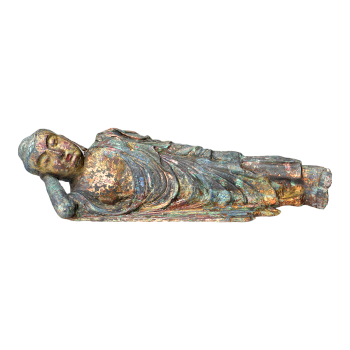
The statue of the gatekeeper god from the 8th century is now housed in the Minneapolis Museum of Art in the United States. This type of statue is usually located at the entrance of Buddhist cave sanctuaries and temple complexes, with the purpose of obstructing any forces opposing Buddhist thought. Therefore, they are vividly depicted as energetic postures, threatening facial expressions, exaggerated muscle structures, and ready to face all threats. The basic posture of this rare Tang Dynasty work, with its surrealism and complete plasticity, represents a style that had a huge impact on the Buddhist guardian image carved during the Kamakura period in Japan (1185-1333).
Nirvana Buddha statue

Nirvana Buddha statue

Nirvana Buddha is a Buddha statue depicting the Buddha's entry and death, also known as Sleeping Buddha, Sleeping Buddha, or Sleeping Buddha. It is manifested in the form of a Buddha statue depicting the appearance of Shakyamuni entering and disappearing.
Colorful glazed statue of Wei Tuo painted in the Ming Dynasty

Colorful glazed statue of Wei Tuo painted in the Ming Dynasty

This artifact is a Bodhisattva named "Weituo", a statue from the Ming Dynasty (1368-1644) in China. This ceramic artifact is currently housed in the National Museum of Scotland. The prototype of Weituotian is Shijiantuotian, the son of Brahmanism's Great Self in Heaven. Shijiantuo has over twenty names. In addition to Shijiantuo, common ones include Kumaraj, Kajiya, Shanfan, Nengzhou, and the Six Faced Child. The common image is a two armed young male war god, and there are also six sided images.
Standing Arhat, a statue in the Song Dynasty

Standing Arhat, a statue in the Song Dynasty

This Chinese cultural relic is a sculpture named "Upright Arhat", which is a Chinese work in the 6th century AD. This sculpture is currently housed in the Minneapolis Museum of Art in the United States.
19th century Japanese ivory root sculpture "Mother of Ghosts Capturing Ghosts"

19th century Japanese ivory root sculpture "Mother of Ghosts Capturing Ghosts"

This artifact is an ivory root sculpture called "Ghost Mother Capturing Ghosts", created by a Japanese artist in the 19th century. This is a small Japanese root knot sculpture, usually made of ivory, used to decorate and secure the waistband of a kimono. It is currently housed at the Minneapolis Museum of Art in the United States. This piece depicts a ghost mother catching a ghost with a hat. Guizimu is a deity in traditional Chinese culture, believed to be the god who drives away ghosts. His image is usually depicted as a agile warrior holding a sword, with a stern face, chasing or capturing demons.
Limestone relief Buddha statues from the Shunzhi period of the Qing Dynasty in the 17th century

Limestone relief Buddha statues from the Shunzhi period of the Qing Dynasty in the 17th century

Buddha seated statue, produced in the late 19th century

Buddha seated statue, produced in the late 19th century

This piece is made of gold-plated bronze and measures approximately 53.3 centimeters in size. This work was created by an unknown Thai artist in the late 19th century. This Buddha statue depicts the Buddha dressed in the attire of a prince, sitting on a carpet on a beautiful throne. This depiction became widely circulated after King Rama I (reigned 1782-1809) defeated the Burmese invasion and established the Chakri dynasty that ruled present-day Thailand. In 1917, this sculpture was collected at the Mia Museum. This is the first Asian art piece to enter the museum's collection.
Poseidon, the ancient Greek sea king, is depicted in blue bronze with a full body

Poseidon, the ancient Greek sea king, is depicted in blue bronze with a full body

Poseidon (Greek: ∋οσειδῶν, English: Poseidon) is a Greek mythological sea god and one of the twelve Olympian gods. He was also the god in charge of horses. Legend has it that he gave humans the first horse, which was a golden chariot driven by a white horse. He was the brother of Zeus and Hades. Poseidon's image is usually described as a strong man wearing a sea god robe, holding a trident. He is in charge of the ocean, waves, marine life, and navigation, possessing strong power and the ability to control the ocean.
Marble bust of the ancient Greek god Hercules

Marble bust of the ancient Greek god Hercules

Hercules (Ancient Greek: Ἡρακλῆς, Modern Greek: Iraklis, English: Heracles, also translated as Heracles, Heracles, Hercules, Hercules) is the greatest hero and demigod in ancient Greek mythology. After birth, he was initially named Alcides. The son of King Zeus and Alcmene, born with infinite strength.
The sculpture of "Terpsichore" (Goddess of Song and Dance)

The sculpture of "Terpsichore" (Goddess of Song and Dance)

Terpsichore "is an ancient Roman statue. In Greek mythology, Terpsichore is one of the nine Muses and the goddess of dance and choir. Her name comes from ancient Greek, meaning 'joy of dance'. She is usually depicted sitting, holding strings, and accompanying dancers and choirs with her music. This statue is currently housed in the Vatican Museums in Italy.
The statue of King Vishnu

The statue of King Vishnu

This model depicts Visravana, also known as the Heavenly King, in Japan. In Buddhism, the Bodhisattva Samantabhadra is one of the Four Heavenly Kings and is often depicted as a deity protecting Buddhism and the Buddhist world. This sculpture is currently located at the Guimet Museum in France.
Statue of Ar é thuse's Nymphe

Statue of Ar é thuse's Nymphe

This sculpture was created by Claude Poirier (1656-1729) and is known as the 'Nymphe of Ar é thuse'. It is made of marble, with a height of 0.99 meters, a length of 1.66 meters, and a width of 0.68 meters. This sculpture is now housed in the Louvre Museum in Paris, France. This sculpture was created between 1706 and 1711 and is exhibited alongside Jacques Prou's sculpture Amphitrite. In Greek and Roman mythology, Nymphes (fairies or nymphs) usually reside in mountains, forests, and rivers.
Roman marble statue of Hera Borgese

Roman marble statue of Hera Borgese

This statue represents the goddess of love Aphrodite, originating from MonteCalvo in the 2nd century AD, and is currently housed in the Nie Karlsberg Sculpture Museum in Copenhagen, Denmark. This sculpture is a Roman marble replica of a classical Greek bronze statue.
The Egyptian statue of Horus from the Roman period, known as the "Horus Sitting Statue"

The Egyptian statue of Horus from the Roman period, known as the "Horus Sitting Statue"

This artifact, named the "Horus Sitting Statue," is a limestone sculpture depicting Horus dressed in Roman military uniform. It was made around the 1st to 2nd century AD and is currently housed in the British Museum. The arm of the sculpture has been lost, and there was originally a crown on top of the head, which may have been made of other materials. The details of the feathers on the falcon's head are finely crafted, and the eyes are humanoid with the pupils depicted. The feathers of the falcon god also serve as scales for the carapace, with its sleeves ending below the shoulders.
The marble statue "Weeping Angel" created by William Wetmore Stoy

The marble statue "Weeping Angel" created by William Wetmore Stoy

The Weeping Angel "is a sculpture created by American sculptor William Wetmore Storey in 1894 for the grave of his wife, Emmeline Storey, in the Protestant cemetery in Rome. The full name given to it by William Wetmore Stoy is' The Sad Angel Weeps on the Demolished Altar of Life '. This is Stori's last important work before his death, one year after his wife passed away. The Metropolitan Magazine, published in 1896, documented the creation process of this statue: according to this account, the death of his wife had such a great impact on Stori that he lost interest in sculpture.
Statue of Aphrodite of Syracuse

Statue of Aphrodite of Syracuse

This statue is made of Parian marble, 1.8 meters high, and can be traced back to the second century AD. The sculpture initially lacked a head, neck, and right arm, and was later created by sculptor Antonio Canova
Statue of Ganesha, the dancing elephant head god

Statue of Ganesha, the dancing elephant head god

This statue was made in North India around 750 AD, and the elephant headed god Ganesha is one of the most popular deities in Hinduism. He is the son of Parvati, revered as the Lord of the Beginning, as well as the creator and remover of obstacles. The statue is currently housed in the British Museum.
The sandstone statue of the Aztec civilization, "Sitting Mithrant Kutli"

The sandstone statue of the Aztec civilization, "Sitting Mithrant Kutli"

The statue of Mithrant Kutli, the Aztec god of death, is currently housed in the British Museum in London. This statue is carved from sandstone, which has not been found in the highlands of Mexico and may have been collected and transported from the coastal areas of the Gulf in northern Mexico. The back of this statue is engraved with three pictographic characters: 'Two skulls',' Five vultures', and 'Four houses'. Mithrant Kutli is the god of death in Aztec mythology, often depicted as a figure with a skull face.
Buddha's seated statue from the 2nd to 3rd century AD

Buddha's seated statue from the 2nd to 3rd century AD

This Buddha statue may have been made in the Gandhara region (now Pakistan) in the 2nd to 3rd century AD. The height of this Buddha statue is 95 centimeters, the width is 53 centimeters, and the diameter is 24 centimeters. This Buddha statue depicts the Buddha sitting and preaching. The Buddha's gesture is very special. This gesture, also known as the clay jar or the Dharma wheel, reveals that the Buddha is telling a sermon, explaining the four noble truths of human existence and the path to enlightenment. This statue is currently located in the British Museum.
Sandstone slabs carved with pine fish in the Middle Ages

Sandstone slabs carved with pine fish in the Middle Ages

This is a carved sandstone slab depicting Matsya, the first incarnation of the Hindu god Vishnu. In many legends, the pine fish is described as the ancestor Manu who saved humanity from the Great Flood. This sculpture was made in the 9th and 10th centuries. This sculpture is currently on display at the Medieval Europe Gallery (G33/od) of the British Museum.
Ancient Greek centaur sculpture

Ancient Greek centaur sculpture

This sculpture depicts a creature that is half human and half horse - a centaur. The hands of this sculpture are tied, and the head and torso rotate significantly to the right and tilt backwards. The right front leg of the horse is raised, and the tail is on the right side. This sculpture is a replica, with an original height of 134 centimeters. It is a replica of one of the two marble sculptures discovered during excavation work at Hadrian's Villa in Rome in 1736, located at the National Museum of Art in Krakow, Poland. In ancient Greek and Roman mythology, centaurs were a mixed race of horse and horse. Centaurs are often depicted in ancient Greek mythology as uncontrollable beasts of sexual and physical violence.
Statue of Nike, Goddess of Victory

Statue of Nike, Goddess of Victory

Nike is the ancient Greek goddess of victory, the daughter of the giants Pallas and Styx. Nike symbolizes victory in any field, including art, music, war, and sports. In Greek art, Nike is often depicted as the flying goddess of victory. This sculpture is the most famous work of Greek sculptor Paionios (late 5th century BC). This statue was discovered in Olympia between 425 BC and 420 BC. Including the pillars, the height of the statue is 12 meters. The statue is now in the archaeological museum of Olympia, and the pedestal is still in place in Olympia.
The sculpture of the Pacific god A'a, carved on the island of Lulutu in the Australian archipelago in the 16th century

The sculpture of the Pacific god A'a, carved on the island of Lulutu in the Australian archipelago in the 16th century

The A'a statue on Lulutu Island is a wooden sculpture of the A'a god, made on the Pacific island of Lulutu in the Australian archipelago. The production period may have been between 1591 and 1647. In the early 19th century, this sculpture was given to the London Missionary Society by islanders to commemorate their conversion to Christianity. Afterwards, it was brought back to the UK and exhibited at the British Museum. The image of A'a is one of the best surviving works of Polynesian sculpture, and according to Julie Adams, director of the Oceanian Collection at the British Museum, in the 21st century, the sculpture is considered an "international celebrity".
Saint George Dragon Slaying Sculpture

Saint George Dragon Slaying Sculpture

This sculpture is located in the courtyard of the Archbishop's Palace in Bratislava and is part of the Saint George Fountain. The Archbishop's Palace is a neoclassical palace located in the old town of Bratislava, the capital of Slovakia. This sculpture depicts the scene of Saint George riding a horse and fighting against a dragon. This depiction is based on a legend that emerged in the 12th century and was recorded in the medieval text collection 'Legenda aurea'.
Iron Buddha Statue of Shakyamuni during the Goryeo Dynasty in Korea

Iron Buddha Statue of Shakyamuni during the Goryeo Dynasty in Korea

This artifact is a cast iron Buddha statue from the Goryeo Dynasty in Korea. It is now housed in the British Museum in London. Its production date is from 918 AD to 1392 AD 1234. This Buddha statue is made of cast iron. The Buddha statue was discovered at a temple site in Hasachangli, Gwangju, buried to the waist. Many features are similar to the main Buddha statue in Shiku Temple, such as the outer robe covering only one shoulder, fan-shaped folds in front of the crossed legs, and a right hand lowered towards the ground. This statue was made in the early Goryeo period of the 10th century.
Lammasu sculpture

Lammasu sculpture

Lammasu is a god in Mesopotamian mythology, typically depicted with the body of a bull or lion, wings of an eagle, and a human head. In art, Lammasu is depicted as a hybrid, a winged bull or lion with the head of a human male. This sculpture is located at the Pergamon Museum in Berlin. Lammasu's sculptures originated in the Sumerian period and later developed during the Asuro Akkadian period.
Granite Statue of the 25th Dynasty of Ancient Egypt, "The Sanctuary of Amun: King Tahaka and the Ram Statue"

Granite Statue of the 25th Dynasty of Ancient Egypt, "The Sanctuary of Amun: King Tahaka and the Ram Statue"

This artifact is a statue of the god Amun, known as the protector of Amun: the statue of King Tahaka and the ram, appearing in the image of a ram, protecting King Tahaka. It was discovered at the T Temple in Kava, Sudan and is now housed in the British Museum. It was made between 690 BC and 664 BC, during the 25th Dynasty of ancient Egypt. The ram lay on its belly, with its front legs folded underneath, and the three-dimensional statue of King Tahaka stood between them. There is a hieroglyphic inscription around the base, declaring from front to back that Tahakha was the son of Amun and Mutt, and he "completely satisfied the heart of his father Amun".
Fragment of a statue from the Gallic Roman period titled 'The God of Ophigny'

Fragment of a statue from the Gallic Roman period titled 'The God of Ophigny'

This is a fragment of a limestone statue, known as the god of Ophiene, with a pig image on it and a twisted necklace around its neck. The fragments were made during the 1st century BC, Roman Empire period, and Gaul Roman period (58 BC -5th century AD). This fragment was discovered in Ophiene. The fragments are made of limestone. The dimensions of the fragments are: height of 25.8 centimeters, width of 10.5 centimeters, and depth of 7.5 centimeters. The fragments are now collected at the National Archaeological Museum in London.
The marble statue 'Giant Half body of Zeus' from Lazio, Italy

The marble statue 'Giant Half body of Zeus' from Lazio, Italy

This statue is a marble bust of Zeus. It was discovered in the Villa Hadrian in Tivoli, Lazio, Italy. Now, the statue is housed in the British Museum in London.