The marble statue of Apollo from the Hellenistic period of ancient Rome

The marble statue of Apollo from the Hellenistic period of ancient Rome

This marble statue is Apollo, holding a qin and quiver in his hand. He was naked except for the cloak around his waist. The right arm that was originally raised, as well as the left wrist and hand, are now missing. This statue is a work from the Hellenistic period of Rome, made in the 2nd century AD. This statue was excavated by an archaeological team led by Sir Robert Murdoch Smith and Edwin A. Borcher at the Temple of Apollo (Cyrene) in Libya. Now, this statue is housed in the British Museum in London. The height of the statue is 2.28 meters. This statue is a Roman replica of the original Greek work dating back to 200-150 BC.
The igneous rock statue of Yoga Buddha, a cultural relic from the Chola period in India

The igneous rock statue of Yoga Buddha, a cultural relic from the Chola period in India

Yoga Buddha is a very important deity in Indian history, and his story and image occupy a significant position in Indian yoga culture. Archaeologists have discovered a large number of stone sculptures and pottery seals in the Harappan and Mohenjodaro cultures of the Indus Valley civilization, featuring figures in yoga and meditation postures. There are many cross legged (described as yoga sitting posture) human figures on the Harappa seal, and the statues are now collected at the Minneapolis Museum of Art.
Bronze statue from the Sultanate of Delhi, India, depicting the Buddha's achievement without impurities

Bronze statue from the Sultanate of Delhi, India, depicting the Buddha's achievement without impurities

This statue, named the Pure Accomplishment Buddha, is one of the Five Wisdom Tathagatas in Tibetan Buddhism. It is related to the achievements of the Buddhist path and the destruction of poison. His name means' pure achievement '. His spouse is Tara, meaning the one who liberates, and his mount is Garuda. He belongs to the business family, whose family emblem is the Double Diamond Rod. This statue is made of copper and is currently housed in the Minneapolis Museum of Art in the United States. It was made in the 13th century AD, between 1200 and 1300 AD. This statue is a representative work of Tibetan Buddhist art, showcasing the artistic style and techniques of that period.
Amitabha Buddha statue

Amitabha Buddha statue

This statue was originally located in Hancui Village, Hebei Province, northern China. According to the inscription on the pedestal of the statue, it was enshrined for Chongguang Temple in 585 AD. This statue was created by art merchant C T. Loo donated it to the Chinese government, and in 1938, the Chinese government gave it as a gift to the British Museum to commemorate the Chinese art exhibition held in London from 1935 to 1936 This Amitabha Buddha statue is about 6 meters high and is the largest ancient Chinese statue in the West
Nereid Monument

Nereid Monument

In Greek mythology, Nereid is the daughter of the sea gods Neris and Doris, who help sailors in the face of fierce storms. This monument comes from Kesantos in Lysia (now near Fetshiya, Türkiye), and was built about 390-380 BC. It is believed to have been built in memory of Arbinas, a member of the Cthulhu dynasty that ruled Silesia under the Achaemenid Empire. The form of this monument is a Greek temple located on a pedestal decorated with carved reliefs.
The Nereid Monument, British Museum

The Nereid Monument, British Museum

Nereid Monument, a sculpture tomb from Lysia, is located in Santos, near Fetshiya, Türkiye today. It takes the form of a Greek temple, decorated with carved reliefs on its pedestal, and is believed to have been built in the early 4th century BC (around 390 BC) for Arbinas (Erbbina or Erbinna in Lysian), the ruler of the Shantos dynasty that ruled Silesia under the Achaemenid Empire. This sculpture is currently housed in the British Museum.
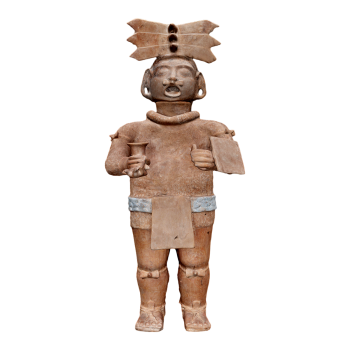
Xipe T ó tec Mexican Cultural Sculpture
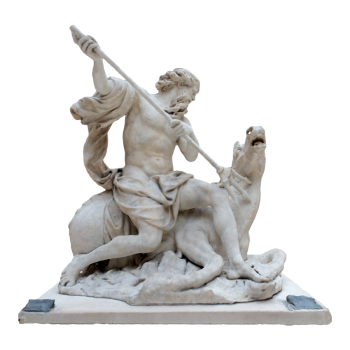
Xipe T ó tec Mexican Cultural Sculpture

This ceramic sculpture represents the god Xipe T ó tec ("Our Master, the Skinned Man"). It was discovered by Swedish archaeologists in 1932. This sculpture is currently housed in the Teotihuacan exhibition hall of the National Museum of Anthropology (MNA) in Mexico. Xipe T ó tec is a god of life, death, and resurrection in Mexican culture, as well as a god of agriculture, plants, the East, disease, and goldsmiths. This sculpture has two different human bodies: a complete human body below, and on top of it is the skin and some tissues of a victim.
Statue of Neptune

Statue of Neptune

This is a work by French sculptor Antoine Coysevox, named 'Neptune'. This artwork is a marble sculpture, measuring 1.85 meters in height, 1.77 meters in length, and 1.11 meters in width. This work is one of the "River" sculpture groups in Mally Park, opposite the Aphrodite sculpture at the bottom of the waterfall, now located in the Louvre Museum in France.
Statue of En é e et Anchise

Statue of En é e et Anchise

The works of French sculptor Antoine Coysevox are currently housed in the Louvre Museum. The height of this artwork is 2.64 meters, the width is 1.14 meters, and the depth is 1.10 meters. The hero Aeneas and his father Anchises in ancient Roman mythology. This work is currently housed in the Louvre Museum, with a height of 2.64 meters, a width of 1.14 meters, and a depth of 1.10 meters.
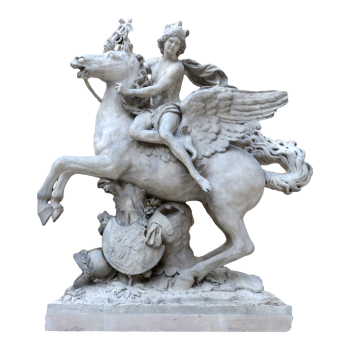
Statue of Mercury on a Flying Horse

Statue of Mercury on a Flying Horse

This sculpture is the work of French sculptor Antoine Coysevox and is currently housed in the Louvre Museum. This work was created between 1698 and 1702, depicting the scene of Mercury riding a flying horse. The height of this sculpture is 3.15 meters, the width is 2.91 meters, and the depth is 1.28 meters. It is made of Carrara marble.
Statue of the mythological figure Mercury

Statue of the mythological figure Mercury

This sculpture is created by B Created by Thorvaldsen, currently housed in the Krakow National Museum. This work has been digitized as part of the Malopolska Virtual Museum project. In this work, the mythological figure Mercury (i.e. Hermes in Greek mythology) is preparing to kill Argos. The height of this sculpture is 174.5 centimeters, carved from marble. The creation date of this work is between March 21, 1819 and 1822. This work is part of the neoclassical art movement and reflects the modernity of Europe.
The marble bow statue of the British fifth class frigate 'The Old Father Thames'

The marble bow statue of the British fifth class frigate 'The Old Father Thames'

The statue is a cultural relic dating back to 1823, which was a five class frigate with 46 guns built at Chatham Shipbuilding. The statue is a carefully carved marble male half body, depicting an angry river god and undoubtedly representing the spirit of the Thames River. The statue is known as the 'Old Father Thames' and was taken from the fifth class frigate HMS Thames (1823). The Thames River is an important river that serves as the main trade route to the busiest port in London. It is an important shipbuilding center with royal docks and numerous private companies, and the statue is now housed in the National Maritime Museum in London.
The marble statue of the Nine Muses - Erato during the reign of Emperor Hadrian in ancient Greece

The marble statue of the Nine Muses - Erato during the reign of Emperor Hadrian in ancient Greece

Erato is one of the nine Muses in Greek mythology, and she is the goddess of inspiration for literature, science, and art. Erato is the muse of lyrical poetry, especially erotic poetry. In Orphic hymns, Erato is known for her visual charm. Since the Renaissance, she has been often depicted wearing a wreath of myrtle and roses, holding a harp or small harp, which is an instrument often associated with Apollo. This statue is made of marble and comes from Mount Calvo in the 2nd century AD. It is now collected at the Carlsberg Art Museum in Copenhagen, Denmark.
The marble statue "Aphrodite Bathing" from the classical period of ancient Greece

The marble statue "Aphrodite Bathing" from the classical period of ancient Greece

Aphrodite is the goddess of love and beauty in ancient Greek mythology, often depicted in scenes related to water, such as bathing or drying oneself after bathing. This is one of the most famous sculptures of Aphrodite, created by the Greek sculptor Praxiteles in the 4th century BC. The statue is a typical feature of ancient Greek sculpture, depicting the scene of a goddess suddenly startled while bathing. The statue is now housed in the British Museum. Many versions of the statue depict Aphrodite attempting to cover her body with her hands or a falling curtain. In this statue, Aphrodite crouches naked and turns her head to the right, as if startled.
Indian Shiva Nataraja Igneous Rock Statue from the Chola Period

Indian Shiva Nataraja Igneous Rock Statue from the Chola Period

Shiva is one of the three main gods of Hinduism. Its predecessor was the god of reproduction, "Beast Lord," and the god of Vedic storms, Tatra, during the Indus Civilization era. It had a dual personality of reproduction and destruction, creation and destruction, presenting various bizarre and bizarre appearances, mainly including the Linga, Gentle, Superhuman, Dance King, Rika, and Half Girl. Linga is the most basic symbol of Shiva. Like many gods in mythology, due to Shiva's omniscient and omnipotent nature, her gender is not fixed, but changes at any time according to her different appearances. In Buddhist literature, Shiva is referred to as the Great Self in Heaven, residing at the top of the realm of colors, and is the ruler of the three thousand realms.
Roman Empire period marble statue "dance muse"

Roman Empire period marble statue "dance muse"

This marble statue is the work of ancient Rome in the 2nd century AD and is now in the museum in Copenhagen, Denmark. The rotation movement emphasized by the right hand holding the cloak indicates that the woman is dancing. She's the muse, the muse of dance. The muse in Greek mythology is the muse of sacred poetry, sacred hymns, dance and eloquence, and agriculture and pantomime. She is depicted as very serious, contemplative and meditative, often putting her fingers to her mouth, wearing a long cloak and veil, and resting her elbows on a post. It is also sometimes considered the muse of geometry and meditation. Museum in Copenhagen, Denmark
The Golden Wood Carving of Compassionate Avalokitesvara from the Jin Dynasty
The Golden Wood Carving of Compassionate Avalokitesvara from the Jin Dynasty

This Bodhisattva statue is a cultural relic in Shanxi Province, China, from the Jin Dynasty, around 1200 AD. Its name is "Avalokitesvara of Mercy". The decoration of the statue is very fine, made of wood, with traces of gold and multi-color on it. The statue is the image of the Bodhisattva of Guan Shi Yin, who is the Bodhisattva of compassion. Bodhisattvas are the central element of Mahayana Buddhism. They are people who have reached a high degree of enlightenment. They help others to reach enlightenment and postpone their own enlightenment on the road to Buddhism. This work shows two intertwined dragons and a remarkable necklace. This statue is now in the Museum of Art History in Brussels, Belgium.
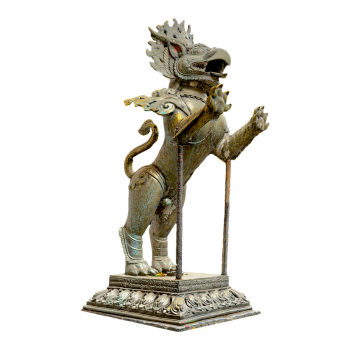
Gryphon statue in the Golden Temple of Patan, Nepal (Hiranya Varna Mahavihar)

Gryphon statue in the Golden Temple of Patan, Nepal (Hiranya Varna Mahavihar)

Griffin (ancient Greek: γρ≠ φων), also known as "Griffin", "Gryphon", "Sphinx Eagle", "Sphinx Eagle Beast", "Fawl Head Flying Lion" or "Lion Bird" is a legendary creature popular in West Asia to the Mediterranean. Hiranya Varna Mahavihar, is a Buddhist temple located in Patan, Nepal. Dating back to the 12th century, the temple was built by King Bhaskar Verma in the 12th century, and all the statues and structures inside the temple were painted in gold, making it popularly known as the "Golden Temple".
Gryphon statue in the Golden Temple of Patan, Nepal (Hiranya Varna Mahavihar)

Gryphon statue in the Golden Temple of Patan, Nepal (Hiranya Varna Mahavihar)

Griffin (ancient Greek: γρ≠ φων), also known as "Griffin", "Gryphon", "Sphinx Eagle", "Sphinx Eagle Beast", "Fawl Head Flying Lion" or "Lion Bird" is a legendary creature popular in West Asia to the Mediterranean. Hiranya Varna Mahavihar, is a Buddhist temple located in Patan, Nepal. Dating back to the 12th century, the temple was built by King Bhaskar Verma in the 12th century, and all the statues and structures inside the temple were painted in gold, making it popularly known as the "Golden Temple".
Plaster statue of the sculptor Joseph Ducacu, The Fall of Babylon

Plaster statue of the sculptor Joseph Ducacu, The Fall of Babylon

The Fall of Babylon is a work of art created in 1884 by Joseph Dukaju (1823-1891), now in the collection of the Royal Gallery in Brussels, Belgium. Babylon was an important city in the ancient Middle East, famous for its majestic walls and hanging gardens. However, the glory of Babylon did not last long. In 539 B. C., the Persian king, Serus II, captured Babylon, marking the end of the Neo-Babylonian Empire.
Sitting Statues of Sakyamuni Buddha in the Period of the Imperial Empire of Gui Shuang
Sitting Statues of Sakyamuni Buddha in the Period of the Imperial Empire of Gui Shuang

The statue depicts the image of Buddha Sakyamuni in a state of enlightenment, sitting in a meditative posture. This statue is probably an early Buddha found by the site of Jamal Garry in the ancient Gandhara region of modern Pakistan during the Kisam Empire, during the 2-3rd century AD.
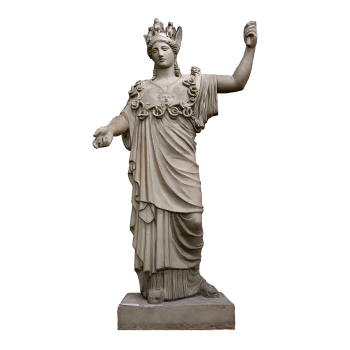
Late Roman period plaster replica statue "Bringing Hope-Athena of Farnese"

Late Roman period plaster replica statue "Bringing Hope-Athena of Farnese"

Bringing Hope-Farnese's Athena is a statue of Asina, a Roman plaster replica of a late 5th century BC Greek original. The design of the statue's intricate helmet was inspired by Asina Parthenon of the Parthenon. The repaired parts include the arms, the animal and cheek pieces on the helmet, and some amulet snakes. The statue has a height of 224cm and is now preserved in the National Museum of Naples.
The statue of kaolin during the reign of Ramapala, India "Skywalker Bodhisattva of Mercy"

The statue of kaolin during the reign of Ramapala, India "Skywalker Bodhisattva of Mercy"

The sculpture is an artifact from the reign of Bihar, Para Dynasty, Ramapala (1078 AD/79 to at least 1130 AD) in eastern India. The name is "Skywalker Mercy Bodhisattva. The sculpture is very finely decorated, made of kaolin with traces of pigment. This sculpture is the image of Avalokitesvara, a powerful and compassionate bodhisattva, sitting in an elegant posture with the image of Amitabha above his head. This image is a compassionate bodhisattva that brings liberation to evil spirits. To the right of Avallokitsvara is the Green Mother, holding a lotus flower in his hand, and to his left is the four-armed goddess, holding a rosary and a water bottle in his hand.
Bronze statue of the Chola period in Tamil Nadu, South India Shiva, King of Dance
Bronze statue of the Chola period in Tamil Nadu, South India Shiva, King of Dance

The statue is a work from the Chola period (900-1200 AD) in Tamil Nadu, South India, depicting Shiva, the king of dance. The statue measures: 113 x 102 x 30 cm overall and is currently in the collection of the Cleveland Museum of Art. In this statue, Shiva is depicted as the source of all movement in the universe. His dance of destruction is accompanied by the arc of flame, symbolizing the demise of the universe at the end of an era. Four hands hold different objects, including flame and drum, representing destruction and creation respectively. The right foot steps on a dwarf demon, symbolizing the smashing of ignorance.
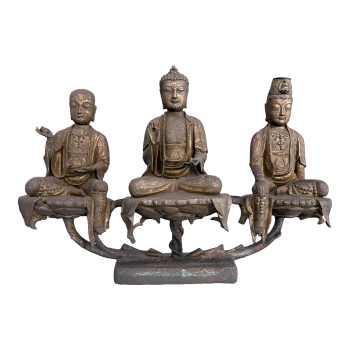
Bronze statue of the Joseon Dynasty "Three Amitabha"

Bronze statue of the Joseon Dynasty "Three Amitabha"

This relic is a bronze statue named Amitabha Three, made in 1400 AD. This statue is from the South Korea of the Joseon Dynasty (AD 1392-1910). This statue is made of bronze material with traces of gilding. The overall dimensions of this statue are 40.6 x 16.5 x 54.6cm. Among them, Amitabha Buddha sits in the center of the lotus seat. On his left and right sides are two waiters: Ksitigarbha Bodhisattva and Guanyin Bodhisattva. The combination of these three was popular in the early Korean period. This statue is now in the collection of the Cleveland Museum of Art.
Classical Indian period igneous statue "Yoga goddess holding a jar (Yogini with a jar)"

Classical Indian period igneous statue "Yoga goddess holding a jar (Yogini with a jar)"

The statue is known as the "Yoga goddess holding a jar" and was made during the classical Indian period in the early 10th century AD. In the Indian subcontinent and many indigenous beliefs, the goddess is seen as the embodiment of life-giving energy. The goddess known here as yoga gracefully demonstrates complete control over the body. She holds a jar in her hand that may contain drugs, demonstrating her healing powers. Her now fractured left lower limb used to hold a skull cup for drinking. The sculpture was once enshrined in a circular open-air temple, along with at least 15 other goddesses, each believed to have unique powers, and is now in the collection of the Minneapolis Museum of Art.
The statue of the Song Dynasty in the Korean Dynasty

The statue of the Song Dynasty in the Korean Dynasty

This work demonstrates the persistence of Buddhism and its religious practice during the Joseon Dynasty (1392-1910), even after Neo-Confucianism became the state religion. It is difficult to determine which Buddhist deity this statue represents due to the lack of a crown, but it can undoubtedly be classified as a bodhisattva (meaning "awakening person"). This work is from the Joseon Dynasty (1392-1910) period. The Joseon Dynasty was the last feudal dynasty in the history of the Korean Peninsula. The capital of the Korean dynasty was in Kajing, the old capital of Koryo (now Kaesong; Also known as Songdu), the capital was set in Hanyang (now Seoul) in 1394 and was renamed Seoul the following year.
Marble Steles of Sakyamuni and Maitreya in the Northern Qi Period

Marble Steles of Sakyamuni and Maitreya in the Northern Qi Period

The stele is a marble carving from the Northern Qi period. The Northern Qi Dynasty (550-577) was one of the Northern Dynasties in the Southern and Northern Dynasties in Chinese history. During the Northern Qi period, Buddhism spread and developed widely in China. Buddhist art works in this period often show a unique artistic style. The Sakyamuni on this stone tablet represents the past and future of Buddhism respectively. The Buddha Sakyamuni shows a kind smile with fearless and alms gestures, flanked by two Bodhisattvas and two disciples. Sakyamuni, also known as Gautama Siddhartha, was the founder of Buddhism and founded Buddhism in ancient India in the 6th century BC.
Painted Wood Carving of the Northern Song Dynasty "Eleven-sided Guanyin Bodhisattva"

Painted Wood Carving of the Northern Song Dynasty "Eleven-sided Guanyin Bodhisattva"

"Eleven-sided Guanyin Bodhisattva" is a wood carving art from the late Northern Song Dynasty to the Jin Dynasty in China. It is currently in the Cleveland Museum of Art. The sculpture is 218.5cm high and is carved from willow made of painted and cut gold. This statue is the Avalokitesvara in Buddhism, symbolizing the Buddha's steps to enlightenment. The historical and artistic value of sculpture is very high, and it is the treasure of ancient Chinese art. It shows the carving techniques of the Song Dynasty, reflecting the religious beliefs and aesthetic concepts of the time.
New Assyria Period Gypsum Relief "Salute Guardian Spirit Saluting Protective Spir"

New Assyria Period Gypsum Relief "Salute Guardian Spirit Saluting Protective Spir"

The "Patron Saint of Tribute" is a plaster relief dating from the Neo-Assyrian period (911-609 BC). Found at the Northwest Palace in Nimrud, Iraq, currently in the collection of the Cleveland Museum of Art. The relief, which depicts a winged god and an agricultural harvest, was created during the reign of Ashur Nasir Pal II, the second king of the Neo-Assyrian Empire, from 883 BC to 859 BC. This relief was made under his leadership to decorate the palace. It is one of hundreds of similar reliefs.
The marble statue of Dioscuri in Copenhagen Square, Denmark

The marble statue of Dioscuri in Copenhagen Square, Denmark

Dioscuri was a twin deity in ancient Greek and Roman mythology. They rescued the shipwrecked crew and were given a good wind by people offering sacrifices. Their mother was Leda and their father was Zeus, the king of the gods. Later Zeus placed them in the sky and became Gemini. In Rome, tradition holds that reverence for them was introduced in 484 BC. Orus Pastumius built their shrine on the square right after he swore at the Battle of Lake Rejilus. Legend has it that in this battle, Dioscuri fought on the side of the Romans and brought news of the victory to Rome.
Minneapolis Art Gallery Collection 12th Century Bronze Statue of Shiva Nataraja, India

Minneapolis Art Gallery Collection 12th Century Bronze Statue of Shiva Nataraja, India

The Hindu god Shiva appears in several incarnations. Here, Shiva appears as the king of the dance. He raised his left foot in an elegant dancing pose. In his upper right hand, Nataraja holds a drum, the sound of which embodies creation. The flame he held in his upper left hand symbolized destruction. Together they symbolize the creation and destruction of the universe. The gestures of the lower left and lower right palms of the icon indicate protection. The foot resting on the demon's back symbolizes the elimination of ignorance, while the raised left foot symbolizes salvation. A now-missing ring of fire, symbolizing the simultaneous and continuing creation and destruction of the universe, will surround the bronze icon.
Minneapolis Art Museum Plaster Statue of Guanyin Bodhisattva of the Northern Song Dynasty

Minneapolis Art Museum Plaster Statue of Guanyin Bodhisattva of the Northern Song Dynasty

Minneapolis Museum of Art 13th Century Japanese Wood Carving Northern Heavenly King Vishamon Sky

Minneapolis Museum of Art 13th Century Japanese Wood Carving Northern Heavenly King Vishamon Sky

This is a late 13th century statue of the celestial Visharman, now in the Minneapolis Museum of Art. This statue is made of Japanese cypress wood, painted with color, gold foil, metal. It was created by Chang Qing, a famous Japanese sculptor of Buddha statues. Pishaman day is one of the four kings in Buddhism, guarding the north, driving out demons and protecting the world. He wore a heavily armored samurai with a spear and a small tower.
Marble statue of Hercules of FarNese at the National Archaeological Museum of Napoli, Italy

Marble statue of Hercules of FarNese at the National Archaeological Museum of Napoli, Italy

The original of the statue is bronze but has been lost, and the extant is a Roman-period marble replica, in several different sizes and versions. One of the most famous replicas is Farnessey Hercules, created in 212 by the sculptor Grikhon and now in the collection of the National Archaeological Museum of Napoli, Italy. The statue depicts Hercules, who has just completed his twelve drudgery, with a haggard face and melancholy eyes, showing his humanity and tragedy.