
Sending Empress Bamboo Root Carving

Sending Empress Bamboo Root Carving

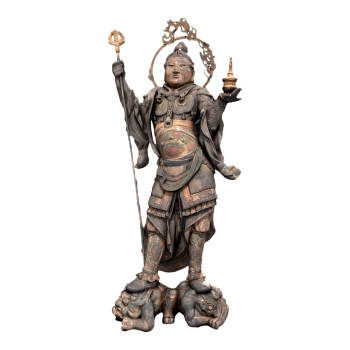
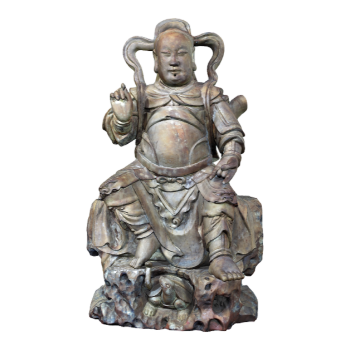
Bamboo root carving is a traditional handicraft, which uses bamboo root as raw material for carving creation. In 2014, bamboo root carving was included in China's intangible cultural heritage list. Bamboo root carvings are included in China's intangible cultural heritage list. This bamboo root carving carved the Chinese mythical figure Sending the Empress. In different parts of China, there are different stories and legends of the Chinese fertility goddess. Empress Bamboo is a goddess image derived from the three goddesses in the Ming Dynasty novel "Fengshen Bang. The three goddesses are the younger sisters of Zhao Gongming, the god of wealth, named Zhao Yunxiao, Zhao Qiongxiao and Zhao Bixiao. Later, these three goddesses merged into one and were called Empress Zhu Sheng.
Marble statue of the Cleveland Museum of Art The Muse of Poetry

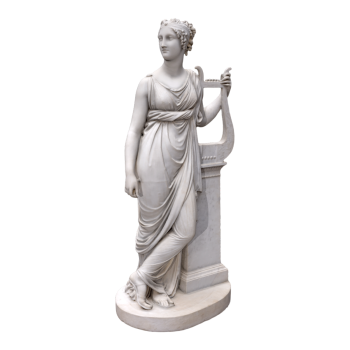
Marble statue of the Cleveland Museum of Art The Muse of Poetry

The Poetic Muse in Ancient Greek Mythology She is one of the nine Muses who inspired her creation. She holds a lyre and has a double snake-wound staff. The statue was carved out of marble by Italian sculptor Antonio Canova in 1816. It is one of nine muse statues designed by Canova for Tsar Alexander I of Russia. The statues were originally intended to be placed in the Hermitage Museum in St. Petersburg, but they were scattered to different places due to the sudden death of the Tsar. The Poetic Muse was eventually acquired by the Cleveland Museum of Art in 1968. It is one of the museum's most important collections.
Marble relief "The Death of Mel Arg" at the City Museum in Brussels, Belgium

Marble relief "The Death of Mel Arg" at the City Museum in Brussels, Belgium

The Melleag of Death is a set of three marble reliefs created by the French sculptor Jacques Bergé (Jacques Bergé) at the end of the 19th century, depicting the life and death of Melleag in Greek mythology. These reliefs are "Melaag Kills the Wild Boar", "Melaag and Atalanta" and "The Death of Melaag", which respectively show the bravery, love and tragedy of Melaag. These reliefs are currently in the collection of the Brussels City Museum, located in the "" Royal Palace "" or "" Bakery "in the Grand Place of Brussels. The building itself is a historic museum.
The Abduction of Prosopina in Marble at the Bogise Gallery in Rome
The Abduction of Prosopina in Marble at the Bogise Gallery in Rome

The Abduction of Proserpina is a large group of Baroque marble sculptures by Gian Lorenzo Benigni. The sculpture depicts a Roman mythology in which Pruto, the god of the underworld, captures and takes Prosopina. Pruto exalts Proserpina, while Serborus symbolizes the border of the underworld into which Pruto brought Proserpina. The sculpture is made of Carrara marble and was originally placed on an already destroyed pedestal with a poem by Barberini Maffeo. The sculpture is now located in the Bogise Gallery in Rome.
Marble statue of Emperor Zhenwu

Marble statue of Emperor Zhenwu

Zhenwu Emperor, also known as Xuantian God, Xuanwu Emperor, Yousheng Zhenjun Xuantian God, and Insufficient Patriarch, is the full name of Zhenwu Dangmo Emperor. He is the northern god in Han myths and legends, and is the famous Yujing Zun God among Taoist immortals. At present, the main god enshrined in Wudang Mountain in Hubei Province is Emperor Zhenwu, who is called "Zhen Zhen Zhen Zhen Zhen Wu Ling Ying You Sheng Emperor" in the Dao Jing, and is referred to as "Zhenwu Emperor" for short ". Han folk called the Lord of the Demon, the Patriarch of Reporation, and the Patriarch of the Hair. After the Ming Dynasty, it had a great influence on the whole country, and the folk beliefs Han modern China were particularly common.
Amitabha Statues

Amitabha Statues

Sculpture of the god Thoth

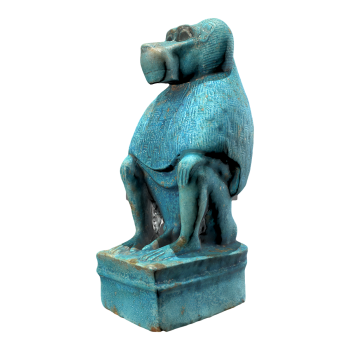
Sculpture of the god Thoth

Thoth, also translated as Thoth or Thoth, is the god of wisdom and the moon, the local god of Heliopolis, the inventor of words, the instrument of the gods, and is depicted in the Book of the Dead as the Statue Judge. Toth is often depicted as a heron head, with a name meaning and curved mouth reminiscent of a crescent moon. Sometimes, Tochow is also depicted as a baboon holding a crescent moon because baboons are nocturnal and quite intelligent. The model is a Thoth sculpture, made in 7-6 BC, now in the collection of the Minneapolis Institute of Art.
Giant Buddha at Shansheng Temple

Giant Buddha at Shansheng Temple

A wooden Guanyin sculpture 3D model

A wooden Guanyin sculpture 3D model

[3D Scanning] Copper Buddha Head Half-body Buddha Statues AR Buddha Crafts Copper Products Ornaments

[3D Scanning] Copper Buddha Head Half-body Buddha Statues AR Buddha Crafts Copper Products Ornaments

The Buddha bust is made of cast resin, rich in bronze powder, and has the charming appearance of a vintage work.
The top of a pyramid

The top of a pyramid

This item was placed at the top of the funeral pyramid on the roof of the chapel. It shows the symbol of day and night. Unearthed in the Saqqara region of Egypt, the 18th dynasty of ancient Egypt, about 1325-1300 BC, made of limestone. It is currently housed in the National Museum of the Netherlands.
Bronze Buddha statue 3D Buddha avatar Buddha Buddha statue AR crafts Buddha head

Bronze Buddha statue 3D Buddha avatar Buddha Buddha statue AR crafts Buddha head

Excellent details and complex craftsmanship, engraved with high-quality resin, hand-polished.