Sculpture/Artifacts
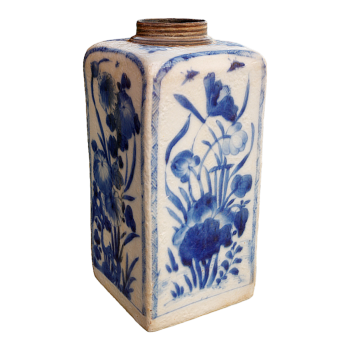
Cloisonne bottle 3D model
Cloisonne (Cloisonne), one of China's famous special metal crafts, to the Ming Dynasty Jingtai years this craft technology production reached the peak, the production of the most exquisite and famous crafts, so later called this metal for "cloisonne". Cloisonne is named "copper tire cloisonne enamel", commonly known as "enamel", also known as "inlaid enamel", is a kind of copper tire, with soft flat copper wire, pinched into various patterns and welded on, and then filled with enamel color glaze in the pattern of firing artifacts.
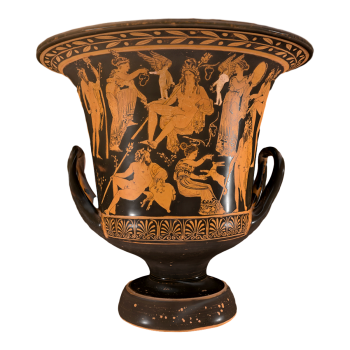
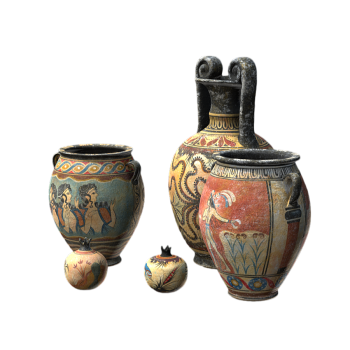
A group of pottery 3D models of the Cretan civilization
Minoan civilization, also translated as Minoan civilization, is an ancient civilization in the Aegean region, appeared in ancient Greece, the Bronze Age before the Mycenaean civilization, about 2850 BC -1450 BC. The development of this civilization was mainly concentrated on the island of Crete.
The Minoan civilization, to be exact, should be the civilization of the Crete region. The Cretan civilization originated in ancient Egypt and Asia Minor. Judging from the unearthed objects, Crete was once a good trading port in the early Mediterranean and had close commercial ties with ancient Egypt and Asia Minor.
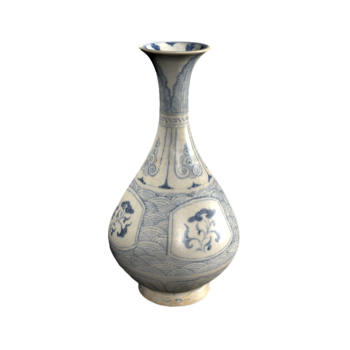
Blue and white porcelain porcelain vase 3D model
Blue and white porcelain (blue and white porcelain), also known as white blue and white porcelain, often referred to as blue and white, is one of the mainstream varieties of Chinese porcelain, is underglaze porcelain. Blue and white porcelain is made of cobalt ore containing cobalt oxide as raw material, painted on the ceramic body, and then covered with a layer of transparent glaze, a high temperature reduction flame firing. The cobalt material is blue after firing, and has the characteristics of strong coloring power, bright color, high firing rate and stable color. The original blue and white porcelain was seen in the Tang and Song dynasties, and the mature blue and white porcelain appeared in the Hutian kiln in Jingdezhen in the Yuan Dynasty. Blue and white in the Ming Dynasty became the mainstream of porcelain. The development reached its peak during the Ming Xunde period.
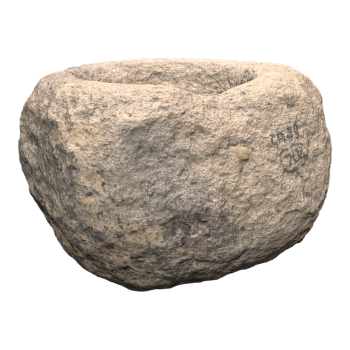
Neolithic Pot 3D Model Handmade Pottery
Pottery is the daily life utensil of the ancient ancestors. Painted pottery integrates the shape of the instrument and the beautiful pattern. It is a work of art in itself. It is not only a sign of the advanced pottery technology, but also the crystallization of the wisdom of the ancient people.
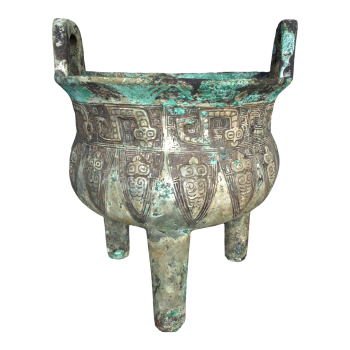
A censer of Qianlong period
A bronze incense burner commissioned by a Kowloon merchant. Probably from a magnificent imperial temple. Based on a ritual food vessel made 3000 years ago. It is now located in the British Museum.
Ancient Wine Warmer Dou
The culling bucket, also known as "Diao Dou", was first published in Sima Qian's "Historical Records" and is a bronze-cast marching utensil. This bowl was unearthed from the Sui and Tang tombs in Xiaotun, Yin Ruins. The long handle is slightly perpendicular to the spout. Looking down from top to bottom, it can be observed that the tail end of the handle is pentagonal, with a square hole in the middle, and the shape is exquisite. Turning to the bottom again, you can find that the bottom of the device and the foot are not glazed. The bowl is a warm boiler, which can be heated on the fire. A large number of tombs were unearthed from the Han Dynasty to the Six Dynasties. The materials are copper, iron, pottery and porcelain. The handle has a straight handle and crank. The decoration varies, but the shape is the same.
Random Model
Small indoor scene
176 View
Winslet Machine Experiment
281 View
Solid wood rocking chair
171 View
Toledo Type 43 Cannon
200 View
Japanese VHS Player
151 View
British retro red paint switch
182 View
American multi-layered sandwich
120 View