German stone pottery beer glass Bartmann Kruik

German stone pottery beer glass Bartmann Kruik

Batman Kruik is a stone pottery product from Freising, Germany, exquisitely decorated and possessing significant Renaissance characteristics. Featuring a relief style beard head, surrounded by six medals, four buttercup leaves, and a horizontal ribbon engraved with a repeated motto, meaning 'Do not forget, I am God'. Originating from the NR4 shipwreck site near Luttelgeest, Nord Ostpold province, Netherlands. It can be traced back to 1590 to 1600 and is a valuable witness to Dutch maritime history and ceramic craftsmanship. It is currently housed in the Batavialand Museum.
Qing Dynasty cinnabar lacquer snuff pottery pot

Qing Dynasty cinnabar lacquer snuff pottery pot

The "Qing Dynasty cinnabar lacquered snuff pottery pot" is a Chinese cultural relic from 1780-1850 AD, currently housed in the Minneapolis Museum of Art in the United States. This cultural relic is made of ceramics and decorated with cinnabar paint on the outside.
Ceramic artifacts with lion headed handles at the Cleveland Museum of Art in the United States

Ceramic artifacts with lion headed handles at the Cleveland Museum of Art in the United States

It is a porcelain fired in Jingdezhen, Jiangxi Province during the Yuan Dynasty (1271-1368) in the 13th century. Adopting underglaze painting decoration techniques. The sides of the jar are decorated with lion shaped handles, which is one of its most prominent features. It only showcased the highly developed ceramic craftsmanship at that time, and also reflected the aesthetic characteristics of Chinese ceramic art. The design of the lion's head handle adds a decorative effect to the jar, making it not only a practical vessel, but also of high artistic value. Currently housed in the Cleveland Museum of Art in the United States.
Bronze wine vessels for sacrificial offerings in the Shang Dynasty

Bronze wine vessels for sacrificial offerings in the Shang Dynasty

The "Shang Dynasty Sacrificial Wine Vessel" is a Chinese cultural relic dating back to the 12th to 11th centuries BC, currently housed in the Minneapolis Museum of Art in the United States. This cultural relic is made of bronze. Its dimensions are 27.62 × 12.7 × 11.75 centimeters and it weighs 1.3 kilograms.
Valdivian style pottery jar

Valdivian style pottery jar

A modern ceramic container that imitates the pottery style of the Valdivian culture period in Colombia, South America. It existed approximately between 3500 BC and 1800 BC and is known for its unique pottery making techniques, typically featuring intricate hand carvings and complex patterns. Not only does it have significant value in archaeological and anthropological research, but it is also appreciated in contemporary times for its unique aesthetic and cultural significance. Design often reflects the artistic aesthetics and social life of ancient Valdivians. The modern production of Valdivian style pottery jars is not only a continuation of ancient craftsmanship, but also a tribute to this cultural heritage.
Bronze Turkic wine jar

Bronze Turkic wine jar

The Turkic wine jar is a 5th century BC wine vessel, now housed in the Minneapolis Museum of Art in the United States. This storage container is part of an important hunting scene for the Hu people. They showcase the influence of nomadic art in northern China. The four main straps depict scenes of men hunting birds, deer, wild boars, and tigers with spears, knives, and bows and arrows. These pictorial scenes depicting human activities represent a revolutionary change in bronze art.
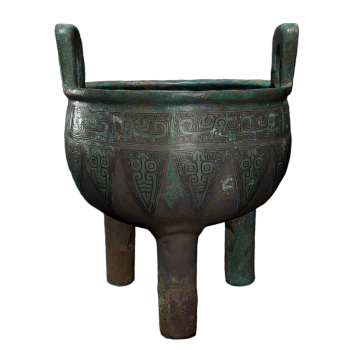
Zhou Dynasty Three legged Cauldron

Zhou Dynasty Three legged Cauldron

This cultural relic is a three legged tripod, a bronze vessel, and its ceramic prototype can be traced back to the Peiligang culture of the Neolithic Age. In the early Shang Dynasty (1600-1300 BC), bronze versions of the flat footed tripod began to be cast. Ding is an ancient Chinese cooking or storage vessel, usually with two handles located at the edges, supported by three or four cylindrical legs. The shape of the tripod was almost ubiquitous in early China, including ceramic vessels from the Neolithic period and bronze vessels from the Shang Dynasty, as well as many later imitations of bronze and glazed pottery. This artifact is housed in the Minneapolis Museum of Art.
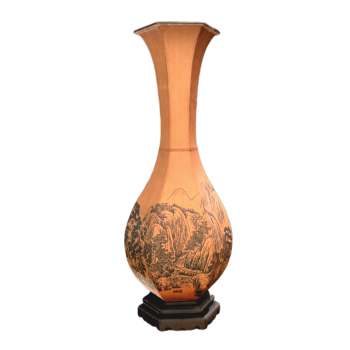
The Vase of 'Quiet Mountains and Streams'

The Vase of 'Quiet Mountains and Streams'

The vase of "Quiet Mountains and Streams" is an artwork made using Baoqing bamboo carving techniques. Baoqing bamboo carving is a traditional handicraft in Shaoyang City, Hunan Province, China, known for its exquisite carving techniques and unique artistic style. This work was completed by Zhang Zongfan, the inheritor of Baoqing bamboo carving intangible cultural heritage, and his students, showcasing the exquisite craftsmanship of Baoqing bamboo carving. The size of this vase is 28 centimeters wide and 54 centimeters high, which is a work that combines traditional craftsmanship with modern design. Baoqing bamboo carving has a long history, and its works usually have high artistic value. It showcases the exquisite craftsmanship of traditional handicrafts.
"Xiaoxiang charm" bas-relief vase

"Xiaoxiang charm" bas-relief vase

"Xiaoxiang charm" bas-relief vase is a fusion of traditional technology and modern design works. This work was completed by Zhang Zongfan, the non-genetic inheritor of Baoqing bamboo carving, and his students, showing the exquisite bamboo spring carving technology. The size of this work is 8.8cm wide and 20cm high. Through the technique of bas relief, the theme of "Xiaoxiang Charm" is presented on the vase in the form of art, reflecting the cultural characteristics and craft aesthetics of Hunan. It is a work of art showing the intangible cultural heritage of Hunan. Let people better understand and appreciate the traditional culture and technology of Hunan.
Late merchant bronze three-legged jue wine vessel

Late merchant bronze three-legged jue wine vessel

Jue is a vessel used in ancient China to serve warm wine in ancestor worship rituals. It is ovoid and supported by three spreading triangular legs, with a long curved beak on one side and a balanced handle on the other. Many examples have one or two ring handles on the sides and two column protrusions on the top, which may be used to enable people to lift the vessel with a belt. They are usually gorgeously decorated and have gluttonous decorations.
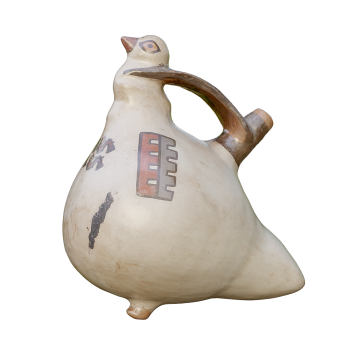
Chimu Painted Double Body Container

Chimu Painted Double Body Container

It is a representative work of the Chimu culture, an artifact from 1200 to 1440 BC, originating from Peru. It consists of two oval parts with a flat bottom, one of which is turned upside down to form an opening, and the other is decorated with the image of a bird's head. The unique design not only shows the exquisite ceramic art technology in Chimu culture, but also reflects the aesthetic taste and cultural characteristics of the society at that time. It is of great value in cultural and historical research, not only showing the artistic characteristics of Chimu culture, but also reflecting the lifestyle and religious beliefs of the society at that time. It was an important civilization in the Andean region of pre-Columbian South America.
Shang Dynasty Bronze Gong Wine Ware

Shang Dynasty Bronze Gong Wine Ware

It's a ritual used to hold wine. It was mainly made during the reign of King Wu and King Zhao in the late Shang Dynasty (1300-1046 BC), and during the early Western Zhou Dynasty (1046-977 BC). Found in Anyang, this deep, boat-shaped wine-tipper demonstrates almost perfect craftsmanship. On the lower part of the handle and side are carved Taotie masks.
Tübingen University Museum Attica red pottery bottle

Tübingen University Museum Attica red pottery bottle

A ceramic vessel from the ancient Greek period characterized by a black glaze on red clay pottery, with figures and figures in the outline of the pattern retaining the original red color of the clay, creating a sharp contrast. This style, which appeared around 530 BC and reached its peak in the 5th century BC, is representative of pottery making in the Attica region of ancient Greece. The red colored pottery bottle is usually used to mix water and wine. Its shape is wide mouth, short neck, deep abdomen, handles on both sides, and wide and stable circle feet at the bottom. Not only had a practical function in ancient Greek society, the patterns on the surface also reflected the cultural and artistic level of ancient Greece.
Western Zhou tripod

Western Zhou tripod

This relic is a tripod, a bronze vessel, and its ceramic prototype can be traced back to the Neolithic Peiligang culture. In the early Shang Dynasty (1600-1300 BC), bronze versions of the Pingzu Ding were cast. Ding is an ancient Chinese cooking or storage vessel, usually with two handles at the edge, supported by three or four columnar legs. The shape of the tripod is almost ubiquitous in China's early eras, including Neolithic ceramic vessels and Shang dynasty bronze vessels, as well as many later bronze and glazed pottery imitations. This artifact is in the collection of the Minneapolis Museum of Art.
Carved Bronze Oval Ware

Carved Bronze Oval Ware

The engraved bronze oval vessel is a sphere-shaped vessel decorated with geometric patterns. The production period is the European (period) Bronze Age, made of bronze material, size height: 13.7 meters, diameter: 7.5cm, is now collected in the French National Archaeological Museum.
Ancient Greek clay pot

Ancient Greek clay pot

The ancient Greek clay pot was an ancient Greek ceramic vessel, often used to store and transport small quantities of liquids, such as oils and perfumes. The artifact you mentioned was found on the island of Cyprus during the European Iron Age in the 7th century BC. Production period 7th century BC, Europe (period) Iron Age. It is found on the island of Cyprus (origin). Dimensions: height 22cm, diameter 12.3cm, currently collected in the Louvre Museum in France.
Ancient Greek spherical wine bottle

Ancient Greek spherical wine bottle

The ancient Greek spherical wine bottle was a small clay bottle with a main face resembling a baby. The period is the 4th century BC, the classical period of ancient Greece. The production site is in Attica, ancient Greece, and the discovery site is in Laurion (mine). The height is 6.8 centimeters, the width of the bottle body is 5.5 centimeters, the caliber is 3 centimeters, and the bottom diameter is 4.9 centimeters. It is now collected in the National Museum of Archaeology in France.
Onion ball diameter clay cup

Onion ball diameter clay cup

The "Onion Ball Diameter Pottery Cup" is a glass made of clay, shaped like the bulb of an onion and decorated with slight grooves. The production period was in the 9th century BC, during the late period of European bronze ware. The discovery was made in Brison Saint Innocent, Gr é sine station, and Lac du Bourget in the Savoy department of France. The dimensions are height: 21 centimeters, width: 13.7 centimeters, depth: 4.5 centimeters. It is currently housed in the National Museum of Archaeology in France.
Saint Germain kettle

Saint Germain kettle

This kettle comes from Saint Germain en Laye and can be traced back to the early Middle Ages, which is the high school century. This kettle is now housed in the National Archaeological Museum of France. The collection of this museum includes various technological and artistic works since the emergence of humans in France. The size of this' kettle 'is 8.7 centimeters high and 15.6 centimeters wide.
Saint Germain single ear wine jug

Saint Germain single ear wine jug

The Saint Germain single eared wine jug was discovered in the archaeological site of Saint Germain en Laye, and this cup can be traced back to the 6th century AD. The name 'Saint Germain' comes from the Catholic saint Paris, who was born in Outan and served as the Bishop of Paris from 555 to 576, during which time he built the Abbey of Saint Germain de Prey. The Saint Germain Cup is currently housed in the National Museum of Archaeology in France.
Saint Germain high footed round cup

Saint Germain high footed round cup

The Saint Germain double eared cup was discovered in the archaeological site of Saint Germain en Laye and can be traced back to the 6th century AD. The name 'Saint Germain' comes from the Catholic saint Paris, who was born in Outan and served as the Bishop of Paris from 555 to 576, during which time he built the Abbey of Saint Germain de Prey. The Saint Germain Cup is currently housed in the National Museum of Archaeology in France.
Saint Germain Double Ear Cup

Saint Germain Double Ear Cup

The Saint Germain double eared cup was discovered in the archaeological site of Saint Germain en Laye and can be traced back to the 6th century AD. The name 'Saint Germain' comes from the Catholic saint Paris, who was born in Outan and served as the Bishop of Paris from 555 to 576, during which time he built the Abbey of Saint Germain de Prey. The Saint Germain Cup is currently housed in the National Museum of Archaeology in France.
Sanxingdui portrait gold mask

Sanxingdui portrait gold mask

The golden mask is a golden artifact unearthed from the 5th sacrificial pit in the Sanxingdui site's sacrificial area. After testing, its gold content is about 85%, silver content is about 13% to 14%, and there are other impurities.
Shang Dynasty Bronze Beast Faced Pattern Square Cauldron

Shang Dynasty Bronze Beast Faced Pattern Square Cauldron

Fangding "means a square cooking utensil with two ears and four feet. During the Shang and Zhou dynasties, it was popular and commonly used as sacrificial vessels, such as the excavated animal face milk nail patterned square cauldron, Simuwu square cauldron, and Hedang square cauldron.
Big Mouth Water Bottle (Cultural Relic of Haihun Marquis Tomb)

Big Mouth Water Bottle (Cultural Relic of Haihun Marquis Tomb)

The Haihun Marquis Tomb is located in Guanxi Village, Datang Ping Township, Xinjian District, Nanchang City, Jiangxi Province. It is the tomb of Liu He, the Haihun Marquis of the Western Han Dynasty. It is the best preserved, structurally complete, functionally laid out, and has the most complete sacrificial system of the Western Han Dynasty marquis cemetery in China so far. It is also the largest known area, rich in connotation, and relatively well preserved tomb of Han Dynasty local marquis levels in southern China. More than 10000 pieces (sets) of precious cultural relics such as gold, bronze, iron, jade, lacquered wood, bamboo slips, and wooden slips showcase the dream and glory of the Haihun civilization.
Tiger Phoenix Frame Hanging Drum

Tiger Phoenix Frame Hanging Drum

Cultural relics of Hubei Provincial Museum. Tiger Phoenix Hanging Drum, also known as Tiger Phoenix Hanging Drum or Tiger Bird Hanging Drum. Excavated from Tomb No. 2 of the Warring States Chu Dynasty in Jiuliandun, Hubei, it is a typical representative artifact of Chu musical instruments. This is one of the largest tiger shaped phoenix frame drums excavated from a Chu tomb in China. Its height is about 1 meter, with symmetrically arranged double phoenixes and double tigers as the drum frame. The base consists of two crouching tigers with their backs facing each other, with a phoenix standing on each tiger's back. The overall shape of the work is unique and elegant, with exquisite design, reflecting the designer's brilliant imagination and superb artistic expression, and possessing strong Chu cultural characteristics.
3D Printed Model: Ceramic Vase

3D Printed Model: Ceramic Vase

White glaze, decorated with colorful cliffs.
Imperial Seal of Ancient China

Imperial Seal of Ancient China

The jade seal, specifically referring to the emperor's seal, is a symbol of supreme power. Made of gold or jade. The seal originated in the Zhou Dynasty and was commonly referred to as the seal or imperial seal during the pre Qin period. It was not until the Qin Dynasty that there was a distinction between the seal and imperial seal. The seal used by the emperor was called the imperial seal, while the seal used by the subjects could only be called the seal.
Xiaochen Yixi Zun

Xiaochen Yixi Zun

Xiaochen Yixi Zun is the most well-known Chinese collection in the Asian Art Museum in San Francisco, USA, because many academic books and publications on bronze ware internationally regard it as a symbol of Chinese bronze ware and publish it on the cover of the book. Xiaochen Yixi Zun is one of the famous "Seven Treasures of Liangshan". The objects use realistic techniques and are completely unadorned. The overall shape is seamless, revealing a sense of innocence in the simplicity and richness. This artistic technique of seeing magic in simplicity has always been the highest pursuit of traditional Chinese aesthetics. The inscription describes the Shang king's conquest of the barbarians, and information about this war can also be found in oracle bone inscriptions from the Yin ruins.
Bamboo Carving Vase of 'Sparrow Dance Peony'

Bamboo Carving Vase of 'Sparrow Dance Peony'

The bamboo spring carving technique of Baoqing bamboo carving was completed by Zhang Zongfan, the inheritor of Baoqing bamboo carving intangible cultural heritage, and his students.
Ceramic vase with sacrificial patterns from 420 BC

Ceramic vase with sacrificial patterns from 420 BC

Blue and white jade teapot, spring vase, porcelain, antique vase

Blue and white jade teapot, spring vase, porcelain, antique vase

Jingtai Blue Ding Incense Burner Qing Qianlong Copper Body Cloisonn é Enamel Square Ding Incense Burner

Jingtai Blue Ding Incense Burner Qing Qianlong Copper Body Cloisonn é Enamel Square Ding Incense Burner

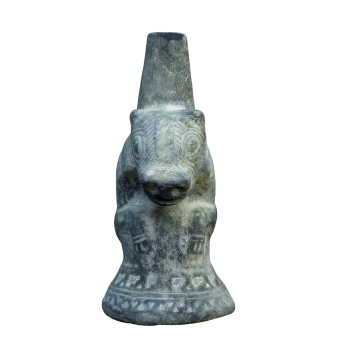
The urn containing the ashes of the Zapotec people

The urn containing the ashes of the Zapotec people

Chinese antique bronze wine vessel owl jar

Chinese antique bronze wine vessel owl jar