Ancient Greek Terracotta Vase

Ancient Greek Terracotta Vase

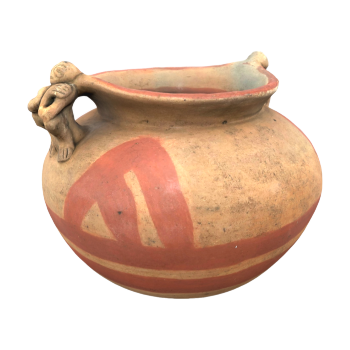
The terracotta vases of ancient Greece are outstanding representatives of ancient art and craftsmanship. These vases are usually made of red clay, a type of clay that has been fired at high temperatures and has a hard and durable texture. The ancient Greeks used these vases to store liquids such as wine, olive oil, and water, as well as for religious ceremonies and as burial objects. The ancient Greek terracotta vase not only played an important role in practicality, but also an important component of Greek culture and social life. They reflect the aesthetic concepts, religious beliefs, and social customs of ancient Greeks, and are valuable materials for studying ancient Greek civilization.
Frog shaped vessels of the Moche civilization in Peru - collected in Bonn, America
Frog shaped vessels of the Moche civilization in Peru - collected in Bonn, America

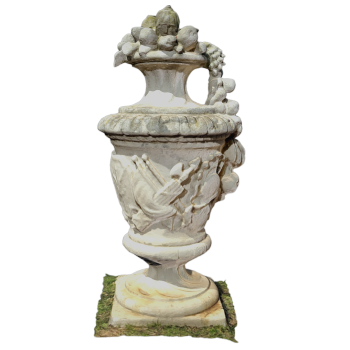
The frog shaped vessel is a cultural relic from the Moche civilization in Peru, and is included in the Bonn Collection in the Americas. This unique ceramic vessel, shaped like a frog, not only showcases the exquisite craftsmanship of the Moche people, but also reflects their profound understanding and reverence for the natural world. The Moche civilization is an important cultural period in South American history, known for its exquisite pottery, metal crafts, and murals. This frog shaped vessel is part of the collection of G ö tzVon Houwald, a collector who loves American art. Not only did it provide physical materials for studying the Moche civilization, but it also provided an opportunity for people to appreciate ancient American art.
Anfula vase

Anfula vase

Originating from the pottery containers of ancient Greece and Rome, they are renowned for their unique double ear design and are commonly used for storing and transporting liquids. In Barcelona, the design of this ancient container is reinterpreted by modern artists and designers, creating decorations that have both classical charm and modern aesthetics. The Anfula vase in Barcelona blends the city's rich historical and cultural heritage with modern art styles. These vases are not only displayed as artworks, but also commonly used to decorate spaces, adding beauty and cultural atmosphere to the interior.
A pottery jar with a red background, black lines, and a base

A pottery jar with a red background, black lines, and a base

The Parita style ceramics from the Greater Cockley region, of the "Arnon" variety, date back approximately between 1150 and 1400 AD. This ceramic jar is characterized by a base and a closure. Its stylistic feature is coated with red paint on the body, decorated with black horizontal lines that run through the can body and base. This decorative technique is a typical representative of Parita style ceramics, reflecting the aesthetic characteristics and craftsmanship level of ceramic art in the region at that time.
Red line decorative pottery jar

Red line decorative pottery jar

It is an ancient ceramic container from the field of archaeology in Panama. This type of pottery jar is characterized by red line decoration, which constitutes its main visual element, showcasing a concise and rhythmic aesthetic. Decorative lines are usually horizontally distributed, which may surround the middle of the pottery jar or create a contrast at the mouth and bottom, thereby enhancing the visual effect and cultural expression of the vessel. This decorative technique not only reflects the craftsmanship level of the craftsmen at that time, but also reflects the unique style and aesthetic tendency of ceramic art in ancient Panama.
Ceramic disc holder with animal image

Ceramic disc holder with animal image

It is a ceramic plate with a base, belonging to the Parita style, dating back to approximately 1150 to 1400 AD. This ceramic style is characterized by black horizontal lines decorated on a red primer, which run through the plate and base. The Parita style ceramics are significantly different from the colorful ceramic decorative styles of the region before. Many previous decorative elements such as "YC", spiral patterns, design saturation, claws, and lizards have disappeared, but animal shaped decorations are still preserved. This type of plate is a typical representative of Parita style due to its unique base.
Cup shaped ceramic container - Bonn Collection of America

Cup shaped ceramic container - Bonn Collection of America

The cup-shaped container in the Bonn Collection of America is a pottery with a unique shape and color. This container is cup-shaped and coated with red and black pigments on the surface, with vivid colors and visual impact. Originating from the Canelo region of Ecuador, it was collected by Erich Wustmann and included in his personal collection. Not only is it a practical drinking vessel, but it also reflects the artistic and cultural characteristics of pottery making in ancient Ecuador. The combination of red and black may be related to local religious beliefs or social customs, reflecting the aesthetic concepts and lifestyle of ancient residents.
Tray with base coated with clawed lizard

Tray with base coated with clawed lizard

This artifact belongs to the Macaracas style and appeared around 1000-1150 AD. Its characteristics are geometric and animal image design, with the left half showcasing Conte style black and purple borders, and thick lines on red and cream backgrounds; The right half showcases Macaracas style saturated decorations, with a central image of a clawed lizard in a color similar to Conte style.
A beautiful blue vase

A beautiful blue vase

Plato with pedestal like plate

Plato with pedestal like plate

It is a ceramic plate with a base, and this style of ceramic work originated in the Panama region and was made around 1150 to 1400 AD. These plates usually present exquisite painted decorations. These plates were not only used as practical eating utensils, but also reflected the aesthetic taste and cultural beliefs of the society at that time. In the Gran Cocl é culture, similar ceramic works are important archaeological discoveries that showcase the ceramic art and craftsmanship of the region during the pre Columbian period.
Camel Ceramic Container - Bonn Collection
Camel Ceramic Container - Bonn Collection

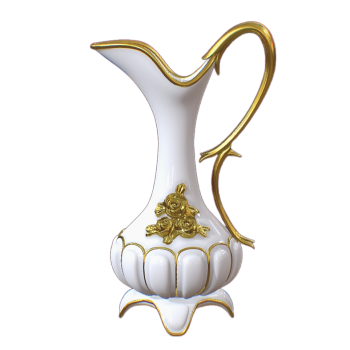
It is a ceramic artwork from the Bonn Collection in the Americas. This vessel features animal shaped decorative elements and a handle decorated with white paintings and five llama patterns. Its exact origin is unknown, but it comes from Johanna Sch ö pp's collection. The llama decoration on this ceramic vessel may be related to the ancient Andean civilization, which has a long history in South America, with the most famous being the Inca Empire. Camels play an important role in local culture, not only as a means of transportation and food source, but also with cultural and religious significance. Due to a lack of detailed information, we are unable to determine the exact origin of this vessel.
Gold inlaid art vase

Gold inlaid art vase

3D design vase

3D design vase

Virtual synthetic vase
Virtual synthetic vase

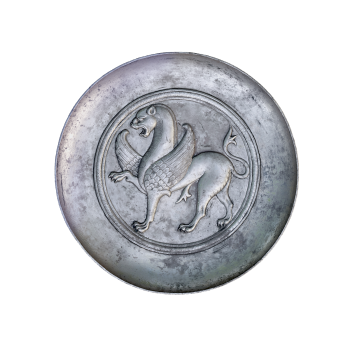
The "Winged Griffon Plate" from the Hefitalit Period - Cleveland Museum of Art

The "Winged Griffon Plate" from the Hefitalit Period - Cleveland Museum of Art

It is a silver artwork from the Sogdiana region, belonging to the Hephaetalite period, made around the 6th to 7th century. It showcases exquisite craftsmanship and unique aesthetic style. Winged lion is a creature in ancient mythology, often depicted with an eagle head and lion body, symbolizing strength and majesty. Collected at the Cleveland Museum of Art. This silver plate is not only a work of art, but also a witness to the exchange of ancient culture and art.
Aribalo Inca cultural pottery

Aribalo Inca cultural pottery

Also known as aryballo, it is a pottery with a unique shape that was widely used in the Inca culture for storing and transporting liquids. Known for its narrow bottom and spherical body, it not only plays an important role in daily life but also holds significant importance in rituals. The design made it easy to carry and pour liquids, and its shape and function were very typical in pottery from the Inca Empire period (approximately 1300-1532 AD). The exquisite craftsmanship of this pottery showcases the Inca people's superb skills in ceramic art. Not only does it exist in Inca culture, but similar pottery forms also exist in ancient Greek culture.
Alabasteron Ancient Greek Pottery - Paul Getty Museum

Alabasteron Ancient Greek Pottery - Paul Getty Museum

It is a type of ancient Greek pottery, named after the Greek word "ἄλαβ στρον", referring to an elongated container with a rounded bottom and a lid at the mouth. The name and shape may originate from Egypt and have the same name as the stone used to make this container. It is usually used to store oils, especially perfume used by women after bathing. This specific Alabasteron was produced in the Attica region and can be traced back to 490 to 470 BC. The scene depicted on the container is a person holding a bow and arrow and an axe, with palm trees in the background. Currently housed in the Paul Getty Museum. It is an important cultural relic for studying the daily life and artistic style of ancient Greece.
Wedgwood Cup Disc - Cleveland Museum of Art, UK

Wedgwood Cup Disc - Cleveland Museum of Art, UK

Produced around 1790 by the Wedgwood factory in England. It is a famous relief decorative style Wedgwood jade porcelain. It was done by Mrs Ms. John Sherwin donated to the Cleveland Museum of Art. Wedgwood jade porcelain is famous for its unique blue and white relief decorations, a style invented by Josiah Wedgwood in the 18th century, a renowned British potter and industrialist. The characteristics of jade porcelain are its hard texture and exquisite relief patterns, which are usually Greek mythology or classical themes.
Striped pattern base tray

Striped pattern base tray

The Macaracas style in the Gran Cocl é region was produced between approximately 1000 and 1050 AD. This multicolored ceramic plate features a base and a high saturation of decorative design, retaining some elements of Conte style, such as thick black lines outlining patterns and the use of purple. The typical features of Macaracas style, such as claw and lizard patterns, are replaced by horizontal lines in red and purple, as well as lines resembling bird beaks, all surrounded by thick black lines.
Jars from the 18th period of the ancient Egyptian dynasty

Jars from the 18th period of the ancient Egyptian dynasty

It is a cultural relic from the 18th period of the ancient Egyptian dynasty, approximately from 1400 BC to 1352 BC, during the reigns of Thutmose III to Amenhotep III. Discovered by Egyptologist Howard Carter and millionaire businessman Theodore M. Davis in King's Valley in 1902. Carter later discovered Tutankhamun's tomb, while Davis donated these artifacts to the Harvard University Museum of the Ancient Near East. Usually a set of four pieces is used to store the internal organs of mummified corpses. This exquisitely carved jar is one of three excavated jars in King's Valley.
White tailed deer pattern ceramic disc

White tailed deer pattern ceramic disc

The Conte style ceramic plate from the Gran Cocl é region dates back to around 700 to 1000 AD. This type of plate features the typical color of Conte style (red circular base, black and red patterns on cream base). The typical pattern at the center of the plate is a white tailed deer (Odocoli virginianus), which repeatedly appears in this style and may symbolize some mythological significance. Remarkably, the claw details in the pattern became more stylized in the subsequent Macaracas style (1000-1150 AD)
Copy Stream Vase

Copy Stream Vase

The design inspiration for replicating stream vases usually comes from streams in nature, which may use flowing lines and shapes to simulate the flow of water. Copying stream vases may target a wide range of consumer groups, especially those who like natural style decoration but do not pursue high-value collectibles. Move. The replica stream vase can be made of various materials, such as ceramic, glass, metal, or plastic, depending on the production technology and design requirements The design of such vases may also reflect a concern for environmental protection, reminding people to cherish the natural environment by imitating natural landscapes.
Ceramic disc with humanoid pattern

Ceramic disc with humanoid pattern

The Conte style ceramic plates from the Gran Cocl é region were made between approximately 700 and 1000 AD. This dish is known for its iconic Conte style color (red base, black and red patterns on cream base). The center of this plate features a typical humanoid pattern, which appears in multiple plates of the same style, indicating that it may represent an image from some mythology. Especially this specific humanoid pattern has been used in multiple advertising campaigns and has become a well-known popular image.
Panama circular base disk

Panama circular base disk

It is a ceramic plate with a circular base, belonging to the Conte style, made approximately between 700 and 1000 years ago, from the Gran Cocl é region, and now belongs to the archaeological category of Panama. This dish is known for its unique Conte style colors (red, black on cream base, and circular base). The center of the plate usually features a typical animal image, such as a white tailed deer, and is decorated with details such as claws, which become more stylized in the subsequent Macaracas style.
Late Inca civilization pottery

Late Inca civilization pottery

It is a type of pottery unique to the late Inca civilization, which lasted from approximately 1450 AD to 1552 AD, the peak of the Inca Empire, until the arrival of the Spanish conquerors. Pottery with distinct characteristics, with a spherical or oval body, a pointed bottom, handles or "wings" on both sides, and a wide and flat mouth at the top. The pottery art of the Inca period is famous for its rich colors and exquisite decorations. Decoration usually includes geometric patterns, animal and plant images, or mythological stories, which not only showcase the aesthetic concepts of the Incas, but also reflect their religious beliefs and social values.
Circular base animal decoration disc

Circular base animal decoration disc

It is a ceramic plate with a circular base and animal shaped design, belonging to the Conte style, made approximately between 700 and 1000 years ago, from the Gran Cocl é region, and now belongs to the archaeological category of Panama. This type of ceramic is known for its unique central pattern, often depicting images of animals or mythical creatures, painted in black and red on a white or cream background, with edges often red. The decorative style of the plate reflects the characteristics of ceramic art during the Conte period, and its central pattern may represent a mythical creature with important cultural symbolic significance.
Collins style wine jug - Academic Art Museum of Bonn University

Collins style wine jug - Academic Art Museum of Bonn University

A Corinthian wine jug, collected at the Academic Art Museum of the University of Bonn, is a pottery piece produced in Corinth between 625 BC and 600 BC. Collins was a leader in pottery production at that time, and its products were widely exported throughout the Mediterranean region. The specific location where this pottery was unearthed is unknown. It is a pot with a three leaf shaped mouth edge and a sometimes upturned strap handle, which connects the mouth edge and shoulder. The black painting technique invented by Collins was used for drawing. It is an important type of ancient Greek pottery, and its design and decorative style reflect the prosperity of Greek culture and art.
Chinese porcelain vase

Chinese porcelain vase

Chinese porcelain has a history of thousands of years, with the earliest porcelain dating back to the Shang Dynasty. By the Tang Dynasty, porcelain production technology had become quite mature, and it reached its peak during the Ming and Qing Dynasties. Chinese porcelain vases are usually made of raw materials such as kaolin, quartz, and feldspar, which are fired at high temperatures to achieve a hard texture, smooth glaze, and good transparency. The production process of Chinese porcelain vases includes multiple steps such as drawing, carving, glazing, and painting, each of which requires exquisite skills and strict quality control. The decorative styles of Chinese porcelain vases are diverse, including blue and white porcelain, pink, doucai, underglaze red, etc.
Minoan vase

Minoan vase

The Minoan vase is a ceramic artwork from the Minoan period of ancient Greek civilization, which existed approximately between 2600 BC and 1100 BC. The Minoan civilization is one of the earliest civilizations in ancient Greece, mainly located on the island of Crete and later on the Greek mainland. The Minoan vase is an important symbol of cultural and artistic achievements during this period. The Minoan vase is renowned for its exquisite craftsmanship and decoration. They usually have smooth lines and elegant forms, decorated with complex geometric patterns, marine creatures, plants, and mythological scenes.
Colorful Carving Cup - American Bonn Collection Series

Colorful Carving Cup - American Bonn Collection Series

The colored carved cup is a pottery artwork from the Bonn Collection in the Americas. The body of this cup is decorated with finely carved geometric patterns, using colors such as green, brown, yellow, and blue to showcase rich visual layers and artistic expression. The origin of the cup is still unclear, which adds a touch of mystery to it. It is not only a display of ancient craftsmanship, but also an exploration of color and shape aesthetics.
Vase made by Edward Knopfflin (Part 1)

Vase made by Edward Knopfflin (Part 1)

The vase made by Edward Knopfflin is an exquisite fine porcelain artwork, created between 1902 and 1916, produced in Palatine, France. Overall, the vase has a flat bottom, slightly expanded middle, rounded top, and then extends upwards to form a higher neck, ending with a wide edge. Two handles decorated with reed patterns connect the middle and upper ends of the neck. In terms of decoration, the vase adopts a hollow design inspired by plants, with green and orange pink as the main colors, and is also decorated with two three-dimensional crayfish. It is one of the collections of the Parthenon Museum of Art and History.
Vase made by Edward Knopfflin (Part 2)

Vase made by Edward Knopfflin (Part 2)

The decorative vase made by Edward Knopfflin is an exquisite fine porcelain artwork, created between 1902 and 1916, produced in Paltenay, France. The main body of the vase is decorated with two oval reliefs, including a white high relief female side image, connected by two deep green flower garlands. In addition, the neck and base are striped and adorned with light reddish brown dots. The two handles connecting the neck and the top of the bottle are placed on two decorative pieces shaped like a ram's head. The color scheme of the entire vase ranges from shallow green to deep green, as well as old rose, white, and ochre. It is a collection of the Parthenone Museum of Art and History.
Geometric Pattern Ancient Pottery - Bonn Collection Series in the Americas

Geometric Pattern Ancient Pottery - Bonn Collection Series in the Americas

The geometric patterned container in the Bonn Collection of America is an ancient pottery with a mysterious origin. Its specific place of origin is not yet clear, which adds a sense of mystery and research value to it. The surface of the container is decorated with geometric patterns, which not only showcase the artistic aesthetics of ancient people, but may also contain specific cultural or symbolic meanings. Through the study of geometric patterns, scholars can gain a deeper understanding of the artistic styles, religious beliefs, and social structures of ancient civilizations.
University of Bonn Academic Art Museum Bass Image Vessel

University of Bonn Academic Art Museum Bass Image Vessel

It is an ancient artwork collected by the Academic Art Museum of Bonn University. The vessel depicting the image of bass was made between 550 BC and 600 BC, and is likely to have been discovered in Nocratis. Made of glazed pottery with a blue-green surface, this material floats on quartz sand during the firing process, forming a texture similar to glaze. Glazed pottery was already produced in Egypt around 4000 BC, and there was a proposal from Naukratis to establish a workshop. However, this work is likely to have been produced in the Eastern Greek region, and there have been proposals to establish a studio in Rhodes. It showcases the image of the Egyptian god Bess, who is a deity with the ability to ward off evil spirits.
Cantalos Ancient Greek Wine Cup

Cantalos Ancient Greek Wine Cup

It is a drinking cup from ancient Greece and is currently housed in the Academic Art Museum of Bonn University. Discovered in a tomb in Falerii Veteres, dating back to the mid-7th century BC to the latter half of the year, made of brownish red coarse clay. The cup body is concave and cylindrical, and the handle is arched and higher than the cup mouth. The bottom is separated from the cup wall by a circular coil, which displays vertical scratches and decorative knobs. There is a fish scratched on each side of the cup wall of the container. Not only is it an example of ancient Greek drinking culture, but it is also an outstanding representative of ancient Greek pottery art.