Jingdezhen Baluste Vase (Part 2)

Jingdezhen Baluste Vase (Part 2)

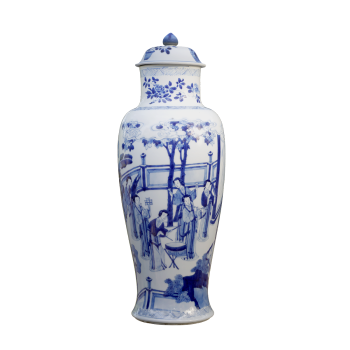
It is one of the five piece decoration set, characterized by the use of cobalt pigment under transparent colorless glaze. Belonging to Jingdezhen style, it is a ceramic container produced in Jingdezhen City, Jiangxi Province, China. The production period was from 1662 to 1722, belonging to the Qing Dynasty. Not only is it a representative of Chinese ceramic craftsmanship, but it also showcases the exquisite craftsmanship and aesthetic style of Jingdezhen porcelain during the Qing Dynasty. Jingdezhen, as the hometown of Chinese porcelain, has been renowned for its exquisite porcelain since ancient times. During the Qing Dynasty, the porcelain craftsmanship of Jingdezhen reached a new height, producing many porcelain pieces with high artistic and historical value.
Jingdezhen Ballust Vase

Jingdezhen Ballust Vase

It is one of the five piece decoration set, characterized by the use of cobalt pigment under transparent colorless glaze. Belonging to Jingdezhen style, it is a ceramic container produced in Jingdezhen City, Jiangxi Province, China. The production period was from 1662 to 1722, belonging to the Qing Dynasty. Not only is it a representative of Chinese ceramic craftsmanship, but it also showcases the exquisite craftsmanship and aesthetic style of Jingdezhen porcelain during the Qing Dynasty. Jingdezhen, as the hometown of Chinese porcelain, has been renowned for its exquisite porcelain since ancient times. During the Qing Dynasty, the porcelain craftsmanship of Jingdezhen reached a new height, producing many porcelain pieces with high artistic and historical value.
Japanese Egret Tea Cup

Japanese Egret Tea Cup

A traditional Japanese tea set with the theme of white egrets, usually depicting the scene of white egrets fishing by the water's edge. It embodies the aesthetics of Japanese ink painting and also contains a longing for natural harmony and peaceful living. Designs are often concise and full of artistic conception, outlining the elegant posture of herons with a few strokes, especially the sharp brushstrokes on the head, leaving a deep impression on people. Not only used in daily tea ceremonies, but also often collected and appreciated as art. The creation can be traced back to the Muromachi period, around the 15th to 16th centuries. At that time, artists used delicate brushstrokes and ink colors to create many works with nature as the theme.
Japanese Red crowned Crane Black Ceramic Bottle (Right) - Krakow Japan Art and Technology Center, Poland
Japanese Red crowned Crane Black Ceramic Bottle (Right) - Krakow Japan Art and Technology Center, Poland

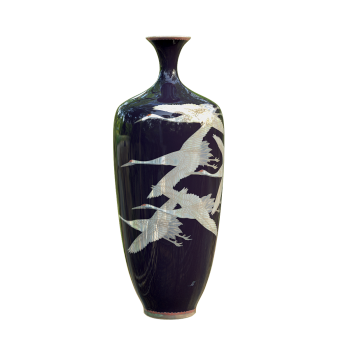
The Japanese Art and Technology Center, located in Krakow, Poland, is renowned for its exquisite craftsmanship and traditional themes, showcasing the level of Japanese craftsmanship during the Meiji period (1868-1912). Adopting cloisonn é enamel technology, silver wire is used to outline the pattern of flying cranes flying on a dark blue background, and the white crane body is embellished with gray and red elements, presenting a continuous style. At the edge of the bottle mouth and near the base, a red circular pattern border can be seen. Under the base, you can see the symbol of the "ヨ" syllable in a form similar to Japanese katakana. He is a representative of Japanese culture and craftsmanship.
Japanese Red crowned Crane Black Ceramic Bottle (left) - Krakow Japan Art and Technology Center, Poland
Japanese Red crowned Crane Black Ceramic Bottle (left) - Krakow Japan Art and Technology Center, Poland

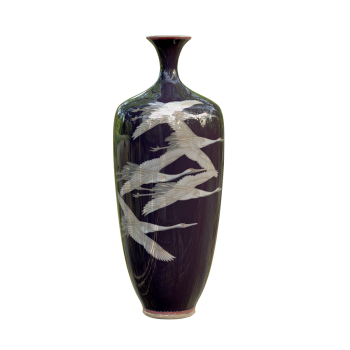
The Japanese Art and Technology Center, located in Krakow, Poland, is renowned for its exquisite craftsmanship and traditional themes, showcasing the level of Japanese craftsmanship during the Meiji period (1868-1912). Adopting cloisonn é enamel technology, silver wire is used to outline the pattern of flying cranes flying on a dark blue background, and the white crane body is embellished with gray and red elements, presenting a continuous style. At the edge of the bottle mouth and near the base, a red circular pattern border can be seen. Under the base, you can see the symbol of the "ヨ" syllable in a form similar to Japanese katakana. He is a representative of Japanese culture and craftsmanship.
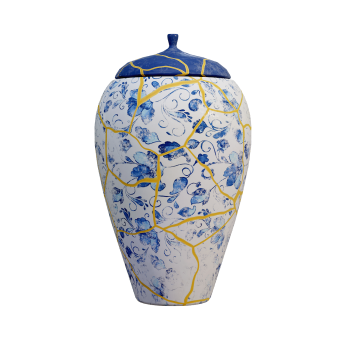
Japanese gold vase

Japanese gold vase

It is a representative of traditional Japanese craftsmanship, which involves re bonding broken ceramic fragments with gold powder or paint to give them new life and beauty. The term 'jinzao' comes from the Japanese word 'jin 継ぎ', meaning 'repair with gold'. This technique is not just about restoration, but also an art form that views fragmentation as a part of life, connecting fragments with gold threads to showcase a unique aesthetic. High quality ceramic materials are usually selected, carefully designed and made, then intentionally broken and repaired. The aesthetic concept of gold vase corresponds to the Japanese culture of "wabi sabi", which appreciates the beauty of imperfection, impermanence, and incompleteness.
Chinese white glazed porcelain vase with colored cracks

Chinese white glazed porcelain vase with colored cracks

It is a molded porcelain drum shaped Chinese porcelain vase with white glaze and colored cracks. The production period is from 1950 to 1960. White glaze and cracked glaze effects are common techniques in porcelain production. White glaze provides a smooth and reflective surface, while cracked glaze is a special decorative technique that creates unique textures and patterns by introducing tiny cracks into the glaze. Not only is it beautiful, but over time, porcelain with cracked glaze will gradually develop its own unique appearance. It is part of the William M. Lindgren Asian Art Collection, preserved in the archives of St. Cloud State University.
Glass enamel decorated Chinese cloisonn é vase

Glass enamel decorated Chinese cloisonn é vase

It is a Chinese cloisonn é vase decorated with glass enamel, belonging to the William M. Lindgren Asian Art Collection and currently housed in the archives of St. Cloud State University. The period is approximately between 1930 and 1950. Cloisonn é craftsmanship is an ancient Chinese metal craft known for its exquisite copper body, enamel glaze, and complex production process. This process usually involves welding fine copper wires onto a copper body to form patterns, then filling these patterns with enamel glaze. After multiple firing and polishing processes, the final product is a colorful and glossy artwork. It is one of China's intangible cultural heritages.
Maya Culture Ceramic Wine Cup - Metropolitan Museum of Art

Maya Culture Ceramic Wine Cup - Metropolitan Museum of Art

This cylindrical drinking cup, which is a Maya cultural artwork collected by the Metropolitan Museum of Art, is considered a representative work of the Maya pottery painter "Metropolitan Master". It features a mythological scene depicting the young rain god Chahk and a supernatural young leopard. Chahk appears in its typical attire and symbolic accessories, while juvenile jaguars are presented with their supernatural facial features and body details. Not only does it showcase the exquisite craftsmanship of Maya art, but it also reflects the complex myths about life, death, and rebirth in Maya culture. Provided important clues for researchers on Maya religion and ritual practices
Clay Vase - Krakow Archaeological Museum, Poland

Clay Vase - Krakow Archaeological Museum, Poland

The Archaeological Museum in Krakow, Poland, has a collection of pottery fragments dating back to ancient times. These fragments were discovered during salvage excavations at the 1c site in Mogila (the area where the S. Ż eromski Hospital is located) in 1958. After repair, this pottery was able to be restored. It is made of sieved good soil on a ceramic wheel, with a smooth surface and polished. Above the crease on the shoulder, a decoration can be seen, limited by decorative strips, presented in a zigzag and diagonal mesh shape, separated by three buttons. This decoration is similar to the common decoration in the Przewalski culture and also appears on the edge of this container.
Dog shaped ceramic container

Dog shaped ceramic container

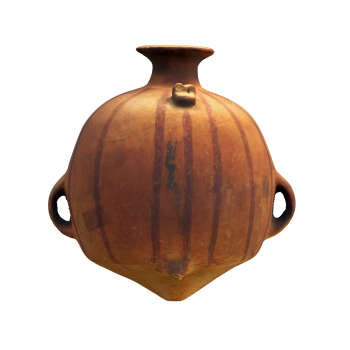
From the central coast of present-day Peru. It represents a dog breed called "viringo", which is the Peruvian Hairless Dog. In ancient American culture, it was valued for its unique appearance and characteristics, and was included in funeral ceremonies, as well as depicted on painted pottery. Nowadays, it has become an important symbol of Peruvian culture. It showcases the ancient Peruvian people's worship and artistic expression of animals, reflecting their profound understanding and respect for nature and animals. Be able to understand the lifestyle, religious beliefs, and artistic aesthetics of ancient Peruvian society. It is one of the important physical evidence for studying ancient Peruvian civilization.
Chancay culture monkey shaped pottery container

Chancay culture monkey shaped pottery container

It is a ceramic artwork in the Chancay culture, created around 1300 to 1500 by an unknown Peruvian artist. Usually used for storing water, which is crucial for survival in the dry desert climate where one resides. The Chancay culture is located in the central coastal region of Peru, where the climate is hot and dry, but there are some oases connected to distant areas of the Andes mountain range, allowing for communication with other cultures and communities, trading plants, food, and other agricultural products. On both sides of the neck are a pair of monkeys, both covering their mouths with their hands. The monkey's tail curves upwards and connects to the neck of the container.
Ancient snake shaped ceramic container

Ancient snake shaped ceramic container

Japanese Peony Ceramic Container - Cleveland Museum of Art

Japanese Peony Ceramic Container - Cleveland Museum of Art

It is a porcelain piece created by Seif ū Yohei III (Japan, 1851-1914), approximately made in 1914. Green glaze was used, and molding and carving techniques were employed in the design. This porcelain is collected by the Cleveland Museum of Art and was a gift donated by James and Christine Heusinger. It showcases the exquisite craftsmanship and aesthetic characteristics of Japanese porcelain art. Not only is it a practical water container, but it is also an exquisite artwork. The peony pattern on it symbolizes wealth and prosperity, reflecting the pursuit of beauty and appreciation of natural beauty in Eastern culture
Roman vase

Roman vase

They are common ceramic containers in ancient Roman civilization, not only daily necessities, but also symbols of art and culture. These vases are usually made of clay and fired at high temperatures, possessing strong and durable characteristics. The design of Roman vases is diverse, ranging from simple practical shapes to complex decorative shapes, reflecting the aesthetic taste and craftsmanship level of Roman society. Decorative patterns may include mythological scenes, historical events, geometric shapes, or plant patterns, which are not only aesthetically pleasing but also convey the religious beliefs and social values of the time. Some Roman vases are used to store liquids, while others are used for decoration or as burial objects at funerals.
Triangle Double Dragon Wedding Vase

Triangle Double Dragon Wedding Vase

Chinese vases are not only elegant and exquisite in shape, but also highly distinctive in decorative arts. They are usually painted with patterns such as landscapes, flowers, birds, and figures, reflecting the aesthetic taste and painting skills of ancient China. There are many types of glazes and glazes for Chinese vases, from the famous blue and white porcelain of the Ming Dynasty to the celadon glaze of the Song Dynasty. Each color and glaze reveals its era and dynasty. As an important part of ancient Chinese civilization, Chinese vases not only showcase the luxury of ancient Chinese society and the vitality of the Maritime Silk Road, but also witness the development of Chinese porcelain making techniques.
Ancient vase

Ancient vase

Ancient vases are works of art in the long river of history. They not only carry practical functions, but also contain rich cultural and artistic values. These vases may be made of different materials such as ceramics, bronze, glass, or stone, and their form and decorative style reflect the aesthetic taste and craftsmanship level of a specific era. In ancient times, vases were commonly used to hold flowers, spices, or as ritual vessels for religion and ceremonies. Over time, many ancient vases have become valuable discoveries in archaeological excavations, providing important clues for us to understand the lifestyle, social customs, and artistic achievements of ancient civilizations.
15th century medieval semi glazed clay wine pot - Hunter Museum in Limerick

15th century medieval semi glazed clay wine pot - Hunter Museum in Limerick

It is a precious ceramic artwork. It has a ribbon shaped handle, with glazed covers on the upper part, handle, and neck inside and outside. This work is currently housed in the Hunter Museum in Limerick. In the Middle Ages, it was a common daily item with a simple and practical design. The ribbon shaped handle is convenient for carrying and pouring wine, while the glazed surface on the neck may be used to protect the pottery from liquid erosion, while also increasing its aesthetic appeal. Although it has been a long time, this semi glazed wine pot is still well preserved, providing us with valuable information for studying medieval ceramic craftsmanship and daily life.
Maiolica Italian style medicine jar - Hunter Museum in Limerick

Maiolica Italian style medicine jar - Hunter Museum in Limerick

It is a type of painted pottery originating from the Italian Renaissance period, known for its bright colors and exquisite decorations. Its shape is cylindrical at the waist, which makes it easy to carry and store medication. The center front of the medicine jar is decorated with an oval shaped portrait of a man, surrounded by exquisite leaf shaped patterns and carving techniques. These decorations are mainly in blue, yellow, and white, showcasing the unique colors and artistic style of Majorica pottery. Portrait painting emphasizes the personality traits of characters, rather than traditional beauty or handsomeness, reflecting the Renaissance's emphasis on character and inner qualities.
Greek neck bottle

Greek neck bottle

It is a ceramic container from ancient Greece, with an iconic long neck and two vertical handles, usually located on the shoulders. This dual ear bottle design is very suitable for carrying and pouring liquids such as oil, wine, or water. Greek necklaces not only have a wide range of uses in daily life, but also play an important role in religious ceremonies and funerals. They are often used as burial objects in tombs to hold liquids for worship. The surface of Greek neck vases is often painted with exquisite patterns, including mythological scenes, battle scenes, or daily life scenes, providing us with a window to understand ancient Greek culture and art.
Greek Vase

Greek Vase

Greek vases are a type of ceramic container in ancient Greek civilization, known for their exquisite decoration and historical value. These vases are usually made of clay and have black or red patterns painted on the surface, reflecting the life scenes, mythological stories, and religious rituals of ancient Greeks. The design of Greek vases is diverse, including double ear vases, water bottles, oil tanks, etc., each with its specific purpose. They are not only daily necessities, but also carriers of art and cultural heritage. The exquisite painting and carving techniques on Greek vases showcase the superb skills of ancient Greek artists. These vases are still important resources for studying ancient Greek culture and art to this day.
Bronze water basin from the Goryeo period in South Korea - Cleveland Museum of Art

Bronze water basin from the Goryeo period in South Korea - Cleveland Museum of Art

It is a bronze water basin from the Goryeo period in Korea (918-1392), made around the 1100-1200s. The exquisite craftsmanship not only showcases the typical characteristics of Goryeo bronze ware in form, but also has exquisite character patterns and calligraphy engraved on its inner walls. These patterns and calligraphy not only have high artistic value, but also reflect the culture and aesthetic taste of the society at that time. This artwork is currently housed in the Cleveland Museum of Art and donated by the Leonard C. Hanna Foundation in 1985.
Musico Moche Civilization Ceramic Container

Musico Moche Civilization Ceramic Container

During the pre Columbian period, music and dance were an indispensable part of the local cultural tradition in the Musico Moche civilization (200-850 AD). Musical instruments made by cultures such as Moche provide rhythm and atmosphere for religious ceremonies and community activities such as farming, channel cleaning, or sowing. This pottery container depicts the image of a Moche musician. He was wearing a long robe decorated with natural element patterns, such as waves, cats, and snakes. Under focused gaze, he was playing the Andean flute or panpipe, playing the melody.
Egyptian Lotus Vase

Egyptian Lotus Vase

Egyptian lotus vase is a decorative item inspired by ancient Egyptian art. Lotus symbolizes the rebirth of life and the rise of the sun in ancient Egyptian culture, often seen in tomb murals, sculptures, and decorative arts. The design of such vases usually combines lotus patterns with typical elements of Egyptian art, such as hieroglyphics or pharaoh patterns. They may be made of ceramics, stone, or other materials, and their surfaces may be coated with gold or colored decorations to imitate the magnificent style of ancient Egypt. The Egyptian lotus vase is not only a tribute to ancient Egyptian civilization, but also an exploration and application of classical aesthetics in modern design.
Ancient Twin Body Bottle Ceramic Container

Ancient Twin Body Bottle Ceramic Container

It is a container with a dual body structure, usually having a bridge shaped handle and a straight neck. The front part is sculptural, while the back part is a side pressed spherical shape decorated with goose skin texture and a personified figure wearing a hat, earmuffs, collar, and anku (an ancient Egyptian scepter). The sculpture depicts a female figure sitting on her lap, breastfeeding a baby sitting on her left knee. This woman has long hair and neck decorations.
Dragon Cloud Pattern Porcelain Jar - Cleveland Museum of Art

Dragon Cloud Pattern Porcelain Jar - Cleveland Museum of Art

It is a Korean porcelain from the late Joseon Dynasty (late 1600s). It belongs to the Joseon Dynasty period (1392-1910) and was made using underglaze iron color technology. It is currently housed in the Cleveland Museum of Art and donated by the Leonard C. Hanna II Foundation in 1986. Not only does it showcase the exquisite craftsmanship of porcelain during the Joseon Dynasty, but its dragon cloud pattern design also reflects the aesthetic style and cultural characteristics of that time.
C à ntir Glazed Sandstone Container - Sabadel Art Museum

C à ntir Glazed Sandstone Container - Sabadel Art Museum

It is a unique artwork from the Sabadel Art Museum, created by the renowned local artist Francesc Elias Bracons between 1955 and 1965. Made of glazed sandstone, with rich colors including green, purple, and brown, giving people a deep and mysterious visual experience. The spout is cleverly designed in the shape of an animal's head, adding a touch of liveliness and fun. Not only is it a practical container, but it is also an exquisite artwork that showcases the artist's love for nature and animals, as well as their clever use of color and shape.
Apache Tray - Cleveland Museum of Art

Apache Tray - Cleveland Museum of Art

It is a tray from the Apache tribe in the early 20th century, belonging to the Western style of the southwestern United States. This tray is made using weaving technology, with specific dimensions of 13.3 cm x 52.4 cm. It was donated by William Albert Price to the Cleveland Museum of Art in memory of his wife. This collection not only showcases the weaving skills of the Apache people, but also reflects the level of craftsmanship and cultural characteristics of the early 20th century. It is currently housed in the Cleveland Museum of Art.
Glazed Sandstone Vase - Savadell Art Museum

Glazed Sandstone Vase - Savadell Art Museum

Created by Catalan artist Francesc Elias Bracons (born in Savodel in 1892 and passed away in Reus in 1991) in the 1950s. Known for its exquisite craftsmanship and sensitivity to color. This work is a handle vase made of glazed sandstone, with colors including green, brown, sky blue, and dark blue. The pot body is round and exquisitely decorated. This artwork has now become a part of the Savadell Art Museum.
Dragon patterned vase

Dragon patterned vase

It is a common traditional Chinese ceramic artwork. These types of vases are usually themed around dragons and use exquisite craftsmanship to depict the image of dragons, symbolizing strength, nobility, and good luck. As an important symbol in traditional Chinese culture, the dragon is often depicted as a hovering or flying posture, surrounded by elements such as cloud patterns and waves, exhibiting a majestic and mysterious atmosphere. The unique oriental charm of dragon patterned vases has also made them a favorite among collectors and art enthusiasts around the world. These vases blend traditional and modern elements, suitable for adding a cultural atmosphere indoors, and are often used as gifts to convey beautiful meanings in various cultural and commercial exchanges
Tang colored ceramic vase

Tang colored ceramic vase

Tang colored ceramic vases are a common decoration and artwork made of ceramic materials, which are fired at high temperatures from clay and have a hard, durable, and usually glossy surface. The history of ceramic vases is long, and their origins can be traced back to ancient civilizations such as China, Egypt, and Greece. There are various types of ceramic vases, with different shapes and sizes, ranging from simple cylindrical shapes to complex sculptural forms, with rich colors and patterns. They can be monochrome or multi-color, with surface decorations including hand drawn patterns, stickers, or underglaze colors
Alabast bottle

Alabast bottle

It is a small pottery or glass container used to hold oil. Originating from ancient Egypt in the 11th century BC, it was originally a container carved from snowflake plaster, which is also the origin of the name "Alabast Bottle". Over time, this type of container began to be made using more materials besides snowflake gypsum. Most Alabast bottles have a similar shape, with a slender body and a circular bottom. Usually there is an opening with a lip at the top, and there may be small handles on both sides of the container neck.
Kero ceremonial drinking device

Kero ceremonial drinking device

In the main indigenous language of Peru, Quechua, this container is called Kero. Used to drink chicha, a beer made from corn, consumed in important public ceremonies and social events. Forms have been discovered from Ecuador to Chile, spanning over 2500 years of history. The geographical distribution and long history have proven the importance of drinking chicha in ceremonies, and it remains a core part of ritual activities and social gatherings to this day.
Frog shaped ceramic container

Frog shaped ceramic container

This frog shaped container has its body carved into a crouching posture, with a handle and water outlet on its back. Decorated with black, yellow, brown, and red paint, with horizontal black lines on the surface to represent the rough skin of frogs. The dots on the back and chin may represent the markings of the Marangon Poison Frog, named after the toxic chemicals it secretes as weapons against predators. The strong substance secreted by Poison Arrow Frog has also been used as medicine. Usually lives in rainforests, near rivers and lakes. Due to the destruction of its natural habitat, the Malan Weng Poison Frog is considered an endangered species.
19th century square tin bottle

19th century square tin bottle

A square tin bottle with a screw cap. There are emblems of various families on both sides. The bottle is part of the collection of the Heiligenkreis Monastery Museum. The bottle is 25.5 centimeters high; Produced in the 19th century.