Medieval silver goblet

Medieval silver goblet

Bronze Cup of the Shang Dynasty

Bronze Cup of the Shang Dynasty

Jue, also known as Jue Cup, is an ancient type of drinking vessel in Chinese bronze ware. According to historical records, noble people were granted titles as a reward by ancient emperors when they divided the feudal lords. Later on, "jue" became the abbreviation for "title", and "promotion to a higher rank" came from this. The cup of nobility is in hand, occupying the favorable timing, location, and people's harmony, symbolizing the victory over difficulties, invincible in all directions, promotion to higher positions, and celebration of victory.
3D model of a replica of drinking pottery from the Late Minoan Civilization I period

3D model of a replica of drinking pottery from the Late Minoan Civilization I period

It is a replica of the ancient Cretan civilization, with its prototype dating back to the Late Minoan period I (approximately 1700-1450 BC). This type of artifact holds an important position in the Minoan culture and is commonly used in ceremonies or banquets, possessing both decorative and practical characteristics. It is a special drinking corner cup with a unique design, usually with one end as the mouth and the other end as a pointed spout, connected by a thin tube in the middle. The surface is decorated with spiral patterns, which are not only beautiful but also reflect the superb craftsmanship of Minoan craftsmen. Replicas can help us better understand the Minoan civilization.
3D model of ceramic container replicas from the late Minos I period

3D model of ceramic container replicas from the late Minos I period

It is a replica from the late Minoan period of Crete (approximately 1700-1450 BC). This pottery is famous for its unique decoration, with patterns of double axes and lilies engraved on it. The double axe is an important symbol in Minoan culture, often associated with religious rituals and power, while the lily flower may symbolize purity or rebirth. This replica showcases the exquisite craftsmanship and artistic beauty of ancient Cretan pottery, providing us with a valuable window to understand ancient civilization, religious beliefs, and daily life.
Late Minoan period II to III ceramic containers

Late Minoan period II to III ceramic containers

It is an ancient Greek ceramic container characterized by a unique decorative style, often associated with palace workshops in Crete. This style of pottery appeared during the late Minoan period II to III (approximately 1450 BC to 1100 BC) and is representative of the late Minoan civilization. Known for its exquisite decorations, especially the papyrus flower patterns depicted above, these decorations not only showcase superb craftsmanship but also reflect the culture and aesthetics of the society at that time. The prototype was discovered in Knossos, which was one of the centers of the Minoan civilization. It is a valuable resource for studying ancient Mediterranean world trade and cultural exchanges.
3D model of a replica of a Minoan period fancy style water bottle
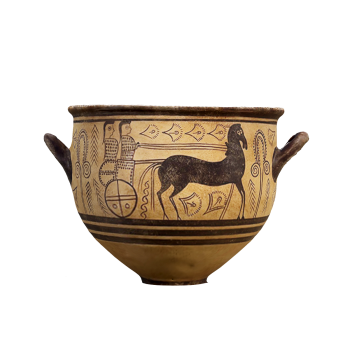
3D model of a replica of a Minoan period fancy style water bottle

It is a replica of an animal shaped outlet, based on the Late Minoan period of Crete from 1700 BC to 1450 BC. It is practical and reflects people's appreciation of art and natural forms at that time. The design is usually complex and the decoration is exquisite, reflecting the highly developed ceramic craftsmanship technology at that time. The animal shaped water outlet not only enhances the aesthetics of the kettle, but may also have symbolic significance, such as expressing worship of nature or being related to mythological stories. The production of replicas aims to inherit and showcase the artistic achievements of ancient civilizations, allowing modern audiences to appreciate the exquisite craftsmanship of ancient craftsmen up close
Late Mycenaean civilization ceramic containers
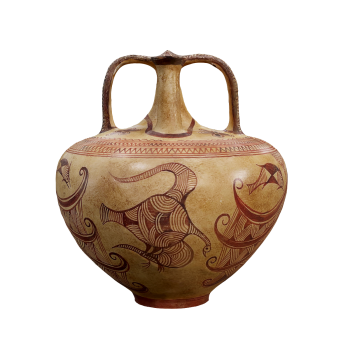
Late Mycenaean civilization ceramic containers

It is a decorative style of Greek pottery from the late Mycenaean civilization (around 1400 BC to 1100 BC), characterized by the depiction of narrative scenes on pottery, usually themed around chariots, soldiers, animals, or mythological stories. Produced by an artist working in Mycenae, Greece, decorated with a row of confident soldiers marching forward. Featuring a wide top opening, low handles on both sides, and a narrow circular base. The decorative style reflects the artistic tradition and aesthetic taste of the Mycenaean civilization. Despite experiencing turbulence in the last few centuries of Mycenaean civilization, artists were still able to create exquisite pottery works.
3D model of a replica of a late Mycenaean stirrup jar

3D model of a replica of a late Mycenaean stirrup jar

It is a replica from the late Mycenaean civilization in Greece (approximately 1400 BC to 1100 BC). This type of jar is named after its top stirrup shaped handle and nozzle configuration. The symmetrical composition and abstract representation of marine life are typical Mycenaean styles. This type of jar is usually used for transporting liquids. The decoration on the jar and the dynamic octopus pattern prove the importance of the ocean as a means of communication and a source of food and wealth. It is even possible that this jar was designed for the export of oil from the region, and it is a celebration of the Mycenaean people's maritime strength and enjoyment of the ocean and its life giving properties.
3D model of Minoan civilization ceramic jar replica

3D model of Minoan civilization ceramic jar replica

During the late Minoan civilization of Crete (1700 BC to 1450 BC), it was commonly used for storing liquids or grains. Not only daily necessities, but also works of art, often decorated with exquisite patterns and reliefs. This pottery jar with cows, goats, dolphins, and seagulls is a replica of the Late Minoan I period (approximately 1700 BC to 1450 BC) on the island of Crete. It has important symbolic significance in the Minoan culture. Cattle may represent strength and wealth, goats symbolize reproduction and abundance, dolphins and seagulls are closely connected to the ocean, reflecting the close relationship between the Minoans and the ocean.
3D model of Mycenaean civilization double ear bottle replica

3D model of Mycenaean civilization double ear bottle replica

It is a double eared vase depicting a bull and stylized flowers, which is a replica from the Mycenaean/Late Hittite III period (1400-1100 BC) in Cyprus. This type of double ear bottle was used at that time for storing and transporting food, such as wine and olive oil. The design originated from large storage containers in the Bronze Age, which later became one of the most common shapes of ancient pottery. The Mycenaean civilization was an important stage of ancient Greek civilization, and the late Hittite III period was the late stage of this civilization. During this period, Cyprus had close ties with the Mycenaean civilization.
Kamares style pottery replica 3D model

Kamares style pottery replica 3D model

It is a type of pottery in the Kamares style, which is closely related to the palace culture of the Minoan civilization and was mainly popular during the Middle Minoan period from 2100 BC to 1550 BC. Known for its abstract curved designs with sharp black and white contrasts and stylized plant and marine life patterns, which are typically painted in white, red, orange, and yellow on a black background. The production is very delicate and requires completion on high-speed rotating ceramic wheels, which is a new invention of the Middle Minoan era. This pottery jar features a rose decoration pattern and a relief of "eyes", which is a replica of the Middle Minoan period in the Festus region.
3D model of Italian red painted double ear bottle replica

3D model of Italian red painted double ear bottle replica

It is a work imitating the 4th century southern Italian red painted double ear vase. The bottle depicts Hymelos and Eros coronating Odia. It showcases characters from ancient Greek mythology and also reflects the profound understanding of emotions and virtues in ancient art. The red painting technique of this double eared bottle is very exquisite. It is made by coating the surface of the pottery with red pigment, depicting characters and patterns, and finally applying transparent glaze and firing it. This technology makes the work colorful, vivid, and has high artistic and historical value. It is a precious artwork that combines ancient Greek mythology, artistic techniques, and cultural connotations. Showcasing the superb skills of ancient artists
Copy of Ionian Wild Goat Style Wine Glass - Martin von Wagner Museum

Copy of Ionian Wild Goat Style Wine Glass - Martin von Wagner Museum

It is a typical pottery from the ancient Greek period from the 7th century BC to the early 6th century BC. The design inspiration comes from the Ionian region, especially the island of Kian, characterized by the decoration of wild goat patterns on the cup body, which is also known as the "wild goat style". They held an important position in ancient Greek culture, serving not only as vessels for drinking but also reflecting the aesthetic and artistic standards of the society at that time. The prototype is currently housed in the Martin von Wagner Museum in W ΓΌ rzburg, Germany. This replica of the wine glass retains the characteristics of the original design, including the wild goat pattern on the cup body and fine handmade decorations.
Corinthian animal style covered jewelry box replica - National Museum of Athens
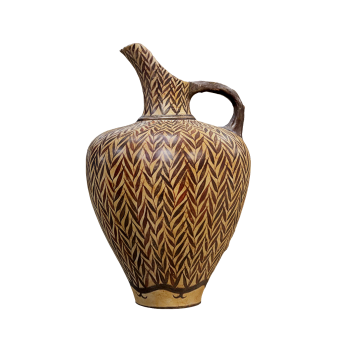
Corinthian animal style covered jewelry box replica - National Museum of Athens

The original object comes from the pre classical period or the "Orientalization" period (around 700-600 BC) and is now collected in the National Museum of Athens. It is a container used in ancient Greece to store cosmetics, jewelry, or other small accessories, usually with a unique lid and handle. Known for its exquisite decorations and vivid animal patterns, these patterns reflect the achievements of the exchange between Greek art and Near Eastern civilization at that time. Craftsmen abandoned traditional geometric vase painting designs and instead adopted new Eastern designs, such as exotic Chimera and Sphinx, fierce beasts and prey, as well as floral rose decorations and palm leaf patterns.
3D model of pottery replicas from the ancient Cretan civilization period

3D model of pottery replicas from the ancient Cretan civilization period

It is a replica of pottery from the ancient Minoan civilization period, based on the late Minoan I period of Faestos (approximately 1700 BC to 1450 BC). Known for its unique design and decorative style, there is usually a spout shaped like a bird's beak at the mouth of the pot, which facilitates pouring liquids. Used for storing and transporting liquids in daily life, it is also an important artwork and cultural heritage in the Minoan culture. The late Minoan period was the golden age of Minoan civilization, during which pottery and other crafts showcased the highly developed artistic and craft level of the Minoan people.
Carrefour Cup replica 3D model

Carrefour Cup replica 3D model

It is a replica Kamares pottery "eggshell cup" with spiral patterns, characterized by a Carrenat outline. It imitates artifacts from the Middle Minoan period (approximately 1900 BC to 1700 BC). Kamares pottery is a type of pottery unique to the Minoan civilization, known for its exquisite craftsmanship and delicate decoration. The characteristics are thin walls, smooth surfaces, and complex geometric patterns. The replica of the Karenat Cup is a tribute and commemoration to the ancient Minoan civilization. Not only does it showcase the exquisite craftsmanship of ancient civilization, but it also allows us to glimpse the culture and aesthetics of that era.
Linear octopus patterned stirrup jar

Linear octopus patterned stirrup jar

It is a type of pottery from the late Minoan civilization on the island of Crete in ancient Greece. This jar is named after its unique stirrup shape and is decorated with a linear octopus pattern. The Minoan civilization, approximately from 2000 BC to 1450 BC, was one of the earliest civilizations in Europe, known for its complex palaces, religious beliefs, and artistic achievements. The stirrup jar is one of the common pottery items in the Minoan culture, typically used for storing food and liquids. The shape design makes them easy to carry and use, while the decorative patterns reflect the Minoan people's worship of nature and marine life. It is the material cultural heritage of the Minoan civilization.
3D model of Mycenaean civilization drinking cup replica

3D model of Mycenaean civilization drinking cup replica

It is an ancient Greek drinking cup characterized by a high foot and wide mouth. It was very popular during the Mycenaean civilization/Late Hittite III period (approximately 1400 BC to 1100 BC), especially in the Agius Cosmas region. The design is beautiful and practical. The high footed design allows drinkers to avoid direct contact with the liquid in the cup, while the wide mouth facilitates drinking. The discovery of replicas in the Agius Cosmas region provides us with important clues to understand the drinking culture of ancient Greeks. These cups are not only used for daily social activities, but may also be used in religious ceremonies and celebrations.
3D model of Mycenaean civilization stirrup jar replica

3D model of Mycenaean civilization stirrup jar replica

It is a type of imitation stirrup jar originating from Cyprus, whose prototype belongs to the Mycenaean civilization/Late Hradic III period (approximately 1400 BC to 1100 BC). Named after its top stirrup shaped handle and spout configuration. In ancient times, this type of jar was often used to transport wine and olive oil in the Mediterranean region due to its ease of carrying and storage, as well as its design that would not overflow. Decorations are usually symbolic and reflect the culture and aesthetics of the society at that time. Decorations with fish and birds as the main themes may be related to the connection between the ocean and nature, and these elements are very common in Mycenaean art.
3D model of ancient octopus patterned eggshell cup replica

3D model of ancient octopus patterned eggshell cup replica

It is a very delicate and artistically valuable ancient ceramic product. The name comes from its eggshell thin cup wall, which was very advanced in ceramic production technology at that time. The production technology of eggshell cups reached its peak during the Minoan civilization (around 2000 BC to 1700 BC), especially during the Middle Minoan period. The Minoan civilization is an important component of ancient Greek civilization, mainly distributed on the island of Crete. Known for its exquisite pottery, murals, and sculptures, the Eggshell Cup is an outstanding representative of its ceramic art. He is an outstanding representative of the Minoan civilization's ceramic art.
3D model of bird beak spout spout pot replica

3D model of bird beak spout spout pot replica

This type of pot was called "prochos" in ancient Greece, which is a container with a beak shaped spout. The original version can be traced back to the Late Minoan II to III period (1450 BC to 1100 BC). The design usually includes painted bird and fish patterns, which are decorative styles borrowed from the original works discovered on Crete. Not only does it hold an important position in ancient Greek culture, but it is also one of the representatives of ancient art and craftsmanship. It embodies the superb craftsmanship of ancient craftsmen, as well as their meticulous observation and expression of the natural world and animals.
Kikaradi Ceramic Vase

Kikaradi Ceramic Vase

The replica of the Cycladic ceramic vase is a modern representation of ceramic art from the ancient Greek Cycladic civilization. The Cycladic civilization (around 3200 BC to 2000 BC) meticulously crafted its exquisite marble carvings through modern craftsmanship, aiming to preserve the aesthetic features and craftsmanship of the original works, allowing the public to appreciate these ancient artworks up close. These replicas are not only loved by art enthusiasts as decorations and collectibles, but also used for education and exhibitions to help people understand and learn about the artistic achievements of the Cycladic civilization.
3D model of cup replica from the late geometric period of ancient Greece

3D model of cup replica from the late geometric period of ancient Greece

It is a replica of the late geometric period of ancient Greece (approximately 800 BC to 700 BC). The depiction of horses and figures in geometric style reflects the artistic characteristics of that era. Geometric style artworks typically depict characters and animals in abstract form, using simple lines and geometric shapes. The replica of this cup is not only a work of art, but also a tribute to ancient Greek culture and art. It may have been used in ceremonies or banquets, and the design of the lid may help maintain the freshness and temperature of the beverage.
Barbotine style ceremonial teapot replica 3D model

Barbotine style ceremonial teapot replica 3D model

Featuring relief decorations, it imitates artifacts from the late Minoan II-III period around 1450 BC to 1100 BC. This style of pot has significant historical and artistic value in ancient Greek culture. The decorative technique of using mud on the surface of pottery. This technique involves applying a layer of mud on the unburned surface of pottery, and then carving patterns or reliefs on it. The pottery of the Late Minoan period is renowned for its exquisite craftsmanship and unique artistic style. These replicas are a tribute to the art of ancient civilizations and also provide a way for modern collectors to appreciate and learn ancient art.
Small vessels with handles from ancient civilizations

Small vessels with handles from ancient civilizations

The small containers used in ancient times to hold liquids or solid objects were made of clay, which not only reflected the level of craftsmanship at that time, but also reflected social culture and aesthetic concepts. It is commonly used in daily life and religious ceremonies, such as perfume, ointment, or funerary objects. Design usually considers practicality and aesthetics, with the handle designed for easy portability and use, while the body decoration reflects artistic and symbolic significance. There are also some yellow patterns embellished on the surface, and small handles on both sides for easy carrying.
Italian geometric style ceramic jar - Castello Banfi collection

Italian geometric style ceramic jar - Castello Banfi collection

The ceramic jars with Italian geometric patterns are from the Castello Banfi collection. It has two horizontal handles and a horn shaped base. The surface is coated with brown clay and covered with red and white glaze. This is a unique red background white painting technique in the Grotdi Castro region. The production time was approximately several decades from the late 7th century BC to the early 6th century BC. Discovered in Poggio Almura, Montalcino.
Etruscan period black glazed pottery bowl - Castello Banfi collection

Etruscan period black glazed pottery bowl - Castello Banfi collection

It is a ceramic artwork from the ancient Etruscan civilization, with orange clay as the base and black paint on the surface. The interior is decorated with concentric circles, a decorative style that is quite common in ancient pottery. This specific black light bowl belongs to the "Small Seal Studio", which is a production method in the Etruscan Lazio region. It can be traced back to the 3rd century BC. This work was discovered in Poggio Almura in Montalcino and belongs to the Castello Banfi collection.
Castiglione Double Eared Vase Pottery - Igleio Archaeological Museum

Castiglione Double Eared Vase Pottery - Igleio Archaeological Museum

The double eared vase originating from Castiglione region is an ancient pottery from the province of Ragusa in Sicily, Italy. It can be traced back to the classical era, around the 6th century BC. In the collection of the Igleio Archaeological Museum. Usually used for storing liquids, and due to its design, it is easy to carry and transport. It has significant value in archaeology and is also an important window for understanding ancient Sicilian culture and way of life. The design and production techniques reflect the high level of craftsmanship and aesthetic concepts of the society at that time. By studying these cultural relics, we can gain a deeper understanding of the history and culture of the ancient Mediterranean region.
Kotyle Ancient Greek Pottery Containers - Igleio Archaeological Museum

Kotyle Ancient Greek Pottery Containers - Igleio Archaeological Museum

It is a pottery container from ancient Greece, usually used to hold liquids. Archaeologists discovered the pottery container at the site of Camarina in the province of Ragusa on the island of Sicily, Italy, during the classical era. Camarina is a ancient Greek city with a long history dating back to the 6th century BC, and is one of the important cultural and economic centers on the island of Sicily. It showcases the daily life of ancient Greeks and also reflects their level of art and craftsmanship. It is currently housed in the Igleio Archaeological Museum. It is of great significance for studying ancient Greek culture and the history of Sicily.
Vari Culture Ceramic Container 3D Model

Vari Culture Ceramic Container 3D Model

It is a ceramic container in the Vali culture, with a style belonging to the medieval horizon period, approximately between 600 and 1000 AD. The Vari culture is one of the ancient civilizations in Peru, mainly distributed in the highlands of the southern Andes Mountains, and its influence extended to the entire Andean region during the medieval horizon period. The ceramic art of the Vali culture is renowned for its exquisite craftsmanship and unique artistic style. Often having a human face shape, the design typically includes a prominent face. It has significant cultural and religious significance and may be related to the ritual activities of the Wari people.
Classical period double ear vase - Igleio Archaeological Museum

Classical period double ear vase - Igleio Archaeological Museum

It is a work of art from the classical period (6th century BC), originating from the Kamarina ruins in Sicily, Italy. It is a clay pottery with two handles, which were used in ancient times to carry liquids. The design of the double ear bottle is not only practical, but also reflects the aesthetic and craftsmanship level at that time. Kamarina was an ancient Greek colony located in the southern part of Sicily, which played an important role in ancient civilization, especially during the Greek and Roman periods. The discovery of this double eared bottle provides valuable clues for us to understand the daily life and culture of that era. It is currently housed in the Igleio Archaeological Museum in Ragusa, Italy.
Red painted pottery vase from ancient Greece - Iglesia Archaeological Museum

Red painted pottery vase from ancient Greece - Iglesia Archaeological Museum

It is a red painted pottery vase from ancient Greece, depicting the image of an Amazon female warrior. Excavated at the Kamarina site in Sicily, Italy, it belongs to the classical period and was made around the 5th century BC. It is currently housed in the Igleio Archaeological Museum in Ragusa, Italy. Red painted pottery bottle is a type of single handle oil bottle, characterized by a layer of white glaze applied to the pottery, and then a pattern painted in black or red on top. It was very popular in Greece from the late 6th century BC to the 5th century BC. Not only does it showcase the exquisite craftsmanship of ancient Greek pottery, but it also provides us with a window to understand ancient Greek culture and mythological stories.
Classical Red Statue Pottery - Igleio Archaeological Museum

Classical Red Statue Pottery - Igleio Archaeological Museum

It is a classical red statue pottery from the Kamarina site in Sicily, Italy. Produced in the 5th century BC, it is currently housed in the Igleio Archaeological Museum in Ragusa. This work showcases the image of the goddess of victory, Niki, flying and is an outstanding representative of ancient Greek art. Not only is it an artwork, but it is also an important witness to ancient Greek culture and religious beliefs. As a symbol of victory, Nike holds an important position in ancient Greek mythology, and her image is often used to decorate pottery, sculptures, and buildings, symbolizing victory and glory. This provides us with valuable physical materials for studying ancient Greek art, religion, and social life.
Lekythos Ancient Greek Ceramic Container - Igleio Archaeological Museum

Lekythos Ancient Greek Ceramic Container - Igleio Archaeological Museum

It is a kind of ancient Greek ceramic container, usually used to hold oil, perfume or condiments. It has a cylindrical body, a narrow neck and deep mouth, and a handle extending from the shoulder to below the neck. Usually used as burial objects for the deceased. In the classical period, especially in the 5th century BC, this type of container was very popular in Athens, possibly derived from the shape of Corinth. Discovered at the Kamarina site in Sicily, Italy, it is a product of the classical period, made around the 5th century BC. It is currently housed in the Igleio Archaeological Museum in Ragusa. This provides valuable physical evidence for us to understand ancient Greek culture and religious customs.
Ceramic Oil Bottles from Ancient Greece - Igleio Archaeological Museum

Ceramic Oil Bottles from Ancient Greece - Igleio Archaeological Museum

It is a ceramic oil bottle from ancient Greece, usually used to hold olive oil and also used as a burial object for the deceased in funeral ceremonies. The design is usually small and exquisite, with various patterns and decorations painted on it, and is one of the representatives of ancient Greek pottery art. This pottery from the classical era, dating back to the 5th century BC, was discovered near Ragusa on the island of Sicily in Camarina, Italy. It is currently housed in the Igleio Archaeological Museum in Ragusa. The archaeological sites and museum collections of Kamarina provide us with valuable historical and cultural information, allowing us to glimpse the glory of ancient Greek civilization.